00191025-01.pdf - 第313页
SIPLACE 80S/F/G User’s Manual 7 Vision Systems Edition 07/97 from S oftware Version SR.010.xx 7.10 Coplanarity Laser Module (SIPLACE 80F only) Line engi neer 7 - 121 7.10 Coplan arity L aser Module (SI PLACE 8 0F only ) …

7 Vision Systems SIPLACE 80S/F/G User’s Manual
7.9 Test Component: Additions to the 80F Machine Edition 07/97 from Software Version SR.010.xx
7 - 120 Line engineer
Key functions
●
With the space bar you can mark the corresponding component type
●
With “RETURN” finish making entries, and the option box is closed. You are returned to the menu “Edit GF
data”.
●
With “ESC” you may quit the option box, without accepting any change which may have been made.
7.9.2.2 Option “Illumination”
The option illumination has already been described for the revolver placement head in Section 7.6.4.4. You
have the possibility of choosing between two planes of illumination, shallow and steep.
For the component vision system of the IC head this option provides three planes of illumination:
–
shallow (bottom LED level)
–
middle (middle LED level)
–
steep (top LED level)
The keyboard commands are the same as those described in Section 7.6.4.4.
SIPLACE 80S/F/G User’s Manual 7 Vision Systems
Edition 07/97 from Software Version SR.010.xx 7.10 Coplanarity Laser Module (SIPLACE 80F only)
Line engineer 7 - 121
7.10 Coplanarity Laser Module (SIPLACE 80F only)
7.10.1 Functional Description
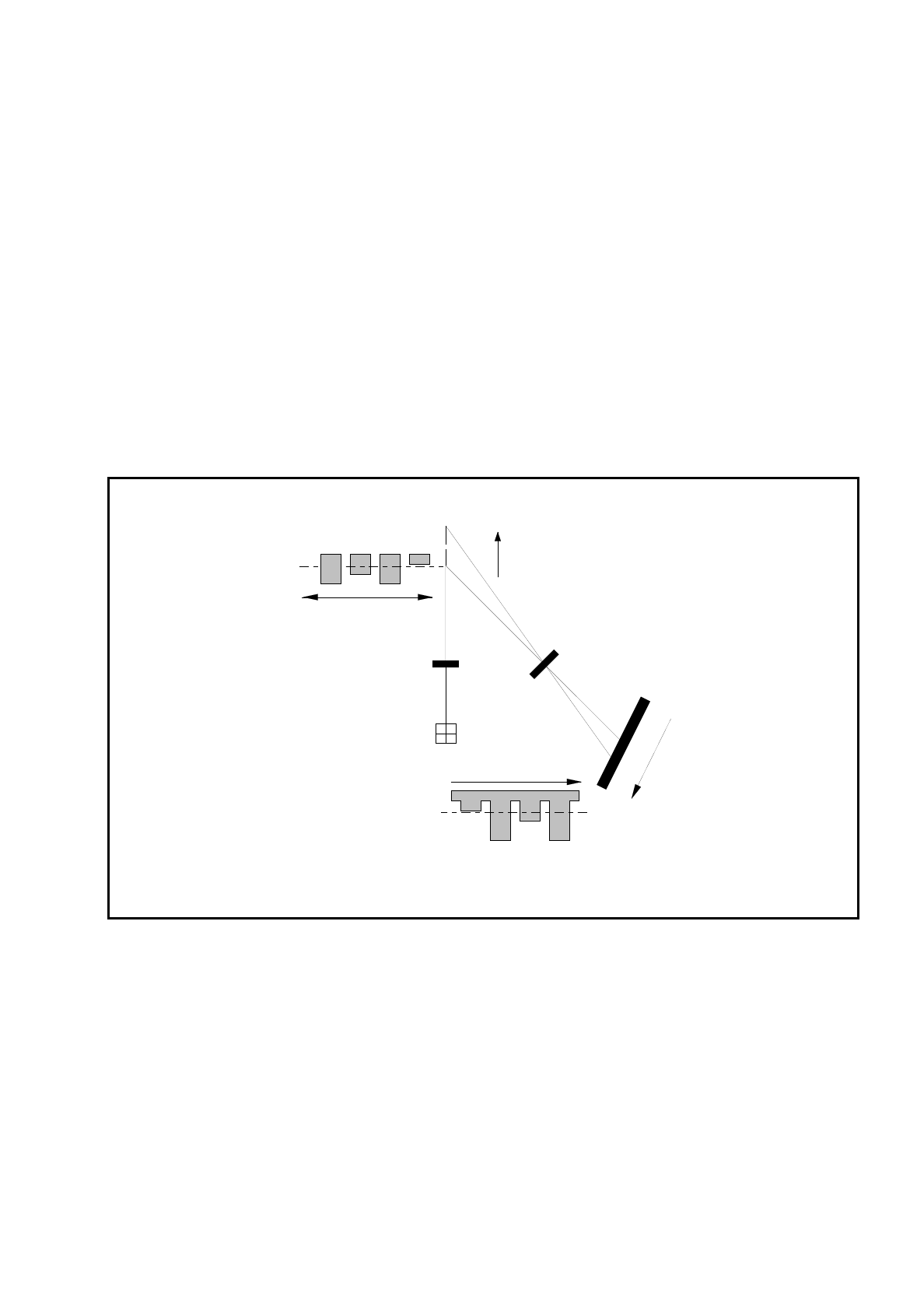
The coplanarity laser module is used to measure the vertical bends of the pins of components. The pin height
is measured with no physical contact on the principle of laser triangulation.
The placement head picks up the component which is to be tested, centers it optically using the IC camera,
and then traverses it with all four sides in succession over the stationary laser beam of the coplanarity laser
module. Every pin is scanned from below by the laser beam. The laser light scattered by the underside of the
pin is picked up by a sensor and serves as basis for the calculation of the exact position of the pin with respect
to the board. The positional values so determined are then compared with the limiting value prespecified by
the user. If this value is exceeded the component is discarded or returned.
Fig. 7.10.1 Measurement principle: laser triangulation
The coplanarity laser module is used in combination with optical component centering by means of the vision
system. Components with bent or missing pins are detected and if necessary discarded.
z = 0
+Z
+Z'
Z' = 0
Receiver lens
Detector
Measurement signal
Time t
Laser
Transmitter
Direction of travel

7 Vision Systems SIPLACE 80S/F/G User’s Manual
7.10 Coplanarity Laser Module (SIPLACE 80F only) Edition 07/97 from Software Version SR.010.xx
7 - 122 Line engineer
7.10.2 Technical Data
Components: Can be used for “gull-wing” component forms
Component size and pin pitch restricted by the
component position recognition system,
i.e. max. size 43.0 mm x 43.0 mm x 11.0 mm.
Principle of measurement: Non-contact measurement by means of laser triangulation
Algorithm functions: JEDEC Standard - Calculation of the mounting level; all
deviations are determined with respect to this level. If a component
is lying aslant at the suction nozzle - which may, for example,
be caused by an adapter - this will therefore have no effect on
the "good/bad" decision.
Range of measurement: ± 0.75 mm (vertical)
Laser focus:
∅
25
µ
m
Laser power: 2.0 - 2.5 mW (maximum)
Wavelength: 750 nm
Resolution: 4
µ
m (vertical)
Repeatability: ± 10
µ
m (vertical)
Measuring precision: ± 20
µ
m (vertical)
Measurement time: approx. 2.5 - 4.5 sec/component for a QFP100 with 0.6 mm pitch
Control and communication: By means of a processor integrated into the module
V24 serial link to station computer
Module dimensions: approx. 440 mm x 30 mm x 85 mm
Place of installation: In machine base beside optic module
(mounted on a support)
Safety: When installed in the machine the coplanarity module complies
with Laser Class 1. The module will not function outside the machine
without additional wiring or interference with the safety functions.
If protective features are bypassed this automatically anticipates
a situation in conformity with
Laser Class 3B - Danger of Injury
to Skin and Eyes
- and therefore protective measures in accordance
with VBG 93 will be required.