00194614-08 Trainingsdoku. SG X-Serie_X4i SW70x (AL2)_EN.pdf - 第213页
C&P20A Overview Parts Overview with Function Description 213 Student Guide SIPLACE X-Serie and X4I SW70x (AL2) Parts Ov erview w ith Function Desc ription 7.2.3 Parts Overview with Function Description Pressure Contr…

C&P20A
C&P20A Function Overview
Student Guide SIPLACE X-Serie and X4I SW70x (AL2) 212
C&P20A Technical Data
C&P20A Function
7.2.2 C&P20A Function
C&P20A Principle
7.2.2.1 C&P20A Principle
▪ Like the C&P12, the C&P20A works according to the Collect&Place principle.
▪ While the Star revolves, the components can be rotated into the required placement position. After
optical measurement, the components are again rotated into the correct placement positions and
placed, while the star is revolving.
▪ This means that each segment is equipped with its own DP drive, to allow angle adjustment while
the star is revolving. Each DP drive has its own control board and vacuum generator.
▪ The communication with the 20 DP drives is carried out via the head CAN bus with the help of a
contactless E/D transformer. This makes continuous star rotation possible.
▪ In the pickup / placement circuit, the Z axis moves the complete DP drive unit upwards or
downwards.
▪ Compressed air is supplied to the 20 Venturi nozzles in the holding circuit via the hollow designed
shaft of the Star motor.
▪ A pressure control valve in the pickup/placement circuit is used to increase the vacuum during pickup
and apply air blast to eliminate the holding circuit vacuum and release the component, during
placement.
▪ The component sensor which is installed in the pickup/placement circuit by default is used to check
the presence of components on the nozzle, both before and after pickup/placement.
Advantages Compared with DLM Heads
7.2.2.2 Advantages Compared with DLM Heads
▪ The holding circuit has one venturi nozzle for each segment: No interference between the segments.
▪ No vacuum plunger: Digital pressure control valve: Faster switching times between vacuum and air
blast.
▪ The placement star is now positioned at an angle which leads to a compact space for arranging the
20 segments and integrating the component camera into the head.
▪ Lower inlet pressure: Low air consumption per segment.
▪ Autonomous rotation and positioning of each segment: Increases placement rate.
▪ No swiveling in and out of DP station onto the segment: Greater accuracy and robustness.
▪ Component sensor in the pickup/placement position: Greater placement reliability.
▪ Digital camera interface: Faster image evaluation
▪ Linear motor as Z drive: Reduction of moving mass. This increases placement rate.
Description C&P20A
Component size 01005 to 2220, Melfs, Bare Dies, Flip Chips, SOT, SOD, components up to max.
6x6mm
Component height 4.0 mm
Component weight max. 1g
Placement accuracy +/-55µm at 4 (sigma)
Angle accuracy +/-0.8° at 4 (sigma)
Placement force 2.0 N +/-0.5 N
3.5 N and 4.5 N +/-1 N
Nozzle types 1001, 1003-1007, 1011, 1032-1037, at which 1235 is for the calibration tool
Nozzle changer 6 magazines with 12 garages each which are freely configurable,
X4I: four magazines each at locations 2 and 4
C&P20A
Overview Parts Overview with Function Description
213 Student Guide SIPLACE X-Serie and X4I SW70x (AL2)
Parts Ov erview w ith Function Desc ription
7.2.3 Parts Overview with Function Description
Pressure Control Valve
7.2.3.1 Pressure Control Valve
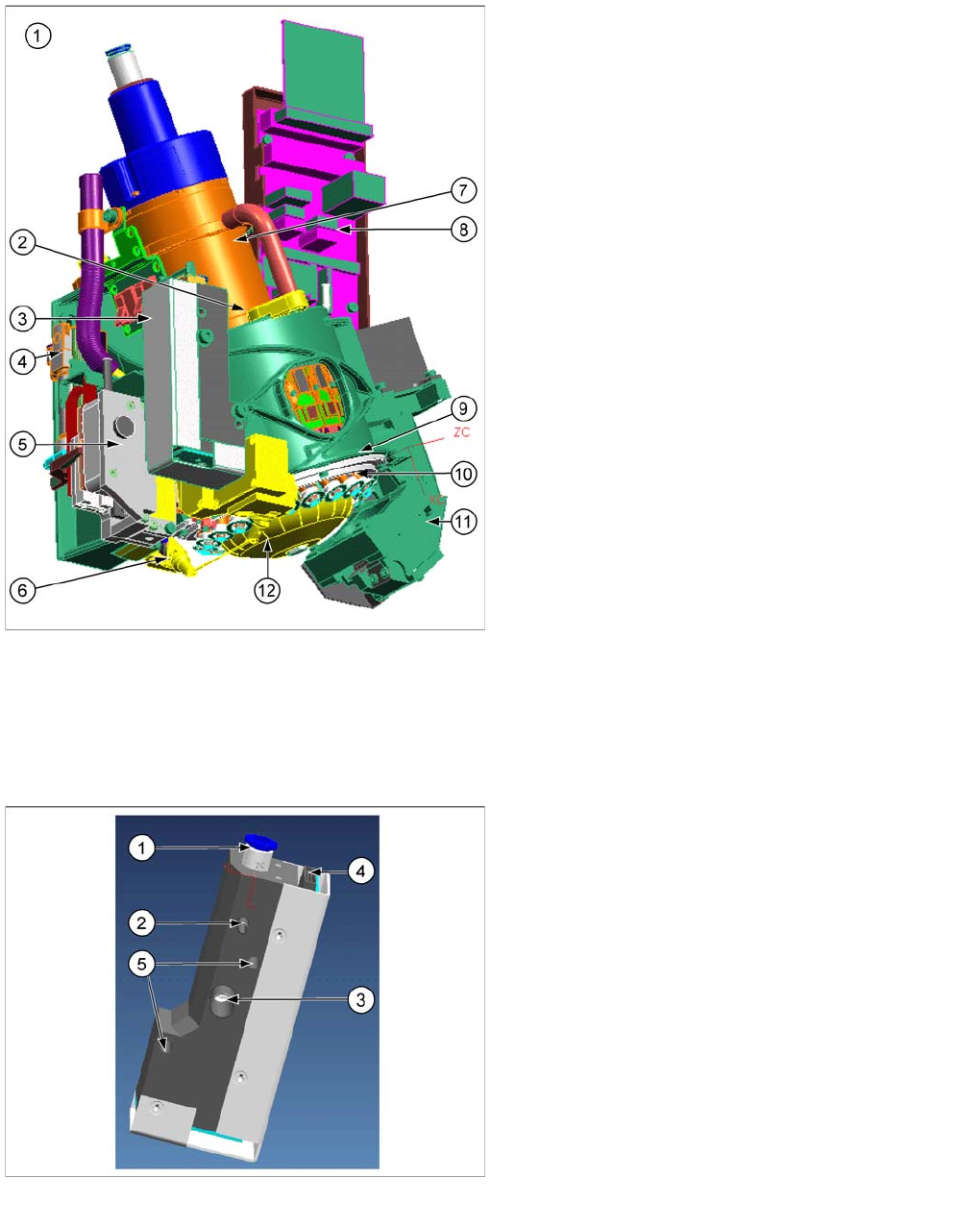
C&P20A function units
C&P20A parts
This section describes the main parts of the C&P20A
head and their technical function.
The description is ordered according to the sequence of
disassembly for servicing.
Legend
1. C&P20A assembly
2. E/D transformer
3. Vacuum generator for placement circuit
4. Pneumatic retract unit
5. Z drive
6. Component sensor
7. Star motor
8. Intermediate distributor board
9. Raceway
10. DP drive
11. Component camera
12. Silencer holding circuit
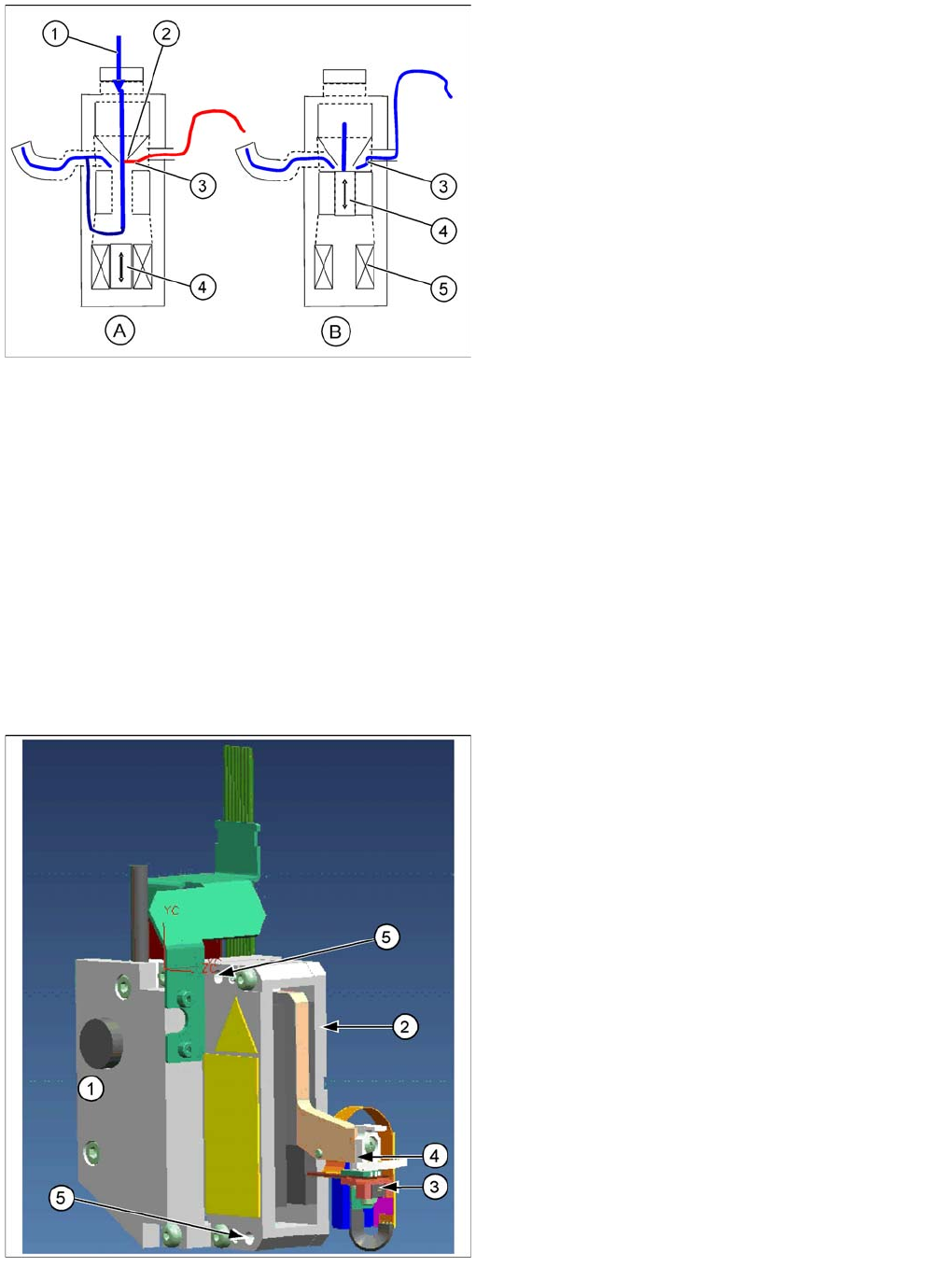
Pressure control valve (digital)
▪ The pressure control valve supplies the pickup/
placement circuit with vacuum during the pickup
process and switches over to air blast during
placement.
▪ The pressure control valve is fixed to the placement
head with two screws and can be replaced during
service work.
Legend
1. Compressed air connection
2. Vacuum/air blast for pickup/placement circuit
3. Discharged air for cooling the X-linear motor (SX4
and X series machines only).
4. Energy and data supply
5. Pressure control valve fixture
C&P20A
Parts Overview with Function Description Overview
Student Guide SIPLACE X-Serie and X4I SW70x (AL2) 214
Pressure Control Valve - Function
Pressure Control Valve - Function
Z Axis
7.2.3.2 Z Axis
Legend
A : Piston setting for max. vacuum during pickup
B : Piston setting for air blast during placement
1. Compressed air inlet
2. Venturi nozzle
3. Vacuum or air blast outlet, depending on piston
setting
4. Pistons
5. Motor
▪ After initialization, the piston is in a central position, in
which neither vacuum nor air blast is applied to the
nozzle.
▪ During pickup, the piston is always in the Open
position, so that maximum vacuum is generated and
is present at the nozzle. The switchover time
(pressure build up time) between max. vacuum of –
850 mbar to max. air blast of +200 mbar ≤ 12 ms.
▪ The function Early vacuum should always be
switched on for the CPx head. However, if this
function is switched off, the piston will be in the "open
position". The vacuum will only be switched on again
after the "light barrier down" signal has been issued .
-> 2 additional switching steps -> time loss.
Legend
1. Incremental measurement system, resolution 0.5 µm
2. Linear motor, primary part, moves up and down
between the secondary parts.
3. Light barrier Z-down emits the end position signal for
the Z axis.
4. Snap jaws: The ball bearing for the DP drive is
rotated via the star axis into the jaw, allowing the
segment to be moved upwards and downwards.
5. Z axis fixtures
The Z axis and retract unit are fixed to the head as a
complete unit, with two screws, and can be easily
replaced during service work.