00194614-08 Trainingsdoku. SG X-Serie_X4i SW70x (AL2)_EN.pdf - 第267页
Collect, Pick and Place Head (CPP) Overview Principle of CPP Head 267 Student Guide SIPLACE X-Serie and X4I SW70x (AL2) ▪ Component spectrum for compo nent 01005 – 50x40 m m Component height max. 11.5 mm ▪ The holding ci…

Collect, Pick and Place Head (CPP)
Configuration Overview
Student Guide SIPLACE X-Serie and X4I SW70x (AL2) 266
Configura tion
8.2.2 Configuration
The CPP head with 12 segments can be configured as follows:
▪ Low installation height (CPP_L)
▪ High installation height (CPP_H)
Requirem ents
8.2.3 Requirements
The following requirements need to be met for using the CPP head in X series machines:
▪ A364 axis controller with servo amplifier SDS120-1.5Z2 or HCU (Head Control Unit)
▪ Station software ≥ SW702
▪Box PC
▪ Head plate for CPP head
▪ X tables and X feeders
▪ Addressing the nozzle changer via the CAN node module or the FCU (Feeder Control Unit)
Technical Data
8.2.4 Technical Data
The component spectrum depends on the component camera fitted and the resulting placement mode.
Special Features of CPP Head
8.2.5 Special Features of CPP Head
▪ There are various placement modes: C&P mode, P&P mode and mixed mode.
▪ Symmetrical head design: The head can be fitted on the left or right.
Component spectrum Component camera
SST29
Component camera
SST38
IC camera SST33
C&P mode (min.
component)
0201 01005 (0603)
C&P mode (max.
component)
27x27 mm / (µBGA to
18x18 mm)
16x16 mm
P&P mode (max.
component)
50x40 mm
Mixed mode (max.
component)
32x32 mm
Component height (CPP_H) max. 8.5 mm C&P mode
max. 8.5-11.5 mm in P&P and mixed mode
Component height (CPP_L) max. 6 mm, at max. placement performance
Placement accuracy +/- 50 µm (4 sigma) in C&P mode with SST38
+/- 55 µm (4 sigma) in C&P mode with SST29
+/- 45 µm (4 sigma) in P&P mode with stationary cameras
Placement force 1 N +/- 0.6N current sensor
2.2N +/- 0.5N current sensor
2.6N +/- 0.8N light barrier mode
3.0N-6.0N +/- 1N current sensor
6.0N - 10.0N +/-1.5N current sensor
Weight of head approx. 5.3 kg with component camera
Component weight: max. 4 g in C&P mode, mixed mode
max. 8 g in P&P mode
Component cameras SST29 (0201 to 27x27, Standard)
SST38 (01005 to 16x16)
Collect, Pick and Place Head (CPP)
Overview Principle of CPP Head
267 Student Guide SIPLACE X-Serie and X4I SW70x (AL2)
▪ Component spectrum for component 01005 – 50x40 mm
Component height max. 11.5 mm
▪ The holding circuit has one venturi nozzle for each segment.
→ No more interference between the segments.
▪ Each segment has its own valve. Each segment can therefore be switched off separately.
This reduces the air consumption.
▪ Each segment has its own motor with incremental measuring system.
The segments can be rotated independently of one another.
▪ The light barrier down is integrated into each segment.
This leads to a higher placement reliability. There is no need to adjust the light barrier down. This
design is more robust, since a movable cable is not required.
▪ A digital pressure control valve enables faster switching times between vacuum and air blast.
▪ The component sensors in the pickup&place position are more robust. The prisms have mechanical
protection.
This leads to a higher placement reliability.
▪ Robust nozzle interface and nozzle magazine
▪ Nozzle types 20xx and 28xx with corresponding magazines
Principle o f CPP Head
8.2.6 Principle of CPP Head
▪ The CPP head functions according to the Collect&Place principle, like the C&P12 head, whereby the
additional operating modes Pick&Place and mixed mode help to extend the component spectrum.
▪ Each segment is equipped with its own DP drive and an incremental measuring system, to allow
angle adjustment while the star is revolving.
▪ Energy and data from the stationary part of the head are transferred via a contactless energy
transformer and a contactless data transformer to the control board (Single Core Solution) and the
DP drives.
▪ In addition, each DP drive has a light barrier Z down. Together with the secondary part of the linear
motor (Z axis), there is no cable which is moved with the Z movement.
▪ The so/called valve terminal is used to switch the supply pressure on and off for each segment.
▪ In the pickup and placement position, the Z axis moves with the complete DP drive unit upwards or
downwards.
▪ In the pickup cycle, the vacuum is increased by the holding circuit, using a pressure control valve.
During placement, the vacuum is eliminated by the holding circuit, with an air blast, and the
components are blown off.
▪ In the pickup/placement position, the standard component sensor is used to check the presence and/
or height of the components on the nozzle, both before and after pickup/placement.
Collect, Pick and Place Head (CPP)
Overview of Parts Overview
Student Guide SIPLACE X-Serie and X4I SW70x (AL2) 268
Overview of Parts
8.2.7 Overview of Parts
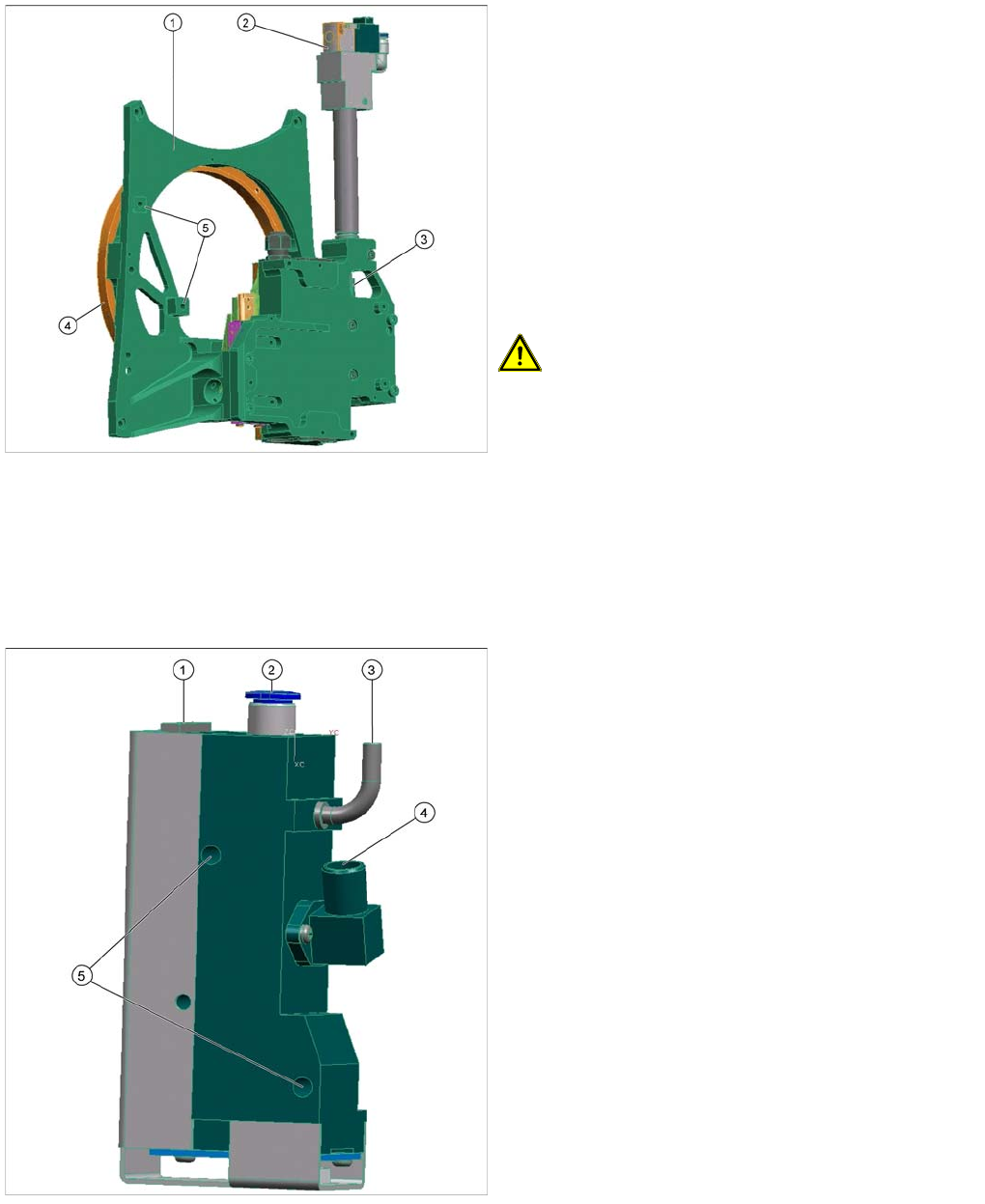
Front plate
8.2.7.1 Front plate
See also
8.2.7.2 Pressure control valve (digital) [ ➙ 268]
Pressure c ontrol valve (d igital)
8.2.7.2 Pressure control valve (digital)
Legend
1. Front plate
2. Return cylinder
3. Z axis with jaws and measuring system
4. Raceway
5. Fixture for pressure control valve
Front plate
The front plate of the CPP head is fixed to the head
housing with four screws and needs to be removed as a
whole unit for service purposes.
CAUTION! Do not dismantle any of the
attachments from the front plate, as all attachments are
coordinated with one another and require special settings
(except the pressure control valve, see ).
LINK
Legend
1. Energy and data supply
2. Compressed air connection
3. Vacuum/air blast outlet for pickup/placement circuit
4. Discharged air for cooling the X motor (SX4 and X
series machines only).
5. Fixture for fastening the pressure control valve to the
front plate
▪ The pressure control valve supplies the pickup/
placement circuit with vacuum during the pickup
process and switches over to air blast during
placement.
▪ The digital pressure control valve can be adjusted
infinitely between max. vacuum and max. air blast in
the pickup/place circuit.
▪ The complete press control valve can be replaced
during service work.