VI User Manual.pdf - 第172页
Tools library 7 - 10 Vision 2007 4.10 User Manual Re v 01 Here is the list of the available formulas that you can use in the equation fields 6. Select the light level ( H ) for this treatment. Now that the mode l descrip…
Tools library
Vision 2007 4.10 User Manual Rev 01 7 - 9
7.2 Model edition
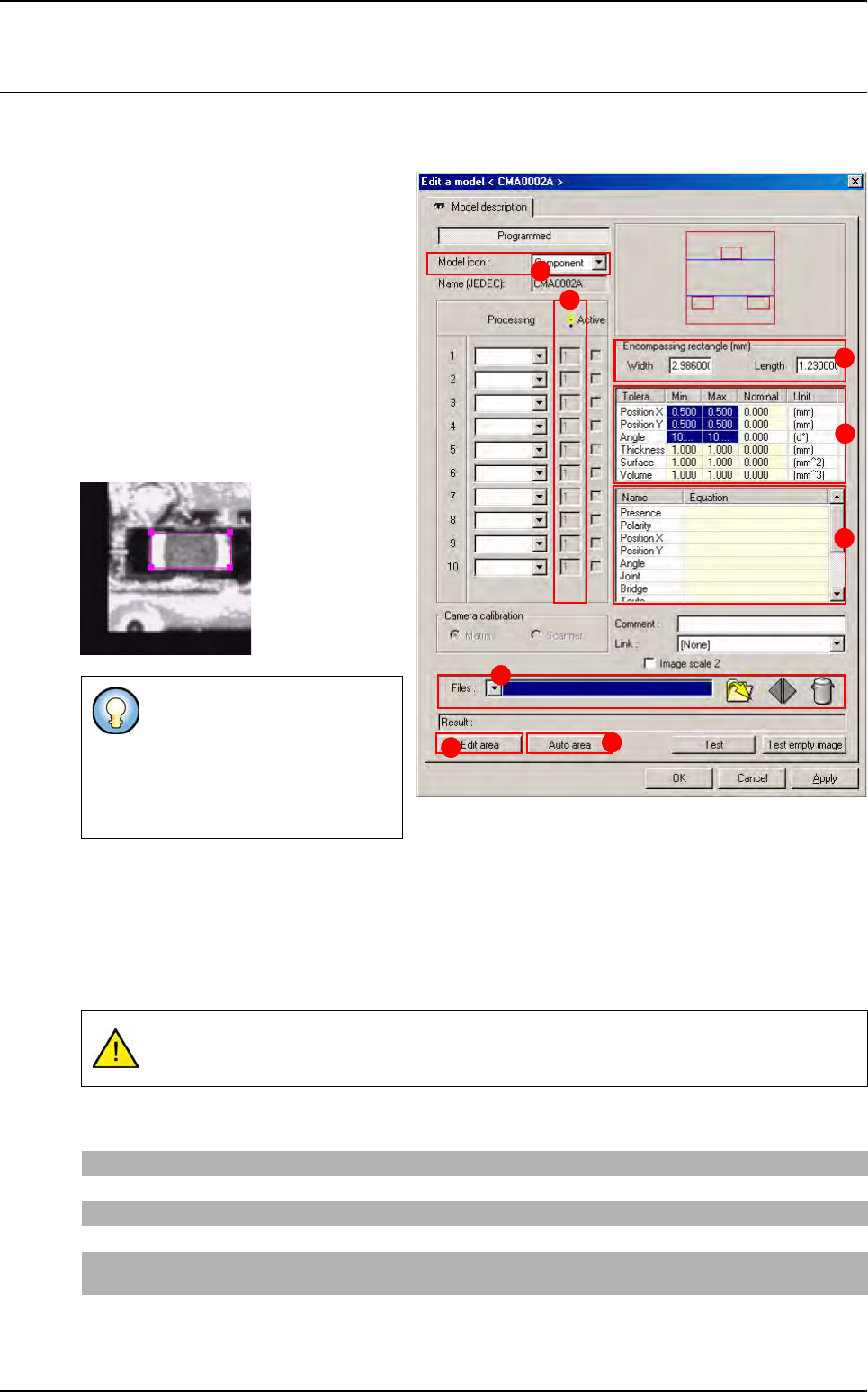
With the library opened, double click on the model that you want to edit, to display the Edit a model
window.
1. Select the image of the component that
you want to program from the list avail-
able in Model image (A) to display the
selected image or browse the image with
this button.
2. Select in Model icon (B), the icon repre-
senting the type of component being
treated.
3. When you click on Edit the area (C) but-
ton a magenta contour appears in the
camera window. Drag and resize this
contour and outline the model image cor-
rectly.
Deactivate the Edit area function by clicking it again. The characteristics of the Encompassing rect-
angle are automatically filled in during step 3.
The Auto area (E) button enables positioning of the encompassing rectangle. The automatic area
edition can be performed if, and only if, the model used is a synthetic model.
4.
In
Tolerances (mm)
(
F
) section,
enter the inspection tolerances ( X, Y and Theta) for the current model.
5. In Equations (G) section, enter the equations to be used for component test.
This magenta rectangle called the
Encompassing
rectangle
(
D
) is
used to define the size of the com-
ponent in the library and therefore
in the associated .tst file during its
creation.
If the tolerances are zero, the inspection result will always be a position error (the perfect
position does not exist).
Presence
Enter the processing window number. If this is the window 1, part R1 (R for Result).
Polarity
Enter the window number in the different text fields if a component requires one of the tests mentioned.
Position X and Y
Enter X1 or Y1 to have the position of the tool in window 1.
Angle
Enter T1 in the Angle text field to indicate that the angle is calculated by the inspection tool of window 1.
Joint
Enter the processing window number. If this is the window 1, part 1-J1 (J for Joint), only if you have a SO
or QFP tool in the window 1.
Bridge
Enter the processing window number. If this is the window 1, part 1-B1 (B for Bridge), only if you have a
SO or QFP tool in the window 1
A
B
C
E
F
G
D
H
Tools library
7 - 10 Vision 2007 4.10 User Manual Rev 01
Here is the list of the available formulas that you can use in the equation fields
6.
Select the light level (
H
) for this treatment. Now that the model description is complete, the different
treatment windows must be determined using the different inspection tools: Vi-Pro, Edge, Histogram,
SO, QFP, Custom, BGA.
7. Component test according to the equa-
tions entered in the model description. Af-
ter returning to the Model description tab, click on Test button. This test will apply all the tools from
the active windows. Examine the inspection results and make any modifications necessary.
8. Click OK to validate the parameters and close the window.
Logical operator
OR, AND, NOT, <, >, == , <=, >=, Test?Res1:Res2
Numerical operator
=, +, -, *, /, -NEG, X^i
Functions
SIN, COS, TAN, ATAN, LN, LOG, EXP, SQRT, ABS, MOD 180 (to ensure angle between 0 and 180°), MODPI (to ensure
angle between 0 and Pi), D2R (convert Degree to Radian), R2D (convert Radian to Degree)
Vi-Pro variables
Ri, Xi, Yi, Ti, Si (Fit error), Ui (scale X), Vi (scale Y)
SO / QFP variables
Ri, Xi, Yi, Ti, Ji (joint), Bi (bridge)
Edge
Ri, Xi, Yi, Ti, Wi (width), Oi (offset), Ci (contrast)
Histogram
Ri
Custom
Mi (maximum histogram for joint inspection), Zi (number of leads with profil error)
If you need the CAD data in an equation, you can use the following variables: X0, Y0 and
T0.
When closing model, if there is no equation in the parser, you have a warning message.
If you right click on the treatment number, a menu box appears with the option to copy or
cut a treatment. You can copy a treatment and paste it in another model only if both are 2
mono zones models or 2 multi zones models. You can paste it on another window. All the
treatment parameters will be paste.
If you paste a treatment on an existing one, you have a message box asking you if you want
to overwrite the existing treatment.
Advice for the model edition:
Save the library (re-synchronization with the .tst file is automatic).
Save the .tst file.
Perform the test on the panel and therefore on the different components to ensure that the
treatment operation is properly applied.
Model edition
Tools library
Vision 2007 4.10 User Manual Rev 01 7 - 11
7.3 Vi-Pro
Vi-Pro is a tool to recognize geometric shape based on vector analysis of the image and not pixel by
pixel. This geometry is based on the most contrasted transitions included in the image. Vi-Pro is used
to find the precise position of a component. It returns the presence, X, Y and Theta position of a com-
ponent.
7.3.1 Model description tab
1. On the Model description tab, in the Edit a model window, click on the button to add a
synthetic image of the model. The .bmp file name appears in picture list window. Select the
image on which to apply the treatment.
2. Click Auto area button to define the component size.
3. Choose the treatment operation: Vi-Pro. A new Vi-Pro tab appears behind the Model de-
scription tab.
4. With the Autotooling, the model is automatically trained.
5. On the Model description tab, in the Edit a model window, choose the treatment operation:
Vi-Pro. A new Vi-Pro tab appears behind the Model description tab.
7.3.2 Vi-Pro tab
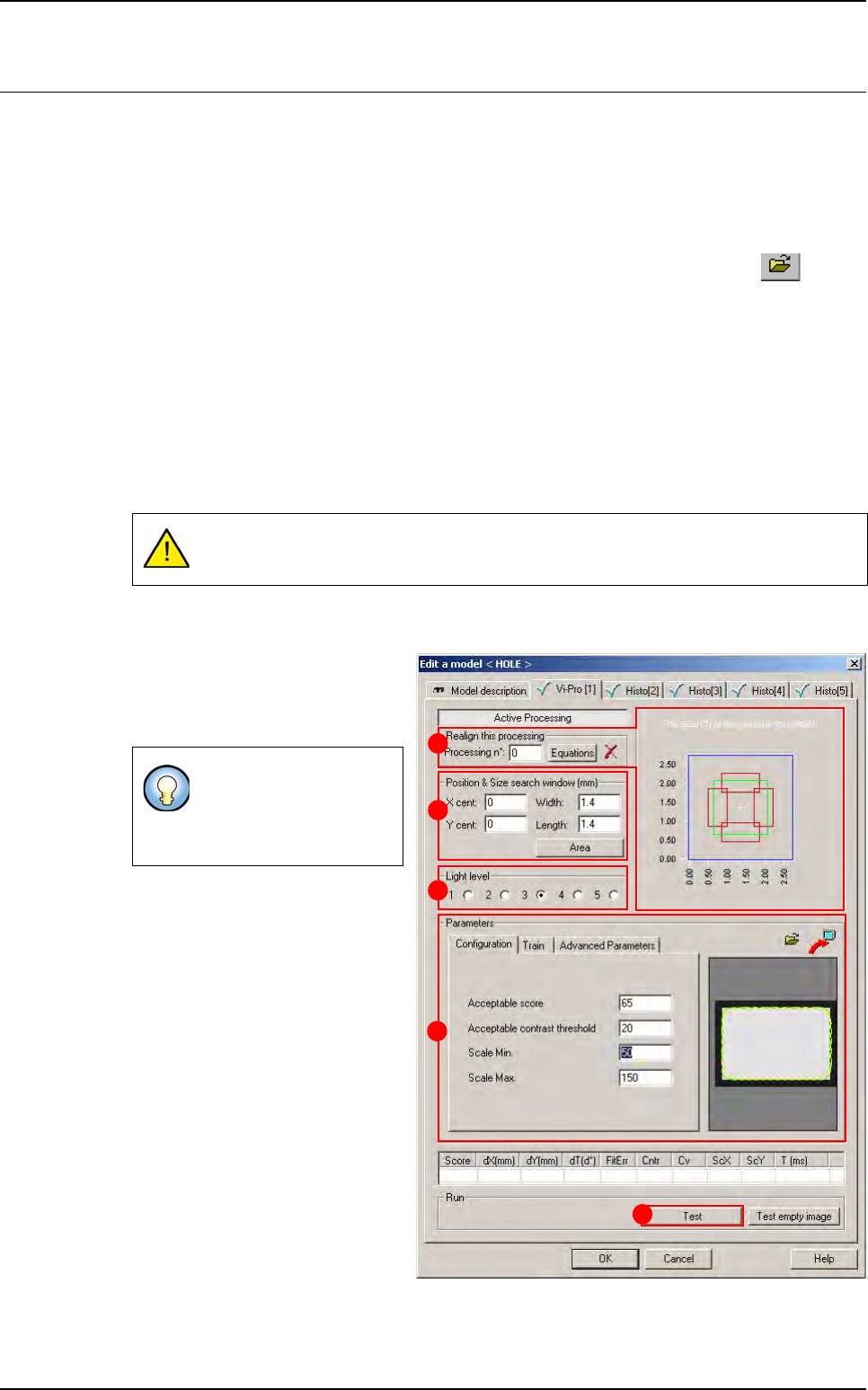
1.
Use
Realign this processing
(
A
)
section if you want to realign the po-
sition of the tool with another one
(not available for window 1).
2.
In
Position & size model window
(mm)
(
B
)
section,
enter the size and
position of the search window (zone
in which the component will be
searched for). These dimensions
must be larger than the Vi-Pro train
area by at least the component toler-
ance.
3.
In
Light level
(
C
) section, select the
light level to use.
4. In Parameters (D) section, enter
the Vi-Pro parameters (see below
7.3.2.1 Vi-Pro parameters).
5.
Click
Test
(
E
) button to test the Vi-
Pro tool and display the results (see
below
7.3.2.2 Vi-Pro test
).
Model training with Vi-Pro is only possible with a synthetic image.
If you need a special
equation to realign, you
can do so using the
Equations button.
A
B
C
D
E