VI User Manual.pdf - 第187页
Tools library Vision 2007 4.10 User Manua l Rev 01 7 - 25 7.5.2.1 Histogram parameters Score Selection Value Average arithmetic average of all the pixel values. Median : the pixel value un- der which half the pixels lie.…
Tools library
7 - 24 Vision 2007 4.10 User Manual Rev 01
7.5.2 Histogram tab
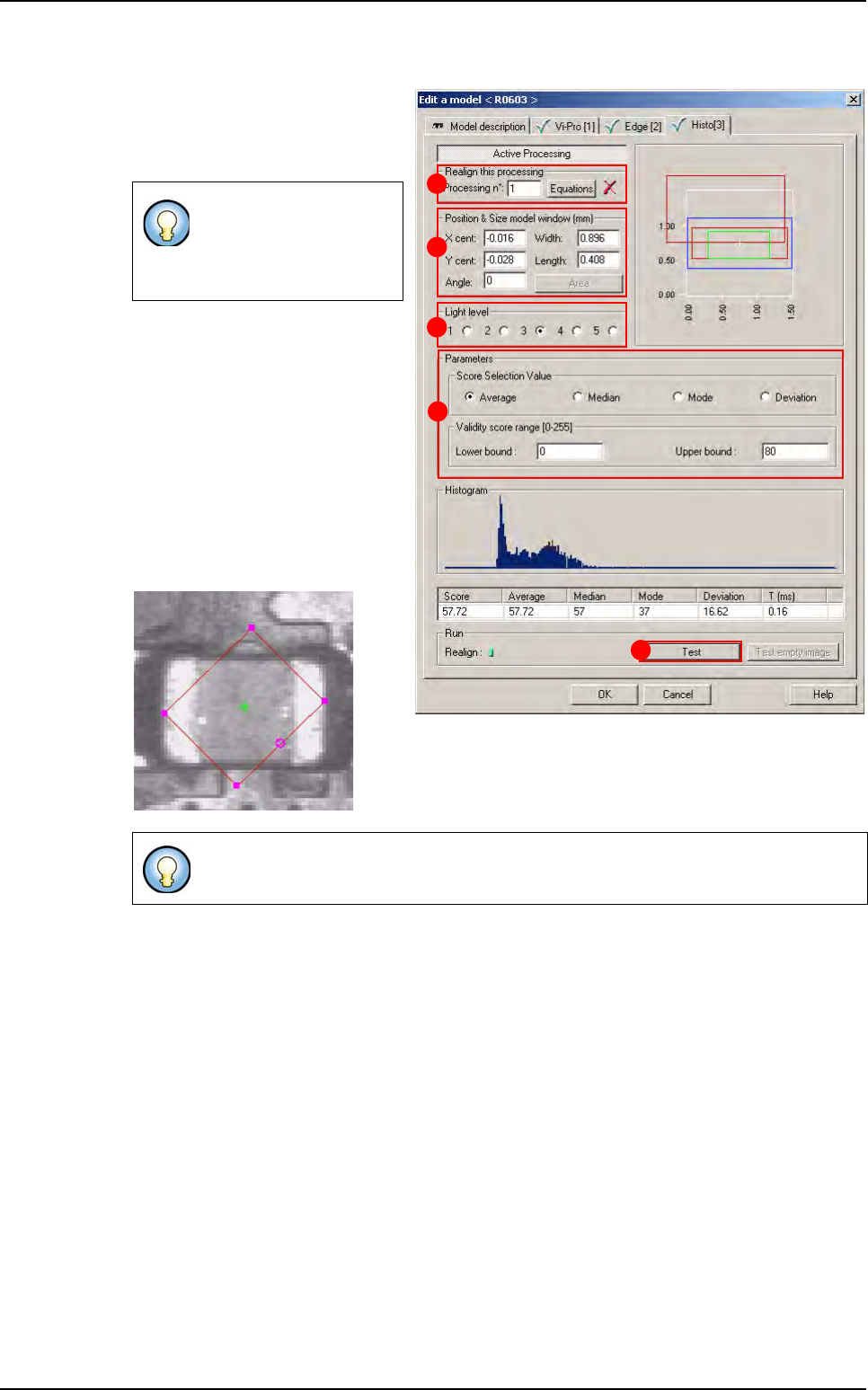
1.
Use
Realign this processing
(
A
)
section if you want to realign the po-
sition of the tool with another one
(not available for window 1).
2. In Position & Size model window
(mm) (B) section, enter the size
and the position of the histogram
area. Histograms areas can be
defined at any time.
Press Area button and use the
mouse to rotate the area directly
on the picture in the camera
window, using the magenta arrow.
You can also enter the angle
directly in the field Angle.
3. In Light level (C) section, select the light level you want to use.
4. In Parameters (D) section, enter the Histogram tool parameters (see below § 7.5.2.1 Histo-
gram parameters).
5. Click Test (E) button to test the Histogram tool and display the results (see below § 7.5.2.3
Histogram test).
If you need a special
equation to realign, you
can do so using the
Equations
button.
The histogram analyses all the pixels parts contained in the defined area.
B
C
A
D
E
Histogram
Tools library
Vision 2007 4.10 User Manual Rev 01 7 - 25
7.5.2.1 Histogram parameters
Score Selection Value
Average arithmetic average
of all the pixel values.
Median: the pixel value un-
der which half the pixels lie.
Mode: the most frequently
occuring pixel value.
Deviation: standard devia-
tion of pixel values.
Validity score range
The selected value (Average, Median, Mode or Deviation) must be between Lower &
Upper bound values for the result to be considered valid.
7.5.2.2 Histogram
Display of the histogram of the area.
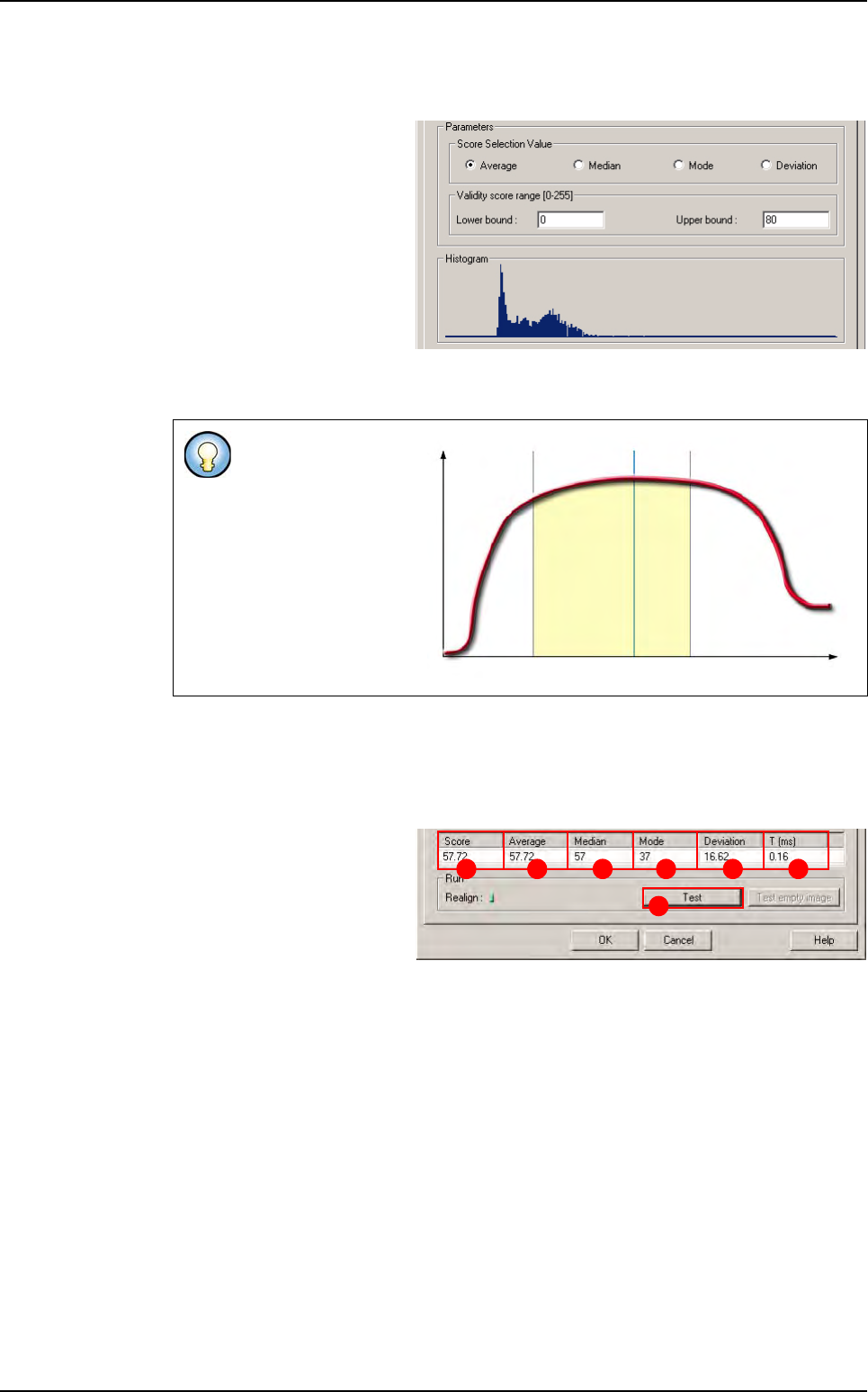
7.5.2.3 Histogram test
Click on Test (A) button to
apply all the inspection pa-
rameters to this tool.
Score (B): score of the test-
ed tool (rate of detection suc-
cess).
Average (C): arithmetic average of all the pixel values.
Median (D): pixel value under which half the pixels lie.
Mode (E): most frequently occuring pixel value.
Deviation (F): standard deviation of pixel values.
T (ms) (G): inspection time.
Minimum threshold:
the minimum value of
gray level accepted
for the test result.
Maximum threshold:
the maximum value
of gray level accept-
ed for the test result.
0 255
Gray level
Minimum
threshold
Maximum
threshold
P
i
x
e
l
p
o
p
u
l
a
t
i
o
n
W
h
i
t
e
B
l
a
c
k
Histogram
result
(average value)
A
B C D E F G
Histogram
Tools library
7 - 26 Vision 2007 4.10 User Manual Rev 01
7.6 BGA
The BGA tool is dedicated to the detection of BGA components. For this detection, we use edge tools
exclusively. The polarity of these edges is determined by the component color.
7.6.1 Model description tab
1.
On the
Model description
tab, in the
Edit a model
window, click on the button . The .bmp
file name appears in picture list window. Select the image on which to apply the treatment.
2. Click Edit area button to define the component size.
3. Choose the treatment operation: a new BGA tab appears behind the Model description tab.
All treatment windows (position & size) are automatically created according to the encom-
passing rectangle definition.
4. With the Autotooling, the model is automatically trained.
7.6.2 BGA tab
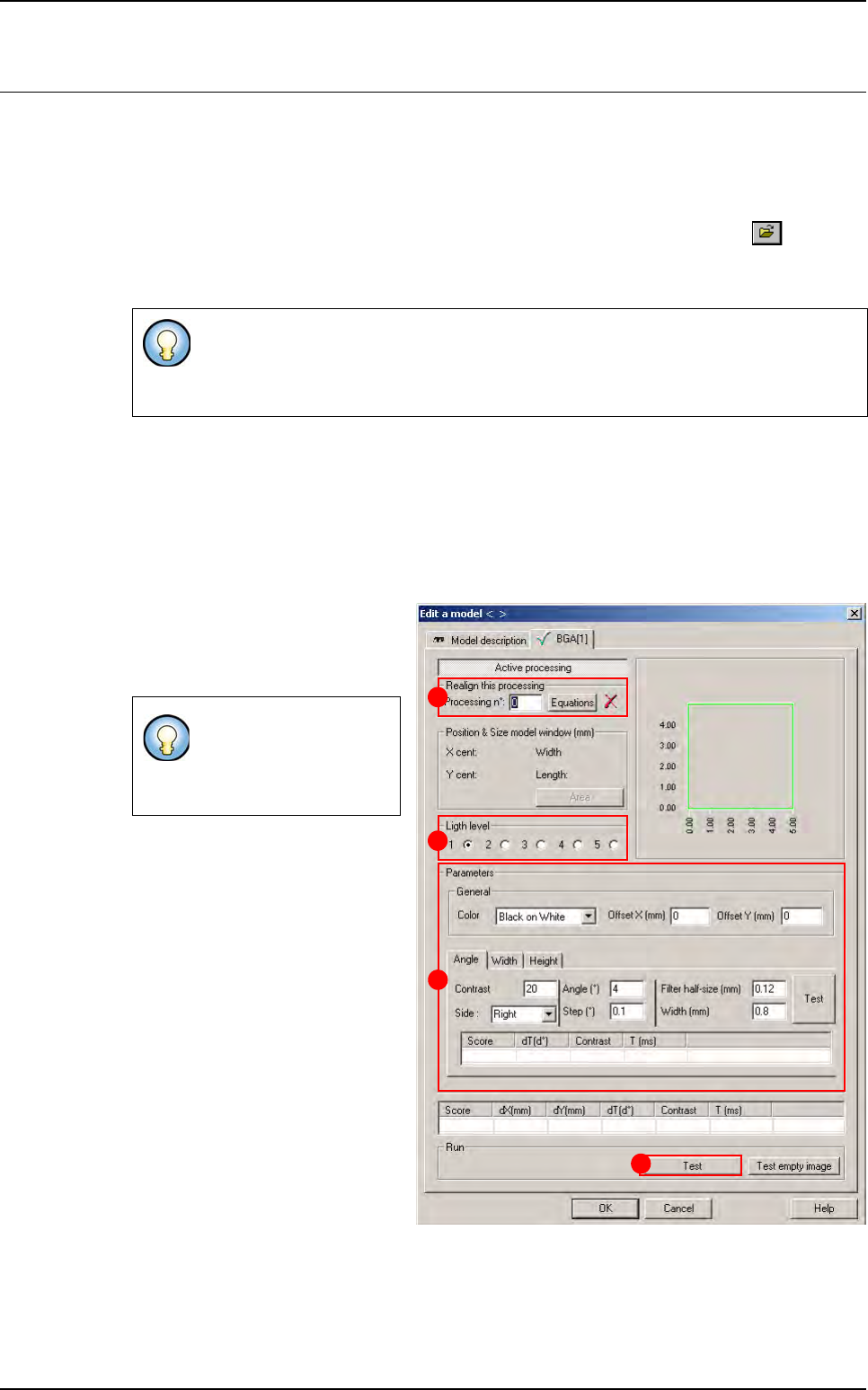
1.
Use
Realign this processing
(
A
)
section if you want to realign the po-
sition of the tool with another one
(not available for window 1).
2.
In
Light level
(
B
)
section, select the
light level to use.
3. In Parameters (C) section, enter
the BGA tool parameters (see be-
low § 7.6.2.1 BGA parameters).
4. Click Test (D) button to test the
BGA tool and display the results
(see below § 7.6.2.2 BGA test).
When you create a BGA, use the encompassing rectangle dimension to initialize
BGA tool dimension.
When you use synthetic model, click on
Auto area
button to define the component size.
If you need a special
equation to realign, you
can do so using the
Equations button.
B
A
C
D