VI User Manual.pdf - 第253页
Tools library Vision 2007 4.10 User Manua l Rev 01 7 - 91 You should set the confu sion threshold high eno ugh to ensure that confusing features in a search image do not receive scor es above the acceptable score. The co…

Tools library
7 - 90 Vision 2007 4.10 User Manual Rev 01
The Search tool also uses 3 accuracy levels: coarse, fine, very fine.
7.15.1.4 Algorithms and performance
Choosing an algorithm and an accuracy level can greatly affect the tool’s processing
time. The following tables indicate the relative speed difference for using the differ-
ent search methods.
Relative search times, score greater than confusion threshold
Relative search times, score less than confusion threshold
7.15.2 Using the Search tool
There are 2 steps to use the Search tool. First you need to train a model, then you can find
instances of that model.
Training the Search tool, you have to select the algorithm(s) and the accuracy level(s) that
you will be able to use at run time.
Running the tool you can choose one of the trained algorithms and select the accuracy level.
The decision parameters are the acceptable score, the confusion threshold, and the accept-
able contrast.
The Search tool uses the confusion threshold and score that you supply to ensure that the
correct instance of the model within the search image is located as quickly as possible. The
confusion threshold is the more important to obtaining good results.
The tool uses both the score and the confusion threshold when considering whether or not
a match represents a valid instance of the model. The confusion threshold is the score above
which any match is guaranteed to be an instance of the model; all matches with scores great-
er than or equal to the confusion threshold are considered to be valid. The acceptable score
is the lower score limit of all valid matches. But other matches, which might not be actual in-
stances of the model, can receive scores above this acceptable score.
The tool uses the confusion threshold to speed the search process. If you are searching for
a single instance of the model in an image, as soon as the Search tool finds an instance with
a score above the confusion threshold, it stops searching and returns the location of the
match. If Search does not find a match with a score above the confusion threshold, it locates
all the matches with scores above the acceptable score and returns the location of the match
with the highest score.
Algorithm/Accuracy level
Coarse Fine Very fine
Cnl normalized
± 2 pixels ± 1 pixel ± 0.25 pixel
Cnl Nonlinear ± 2 pixels ± 1 pixel ± 0.5 pixel
Normalized Search ± 2 pixels ± 1 pixel ± 0.25 pixel
Absolute Search ± 2 pixels ± 1 pixel ± 0.25 pixel
Algorithm/Accuracy
Coarse Fine Very fine
Cnl normalized
100 % 110 % 120 %
Cnl Nonlinear 100 % 150 % 200 %
Normalized Search 100 % 110 % 120 %
Absolute Search 100 % 110 % 120 %
Algorithm/Accuracy
Coarse Fine Very fine
Cnl normalized
100 % 150 % 200 %
Cnl Nonlinear 100 % 200 % 300 %
Normalized Search 100 % 150 % 200 %
Absolute Search 100 % 150 % 200 %
Search
Tools library
Vision 2007 4.10 User Manual Rev 01 7 - 91
You should set the confusion threshold high enough to ensure that confusing features in a
search image do not receive scores above the acceptable score.
The contrast threshold is the ratio of the pixel values dispersion from the trained image to the
real image. It is relative to the trained image.
7.15.3 Model description tab
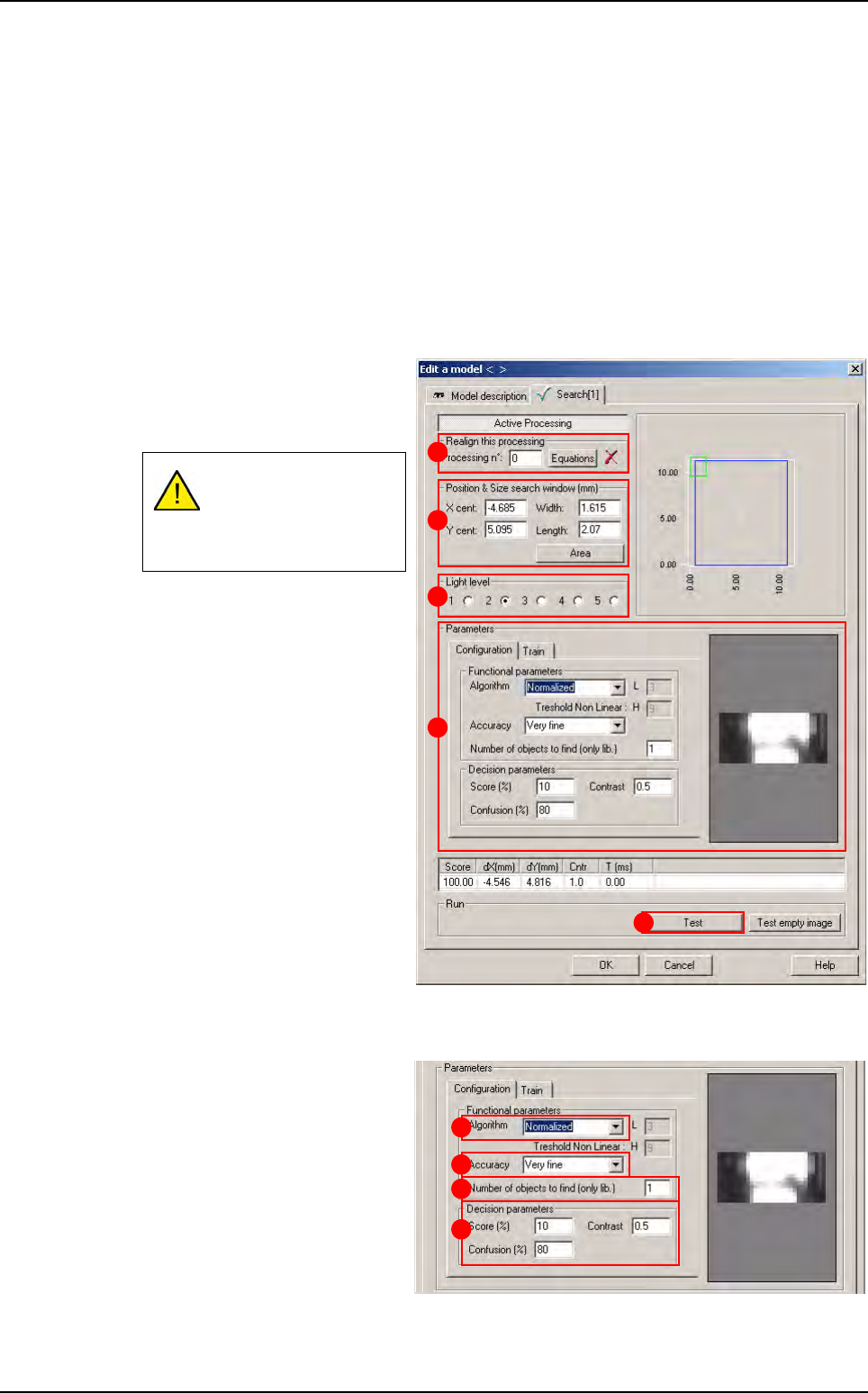
1. On the Model description tab, in the Edit a model window, choose the processing:
Search. A new tab appears (with the tool name) behind the Model description tab.
2. Click Auto area to place the model encompassing area exactly on the image.
7.15.4 Search tab
1.
Use
Realign this processing
(
A
) section if you want to realign
the position of the tool with another
one (not available for window 1).
2. In Position & Size search
window (mm)
(B) section, enter
the size and position of the
search window (zone in which
the feature will be searched for).
3. In Light level (C) section, se-
lect the light level you want to
use.
4. In Parameters (D) section, en-
ter the Search tool parameters
(see below
7.15.4.1 Search pa-
rameters
).
5. Click Test (E) button to test the
Search tool and display the re-
sults (see below
7.15.4.2 Search
test
).
7.15.4.1 Search parameters
Configuration tab
Click Configuration tab
to access the main run
time parameters.
1. In Fonctional param-
eters
section:
Select the
Algorithm
(A) that will be used,
among the trained algo-
rithms.
Select the
Accuracy (B)
level from the trained accuracy levels.
If you need a special
equation to realign, you
can do so using the
Equations button.
A
B
D
C
E
A
B
C
D
Search
Tools library
7 - 92 Vision 2007 4.10 User Manual Rev 01
In
Number of objects to find (only lib)
(
C
) enter the number of results to display in
the list, although only the first one is used. This is useful for debugging purpose.
2. In Decision parameters (D) section, define the minimum score, the confusion
threshold, and the contrast threshold for the tool.
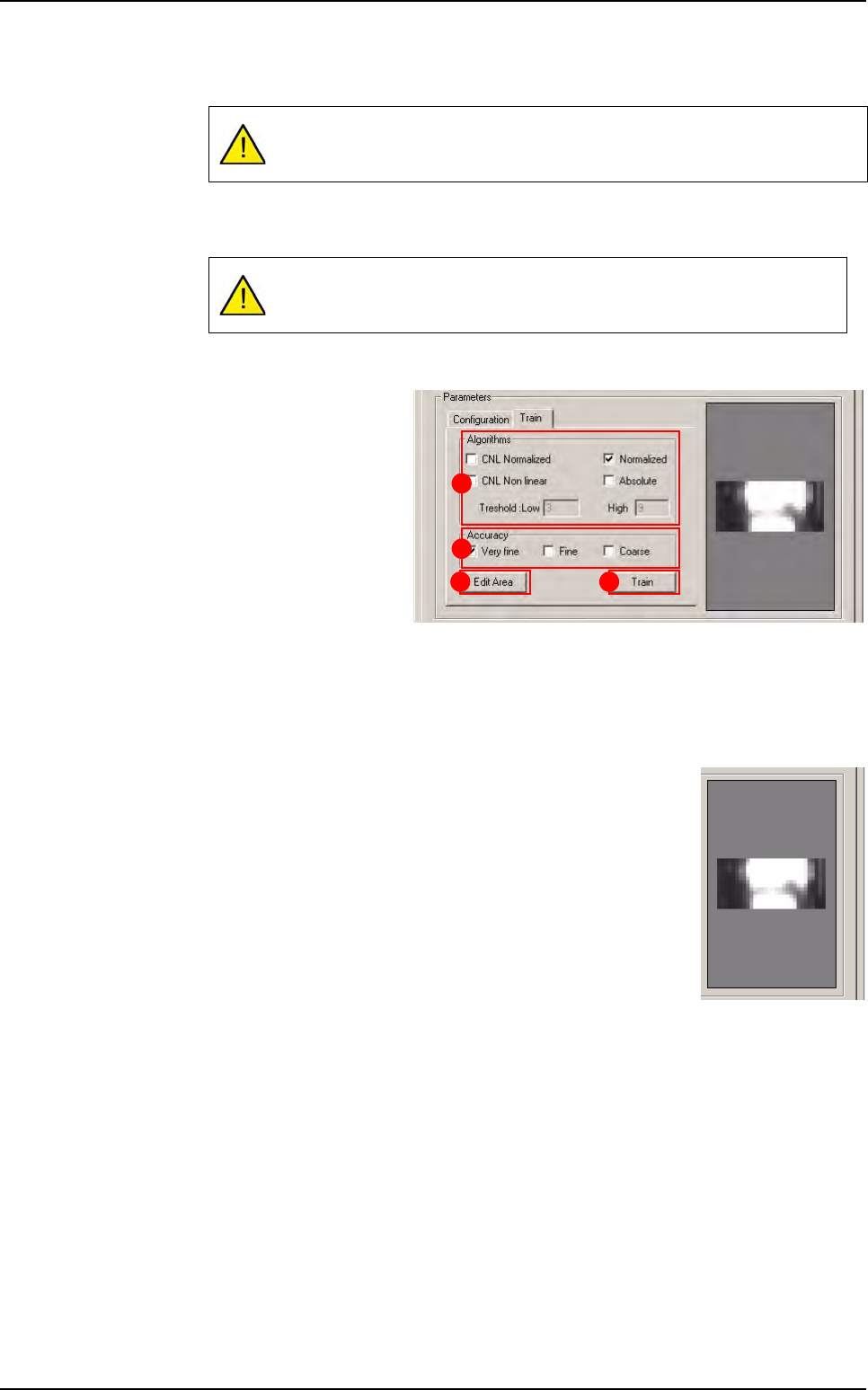
Train tab
Click Train tab to access
the train parameters.
1. In Algorithms (A)
section, select the algo-
rithms you need to train.
The more algorithms
you select, the longer
the train procedure will
last (and the more mem-
ory).
2. In Accuracy (B) sec-
tion, define the accuracy levels you wish to train.
3. Press Edit Area (C) button to encompass the model you need to train or press
Train (D) button to train the model.
Trained image display
Right click in the mask image to display a pop-up menu:
Use this menu to zoom in / out...
7.15.4.2 Search test
The Search tool will return only the results of the highest scoring instance
of the results list.
The selected algorithm and accuracy level may greatly influence the
tool’s processing time. Please refer to the Definition paragraph.
A
B
C D
Search