VI User Manual.pdf - 第264页
Optical Character Verification 8 - 2 Vision 2007 4.10 User Manual Re v 01 8.2 Creation procedure 8.2.1 Add a new text object in a test file 1. Display the acquisition zo nes using the corres ponding icon 2. Selec t the m…
Vision 2007 4.10 User Manual Rev 01 8 - 1
Chapter 8
Optical Character Verification
Optical Character Verification (OCV) is used to check strings of characters on components or anywhere on a
board. Using this, you can detect if a component with a wrong part number is placed on a board.
This tool is mainly used on SO, QFP or BGA.
8.1 OCV description
From Vision 2007, OCV has been totally rebuilt to propose a more efficient, user friendly and easy to
program tool.
The major improvements are:
Propagation by topology
Execution of a group of the text object with the same name root with the menu run by Jedec
The OCV principle is still:
In the .tst file: the text object defines WHAT to verify,
In the library: the font defines HOW to verify.
Optical Character Verification
8 - 2 Vision 2007 4.10 User Manual Rev 01
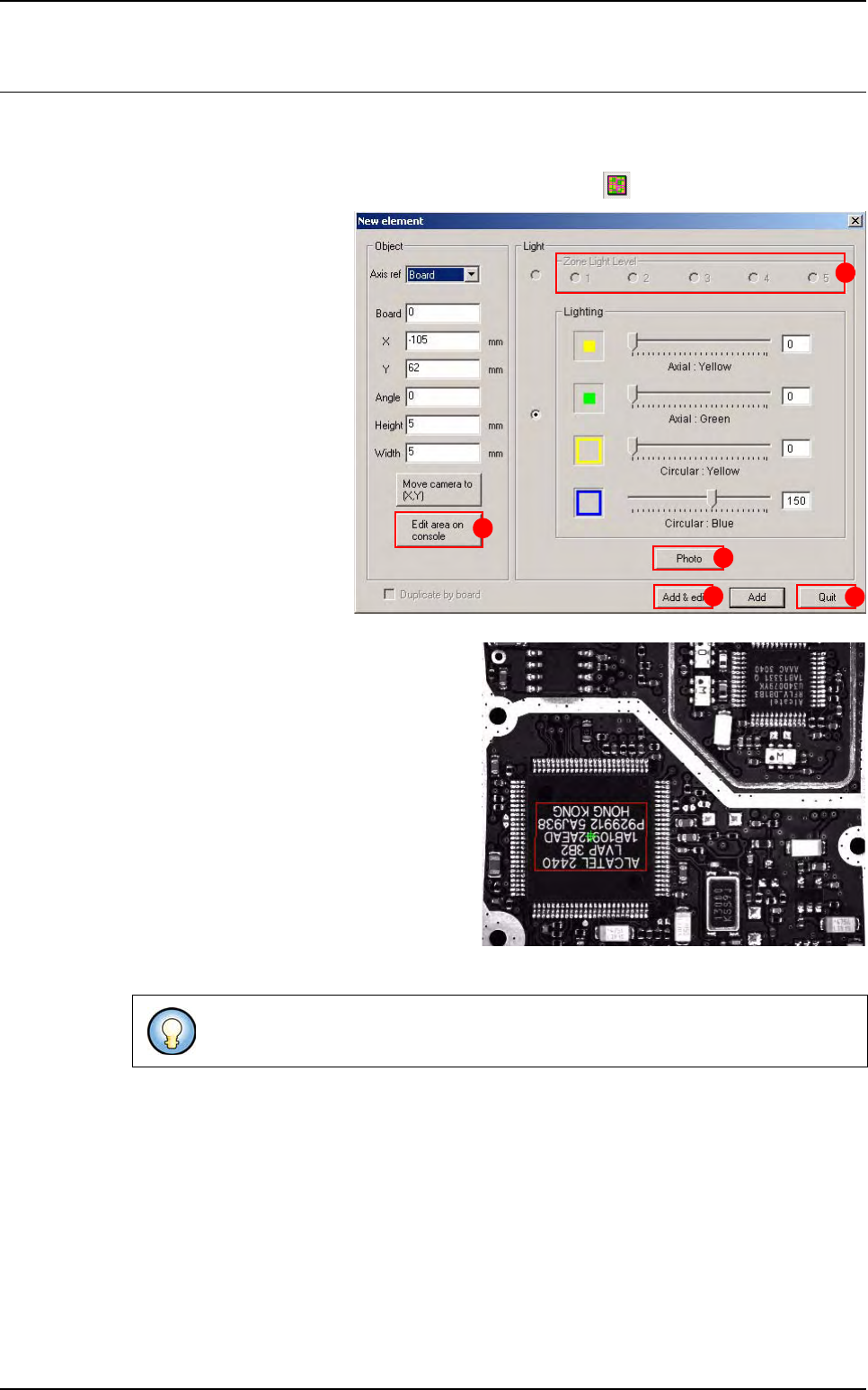
8.2 Creation procedure
8.2.1 Add a new text object in a test file
1. Display the acquisition zones using the corresponding icon
2. Select the menu: Edit\
Text\Add a text object to
open the creation window:
3. Click on the .tst file to refresh the video con-
sole.
4. Select the light level (A).
5. Adjust the text location and area (B).
6. Take a Photo (C) of the string.
7. Click Add & edit button (D) to add the text
object in the .tst file at the defined location
and to edit the text object. The Edit text
window appears (see next page).
8. Click on OK from the Edit text window to
validate the settings.
9. Then close the creation window with the
Quit button (E).
You can add the text on all boards with the option Duplicate by board.
A
B
C
D
E
Optical Character Verification
Vision 2007 4.10 User Manual Rev 01 8 - 3
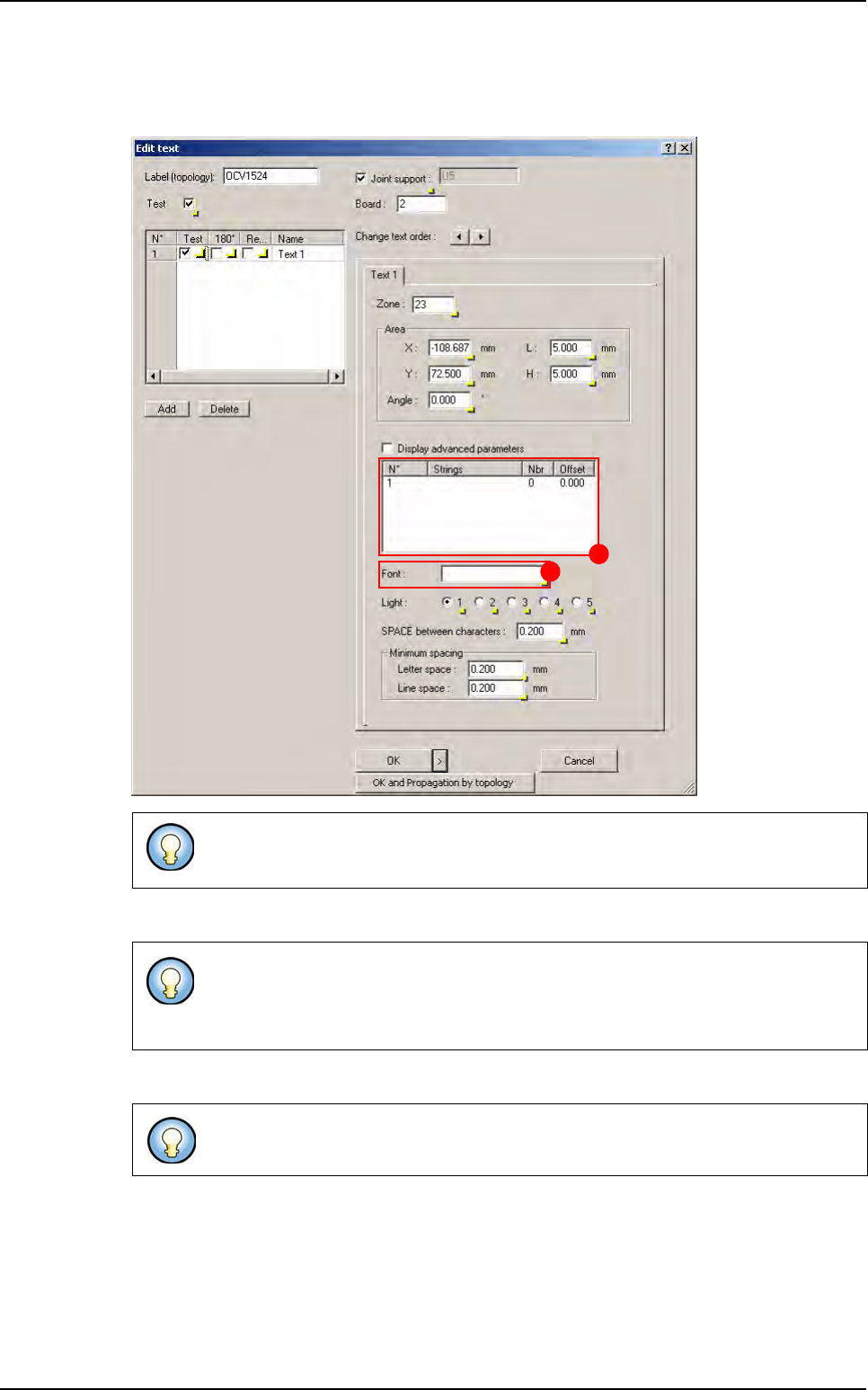
8.2.2 Edit and configure a text object
1. Select the edit from the tool bar and click on the text object to display the edition window.
2. Define the string (A) to verify (edit the box and add the lines to look for).
3. Enter the Font name (B) to be used in the library.
You can also use the find function (Ctrl + F) if you remember the label of the text you
want to edit.
The column Nbr corresponds to the minimum number of characters that needs to be
found to consider the string OK.
The column Offset corresponds to the shift of the line.
Each supplier can have a different font.
A
B
Creation procedure