VI User Manual.pdf - 第270页
Optical Character Verification 8 - 8 Vision 2007 4.10 User Manual Re v 01 7. To train each chara cter individually, place the cursor below the charact er, adjust the ar ea and use the bu ttons Add or Replace . Click on R…
Optical Character Verification
Vision 2007 4.10 User Manual Rev 01 8 - 7
Train tab
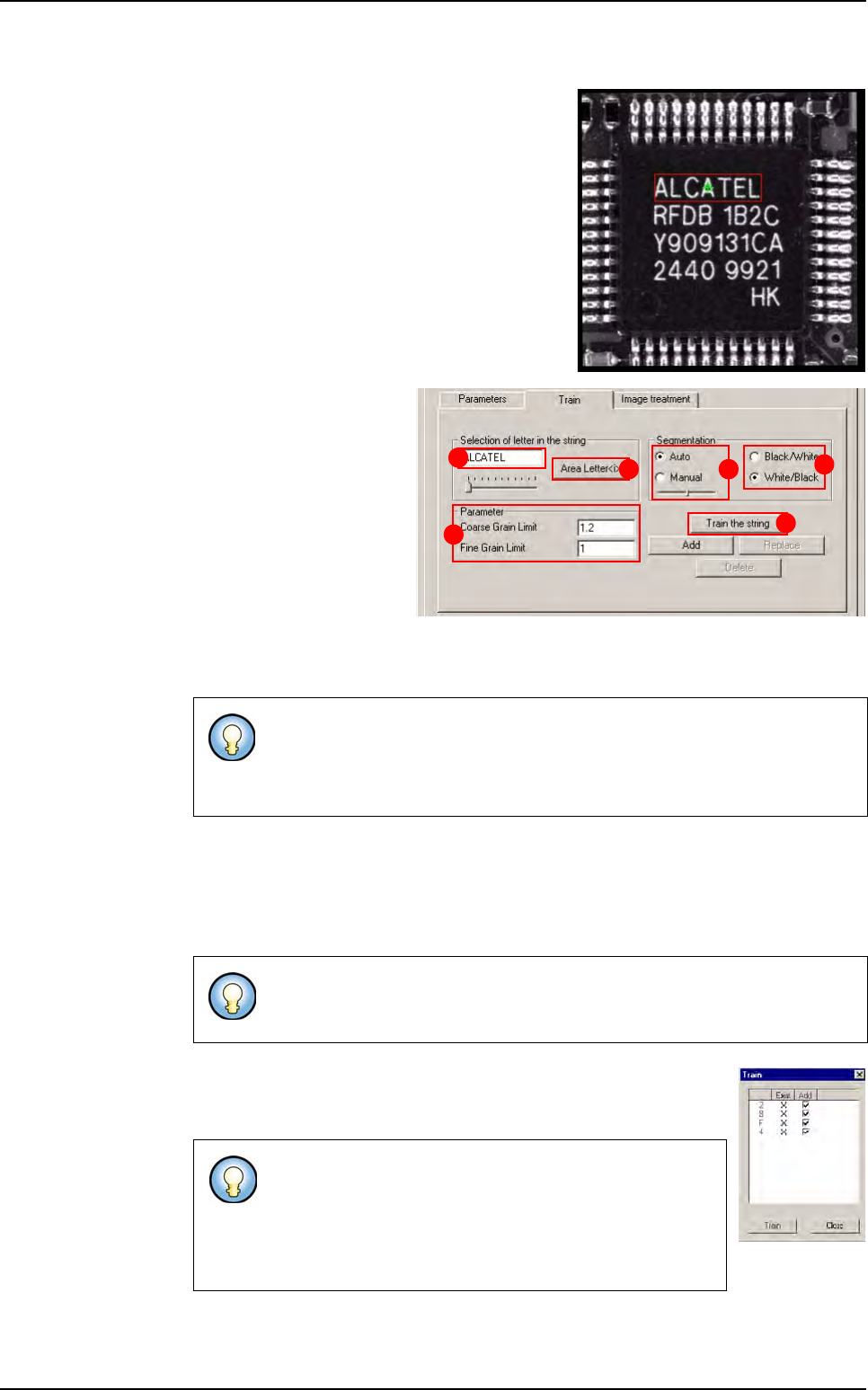
1. Define the area around the string to train (train
only one line once a time).
2. Enter the characters of the
string that needs to be
trained (A) (without space
between two words).
3. Define if the characters are
Black on a White zone or
White on a Black zone
(B).
4. Use the Auto or Manual
segmentation (C) to adjust
the area around each
character of the string. The Auto will perform an automatic segmentation of the pic-
ture.
5. Modify the Coarse/Fine Grain Limit parameters (E) used to define the size of the vec-
tors used to detect transitions:
Large transitions are detected with the Coarse grain limit.
Small transitions are detected with the Fine grain limit.
6. When all characters are well surrounded, you can use the Train the
string button (F) to automatically train all the characters and add
them in the alphabet.
To select the current character, use the arrows icon.
If the result is not as expected, use the Manual segmentation and adjust the
threshold and see the result on the video console or select the character with
the cursor and click on Area Letter<i> button (D) to adjust manually the han-
dles of the training area around the letter.
Increase the Coarse grain limit: reduces accuracy.
Reduce the Fine grain limit: increases accuracy and fine detection.
If some characters are already inside the alphabet, a list
will be displayed and you will be able to select the ones to
add into the alphabet.
If you add a character, it will be linked to the model already
trained and executed if the previous one fails.
A
B
C
E
F
D
Creation procedure
Optical Character Verification
8 - 8 Vision 2007 4.10 User Manual Rev 01
7. To train each character individually, place the
cursor below the character, adjust the area and
use the buttons Add or Replace.
Click on Replace button to replace the existing
character by the current trained character.
Click on
Delete
button to delete the current
trained letter.
Parameters tab
This tab gathers all parameters of the current letter necessary to the running.
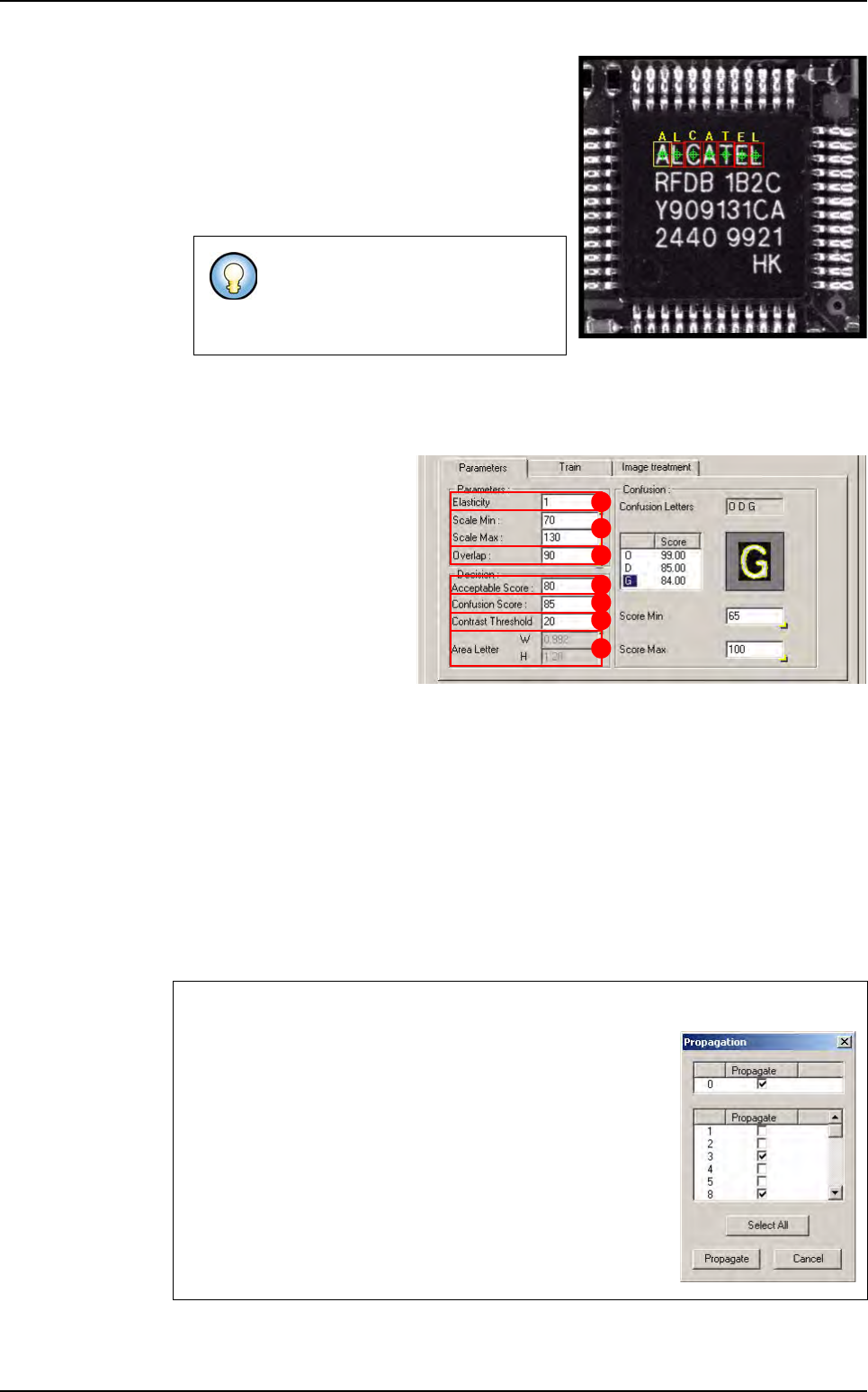
Elasticity (A) is the parame-
ter used to determine the de-
gree of tolerance that OCV
will accept for non linearity of
the component. The elasticity
unit is the pixel. Elasticity is
used to stretch or reduce the
size of components in all di-
rections at once. Standard
setting: between 0 and 1.
Scale Min / Scale Max (B)
put the model letter on the letter with a different size. The scale unit is the percent.
Overlap (C) An amount by which model areas can overlap. If models overlap more than
this amount, they are considered to be the same model, and only 1 of them will be re-
turned from a search operation.
Acceptable Score (D) is the minimum score of the model: if the score of the model is
higher than the acceptable score, the letter is found.
Confusion Score (E) is the score from which the algorithm of confusion is launched.
Contrast Threshold (F) is the minimum value of the threshold at which a transition will
be accepted. Contrast is defined by a gray level value.
Area Letter (G) is the size of the trained letter.
The confusion part gathers the confusion letters and the score to find them.
Before testing the string or the char-
acter, define different running param-
eters for each character in the
parameters tab.
Propagation
To propagate the parameters to the others letters, right mouse
click in the value edit box and tick the Data Propagation
menu.
Then, right mouse click in the group box the Propagate menu
and be able to propagate all parameters of the group box.
A Propagation window allows you to select the character
which you want to propagate.
A
B
C
D
E
F
G
Creation procedure
Optical Character Verification
Vision 2007 4.10 User Manual Rev 01 8 - 9
8.2.4 Confusion algorithm explanation
A Confusion algorithm can be auto-
matically performed when verifying
characters to avoid false detection
8.2.4.1 Teaching
The definition of the characters that can be confused is totally automatic.
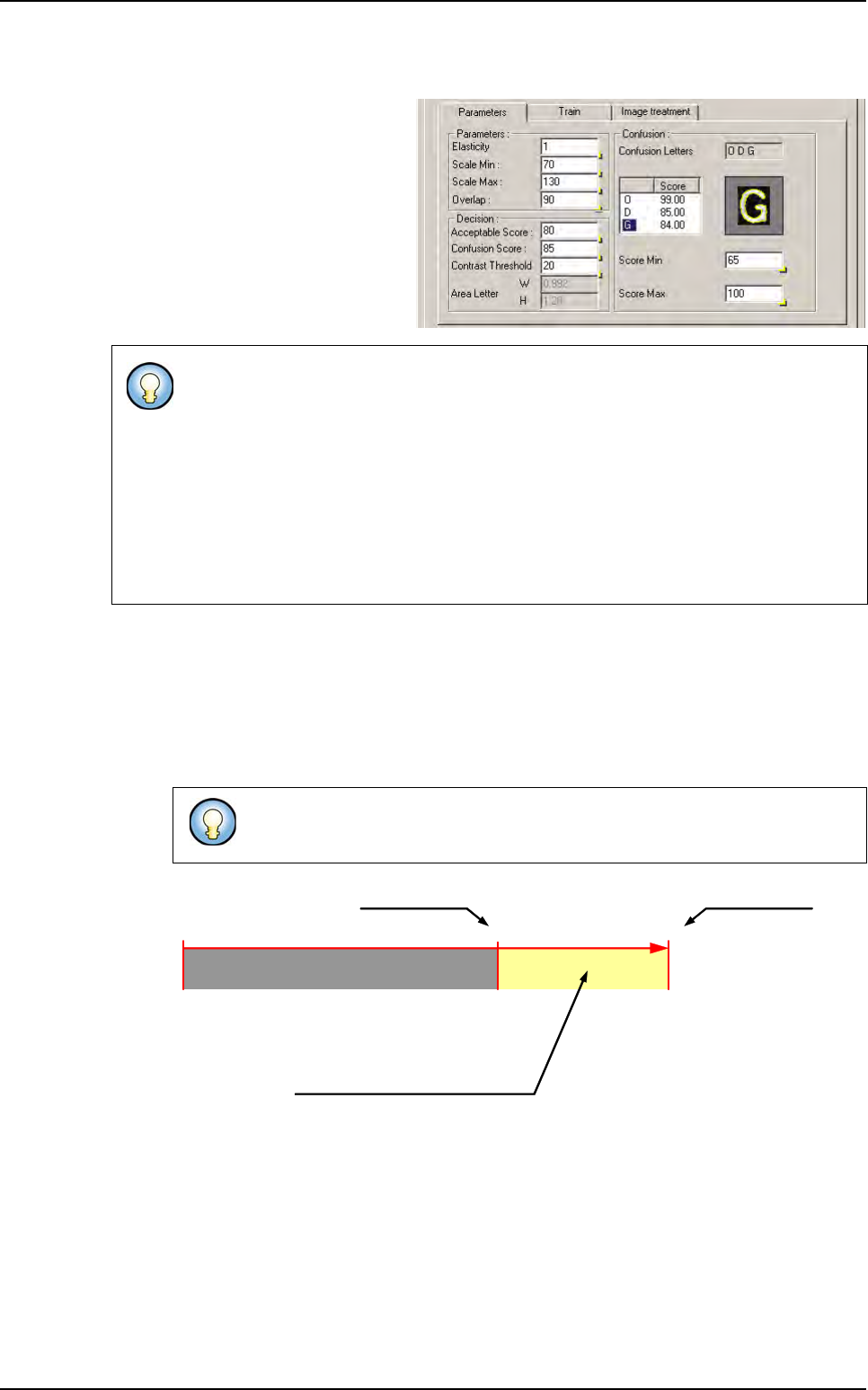
Example: for the letter O, there is 1 confusion letter: G.
When training the letter O, the score of the model G was 84 which is between 65 and
100. That is why G is a confusion letter.
The Confusion algorithm consists in trying models previously identified as Confusion
letters.
If the model of the Confusion letters returns a higher score than the model of the
letter we are about to verify the system returns an error.
Ex: the system verifies a O but in reality it a G.
On the real picture, the score of the model O = 82
On the real picture, the score of the model G = 84
So it is not a O, but it is a G! The system returns an error.
A maximum of 3 confusion letters is possible. They are ordered by the score
obtain during the test on the original picture.
0 100
Score minimum
If score of another model is between
these limits:
this model will be added in the list
of the confusion letters
Score maximum
Unacceptable score
65
Creation procedure