VI User Manual.pdf - 第284页
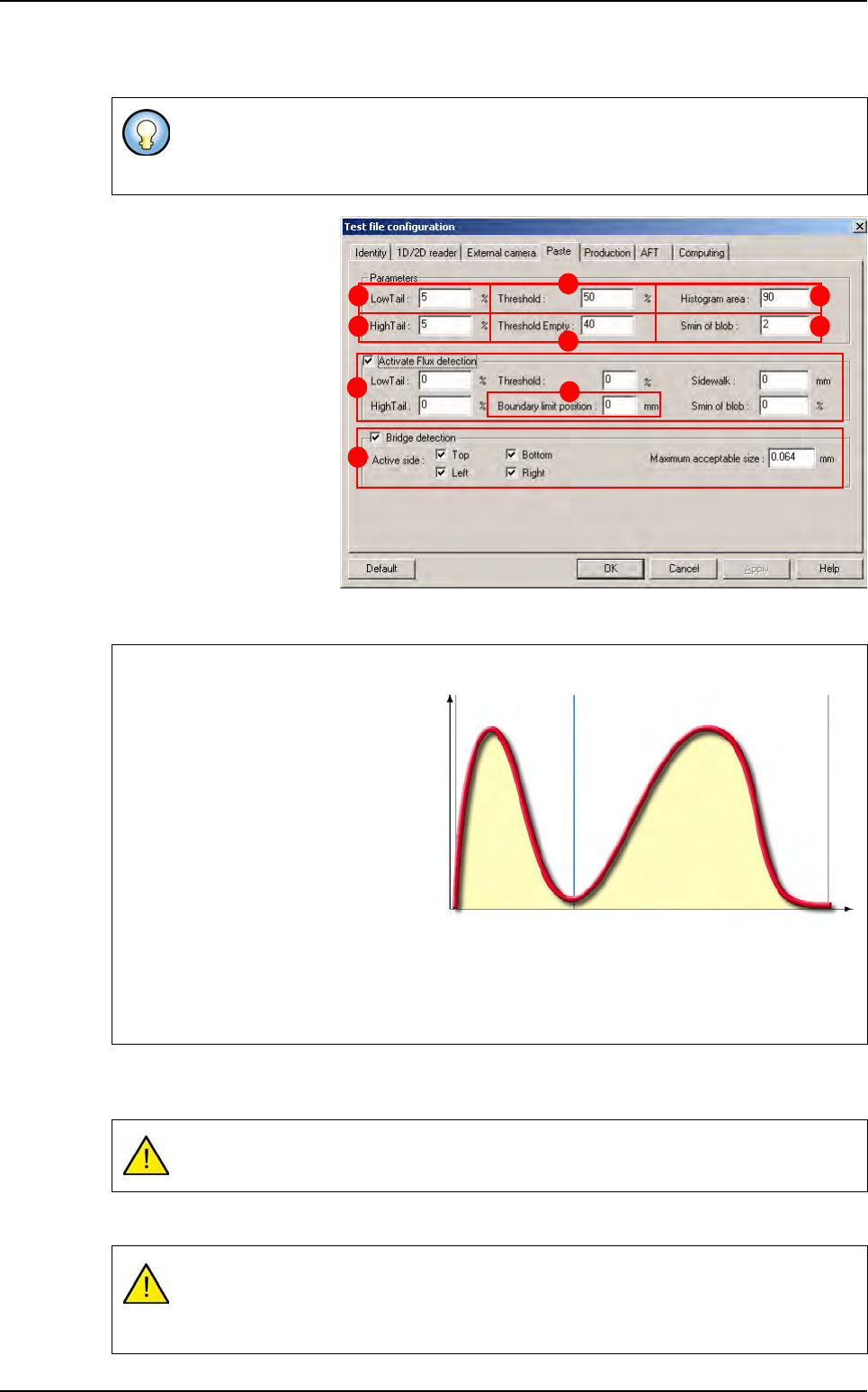
2D solder paste inspection 9 - 6 Vision 2007 4.10 User Manual Re v 01 9.3.3 Processing parameters . Low tail ( A ): back ground noise eliminated on the board (%). High tail ( B ) : backgrou nd noise eliminated on the pas…
2D solder paste inspection
Vision 2007 4.10 User Manual Rev 01 9 - 5
9.3 Solder paste inspection
9.3.1 Image acquisition and subtraction
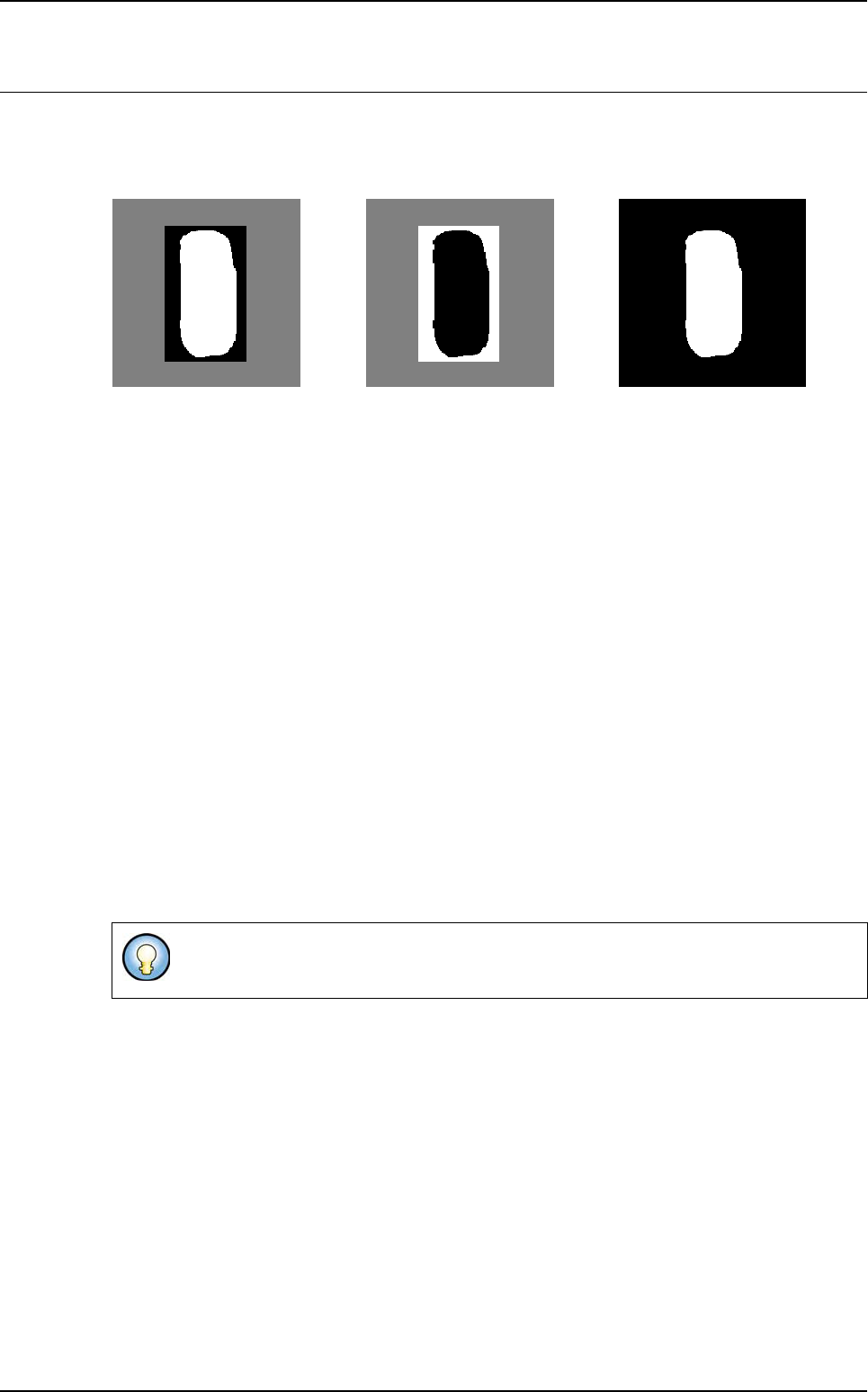
Blue peripheral (255) Amber axial (60)
I
mage 2 Image 1 Resulting image
Image 1:image obtained with amber axial lighting.
Image 2: enhanced image obtained with blue peripheral lighting. This enhancement is performed
to enable inspection of different types of PCB.
Resulting image: resulting image (2 - 1) from which the noise has been eliminated.
9.3.2 Processing
The solder paste is searched for using blob on the resulting image. The blob is a processing tool
which enables search of a shape or spot characterized by a number of pixels (shape size) and
one transition threshold (shape brightness) in gray level.
The blob searches within an area defined by: reception pad area + sidewalk.
The blob returns the surfaces and positions of the centers of gravity of the 20 largest spots found.
If the center of gravity of a spot found is outside the reception pad, the spot is excluded from the
results. The surfaces of the resulting spots are added together and the center of gravity of the
assembly formed by all the spots is calculated.
S = S1+S2+…+S20
X = ( S1X1+S2X2+…+S20X20 )/( S1+S2+…+S20 )
Y = ( S1Y1+S2Y2+…+S20Y20 )/( S1+S2+…+S20 )
If the blob finds something, a final test is performed, which is a histogram to validate that the
blob found the paste. The histogram is placed at the coordinates that the blob returned and its
surface is equal to a percentage of the theoretical surface.
If the histogram validates the paste presence, then the results are returned. Otherwise, a sur-
face fault is returned for the paste.
This sum enables calculation of a weighted center of gravity when the pads are cut for
all parts forming the solder paste pad.
=-
2D solder paste inspection
9 - 6 Vision 2007 4.10 User Manual Rev 01
9.3.3 Processing parameters
.Low tail (A): background
noise eliminated on the
board (%).
High tail (B): background
noise eliminated on the
paste (%).
Threshold (C): distribution
between the board back-
ground and the solder (%).
Threshold empty
(
D
): con-
firmation of paste presence.
Histogram area (E): histo-
gram area relative to theo-
retical area (%) used for
threshold empty.
Smin of blob (F): minimum
size of the mask that the blob must consider. Theoretical surface area of the solder paste (%).
Tick Activate Flux detection (G) tick box to set Flux detection parameters. These parameters
are the same that for solder paste surface detection.
Boundary limit position (H): size limit of the flux.
The parameters of the Test file configuration window are those used, by default, for all
paste pads. These parameters are, however, individually adjustable for each paste pad
in Pad edition.
The blob’s first step is to generate a histogram on its search area.
Low tail: percentage of the total
number of pixels to be ignored in the
threshold calculation. These pixels
are removed from the bottom of the
histogram.
High tail
: percentage of the total num-
ber of pixels to be ignored in the
threshold calculation. These pixels are
removed from the top of the histogram.
Threshold: all the pixels in the blob’s
search area found above this thresh-
old are considered to be solder paste. This threshold is a percentage of maximum gray level.
Empty threshold: if the average of the histogram’s gray levels is below this threshold, this
means that there is no paste.
If you do not tick this box the
Flux detection parameters
are not taken into account.
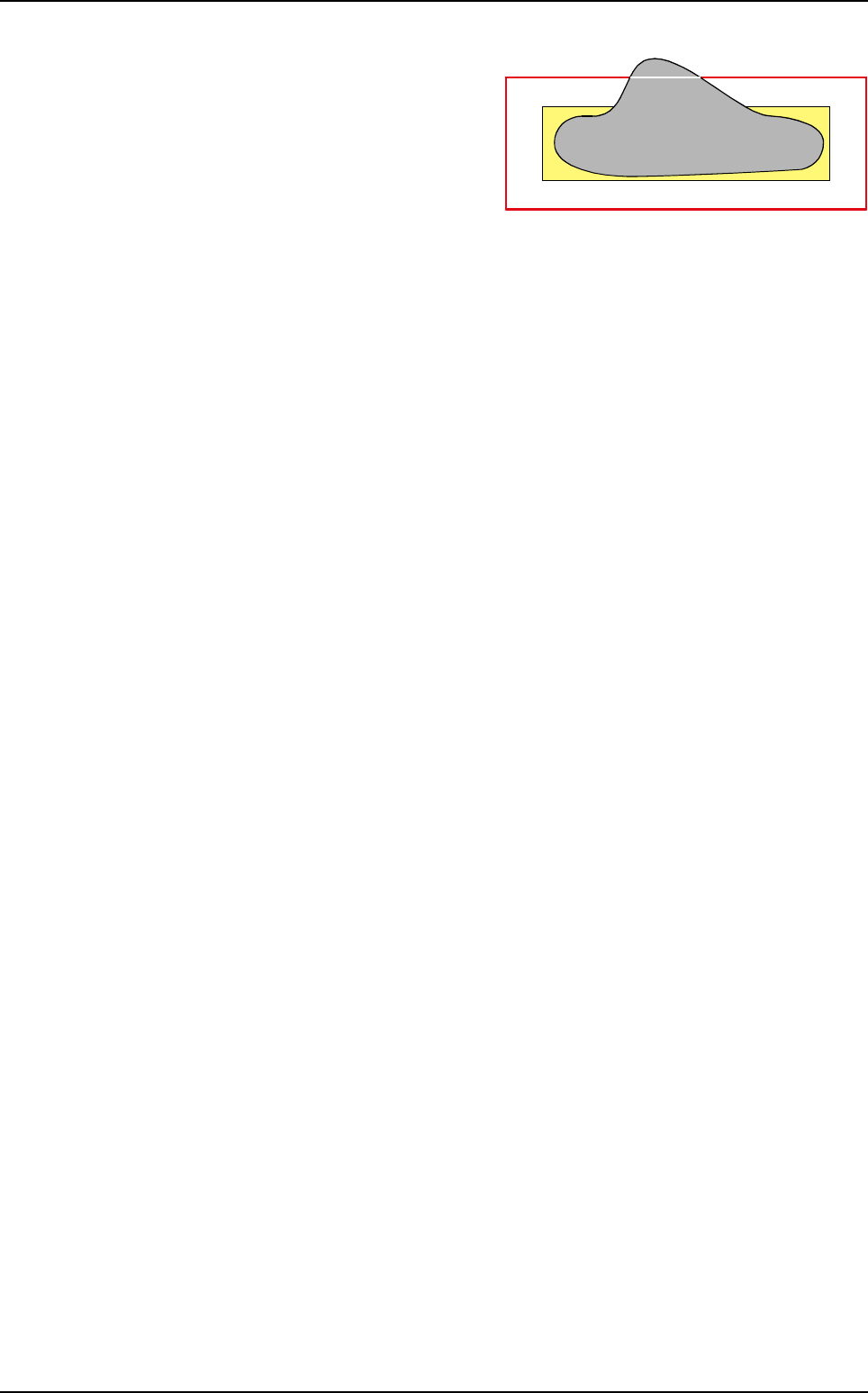
If we detect a white shape whose sides stick out the pad size + 15 %, we do not take
care of this shape.
This value must be included between - 50 % to 100 %.
A
B
C
D
E
F
G
H
I
0 255Gray levels
L
ow
tail
Hi
g
h
tail
N
u
m
b
e
r
o
f
p
i
x
e
l
s
Th
res
h
o
ld
Background
Paste
Solder paste inspection
2D solder paste inspection
Vision 2007 4.10 User Manual Rev 01 9 - 7
Bridge detection ( I ): the short circuit detec-
tion feature can be activated by picking the op-
tion Bridge detection.
The short circuit detection can be set for all pads
by using the Paste tab in the test file configu-
ration window, or by using the Edit pad screen
to set each pad individually (with this way, the
propagation, propagation by topology and prop-
agation by jedec are available).
For each case the following parameters should be set:
The side of the pad to activate.
The maximum size of the bridge length. (0.100 mm is the default value defined in the .ini file,
under [Paste] keyword).
Solder paste inspection