VI User Manual.pdf - 第334页
Optimization 12 - 16 Vision 2007 4.10 User Manual Re v 01 12.3.5 ADC in production When you start the ADC mode, some mess ages tell yo u which step is running: Load empty panel, Load full panel, ADC finished. If yo…
Optimization
Vision 2007 4.10 User Manual Rev 01 12 - 15
12.3.4 Configuration
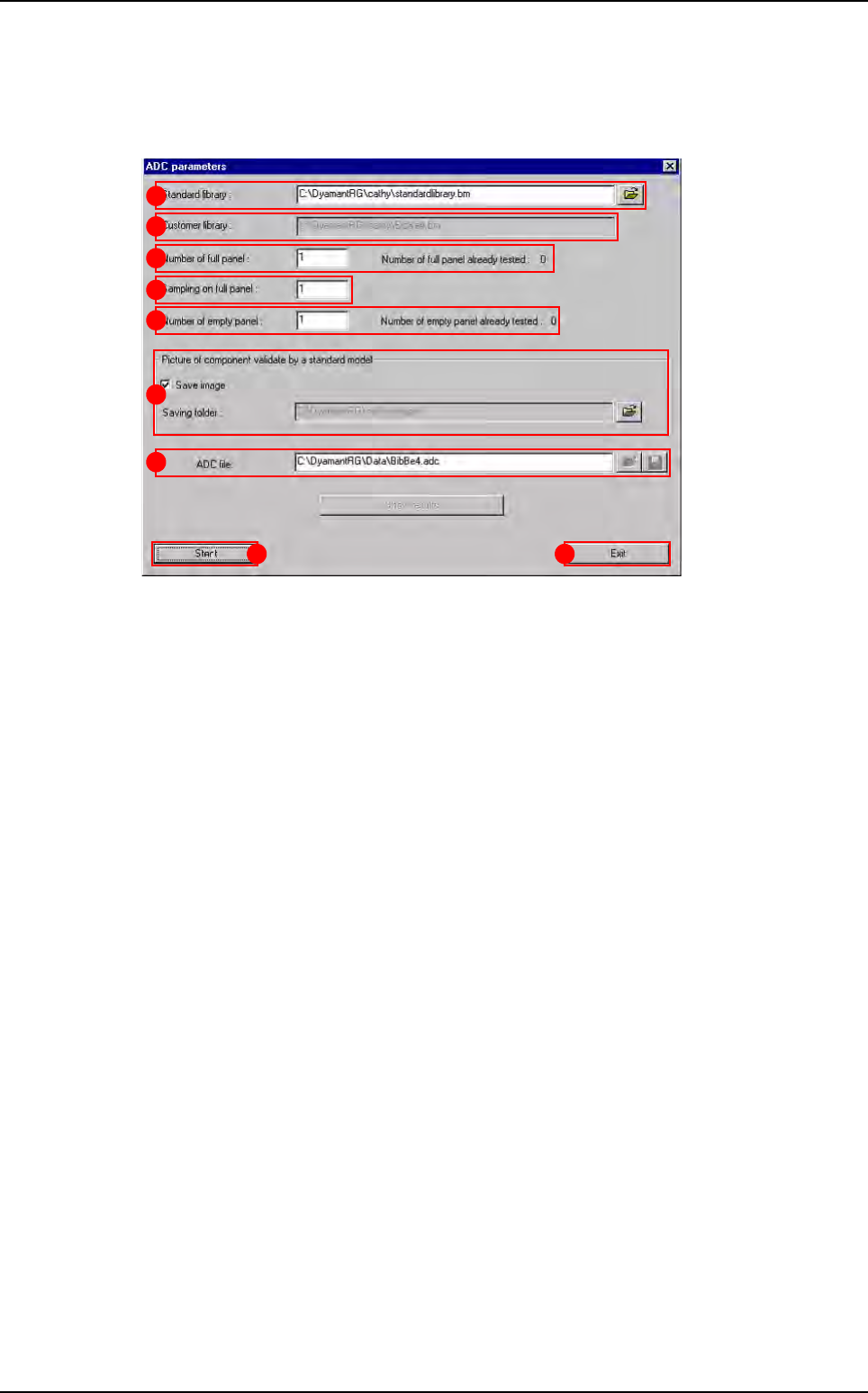
To access the ADC parameters window, go to the production screen and click Ctrl+Shift+A.
You can display this window at any time during production.
In
Standard library (A), select the standard library to use.
The
Customer library (B) comes automatically from the .tst file.
In
Number of full panel (C), enter the total number of full panels to use for ADC calculation.
In
Sampling on full panel (D), enter the sampling on production boards for full panels.
Ex: 1 board on 10 will be used for ADC data collection.
In
Number of empty panel (E), enter the total number of empty panels needed to run ADC
(to check false acceptances).
In
Picture of component validate by a standard model (F) section tick Save image if a
model from the standard library validates a component, to check if it is a good acceptance or
not. Same for empty boards to check false acceptance. In
Saving folder, select the folder
to save images.
In
ADC file (G), load an existing ADC file and complete it with new data. You can save the
ADC file with a new name.
After setting all the needed information, press
Start (H) button to launch the ADC mode.
If you select
Exit ( I ), you will discard the changes.
A
B
C
D
E
F
H I
G
Auto Defect Correction (ADC)
Optimization
12 - 16 Vision 2007 4.10 User Manual Rev 01
12.3.5 ADC in production
When you start the ADC mode, some messages tell you which step is running:
Load empty panel,
Load full panel,
ADC finished.
If you want to check how many boards you still need to run, do a Ctrl+Shift+A to see the ADC
parameters window.
12.3.6 Results
After recording boards, press Show results button to access to the calculated values.
You have the list and the status of each model used from the customer and the standard library.
Seeing the results, you can:
Remove some models from the customer library.
Or add some from the standard library.
12.3.6.1 Display
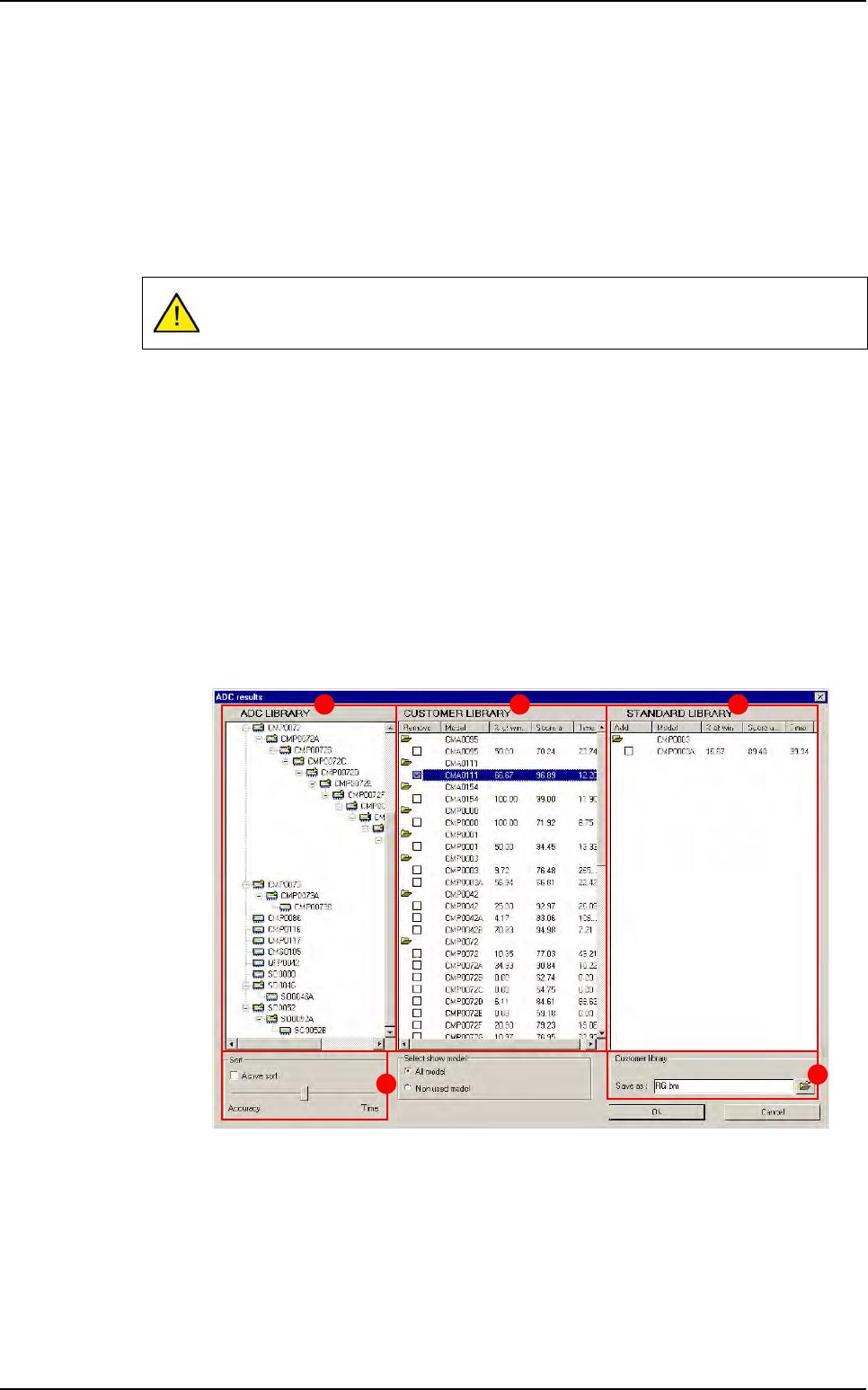
The results are displayed in 3 columns:
ADC library (A) is the list of the models of the final library. (The base of the ADC
library is the customer library and you can add or remove some models inside.)
Customer library (B) is the list of the customer models and the results from ADC.
Standard library (C) is the list of the standard models which have validated any
components and the results.
In
Sort (D) section tick Active sort to change the links arrangement on the ADC
library according to the accuracy or the execution time.
In
Customer library (E) section, you can save the ADC library and rename it.
When ADC is running, we execute every link, so, it can increase your cycle time.
A B C
D
E
Auto Defect Correction (ADC)
Optimization
Vision 2007 4.10 User Manual Rev 01 12 - 17
12.3.6.2 Interpretation
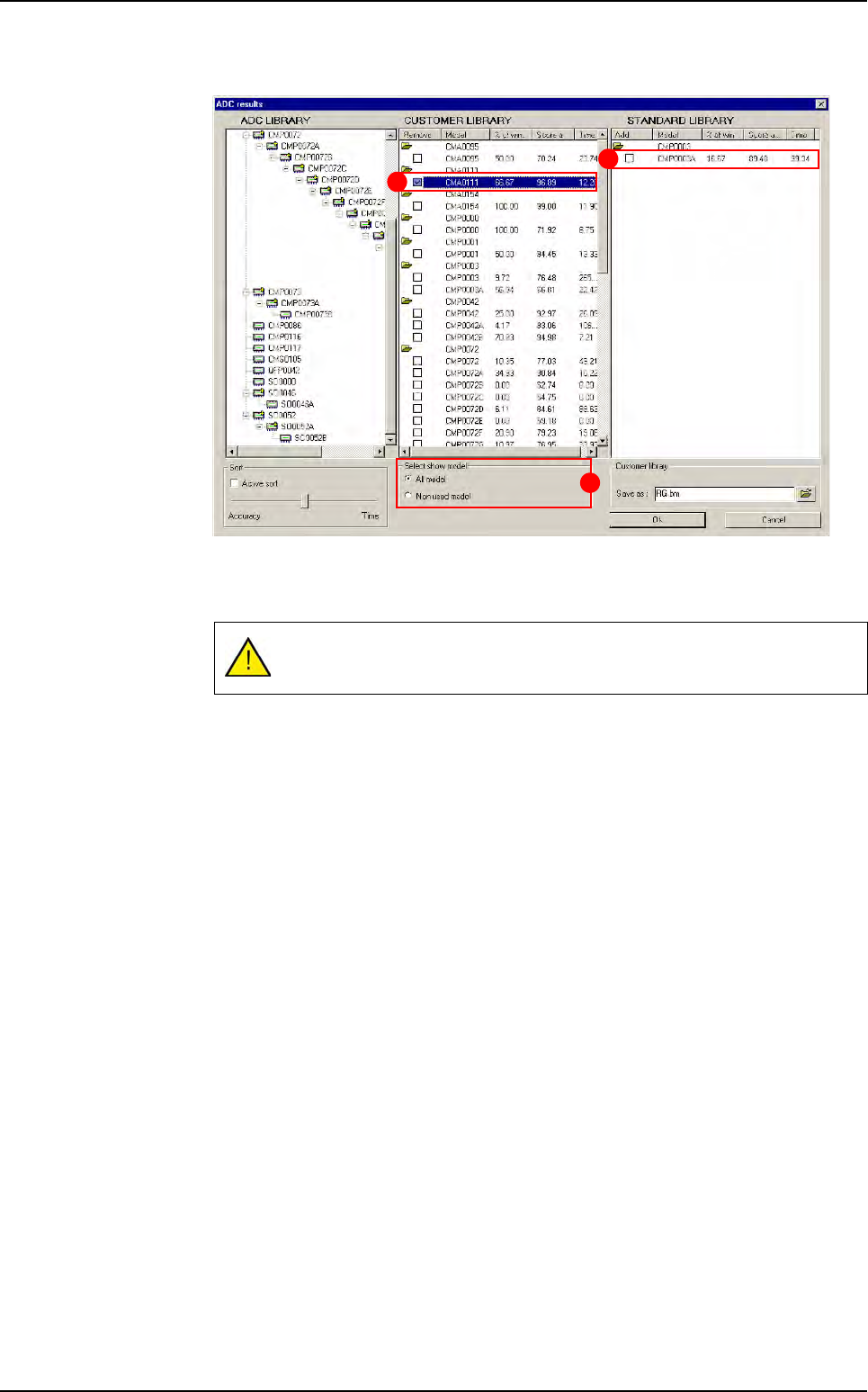
In Customer library, tick the check boxes of the Remove (A) column to remove
unused links.
In
Standard library, tick the check boxes of the Add (B) column to add models
which validate components. The model name will just change when you save the
library. (for this interface it will be the standard name)
You can access to more details if you double click on a model from the
Customer
or the Standard library.
In
Select show model (C) section, you can display all the models from the custom-
er library or only models which are never used: models which never pass any com-
ponents.
These modifications will modify the ADC library organization.
A
B
C
Auto Defect Correction (ADC)