PSV5000_OwnersManual.pdf - 第104页
Maint enance ■ Wo rkspace , He ad and Gant ry - 100 - Data I/O ■ 096 - 0 465 - 00 1C Figure 58: The Soc ke t Open er Pr ess ure Cont rol k nob with bui lt - in gauge on the Power P anel. 4. At the Power P anel on the lef…
Workspace, Head and Gantry Socket Adapters and Actuation
PSV5000 Owner’s Manual - 99 -
running. A job must be finished before turning OFF compressed air or electrical
power. Wait for the gantry to park before turning OFF.
1. If a job is running, Pause or Finish it.
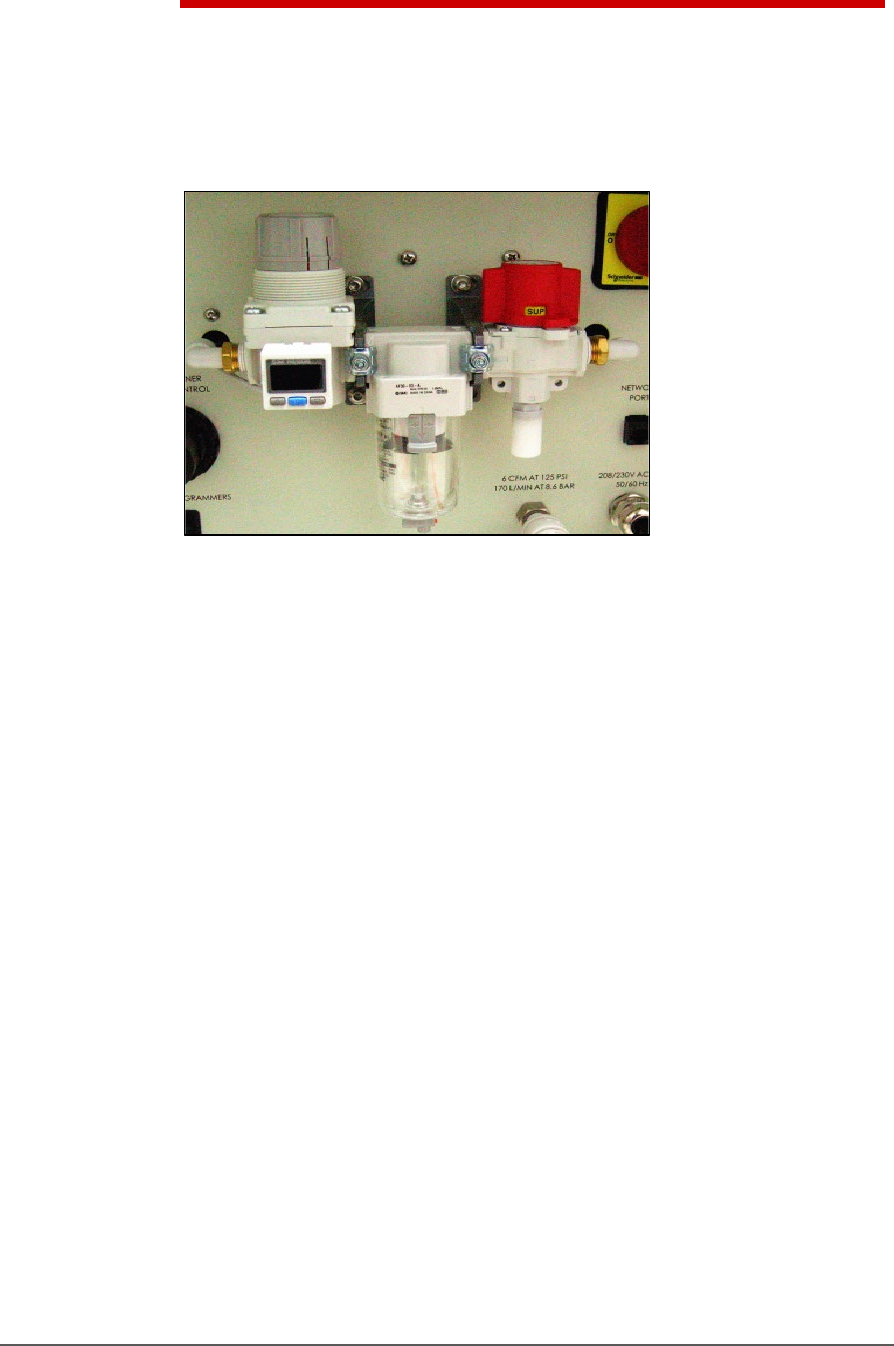
2. On the Power Panel, rotate the valve clockwise to turn OFF the input
air; it is off when the lock rings line up. See the figure below.
Figure 57: Input air regulator/filter on the Power Panel (on the left
side of the machine). When the lock rings on the valve line up,
the air supply to the PSV5000 Machine is OFF.
3. (Optional) Paddle lock the air shutoff valve.
ADJUSTING THE SOCKET ACTUATOR AIR PRESSURE ON THE PROGRAMMERS
Socket Actuators are built into the FlashCORE programmers on
PSV5000. Socket actuation is controlled by air pressure. If Socket
Actuators are slamming up and down loudly, or devices are bouncing, the
air pressure may be too high. If the PNP head does not properly pick or
place a device in a socket because the socket is not opening completely,
the air pressure might be set too low.
Adjust the air pressure setting as follows:
1. Finish a job if one is running.
2. Navigate to the Gantry window and click the yellow label for a
programmer that is easy to see.
3. At the Actuator Tab, click Actuate Socket ON and OFF to visually
verify performance for reference.
Maintenance ■ Workspace, Head and Gantry
- 100 - Data I/O ■ 096-0465-001C
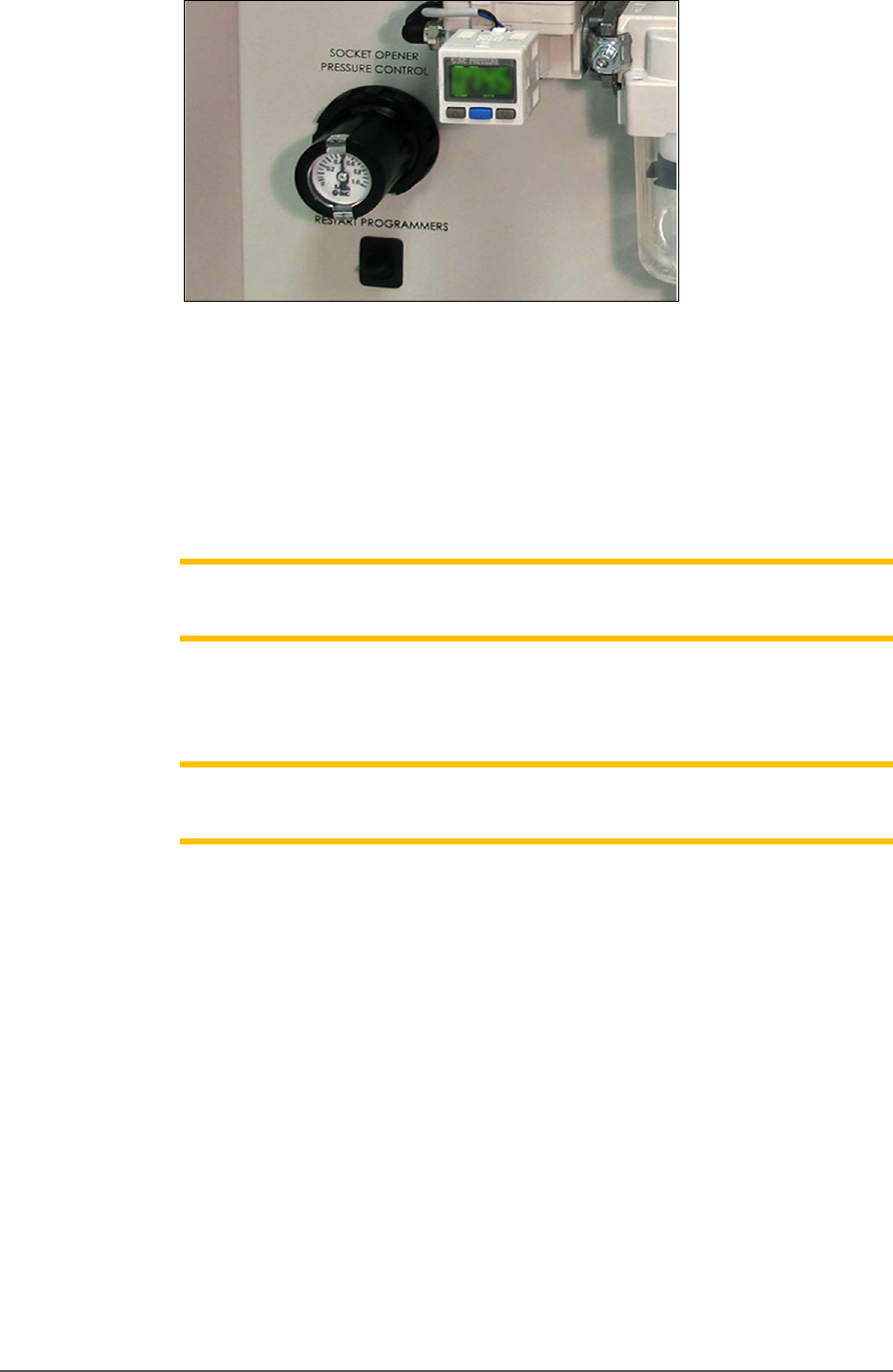
Figure 58: The Socket Opener Pressure Control knob with built-in
gauge on the Power Panel.
4. At the Power Panel on the left side, adjust the air pressure up or
down as desired by pulling the collar on the black knob out and then
rotating it.
5. Push the collar back in.
Note: The lowest pressure setting that opens the sockets all the way
reliably is recommended.
6. Cycle the sockets as before to verify the change in action.
7. Repeat if necessary.
Note: If Socket Actuator problems persist, set the actuator speed (refer to
the next heading).
ADJUSTING THE SOCKET ACTUATOR SPEED ON THE PROGRAMMERS
THE SOCKET ACTUATOR SPEED WAS SET AT THE FACTORY AND
SHOULD NOT NEED ADJUSTMENT. If it is determined that adjustment
is necessary, this procedure requires a Data I/O trained technician since
it requires having an access door open while the machine power is on.
REQUIREMENTS
• Programmer air pressure must be correct. See previous heading.
• Small flat screw driver.
TO ADJUST THE SPEED OF THE SOCKET ACTUATORS:
1. Ensure that power and air are connected and ON, and a Socket
Adapter is installed on the target programmer.
2. At the Gantry window, click the label for a programmer with the
adapter installed. Probe 1 will stop over socket 1.
Workspace, Head and Gantry Socket Adapters and Actuation
PSV5000 Owner’s Manual - 101 -
WARNING: Electric shock hazard! Opening any access doors while
the power is ON can be dangerous even when steps instruct you to
do so. Use extreme caution and do not touch any electronic
equipment except as directed.
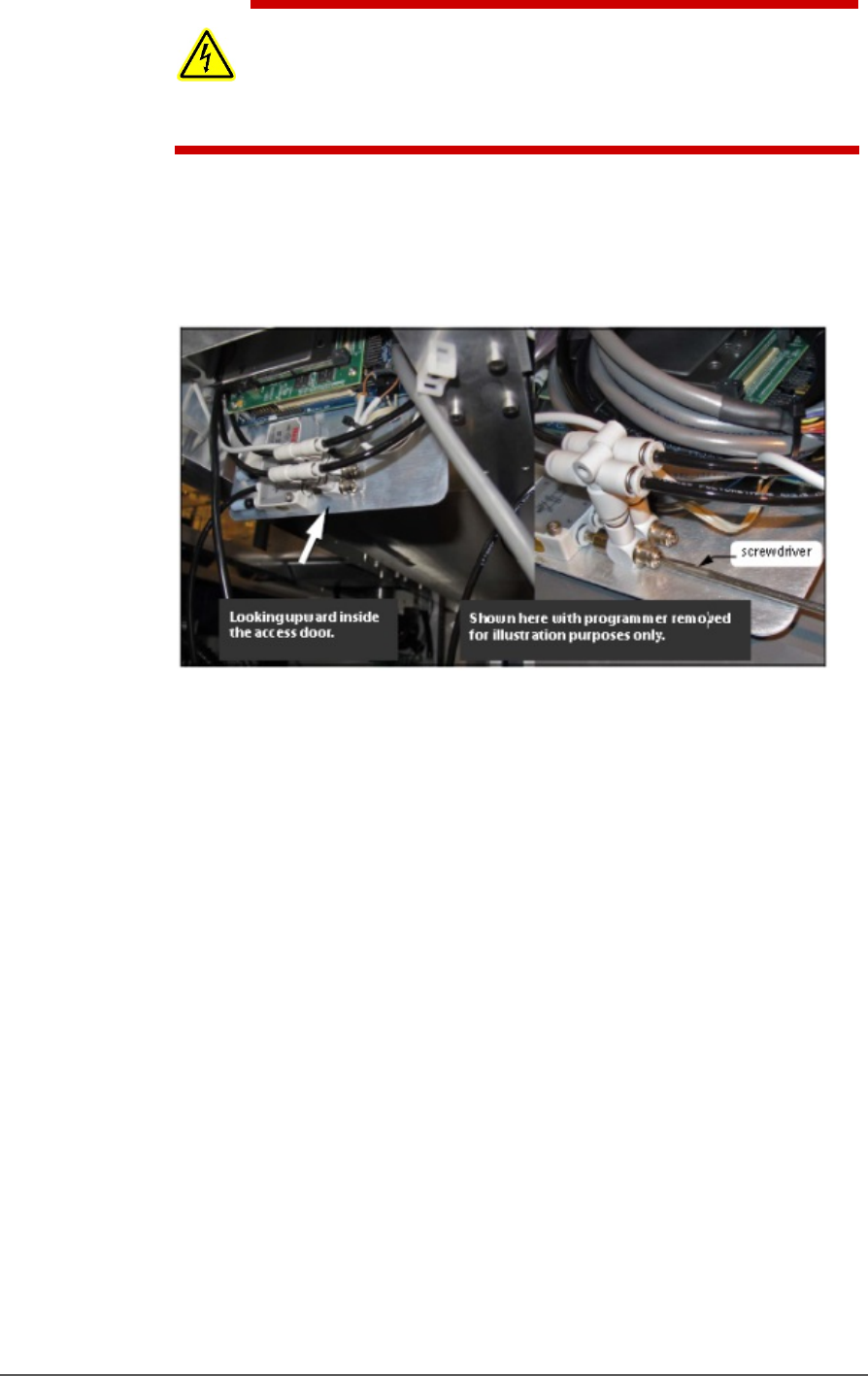
3. Open the access door nearest the target programmer and locate the
in-line air flow control for the up (sockets closed) position. Refer to
Figure 4-3.
Figure 59: Actuator flow controls (arrow). The lower one (that the
screwdriver is at) sets the UP speed. FlashCORE programmers
shown here.
4. Adjust the appropriate flow control 1/2 to 1 revolution clockwise
for slower action, or counter-clockwise for faster action.
5. Close the access door, and clear the door open warning on the
monitor.
6. At the Actuate tab of the Gantry window, click the Actuate Socket
switch to ON while listening and watching the opener. If it is too
fast it will produce a louder noise than optimum when it operates.
If it is too slow it will look slow.
7. Click Actuate Socket OFF.
8. Adjust the flow controls as necessary and repeat the test.
9. Perform the same procedure for the other flow control if necessary.