PSV5000_OwnersManual.pdf - 第16页
Introduction ■ System Description - 12 - Data I/O ■ 096 - 0465 - 00 1C Left Sid e Right Side System D escriptio n Safet y Syste ms The PSV50 00 System mov es devices from inp ut media thr ough a progr ammi ng an d option…

■ Snapshot of PSV5000 □ Setting the Language
PSV5000 Owner’s Manual - 11 -
1. Opent the ini file in Notepad or UltraEdit. (Do not use Microsoft Word
or other word processor.)
2. Find “Language Settings” section.
3. Add a semicolon to the line for the current language.
4. Remove the semicolon from the line for desired language.
Figure 2: Sample from the winAH400.ini file. The language in this
sample is set to English.
5. Save the file.
6. Restart CH700 Software for the changes to take effect.
Introduction ■ System Description
- 12 - Data I/O ■ 096-0465-001C
Left Side
Right Side
System Description
Safety Systems
The PSV5000 System moves devices from input media through a
programming and optional marking process to output media for delivery
to the next phase of the production process. The machine includes a
grounding connection to prevent static electricity (ESD).
The PSV5000 System has several safety systems to prevent personal
injury and system damage. These systems include E-Stops and safety
doors. If your system has a Laser Marking Module, it comes with a fume
extractor.
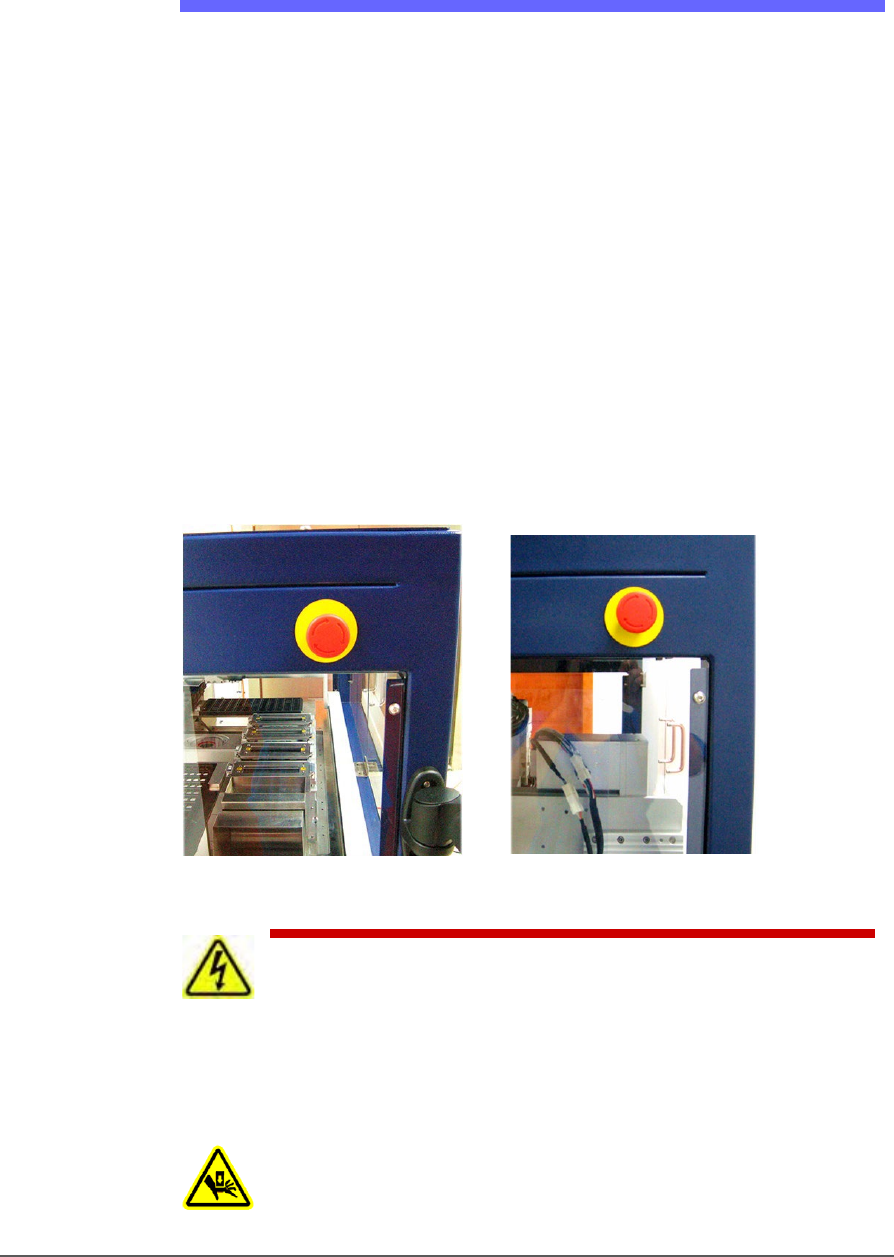
EMERGENCY STOP (E-STOP) BUTTONS
Two large, red Emergency Stop buttons are located near the top of the
PSV5000 System, one on either side of the machine. When an E-Stop
button is pressed, the gantry stops moving immediately. See caution
notice below.
Figure 3: Two Emergency Stop (E-Stop) buttons.
WARNING: Shock hazard! Pressing an E-Stop button removes
power from the motion controller (gantry) only, and power off the
Laser Marking Module. It does not remove electrical power from PSV5000
or any optional equipment installed. Turn the main power OFF before
opening metal doors.
WARNING: Pinch hazard! The E-Stop does not shut off air.
■ System Description □ Safety Systems
PSV5000 Owner’s Manual - 13 -
Socket actuators can still move down and up
SAFETY DOOR WITH INTERLOCKS
During operation, when the high-speed PNP head is processing devices,
the clear plastic doors at the workspace are closed to protect operators
from injury. Both doors have a safety interlock which stops gantry
movement if the operator forgets to first park the PNP head.
Normally, if the power is ON, the PNP head should be stopped in the
park position prior to opening a safety door.
WARNING: Possible collision hazard! The high speed and force of
the gantry can seriously harm anyone working inside the
workspace. When working within the machine workspace, moving the PNP
head must be the responsibility of only one qualified individual. All others
must stay clear of the machine controls to prevent injury to that person.
Ensure that a job is Paused or Finished, or the system power is OFF prior to
opening any safety doors.
WARNING: Shock hazard! Opening the safety doors stops
motion of the gantry only. It does not remove electrical power from the
machine or any optional equipment. Turn the main power OFF for safety
unless otherwise directed.
CAUTION: Possible product damage! Do not use solvents such as
acetone, lacquer thinner, mineral spirits, isopropyl alcohol, or any type
of abrasive compound on the safety doors. These products will damage the
safety door surfaces and ESD coating, and reduce visibility of the work area.
ELECTROSTATIC DISCHARGE (ESD) PRECAUTIONS
Devices (integrated circuits) are very sensitive to static, and could be
damaged by unintended electrostatic discharge while being handled.
The most effective way to prevent damage from ESD is to make sure a
common electric potential (ground) exists between a static-sensitive
device or component, its environment, and the operator.
Operators should wear an antistatic wrist strap (Data I/O part number
440-0021-001) connected to one of the grounding connections on the
Park Position:
The spot where the head
stops when a job is
paused or ended (near
the far right corner).
Home Position:
The far right corner of
the workspace where the
head travels to before
each job is started.
Tool Position:
Near the safety door for
easy access to the PNP
head.