00194103-01.pdf - 第66页
2 Operational safety User Manual SIP LACE F5 HM 2.10 Emissions and ergonomics of the monitor Software Vers ion SR.408.xx 03/ 2006 US Edition 66 2.9.6 Revie w This proc edure will be revi ewed and a mended as required, an…
User Manual SIPLACE F5 HM 2 Operational safety
Software Version SR.408.xx 03/2006 US Edition 2.9 Lock out and tag out procedure
65
– It shall be the responsibility of the maintenance and electrical personnel’s immediate supervi-
sor to instruct his personnel on this procedure.
– It shall be the responsibility of the Safety Officer with assistance from the Safety Committee,
Health Service Department, and the various managers and Vice-presidents to administer the
Lock Out / Tag Out Procedure.
2.9.5 Training
– Employee training
The safety regulations require training for every individual, of course every employee is not ex-
posed to the same degree of danger or is involved with Lock Out/Tag Out as others are. So
extensive training is not necessary for everyone.
– To determine how much training to provide for each worker, the employees are divided into
three groups. Each group has its own level of training.
– Authorized employees.
These workers actually install the locks and tags and do the preventive maintenance or service
work. So they must know the most about controlled energy. First, they must be able to recog-
nize all energy sources and measure the amount of energy. Authorized employees must look
for energy sources out of the realm of the obvious. These energy sources include electrical,
mechanical, hydraulic, pneumatic, chemical, thermal and gravitational. Once these workers
can recognize all energy sources they must be taught how to isolate, control, and release the
energy without any risk.
– Affected employees
These are workers who operate the machinery or equipment that may be de-energized. Other
employees who may be affected include those who work in an area that contain equipment that
may be locked/tagged out. These employees have to be instructed about the nature of the en-
ergy control program. They must know why lock/tag out is important, what tags and locks look
like and why they must not remove tags or locks.
– All others
As the name implies, any employee who is not affected or authorized fits into this category.
There employees include office personal, managers, and upper management. Although they
do not have a direct relationship to the machinery being locked or tagged, they have to receive
some training.
– To evaluate the lock/tag out procedure, the safety department will conduct periodic inspections.
As part of the inspection the safety department will document that all facets of the procedure
are followed. The safety department will follow up with formal classroom review or retraining of
the LO/TO procedure.
2 Operational safety User Manual SIPLACE F5 HM
2.10 Emissions and ergonomics of the monitor Software Version SR.408.xx 03/2006 US Edition
66
2.9.6 Review
This procedure will be reviewed and amended as required, and at least once a year.
2.10 Emissions and ergonomics of the monitor
2.10.1 X-ray radiation
The X-ray radiation generated in the monitor is adequately shielded by the intrinsically safe cath-
ode-ray tube. The local emissions are less than 1 *S/h (micro-Sievert per hour). The accelerating
voltage is limited by the device to a maximum of 26 kV. 2
The monitor conforms to the German Directive for protection against harmful X-ray radiation. The
X-ray emissions from the monitor conformed to the DHHS Rules 21 CFR, subsection J on the date
of manufacture and to the FCC Rules, part 15. 2
2.10.2 Ergonomics and electromagnetic emissions
The monitor fulfills the conditions for ergonomics (to ISO 9241-3) and safety (to EN 60950). 2
The low-frequency electromagnetic emissions fall below the MPR II guidelines issued by the
Swedish Radiation Institute in Stockholm. 2
User Manual SIPLACE F5 HM 2 Operational safety
Software Version SR.408.xx 03/2006 US Edition 2.11 ESD guidelines
67
2.11 ESD guidelines
2.11.1 What does ESD mean?
Almost all of the modules in use today are equipped with highly integrated MOS blocks and com-
ponents. The manufacturing techniques used mean that these electronic components are ex-
tremely sensitive to overvoltage and thus to electrostatic discharge. 2
The abbreviation for such electrostatically-sensitive groups of components is 'ESD'
(Electrostatic
S
ensitive Device). ’ESD’ is used internationally. 2
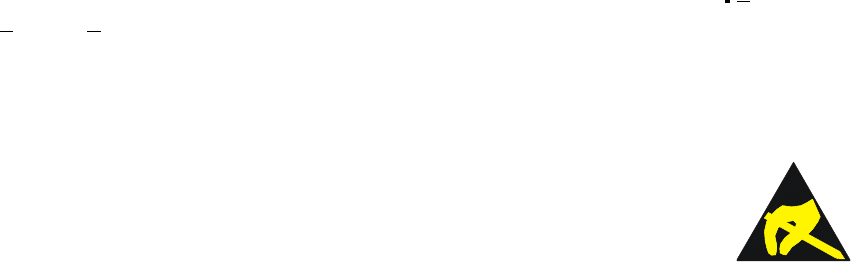
The following symbol on cabinet rating plates, racks or packaging indicates that components
which are sensitive to electrostatic discharge have been used and thus that the modules con-
cerned are also touch-sensitive. 2
ESDs can be destroyed by voltages and power levels that are far below the level
that can be perceived by humans. Such voltages occur if a person touches a com-
ponent or module without earthing themselves. Components that are exposed to
such overvoltages do not generally appear to be defective immediately - incorrect
behavior starts after the component or module has been in operation for some
time. 2
2.11.2 Important measures to protect against static charging
– Most plastics can easily become charged and must therefore be kept away from at-risk com-
ponents.
– Always ensure that people, the workplace and packaging are safely earthed when handling
electrostatic sensitive components.
2.11.3 Handling ESD modules
Do not touch electronic modules unless it is absolutely essential to do so in order to carry out other
work. If it is necessary, make sure that you do not touch the pins or printed conductors when you
pick up flat modules. 2
Do not touch components unless 2
– You are constantly earthed by an ESD wrist strap or
– You are wearing ESD shoes or ESD shoe earthing strips on an ESD floor.
Always discharge yourself before you touch an electronic module. To do this, simply touch a con-
ductive and earthed object immediately before you touch the module (such as unpainted parts of
a switch cabinet, a water pipe, etc.). 2