00197279-03_SM_Glue-Feeder_EN.pdf - 第5页
Introduction 1.1.1 Conventions for the use of safety instructions Safety Instructions Service Manual SIPLACE Glue Feeder 5 1 1 I n t r o d u c t io n Introduction This manual describes the replacem ent of spare parts on …
Contents
4 Service Manual SIPLACE Glue Feeder
3.12.2 Fitting the Dispenser Nozzle 36
3.13 Jet Block (Spare Fluidic) 38
3.13.1 Removing the Jet Block 38
3.13.2 Fitting the Jet Block 40
3.14 Guide Bushing 42
3.14.1 Removing the Actuator O-Ring and Guide Bushing 42
3.14.2 Inserting the Actuator O-Ring and Guide Bushing 44
3.15 Jet Valve P-DOT 46
3.15.1 Removing the Jet Valve P-DOT 46
3.15.2 Fitting the Jet Valve P-DOT 50
3.15.3 Jet Valve P-DOT - Setting the Jet Plunger 56
3.15.3.1 Checking the Jet Plunger Setting 56
3.15.3.2 Setting the Jet Plunger 58
3.16 Pressure Control Valves 62
3.16.1 Pressure Control Valve (Dispenser) 62
3.16.1.1 Removing the Pressure Control Valve (Dispenser) 62
3.16.1.2 Fitting the Pressure Control Valve (Dispenser) 63
3.16.2 Pressure Control Valve (Cartridge) 64
3.16.2.1 Removing the Pressure Control Valve (Cartridge) 64
3.16.2.2 Fitting the Pressure Control Valve (Cartridge) 65
3.17 Manometer 66
3.17.1 Manometer (Dispenser) 66
3.17.1.1 Removing the Manometer (Dispenser) 66
3.17.1.2 Fitting the Manometer (Dispenser) 69
3.17.2 Manometer (Cartridge) 71
3.17.2.1 Removing the Manometer (Cartridge) 71
3.17.2.2 Fitting the Manometer (Cartridge) 71
3.18 Solenoid valve 72
3.18.1 Removing the Solenoid Valve 72
3.18.2 Fitting the Solenoid Valve 74
3.19 Regulator Holder Assembly 77
3.19.1 Removing the Regulator Holder 77
3.19.2 Fitting the Regulator Holder 78
3.20 Plug-in Fitting 79
3.20.1 Removing the Plug-in Fitting 79
3.20.2 Fitting the Plug-in Fitting 80
3.21 Coupler Plug 82
3.21.1 Removing the Coupler Plug 82
3.21.2 Fitting the Coupler Plug 83
3.22 Cartridge Holder Assembly 85
3.22.1 Removing the Cartridge Holder 85
3.22.2 Fitting the Cartridge Holder 86
3.23 EDIF Secondary Assembly 87
3.23.1 Removing the EDIF 87
3.23.2 Fitting the EDIF 88
3.24 Handle assembly 89
3.24.1 Removing the Handle Assembly 89
3.24.2 Fitting the Handle Assembly 92
Introduction
1.1.1 Conventions for the use of safety instructions Safety Instructions
Service Manual SIPLACE Glue Feeder 5
1
1 Introduction
Introduction
This manual describes the replacement of spare parts on a SIPLACE® glue feeder.
1.1
1.1 Safety Instructions
Safety Instructions
Nonobservance of these safety instructions may cause injury to personnel and damage to the machine
1.1.1
1.1.1 Conventions for the use of safety instructions
Conventions for the use of safety instructions
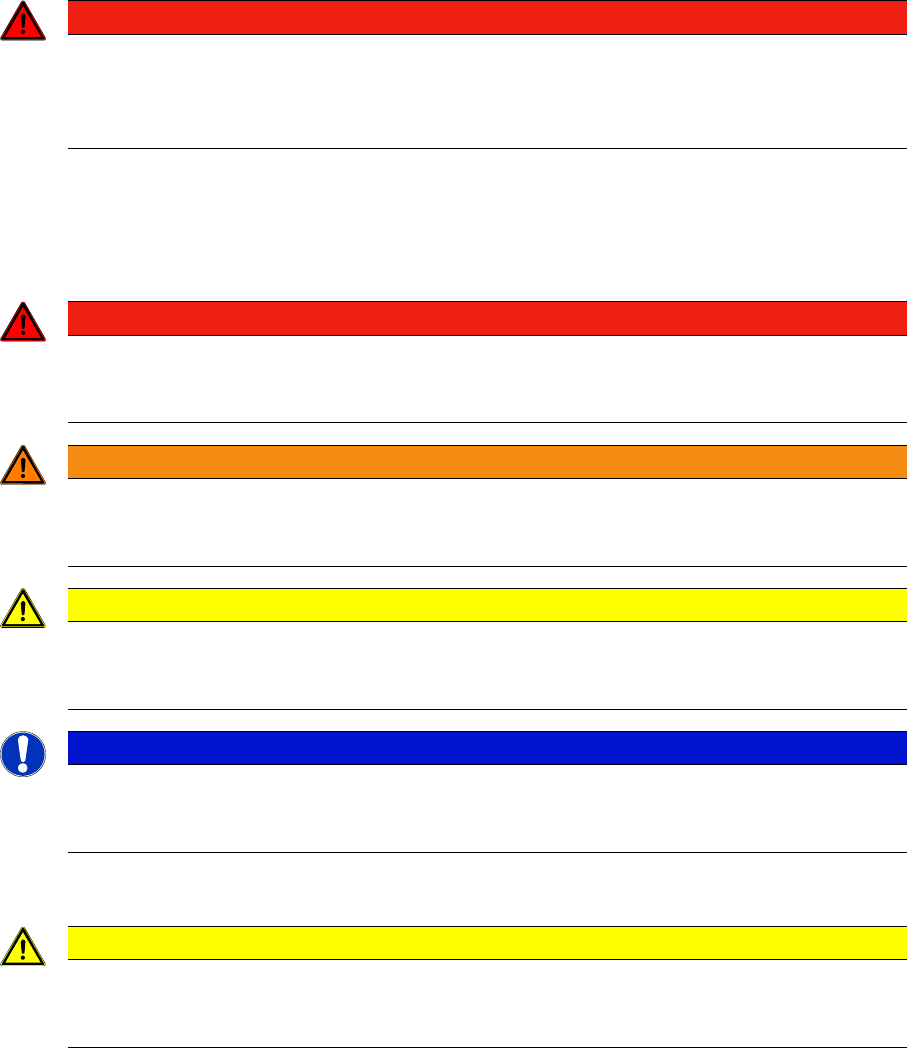
This manual contains notes that must be observed to guarantee your personal safety and to avoid dam
-
age to equipment. These notes are highlighted by warning triangles and are indicated as follows accord
-
ing to the level of risk:
1.1.2
1.1.2 Safety Instructions on Hazardous Materials
Safety Instructions on Hazardous Materials
DANGER
Nonobservance of these safety instructions may cause injury to personnel and damage to the
machine!
► Please observe the safety instructions in the user manual of the relevant machine for all
work!
DANGER
Definition
For the purposes of this manual, this indicates that fatal or severe injuries or considerable dam
-
age to property will occur if this hazard warning is not observed.
WARNING
Definition
For the purposes of this manual, this indicates that fatal or severe injuries or considerable dam
-
age to equipment may occur if these warning instructions are not followed.
CAUTION
Definition
For the purposes of this manual, this indicates that minor injuries or damage to property may
occur if this caution is not observed.
NOTICE
Definition
For the purposes of this manual, this note provides information about the product or indicates
a part of the manual that requires particular attention.
CAUTION
Observe the safety data sheets
Observe the applicable safety data sheet, when handling hazardous materials (e. g. Loctite
241, ethanol).
Introduction
Other Instructions 1.2.1 Environmentally-Friendly Disposal of Materials and Components
6 Service Manual SIPLACE Glue Feeder
1.2
1.2 Other Instructions
Other Instructions
1.2.1
1.2.1 Environmentally-Friendly Disposal of Materials and Components
Environmentally-Friendly Disposal of Materials and Components
SIPLACE products are manufactured using only materials and parts that can be easily separated and
disposed of in an environmentally-friendly way.
1.2.2
1.2.2 Use of Original SIPLACE Accessories and Spare Parts
Use of Original SIPLACE Accessories and Spare Parts
Only use original spare parts and authorized accessories. The use of other parts will affect safety and
will invalidate the liability for any consequential damage.
1.2.3
1.2.3 Information About This Service Manual
Information About This Service Manual
If you should have any questions during the service work, please contact the SIPLACE customer hotline
directly (0049) 089 20800 48642 or send an e-mail to: hotline.siplace@asmpt.com.
1.2.4
1.2.4 ESD Guidelines
ESD Guidelines
1.2.4.1
1.2.4.1 Definition of ESD
Definition of ESD
NOTICE
Observe the applicable regulations
The company operating the system has sole responsibility for the proper, environmentally-
friendly disposal of machines, working materials, consumables and wear parts.
► Please observe your national statutory provisions for waste disposal and environmental
protection.
WARNING
Additional qualifications required
The service work described in this manual may only be performed by specially trained service
technicians, with appropriate qualifications and expertise.
Almost all of the modules in use today are equipped with highly integrated MOS blocks and compo
-
nents. The manufacturing techniques used mean that these electronic components are extremely sen
-
sitive to overvoltage and thus to electrostatic discharge.
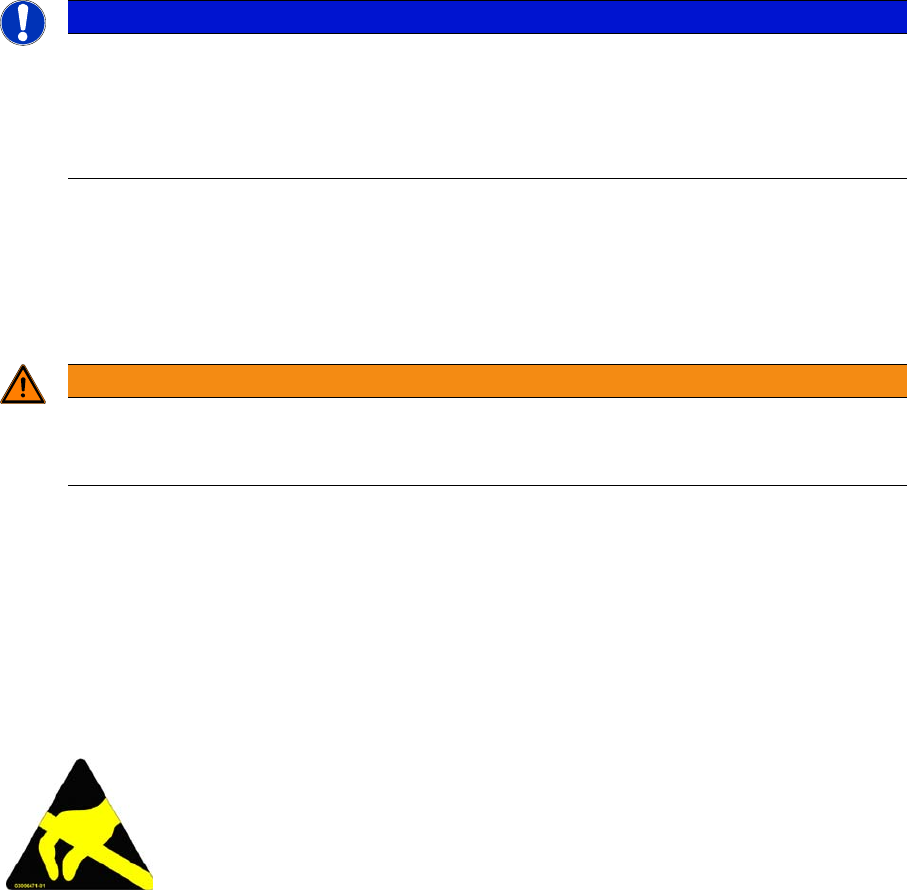
The abbreviation for such modules is 'ESD' (Electrostatic Sensitive Device). This is
used internationally, although the German abbreviation 'EGB' may also be seen. The
following symbol on cabinet rating plates, racks or packaging indicates that compo
-
nents which are sensitive to electrostatic discharge have been used and thus that the
modules concerned are also touch-sensitive.
ESDs can be destroyed by voltages and power levels that are far below the level that can be perceived
by humans. Such voltages occur if a person touches a component or module without earthing them
-
selves. Components that are exposed to such overvoltages do not generally appear to be defective im
-
mediately - incorrect behavior starts after the component or module has been in operation for some
time.