00191369-02.pdf - 第117页
User Manual HS-50 3 Introduction and Basic Concepts Software Vers ion SR.501.xx 12/99 Issue US 3.3 User Interface - V iews and Menus 117 t I I t Setup F2 3 The setup for a feede r lo catio n is di spla yed i n tabular fo…
3 Introduction and Basic Concepts User Manual HS-50
3.3 User Interface - Views and Menus Software Version SR.501.xx 12/99 Issue US
116
t IIt
Shut down computer... 3
All applications are closed without any files which may have been processed being saved and the
station computer is shut down. 3
NOTE
This menu option is not available at the "Operator" access level. 3
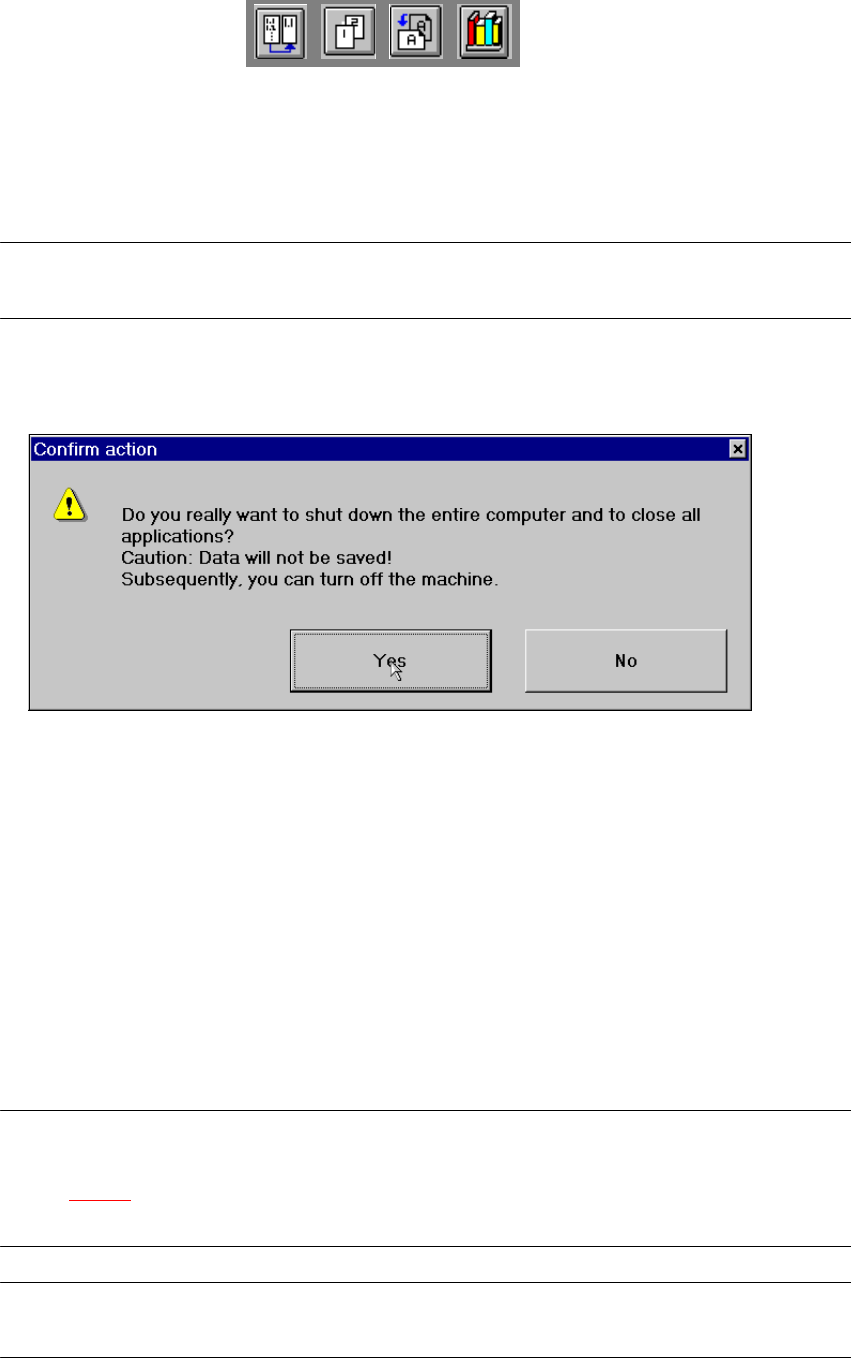
Å Click the menu item Shut down computer...
The following dialog box is opened.
3
Å Click Yes if you want to terminate your work.
The station computer is shut down.
Å Switch off the machine at the main switch.
3.3.2.2 "View" Menu
The "View" menu contains the options for calling the placement functions, single functions and vi-
sion functions. It is also used to start the SITEST test program and call the view for running the
GEM functions. 3
Å Click the required menu option.
The screen display is switched to the corresponding view in which you can then call the nec-
essary functions.
NOTE
All the options in this menu can also be called by clicking the corresponding toolbar button (see
section 3.2.2.2
) or by pressing the corresponding function key. If shortcuts have been defined,
these can also be used. 3
NOTE
The 3 menu options below belong to the group of placement functions. 3
User Manual HS-50 3 Introduction and Basic Concepts
Software Version SR.501.xx 12/99 Issue US 3.3 User Interface - Views and Menus
117
t IIt
Setup F2 3
The setup for a feeder location is displayed in tabular form. It can be called separately for each of
the four locations.
The procedure is described in more detail in Chapter 4
"Placement Functions". 3
Errors F3 3
Errors are differentiated by type and each error type is presented in a separate table. You can call
separate tables for track errors, conveyor errors, machine errors and general errors.
The last error to have occurred is always displayed at the top of the table. Identical errors are cu-
mulated in the error counter ("#E" column).
The procedure is described in more detail in Chapter 4
"Placement Functions". 3
Feeders F4 3
Here you can use a variety of functions to display and fill empty tracks for linear feeders or to dis-
play and modify inventory levels for trays and wafflepack changers.
The procedure is described in more detail in Chapter 4
"Placement Functions". 3
3
NOTE
The following 6 menu options belong to the group of single functions.
The single functions are used to execute specific actions following fatal errors as well as to set up
and test the machine since they allow you to address the various functional modules in a defined
manner.
Execution of the single functions is described in Chapter 5 "Single Functions". 3
Gantry 1 F5 3
This allows you to call the single functions for gantry 1. These functions can be used, for example,
to test the revolver head functions. 3
NOTE
Each of the 4 gantries can be addressed separately.
The functions are identical for all the gantries. 3
Gantry 2 F6 3
Single functions for gantry 2 3
3 Introduction and Basic Concepts User Manual HS-50
3.3 User Interface - Views and Menus Software Version SR.501.xx 12/99 Issue US
118
t IIt
Gantry 3 Shift 5 3
Single functions for gantry 3 3
Gantry 4 Shift 6 3
Single functions for gantry 4
Transport 2 F7 3
Single functions for PCB conveyor 2 (= left conveyor track in the case of twin conveyors) 3
NOTE
The single functions for Conveyor 2 cannot be called unless twin conveyors are configured.
The functions are identical to the functions for Conveyor 1. 3
Transport 1 F8 3
Used to call the single functions for PCB conveyor 1 (= right conveyor track in the case of twin
conveyors). These are used to test and set the functional modules for PCB conveyor as well as
to set the conveyor width. 3
NOTE
The next two menu options belong to the group of vision functions.
These functions are used to teach and test fiducials, measure components and change package
form data.
The vision functions cannot be executed at the "Operator" access level. 3
Teach fiducial F9 3
This menu item is used to call the functions for the processing of fiducials for PCB position detec-
tion.
For a more extensive description of the procedure refer to Chapter 6
"Vision functions". 3
Test component F10 3
This menu item is used to call the functions for the processing of package forms for component
centering.
For a more extensive description of the procedure refer to Chapter 6
"Vision functions". 3