YSD_Users_E.pdf - 第243页
5-54 5 Creating the board data 6.3 Shape parameters Shape parameters 64533-N7-00 Shape T ype T he Shape T ype can be selected from the following 5 types. F rom the drop-down list, select the type that matches the mark be…
5-53
5
Creating the board data
6.2 Basic parameters
[Database] button
2 1
Mark
Basic parameters
3
4
5
64531-N7-00
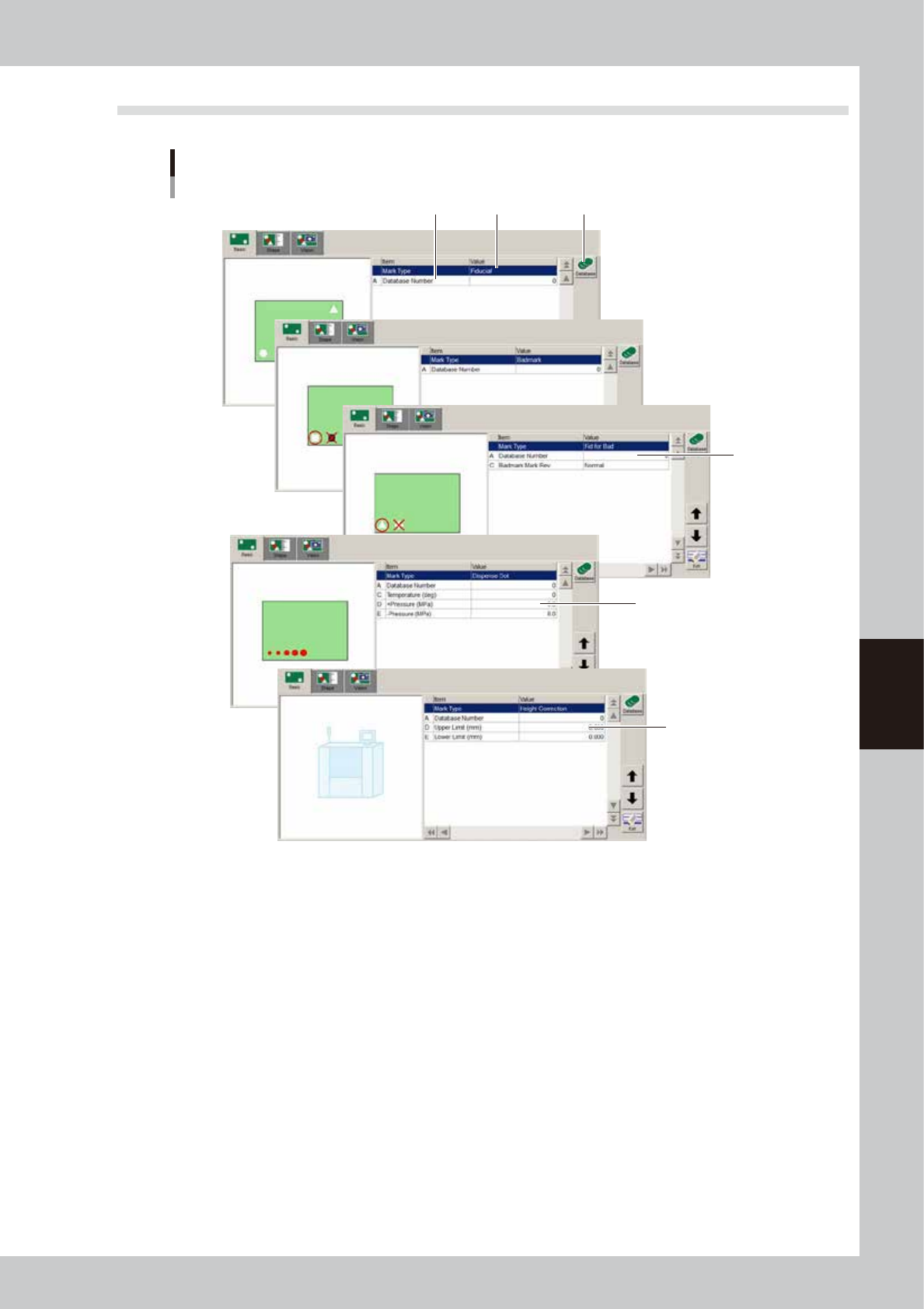
1. Mark Type
Select the mark type from the dropdown list.
The item selected here will be displayed on the Mark Type column in the upper grid.
2. Database Number
Shows the database number when the parameter values were copied from the database.
When you want to copy the parameter values from the database, press the [Database] button to open the database list.
Then select the copy source data and press the [Set] button to make a copy.
3. Badmark Mark Rev
Select “Normal” or “Reverse”. When “Normal” is selected, the machine continues operation as long as no badmark is
detected. When “Reverse” is selected, the machine performs work when a badmark is detected.
4. Temperature, +Pressure, -Pressure
Use these fields to make a note.
5. Upper Limit, Lower Limit
Set the upper and lower limits of the range in which the measurement result is effective. Enter these limits in millimeters.
The downward direction is positive (+) and the upward direction is negative (-), just as with the head coordinate system.
5-54
5
Creating the board data
6.3 Shape parameters
Shape parameters
64533-N7-00
Shape Type
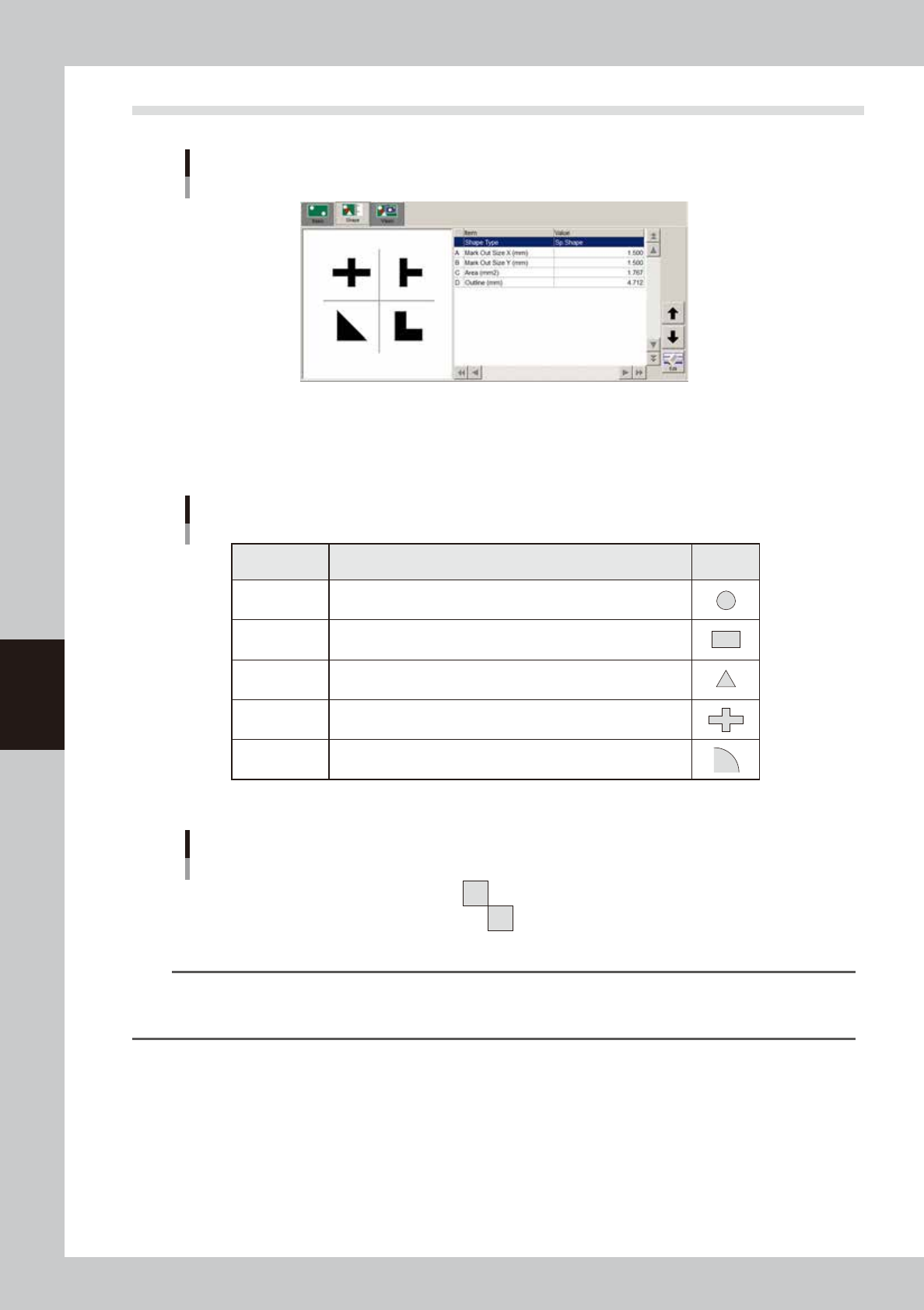
The Shape Type can be selected from the following 5 types.
From the drop-down list, select the type that matches the mark being used.
Setting Description Example
Circle
Square
Triangle
Sp. Shape
Corner
Select to detect a circular mark.
Select to detect a square mark.
Select to detect an equilateral triangular mark.
Select to detect a special mark other than above.
Select to detect a corner of a pattern as a mark.
Shape Type settings
63537-N7-00
Example of special mark
63538-N7-00
TIP
If you use a special mark composed of two or more objects, set the Algorithm Type parameter (described later) to
“Pattern”. In this case, the “Shape” parameter is ignored during recognition, so you can set this parameter to any
type. (For more details, see “6.6 Pattern matching” in this chapter.)
5-55
5
Creating the board data
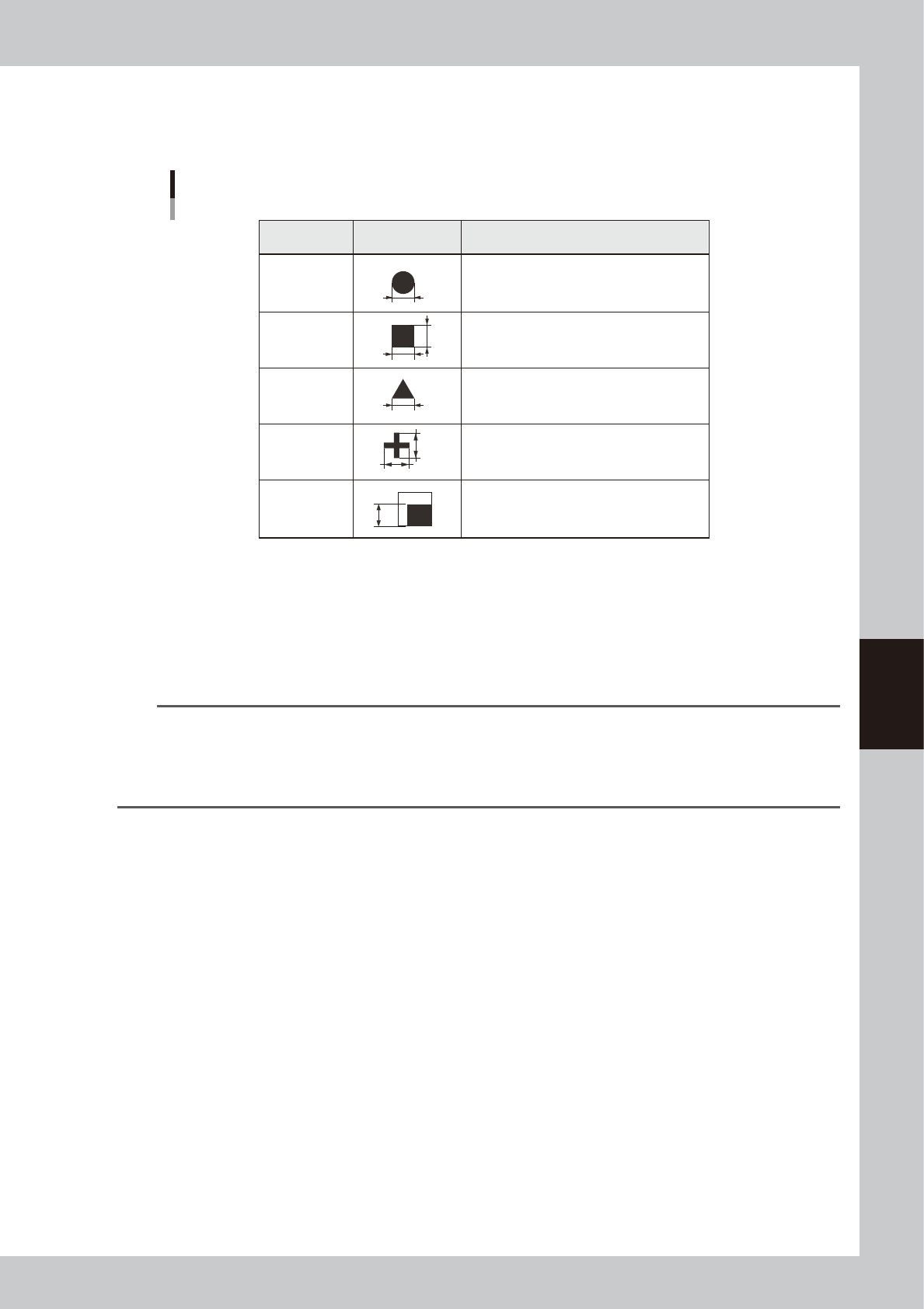
A, B: Mark Out Size
Referring to the table below, enter the correct value in the mark size. This parameter is not displayed when "Mark Type"
of the Basic parameters is set to "Badmark". The Search Area parameters appear instead.
Example Mark Out Size settingShape Type
X
X
Y
Y
Enter the diameter.
Enter the length of each side.
Enter the length of one side.
Enter the X length for the MarkOutSize X, and
the Y length for the MarkOutSize Y.
Enter the length of the shorter side displayed
within the search area.
Circle
Square
Triangle
Sp. Shape
Corner
Mark Out Size settings
63539-N7-00
C: Area (mm
2
)
This parameter is displayed only when the Shape Type parameter is set to “Sp. Shape”. Enter the area of the mark in mm
2
.
D: Outline (mm)
This parameter is displayed only when the Shape Type parameter is set to “Sp. Shape”. Enter the perimeter of the mark in
mm.
n
NOTE
A recognition error may occur due to environmental conditions such as illumination. In such cases, enter a larger
value than previously used for “Tolerance” of the Vision parameters, or set the tolerance to 100%, then perform the
vision test in the Mark Adjust mode and enter the obtained data on the area and perimeter. (The mark area and
perimeter values are displayed after the vision test is complete.) Return the tolerance to the original value after the
data is obtained.