YS24X_Mainte_E - 第5页
ii Safety instructions 1. Safety T o ensure that the machine you purchased is used safely and correctly , always comply with the instructions and rules in this manual regarding safety . However this manual cannot cover a…

i
Safety instructions
CE marking
This equipment conforms to the EU Machinery Directive 2006/42/EC (description A1 below) and EMC
Directive 2014/30/EU (description A2 below).
However, this equipment does not bear CE marking if a custom order item was installed.
A1.
Cautions regarding the official language of EU countries and the language used in operation
manuals, CE declarations, operation screen characters, and warning labels when this equipment is
installed in an EU country.
• All materials except warning labels are written in English only.
n
NOTE
Warning labels only have pictographs or else include warning messages in English, Chinese, Korean and Japanese
language.
A2.
EMC description
• Electromagnetic immunity (Immunity)
Complies with test standards as specified by EN 61000-6-2.
• Electromagnetic emissions (Emission)
Complies with test standards for ISM category: Group 1, Class A, as specified by EN 55011.
n
NOTE
Class A equipment is intended for use in industrial environments. If used in other environments, ensuring
electromagnetic compatibility (EMC) might be difficult. Refer to EN 55011 standards for detailed information.

ii
Safety instructions
1. Safety
To ensure that the machine you purchased is used safely and correctly, always comply with the instructions
and rules in this manual regarding safety. However this manual cannot cover all items regarding safety in
detail. So it is extremely important that the operator or person handling the machine make correct decisions
regarding safety.
1.1 To ensure safety
To maintain the safety of the operator or person working with this machine, it is essential that it (including
external parts feeders) be installed correctly in compliance with the safety standards and conditions of that
country.
Complying with the safety regulations and laws of that country is the responsibility of the customer who
purchased this machine. The supervisor of this machine must take responsibility to ensure all measures have
been taken for machine safety.
1.1.1 Defining safety
1. Safety has priority over all other operations.
2. Safety is more important than any other task.
3. Safety is the foundation for work efficiency.
4. Safety begins with maintaining (keeping it neat and orderly) the work environment.
1.1.2 Causes of injuries and accidents
Most accidents are not something that occurs but something that are caused. So it is important to make an
effort NOT to cause accidents.
n
Hazardous actions
• Ignoring causes of accidents
• Working or operating equipment in cramped locations
• Working in locations or positions where safety cannot be ensured
• Unsafe machine operation and using equipment whose safety cannot be ensured
• Working or operating equipment at speeds where safety cannot be ensured
• Working or operating machines with safety equipment removed
• Performing work or tasks on top of a machine currently in operation
• Playing around or goofing off during work
• Performing maintenance or inspections without wearing safety gear
1.2 Using safety gear
Always wear safety gear when operating or servicing equipment.
Helmet : Use during maintenance work
Safety glasses or goggles : Use around light harmful to eyes and when applying lubricant and when handling organic
solvents.
Respiratory gear : Use when handling organic solvents
Safety gloves : Use when applying lubricant and when handling organic solvents.
iii
Safety instructions
1.3 Restrictions on machine use
1.3.1 Defining the operator and service personnel
c
CAUTION
Only the operator and service personnel having sufficient knowledge of this machine should handle this machine.
Operator:
The operator is someone who has been trained by us in machine operation, has a thorough knowledge of the machine
operation manual and demonstrates adequate knowledge of machine operation and safety.
Main tasks of the operator include pre-operation checks, operation (component mounting) and making setups
(changeovers). The machine is only used in normal operating mode.
Service personnel:
The service personnel are those trained by us in machine maintenance as well as safety instruction and demonstrate a
thorough knowledge of safe handling of the machine according to the type and location of machine operation. They must
also understand hazardous sections of the machine and residual risks.
Main tasks of the service personnel include machine maintenance, repair, adjustment and management of the system.
The service personnel may make changes to the machine settings and operation in factory adjustment mode.
1.3.2 Restricting machine operation with passwords
Machine operating levels usable by the operator and service personnel (mentioned above) must be restricted
by password. This prevents the operator and service personnel from using the machine at a higher level than
allowed.
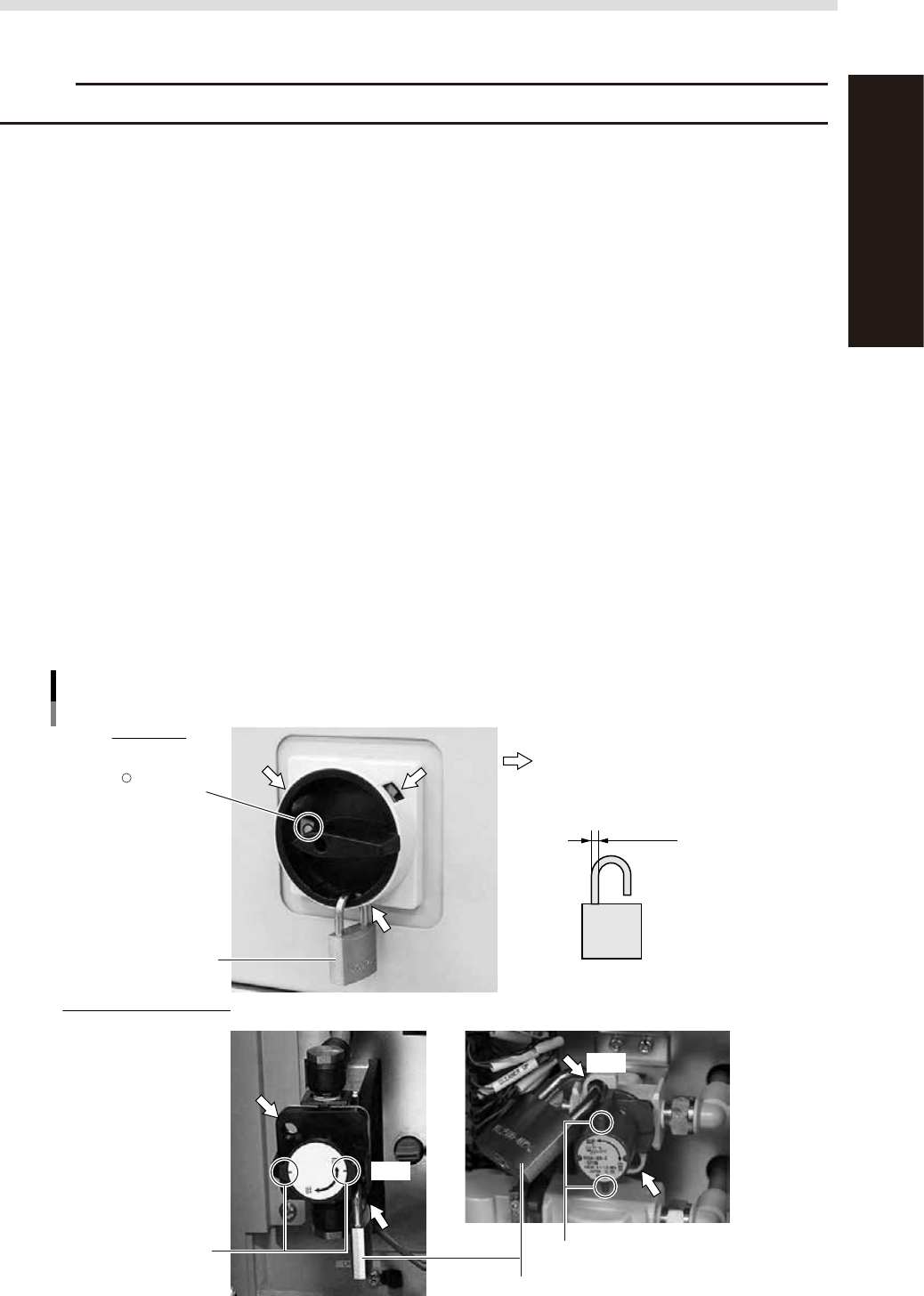
1.3.3 Lock out the main switch and the air supply/exhaust switch
When the maintenance work is performed with the power supply and the air supply off, make sure to lock the
main switch and the air supply/exhaust switch with a padlock as shown below before the work. This is to
prevent a bystander from accidentally turning on the power and the air supply during the maintenance work.
Also, make sure to lock the main switch and the air supply/exhaust switch with a padlock when the machine is
left unused for a long period of time. Manage the key of the padlock according to the customer's rules.
Lock out the main switch and the air supply/exhaust switch
Padlock
“ ”Circle Mark
(OFF position)
OFF position OFF position
Example: YCP10Example: YS100
Padlock
Main switch
Air supply / exhaust switch
: Position where the padlock can be set
Padlock
ø4 to ø6
OFF
OFF
OFF
91208-L0-00