Micron Technical Reference V9 Volume 1.pdf - 第226页
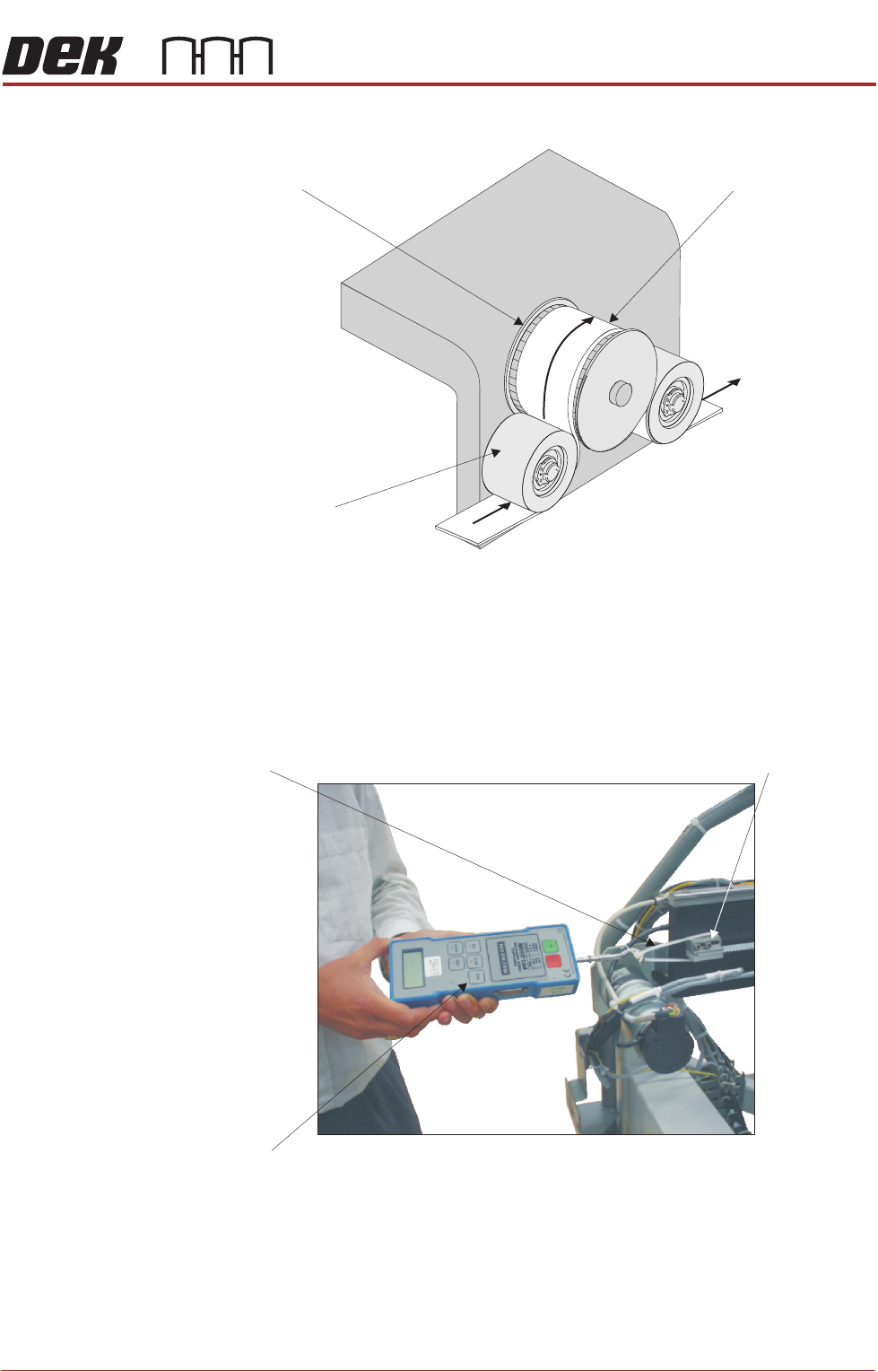
PRINT CARRIAGE MODULE REPLACEMENT PROCEDURES 8.10 Technical Reference Manual Chapter Issue 5, Aug 14 16. Attach a forcemeter to the cable tie and apply a horizontal force of 12kg . 17. Tighten the rea r belt clamp securi…
PRINT CARRIAGE MODULE
REPLACEMENT PROCEDURES
Chapter Issue 5, Aug 14 Technical Reference Manual 8.9
carriage motor pulley and under the rear print carriage idle pulley.
13. Fasten the belt to the rear belt clamp using the belt securing screws
tightened sufficiently to hold the belt.
14. Loosen the rear belt clamp securing screws sufficiently to allow clamp
movement.
15. Loop a cable tie around the clamp.
View on Right Hand End of Print Carriage
Front Idle Pulley
Print Carriage Motor Pulley
Timing Belt
Direction of
Timing Belt
12.00
Forcemeter
Cable Tie
Rear Belt Clamp
View on Rear of Machine

PRINT CARRIAGE MODULE
REPLACEMENT PROCEDURES
8.10 Technical Reference Manual Chapter Issue 5, Aug 14
16. Attach a forcemeter to the cable tie and apply a horizontal force of 12kg.
17. Tighten the rear belt clamp securing screws whilst maintaining the tension
on the belt.
18. Remove the forcemeter and cable tie.
19. Refit any covers removed in Step 7.
20. Power up the machine.
21. Select Maintenance.
22. Select Diagnostics.
23. Use Next or Previous to highlight Print Carriage.
24. Select Select Module.
25. Use Next or Previous to highlight Cycle Print Carriage.
26. Select Run Diagnost.
27. Ensure the print carriage moves smoothly over it’s full range of travel.
28. Select Stop.
29. Select Exit.
30. Select Exit.
31. Select Back.

PRINT CARRIAGE MODULE
CALIBRATIONS
Chapter Issue 5, Aug 14 Technical Reference Manual 8.11
CALIBRATIONS
Temperature/
Humidity Sensor
The temperature/humidity sensor (located on I/O node board 3) is calibrated at
manufacture and is not adjustable.
NOTE
I/O node board 3 is located inside the print carriage extrusion and the temper-
ature and humidity are measured at this point. Due to heat sources, movement
and air flow, it must be expected for the temperature and humidity to vary
throughout the machine.