JANETS_INM.pdf - 第263页
JaNets In structio n Manual 7. Program Editor 7- 56 T able 7.4 - 43 C heck it ems displa yed on th e “ Coplan arity Check ” screen Item Description Check Yes/No/ When you select a lead comp onent as the component type, t…
JaNets Instruction Manual 7. Program Editor
7-55
Component check detailed information setting screen
When you select “Component Data” from the tree view, and then “Check,” the following screen
appears.
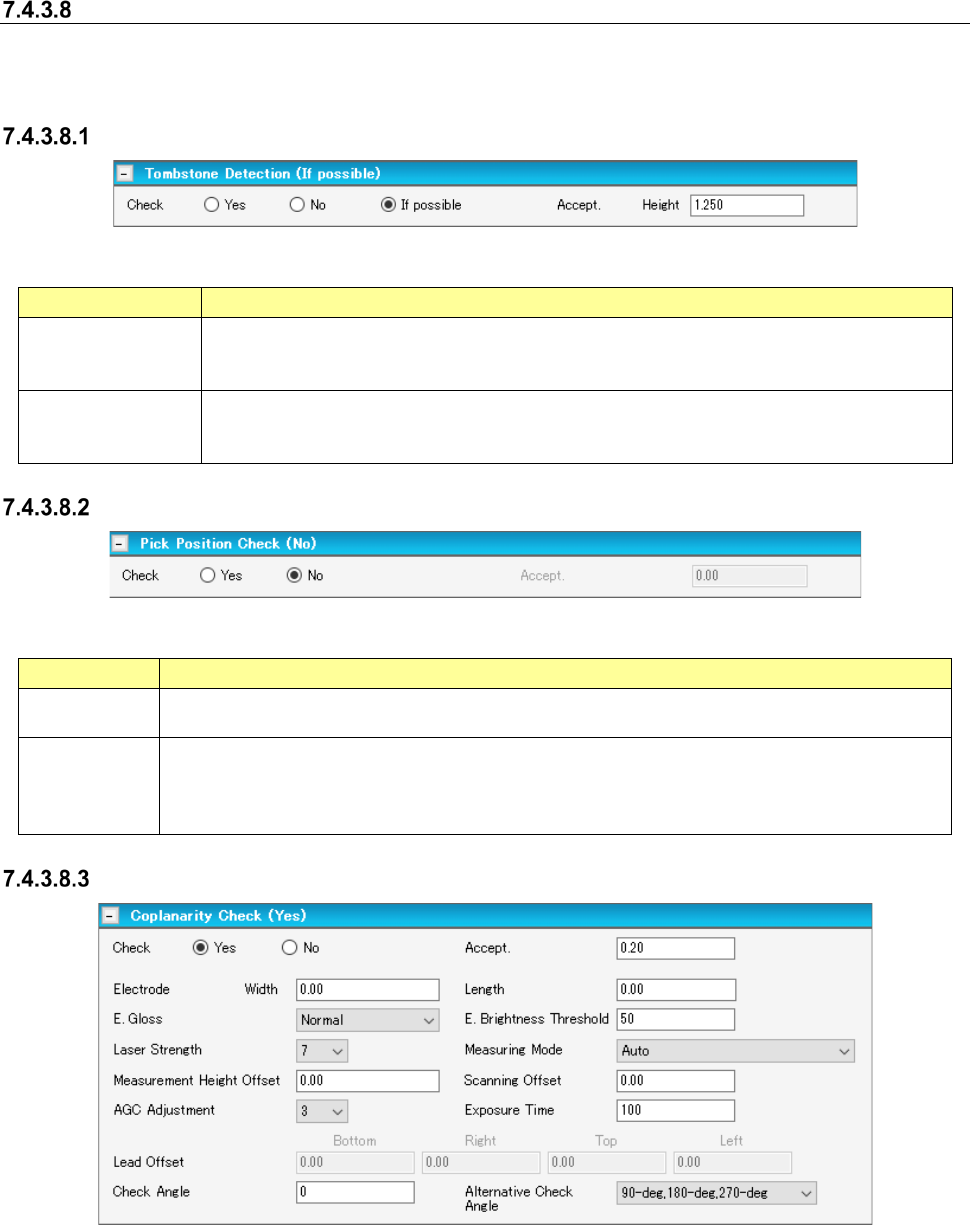
Tombstone Detection
Figure 7.4-76 “Tombstone Detection” screen
Table 7.4-41 Check items displayed on the “Tombstone Detection” screen
Item
Description
Check
Yes/No/If possible
Specify whether to run a tombstone error check or not by selecting the corresponding radio
button.
The “If possible” radio button is selected by default.
Accept.
Height
You can enter a value in this field when you select the “If possible” radio button of the
“Check” menu item. Enter the height as the judgment value.
The input range varies depending on the component type.
Pick Position Check
Figure 7.4-77 “Pick Position Check” screen
Table 7.4-42 Check items displayed on the “Pick Position Check” screen
Item Description
Check
Yes/No/
Specify whether to run a pick position check or not by selecting the corresponding radio button.
The “No” radio button is selected by default.
Pick Position
Check
Accept.
You can enter a value in this field when you select the “Yes” radio button of the “Check” menu
item. Enter the height as the judgment value.
The default value and the input range respectively vary depending on the component size and the
component supply angle.
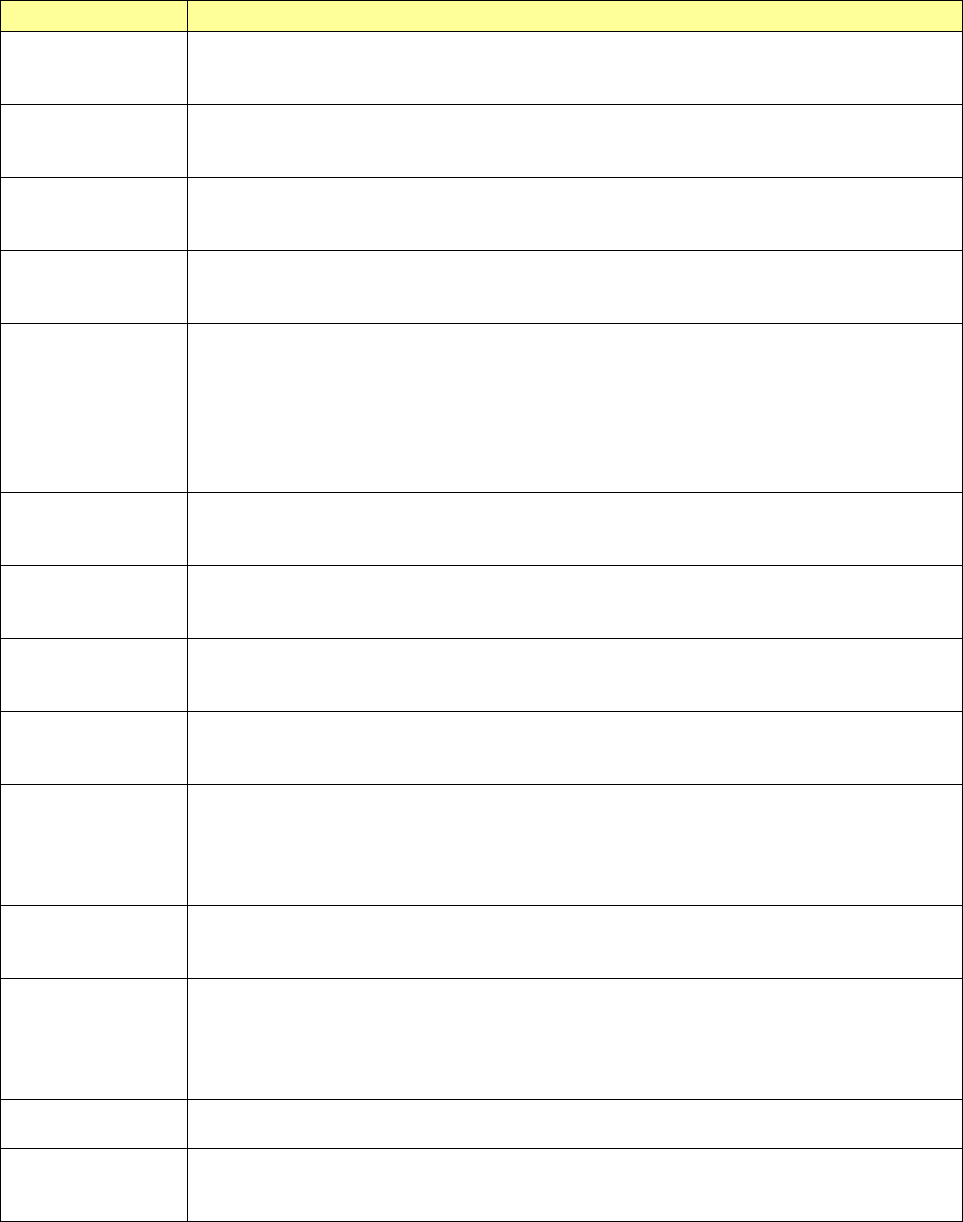
Coplanarity Check
Figure 7.4-78 “Coplanarity Check” screen
JaNets Instruction Manual 7. Program Editor
7-56
Table 7.4-43 Check items displayed on the “Coplanarity Check” screen
Item
Description
Check
Yes/No/
When you select a lead component as the component type, the “Coplanarity” radio button is
activated. Specify whether to run a lead float check or not by the corresponding radio button.
The “No” radio button is selected by default
Coplanarity Check
Accept.
You can enter a value in this field when you select the “Yes” radio button of the “Check” menu
item. Enter the height as the judgment value.
Input range: 0.01 to 1.00 mm (Default value: 0.20)
Coplanarity Check
Electrode Width,
Length
You can enter these fields when you select the “Yes” radio button of the menu item “Check.”
Enter the width and length of the electrode.
Input range: 0.00 to 3.00 mm (Default value: 0.00)
Coplanarity Check
E. Gloss
You can enter this field when you select the
“Yes” radio button of the menu item “Check.”
Select the electrode gloss information from the combo box.
Select “Normal,” “Gloss” or “No Gloss.” “Normal” is selected by default.
Coplanarity Check
E. Brightness
Threshold
You can enter this field when you select the “Yes” radio button of the menu item “Check.”
Enter a threshold value of the brightness of the electrode. The input range is from 5 to 20.
Default value
Ball component: 50
Component other than a ball component
“Normal” is selected as the “E. Gloss”: 40 “Gloss” is selected as the “E. Gloss”: 80
“No Gloss” is selected as the “E. Gloss”: 15
Coplanarity Check
Laser Strength
Select the laser strength from the combo box when you select the “Yes” radio button of the
menu item “Check.”
Input range: 0 to 7 (Default value: 7)
Coplanarity Check
Measurement
Height Offset
You can enter this field when you select the “Yes” radio button of the menu item “Check.”
Enter the measurement height offset.
Input range: - 4.00 to 4.00 mm (Default value: 0.00)
Coplanarity Check
Scanning Offset
You can enter this field when you select the “Yes” radio button of the menu item “Check.” Enter
the scanning position offset.
Input range: 0.00 to 3.00 mm (Default value: 0.00)
Coplanarity Check
AGC Adjustment
Select an AGC correction value from the combo box when you select the “Yes” radio button of
the menu item “Check.”
Input range: 0 to 5 (Default value: 3)
Coplanarity Check
Measuring Mode
You can select this menu item when you select the “Yes” radio button of the menu item
“Check.”
Select the measurement mode among “Auto,” “Standard Measurement Mode” and “High Defi-
nition Measurement Mode” from the combo box.
“Auto” is selected by default.
Coplanarity Check
Exposure Time
You can enter this field when you select the “Yes” radio button of the menu item “Check.” Enter
the exposure time of the camera inside the coplanarity sensor.
Input range: 1 – 1000 (Default value: 100)
Coplanarity Check
Lead Offset
Bottom, Right, Top
and Left
You can enter these fields when you select the “Yes” radio button of the menu item “Check.”
Enter the offsets from the edge of the outer of a component to the tip of the lead (bottom, right,
top and left).
The “Lead Offset” items you can enter vary depending on the component type.
Input range: 0.00 to 50.00 mm (Default value: 0.00)
Coplanarity Check
Check Angle
Set the component angle to be applied when the system runs a check.
Input range: 0 – 359 (Default value: 0)
Coplanarity Check
Alternative Check
Angle
Select the angle among: “90-deg., 180-deg., 270-deg.,” “180-deg.” and “None.” The default
angle is “90-deg., 180-deg., 270-deg.”
JaNets Instruction Manual 7. Program Editor
7-57
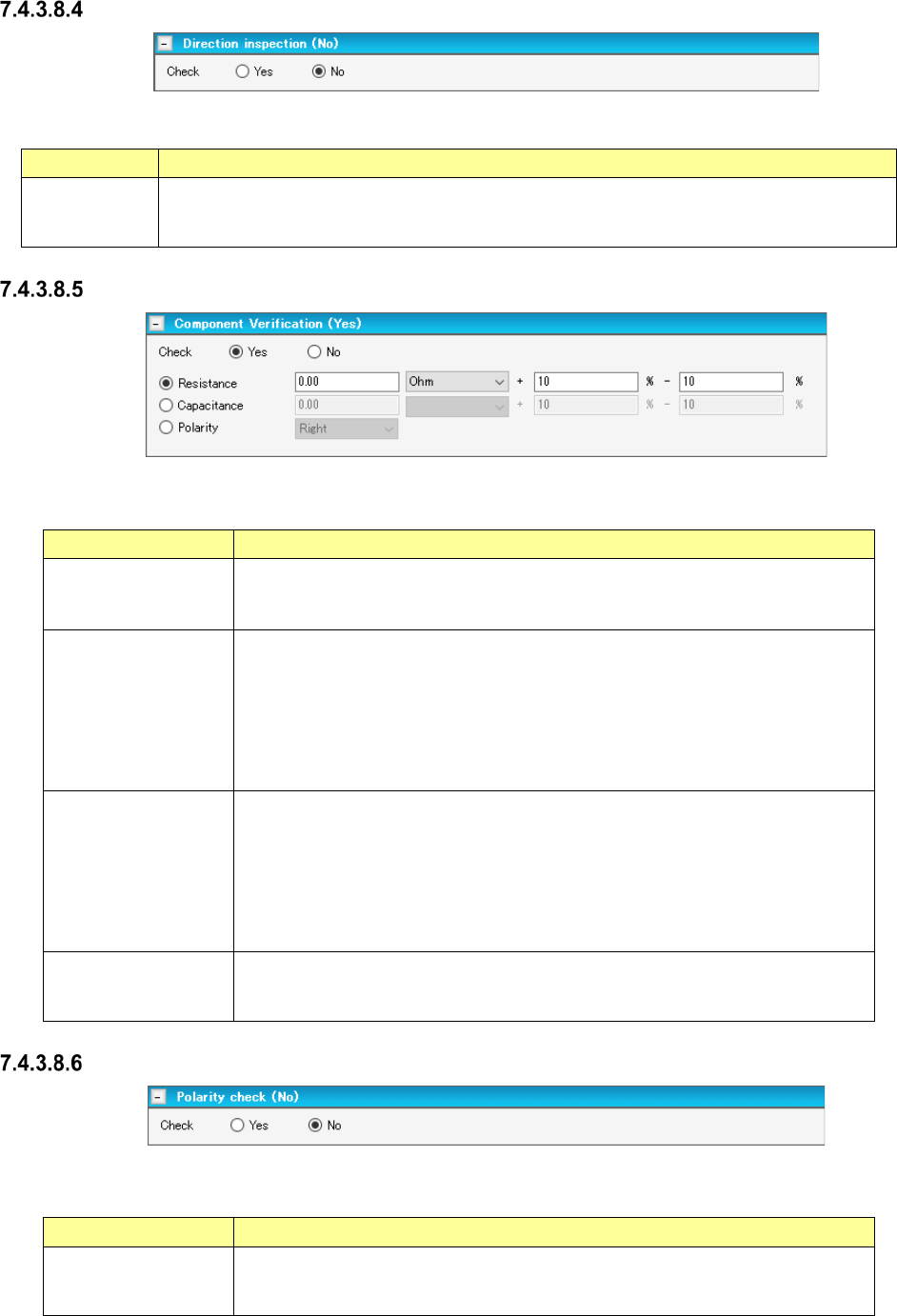
Direction inspection
Figure 7.4-79 “Direction inspection” screen
Table 7.4-44 Inspection items displayed on the “Direction inspection” screen
Item Description
Check
Yes/No/
Select whether to conduct the direction inspection or not with the corresponding radio button.
You can select this menu item only when “SOT” or “GNRL Vision” is selected as the component
type. The “No” radio button is selected by default.
Component Verification
Figure 7.4-80 “Component Verification” screen
Table 7.4-45 Check items displayed on the “Component Verification” screen
Item Description
Check
Yes/No/
Select whether to check a resistance value, capacitance and polarity or not with
the corresponding radio buttons.
The “No” radio button is selected by default for all items.
Component Verifica-
tion
Resistance
You can enter these fields when you select the “Yes” radio button of the menu item
“Check.” Enter the judgment value, the unit, and the upper limit and lower limit of
the tolerance.
Select the unit from the combo box among: “Ω,” “KΩ” and “MΩ.”
The input range of the judgment value is 0.00 to 999.99. (Default: 0)
The input range of the upper limit is 0 to 100 %. (Default: 10)
The input range of the lower limit is – 100 to 0 %. (Default: 10)
Coplanarity Check
Electrode Width,
Length
You can enter these fields when you select the “Yes” radio button of the menu item
“Check.” Enter the judgment value, the unit, and the upper limit and lower limit of
the tolerance.
Select the unit from the combo box among: “pF” and “μF.”
The input range of the judgment value is 0.00 to 999999.99. (Default: 0)
The input range of the upper limit is 0 to 100 %. (Default: 80)
The input range of the lower limit is – 100 to 0 %. (Default: 20)
Component Verifica-
tion
Polarity
You can enter this field when you select the “Yes” radio button of the menu item
“Check.” Select the direction from the combo box.
Select “Right” (default), “Top,” “Left” or “Bottom.”
Polarity check
Figure 7.4-81 “Polarity check” screen
Table 7.4-46 Check item displayed on the “Polarity check” screen
Item
Description
Check
Yes/No/
Select whether to run a polarity check or not with the corresponding radio button.
You can set this item only when “INS electrolytic capacitor” is selected as the
component type.