JANETS_INM.pdf - 第404页
JaNets Instr ucti on Man ual 8. Job Optim izer 8- 19 8.3.9 .4 Planned Start Date, Planned Start Ti me, Planned End Date and P lanned End Time When you ad d a product ion program t o the begi nnin g of the Reser vation li…
JaNets Instruction Manual 8. Job Optimizer
8-18
Editing the Reservation list
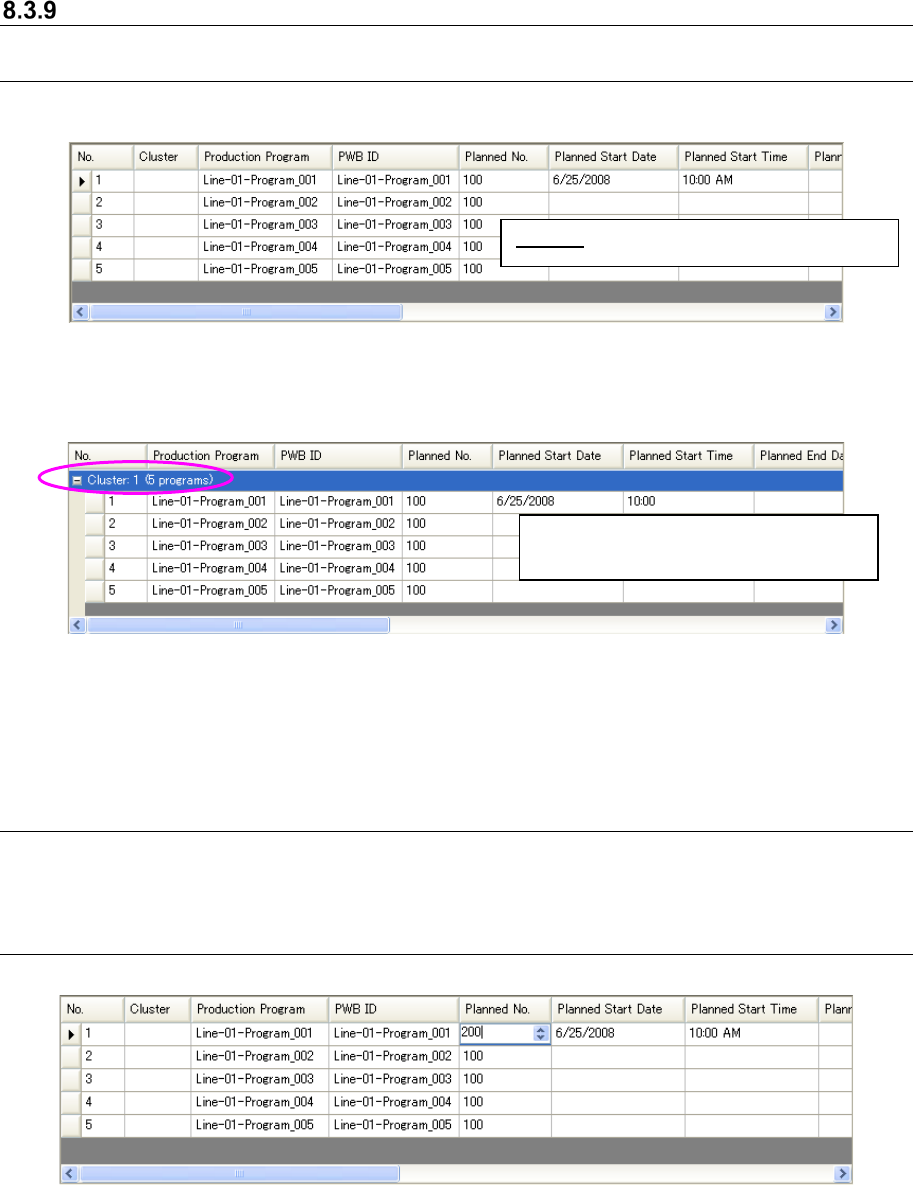
8.3.9.1 Cluster
(Example of a reservation file not optimized or a reservation file whose cluster is not optimized)
Figure 8.3-26 Main screen – Reservation list (Cluster)
(Example of a reservation file whose cluster is optimized)
Figure 8.3-27 Main screen – Reservation list
(grouped according to the cluster number)
* When you edit a Reservation list after it is displayed, the cluster numbers are cleared, and the
tree is hidden.
8.3.9.2 Production Program and PWB ID
When you add a production program to the Reservation list, the program name and the PWB ID of
the added production program are automatically displayed on the screen.
8.3.9.3 Planned No.
Figure 8.3-28 Main screen – Reservation list (Planed No.)
Cluster: Is displayed as a normal column
Five production programs exist (are
grouped) in the “Cluster 1.”
JaNets Instruction Manual 8. Job Optimizer
8-19
8.3.9.4 Planned Start Date, Planned Start Time, Planned End Date and Planned End
Time
When you add a production program to the beginning of the Reservation list, the added data and
time are automatically displayed on the screen. When you add one to the second or later line of
the Reservation list, such data is not displayed.
When you also enter the “Planned Start Date” and the “Planned Start Time” to the second or later
line, you can display the planning and its result with the “Result Summarizer” utility by comparing
them after PWB production. When you also enter the “Planned End data” and the “Planned End
Time,” you can compare the planning and its result with the “Result Summarizer.”
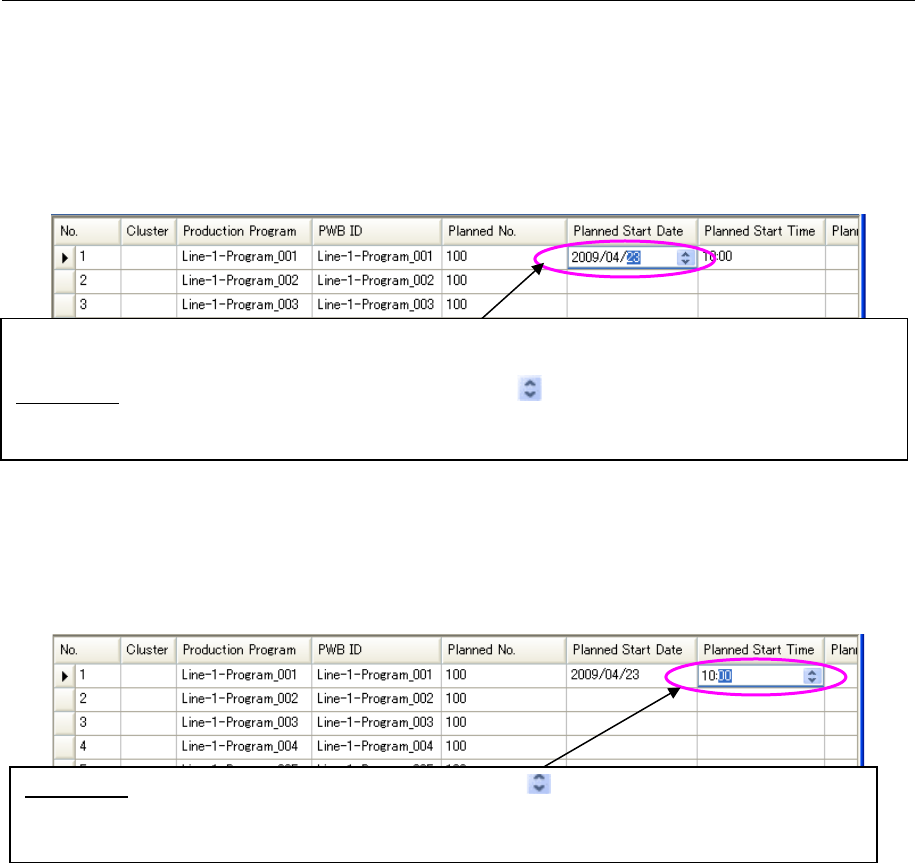
Figure 8.3-29 Main screen – Reservation list (Planned Start Date)
* When you double-click a cell whose “Planned Start Date,” “Planned End Date,” “Planned
Start Time” or “Planned End Time” is to be changed or when you press the [Enter] key after
selecting the cell, you can edit the cell.
Figure 8.3-30 Main screen – Reservation list (Planned Start Time)
How to edit: After selecting the cell to be changed, press the < > button or press the [↑] key or the [↓]
key. Or you can also enter a value directly in the selected cell. To delete a value from a cell, select the
cell and press the [Del] key.
You have to enter the “Planned Start Date” and the “Planned Start Time” of a production program in the first
line only. You can change these values (see the descriptions below), but cannot delete either of them.
How to edit: After selecting the cell to be changed, press the < > button or press the [↑] key or the [↓] key.
Or you can also enter a value directly in the selected cell. To delete a value from a cell, select the cell and
press the [Del] key.
JaNets Instruction Manual 8. Job Optimizer
8-20
8.3.9.5 No. of Components
Specify whether a reserved production program will use the number of components in the
previous production program or not.
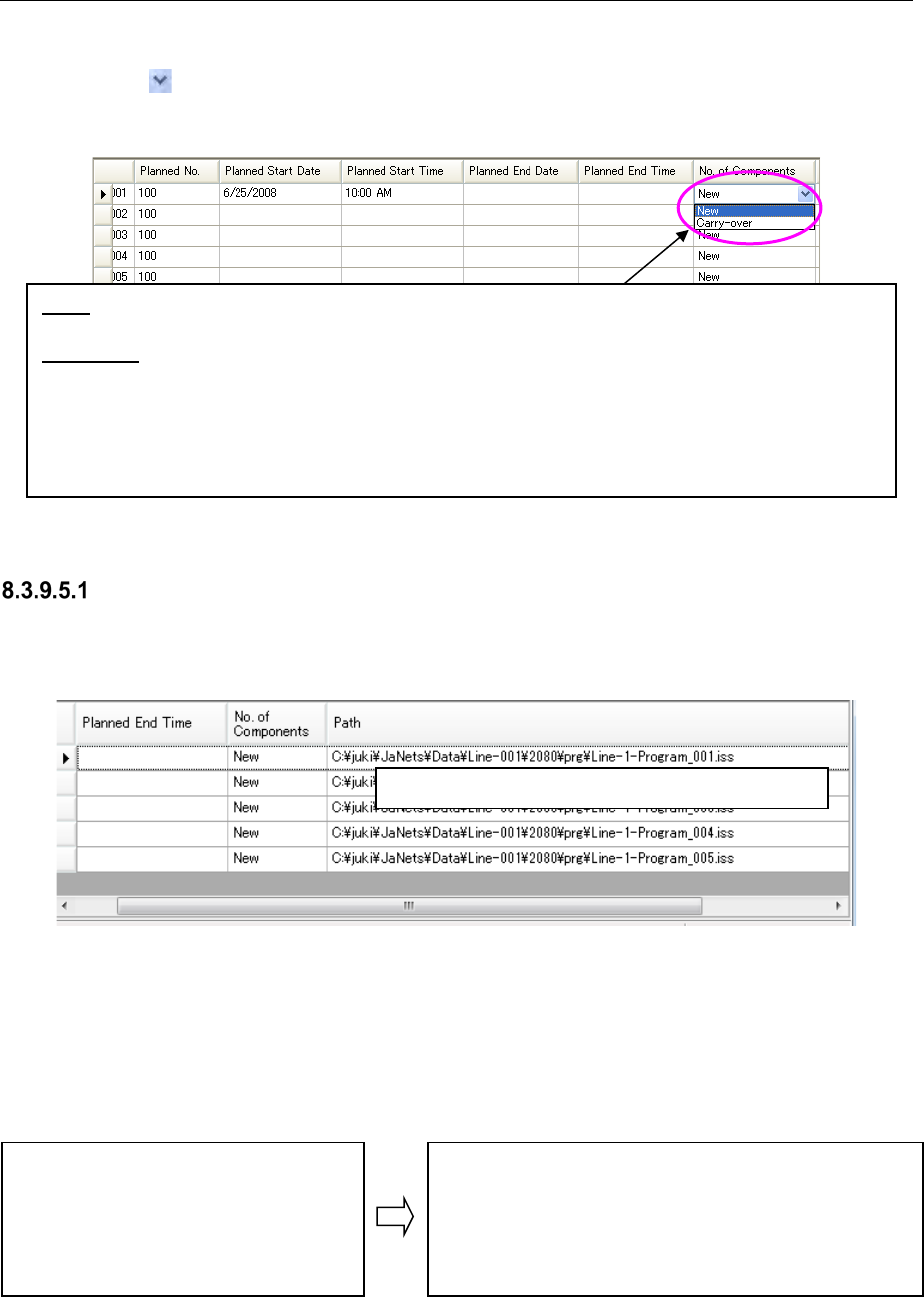
Press the < > button in the “No. of Components” cell, and select the [New] command or the
[Carry-over] command from the displayed pull-down menu.
Figure 8.3-31 Main screen – Reservation list (No. of Components)
Displaying the absolute path of a production program
When you add a production program to the Reservation list, the absolute path of the added
production program is automatically displayed on the screen.
Figure 8.3-32 Main screen – Reservation list (Path)
When you add a new production program, the folder whose name is the same as that of the
reservation file is created on the same path as that of the reservation file, and all production
programs are copied in this folder. If two or more production programs whose names are all the
same are added to the Reservation list, the second and later production programs are saved in the
sub-folders “a production program name” + “-“ + “serial number” respectively. The serial numbers
from “2” are added to sub-folders.
Figure 8.3-33 Changes in the paths of production programs when they are saved
The “Path” is displayed only, and you cannot edit it.
New:
Applies the number of components set with the [No. of Components] command to each production
program.
Carry-over: Copies the number of the remaining components of the previous production program to that
of the next production program when the same type of components are set at the same feeder position
for the consecutive production programs
* When the same component is set in different feeder positions, the number of components will not be
succeeded.
* In RX-7 series, the number of components is not succeeded regardless of the setting.
C:\Juki\JaNets\Line001\Prg\a.iss
C:\Juki\JaNets\Line001\Prg\b.iss
C:\Juki\JaNets\Line001\Prg\c.iss
C:\Juki\JaNets\Line001\Prg2\a.iss
C:\Juki\JaNets\Line001\Prg2\b.iss
C:\ISS\Line001\Prg3\a.iss
C:\Juki\JaNets\Line001\2014\01\reserveA\a.iss
C:\Juki\JaNets\Line001\2014\01\reserveA\b.iss
C:\Juki\JaNets\Line001\2014\01\reserveA\c.iss
C:\Juki\JaNets\Line001\2014\01\reserveA\a_2\a.iss
C:\Juki\JaNets\Line001\2014\01\reserveA\b_2\b.iss
C:\Juki\JaNets\Line001\2014\01\reserveA\a_3\a.iss