DEK高级培训资料.pdf - 第139页
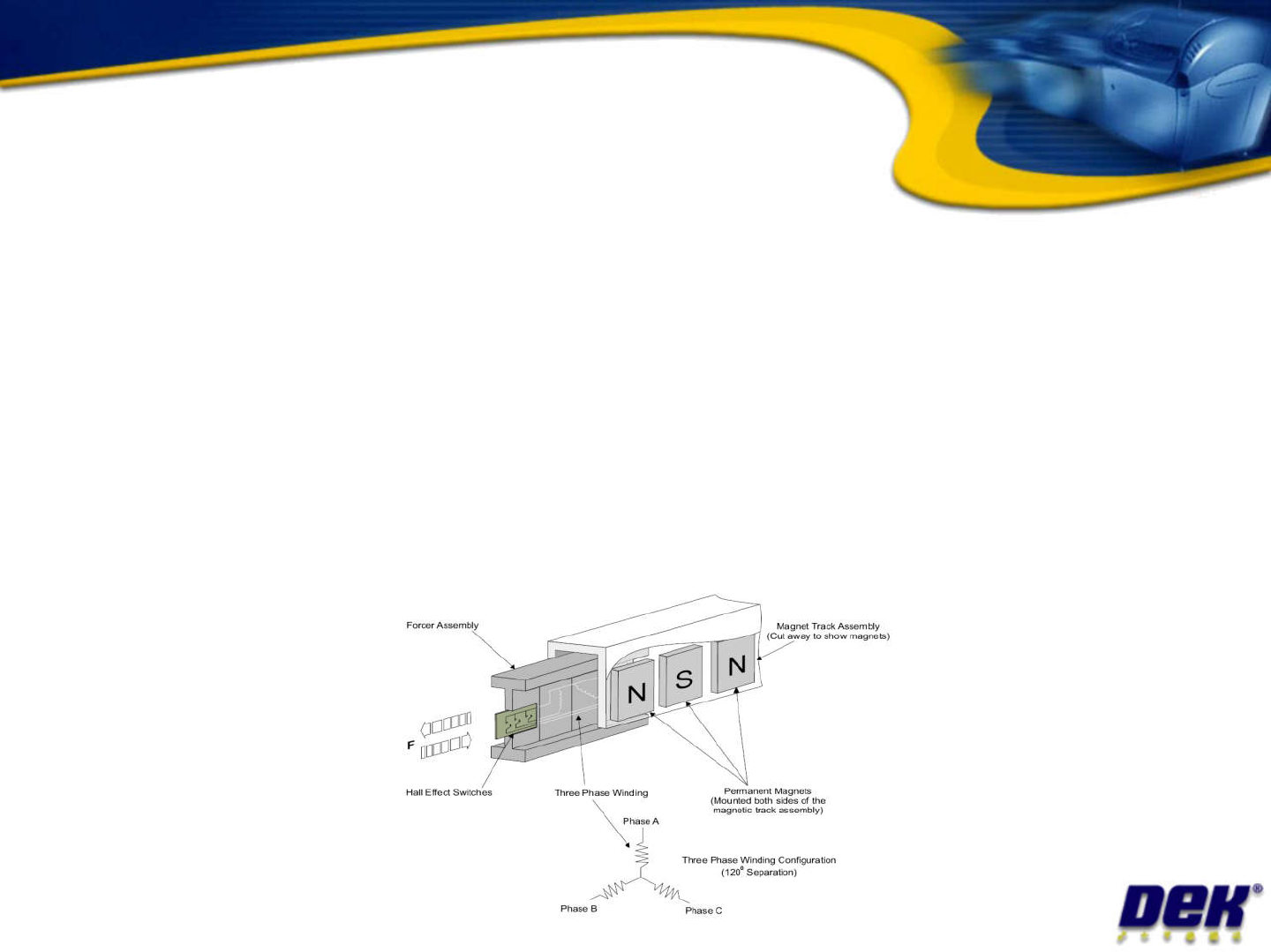
• A Euro Flex card supplies pow er sequentia lly to the three pha se w indings in the Forcer . T he w indings are phy sically 120 degrees out of phase. • Magnetic attraction be tw e en the in-phase winding and the perman…

•
High speeds: The maximum speed of a linear motor is limited only by the
bus voltage and the speed of the control electronics.
•
High Precision: The accuracy, resolution, and repeatability of a linear
motor driven device is controlled by the feed back device.
•
Fast Response: The response rate of a linear motor driven device can be
over 100 times that of a mechanical transmission. This means faster
Camera System (Linear)
Issue 2: July 2007
over 100 times that of a mechanical transmission. This means faster
accelerations and settling times, thus more throughput.
•
Stiffness: Because there is no mechanical linkage increasing the stiffness
is simply a matter of gain and current.
•
Zero Backlash: Without mechanical transmission components, there is no
backlash.
•
Maintenance Free Operation: Because the linear motors of today have no
contacting parts there is no wear.
•
A EuroFlex card supplies power sequentially to the three phase windings in the
Forcer. The windings are physically 120 degrees out of phase.
•
Magnetic attraction between the in-phase winding and the permanent magnetic
poles in the magnet track causes the forcer to move.
•
The 3 Hall Effect switches are used during start up to establish the position of
the forcer relative to the N-S magnets.Their outputs are used by the EuroFlex
drive cards to establish the initial current levels and polarity to be supplied to
Linear Motors Theory
Issue 2: July 2007
drive cards to establish the initial current levels and polarity to be supplied to
the forcer. Once speed and direction is established motion detection passes
over to the encoder.
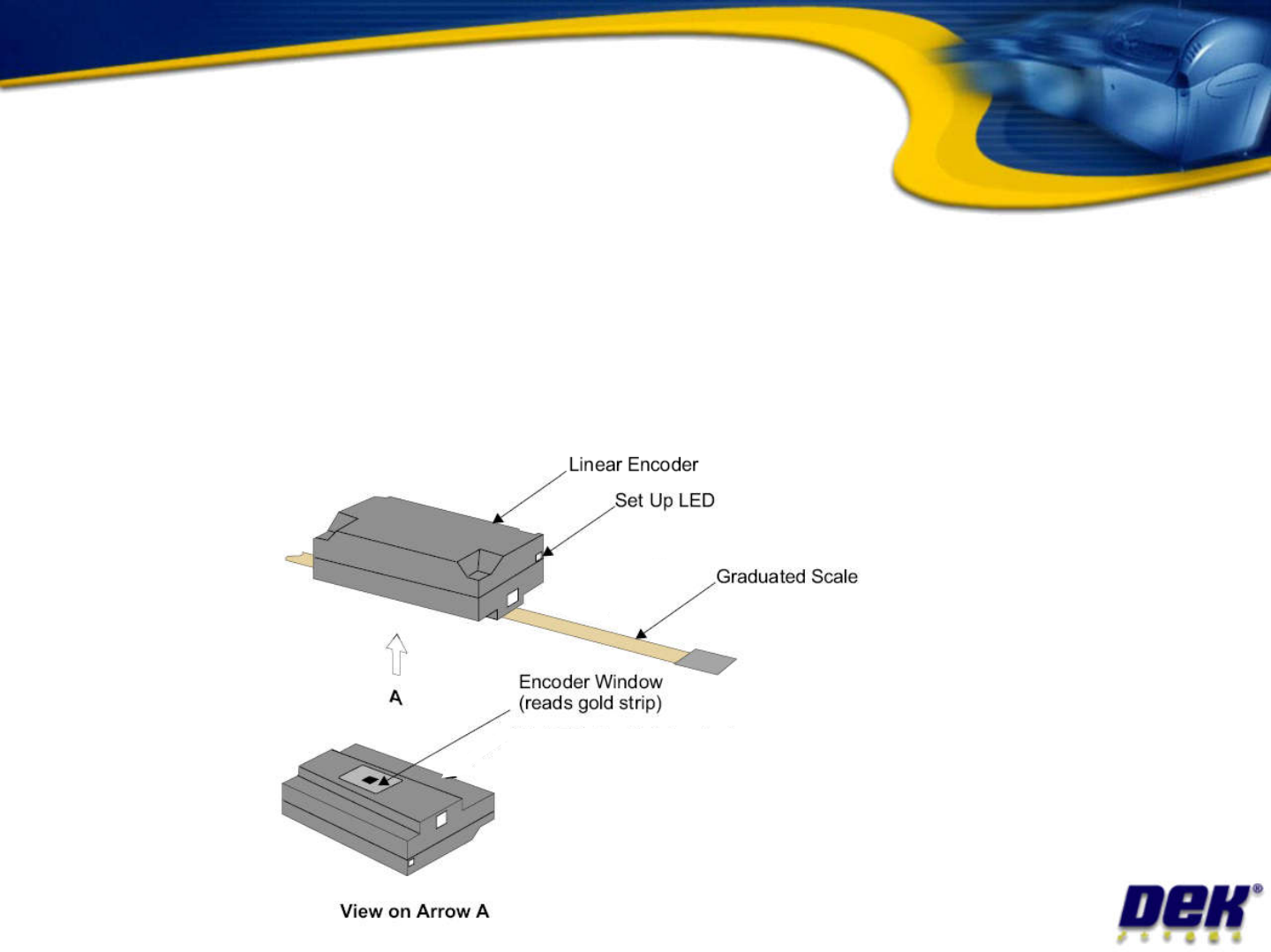
Linear Encoder Theory
•
The optical read head measures positional information
from the encoder strip running the length of the permanent
magnet track
•
Two pulse trains allow direction and velocity to be
calculated
Issue 2: July 2007