IPC-CM-770D-1996 - 第106页
IPC-CM-770 Januaty 1996 The extent to which the user wishes to implement these guidelines may ultimately be validated by actual tests of the assembled printed board in its intended shock and vibration environment. The ul…
January
1996
IPC-CM-770
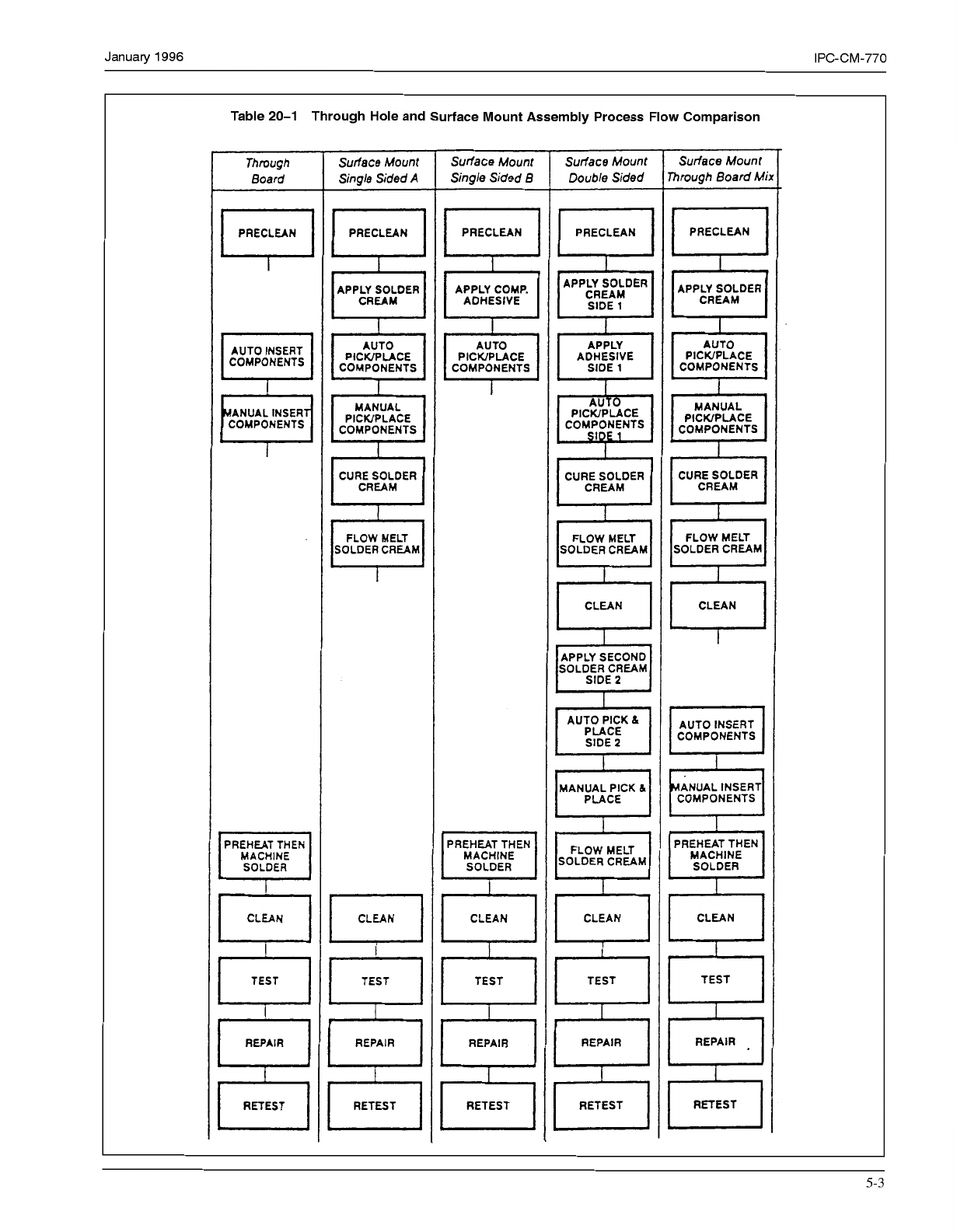
Table 20-1 Through Hole and Surface Mount Assembly Process
Flow
Comparison
~~
Surface Mount
Single Sided
A
Surface
Mount
Single Sided B
Surface Mount
through Board
Mi
Surface Mount
Double Sided
PRECLEAN
Through
Board
n
PRECLEAN
W
PRECLEAN
u
PRECLEAN
PRECLEAN
APPLY SOLDER
I
CREAM
APPLY SOLDER
U
APPLY SOLDER
CREAM
APPLY COMP.
ADHESIVE
PICWPLACE
COMPONENTS
SIDE
1
ADHESIVE
SIDE
1
1
PlC"WUPTLOACE
I
COMPONENTS
I
PlC%$CE
I
COMPONENTS
COMPONENTS
AUTO INSERT
COMPONENTS
MANUAL INSERT
I
I
I
I
MANUAL
COMPONENTS
PICWPLACE
I
I
MANUAL
COMPONENTS
PICWPLACE
[Tl
CURE SOLDER
I
CRYM
I
CURE SOLDER
CURE SOLDER
CREAM
SOLDERCREAM
CLEAN
U
FLOW MELT
SOLDER CREAM SOLDERCREAM
FLOW MELT
I
AUTO PICK
6
SIDE
2
AUTO INSERT
COMPONENTS
ANUAL INSERT
COMPONENTS
PUCL1
MANUAL PICK
6
I
PREHEAT THEN
MACHINE
SOLDER
I
I
PREHEAT THEN
MACHINE
SOLDER
I
FLOW MELT
SOLDER CREAM
CLEAN
MACHINE
SOLDER
I
CLEAN
I
REPAIR
REPAIR
.
RETEST
REPAIR
RETEST
REPAIR
RETEST
REPAIR
RETEST
I
RETEST
5-3
COPYRIGHT Association Connecting Electronics Industries
Licensed by Information Handling Services
COPYRIGHT Association Connecting Electronics Industries
Licensed by Information Handling Services
IPC-CM-770
Januaty
1996
The extent to which the user wishes to implement these
guidelines may ultimately be validated by actual tests of
the assembled printed board in its intended shock and
vibration environment.
The ultimate ability of components to survive in shock and
vibration environments will depend upon the degree of
consideration given to the following factors:
The worst case levels of shock and vibration environment
for the entire structure in which the printed board assem-
bly resides and the ultimate level of this environment that
is actually transmitted to the components mounted on the
board. Particular attention should be given to equipment
which will be subjected to random vibration.
The method of mounting the board in the equipment to
reduce the effects of this environment, specifically the
number of board mounting supports and their interval and
complexity.
The attention given to the mechanical design of the
board; specifically its size, shape, type of material, mate-
rial thickness and degree of resistance to bowing and
flexing that the design provides.
The shape, mass, and location of the components
mounted on the board.
The component lead wire strain relief design as provided
by its package, lead spacing, lead bending, or a combina-
tion of these plus the addition of restraining devices.
The attention paid to workmanship during board assem-
bly
so
as to insure that component leads are properly
bent, not nicked and that components are installed in a
manner which minimizes component movement.
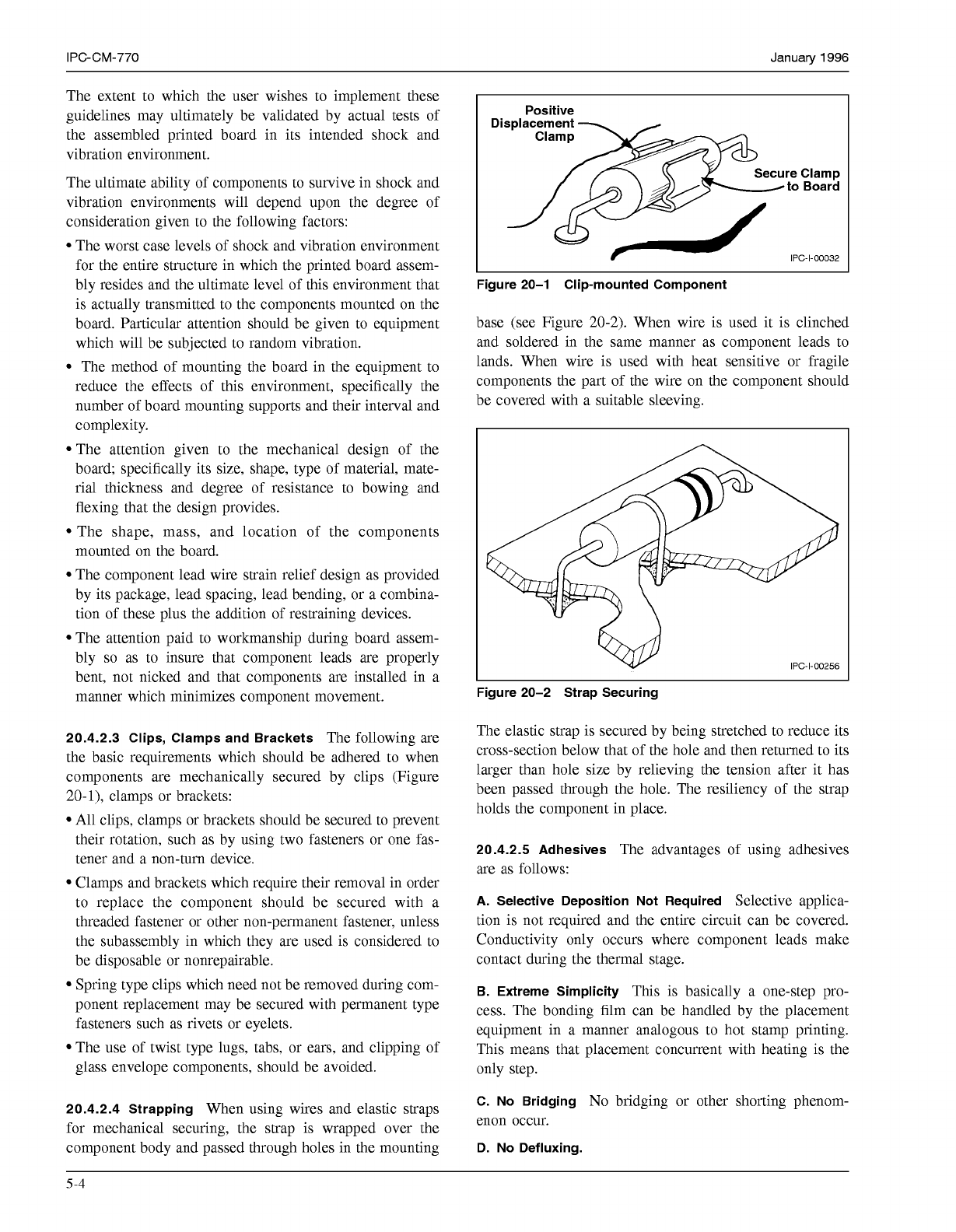
20.4.2.3 Clips, Clamps and Brackets
The following are
the basic requirements which should be adhered to when
components are mechanically secured by clips (Figure
20-l),
clamps or brackets:
All clips, clamps or brackets should be secured to prevent
their rotation, such as by using two fasteners or one fas-
tener and a non-turn device.
Clamps and brackets which require their removal in order
to replace the component should be secured with a
threaded fastener or other non-permanent fastener, unless
the subassembly in which they are used is considered to
be disposable or nonrepairable.
Spring type clips which need not be removed during com-
ponent replacement may be secured with permanent type
fasteners such as rivets or eyelets.
The use of twist type lugs, tabs, or ears, and clipping of
glass envelope components, should be avoided.
20.4.2.4 Strapping
When using wires and elastic straps
for mechanical securing, the strap is wrapped over the
component body and passed through holes in the mounting
Positive
re Clamp
to Board
IPC-I-O0032
Figure 20-1 Clip-mounted Component
base (see Figure
20-2).
When wire is used it is clinched
and soldered in the same manner as component leads to
lands. When wire is used with heat sensitive or fragile
components the part of the wire on the component should
be covered with a suitable sleeving.
Figure 20-2 Strap Securing
The elastic strap is secured by being stretched to reduce its
cross-section below that of the hole and then returned to its
larger than hole size by relieving the tension after it has
been passed through the hole. The resiliency of the strap
holds the component in place.
20.4.2.5 Adhesives
The advantages of using adhesives
are as follows:
A. Selective Deposition Not Required
Selective applica-
tion is not required and the entire circuit can be covered.
Conductivity only occurs where component leads make
contact during the thermal stage.
B. Extreme Simplicity
This is basically a one-step pro-
cess. The bonding film can be handled by the placement
equipment in a manner analogous to hot stamp printing.
This means that placement concurrent with heating is the
only step.
C. No Bridging
No
bridging or other shorting phenom-
enon occur.
D. No Defluxing.
5-4
COPYRIGHT Association Connecting Electronics Industries
Licensed by Information Handling Services
COPYRIGHT Association Connecting Electronics Industries
Licensed by Information Handling Services
January 1996 IPC-CM-770
E. Dry Processing
Precoated boards can be component
populated with only the addition of heat.
F. Fine Line Capability
Lines and spaces well below
10
mils can be connected.
No
shorting occurs with even the
highest density flat packs.
G.
TAB Compatible
The outer lead bonding of TAB can
be easily accomplished with adhesive film.
Depending on the attachment method, an adhesive may be
necessary to attach the device to the board.
Thermoset adhesive and two-part reactive, conductive and
non-conductive adhesives have been used in the electronic
industry for several decades. Perhaps the most extensive
use of conductive adhesives is for die attachment, although
component attachment is not uncommon, especially tempo-
rary or initial attachment of surface mount components for
machine soldering.
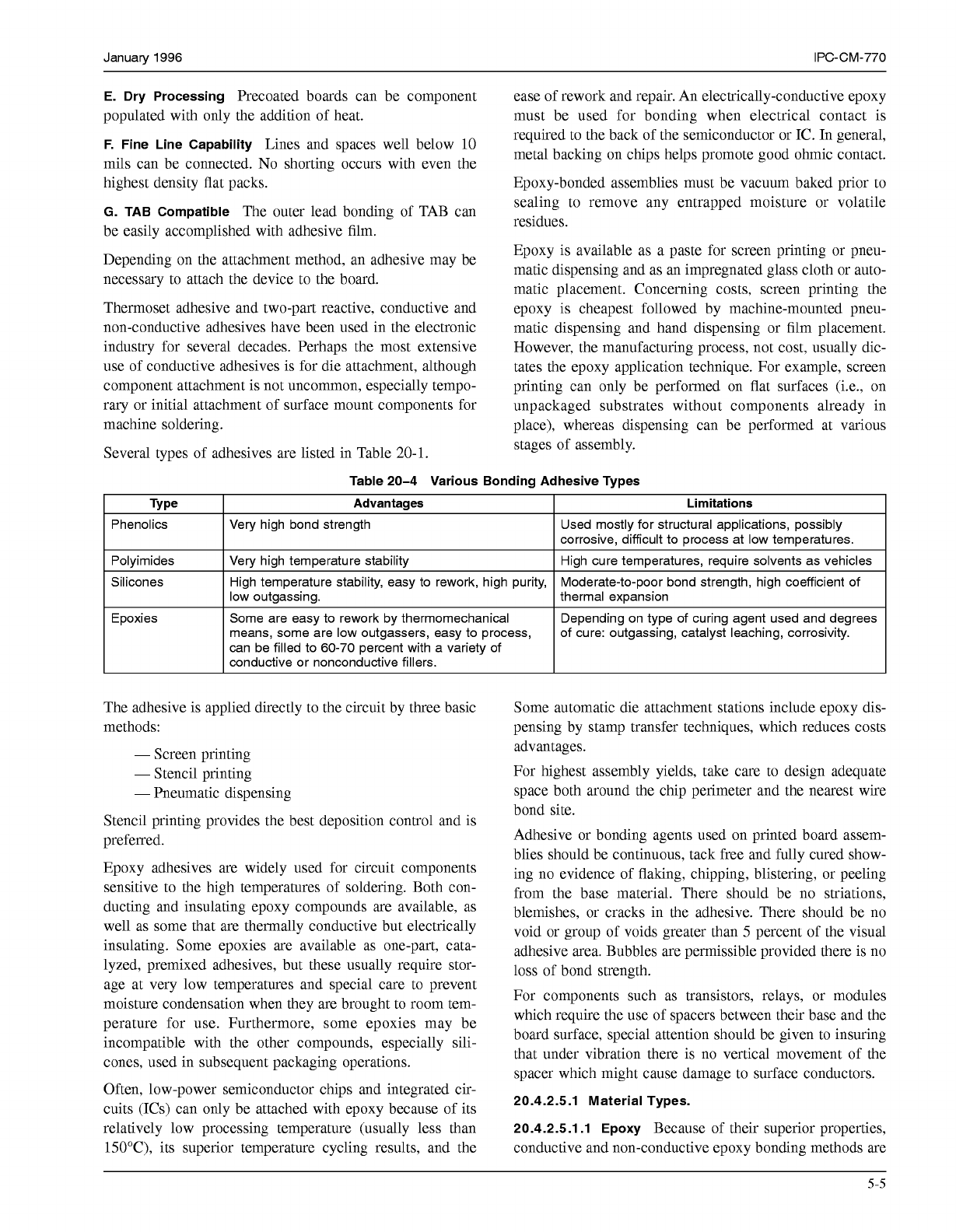
Several types of adhesives are listed in Table
20-1.
ease of rework and repair. An electrically-conductive epoxy
must be used for bonding when electrical contact is
required to the back of the semiconductor or IC. In general,
metal backing on chips helps promote good ohmic contact.
Epoxy-bonded assemblies must be vacuum baked prior to
sealing to remove any entrapped moisture or volatile
residues.
Epoxy is available as a paste for screen printing or pneu-
matic dispensing and as an impregnated glass cloth or auto-
matic placement. Concerning costs, screen printing the
epoxy is cheapest followed by machine-mounted pneu-
matic dispensing and hand dispensing or film placement.
However, the manufacturing process, not cost, usually dic-
tates the epoxy application technique. For example, screen
printing can only be performed on flat surfaces (i.e., on
unpackaged substrates without components already in
place), whereas dispensing can be performed at various
stages of assembly.
Table 20-4 Various Bonding Adhesive Types
TY Pe
Limitations
Advantages
Phenolics
Depending on type of curing agent used and degrees Some are easy to rework by thermomechanical
Epoxies
Moderate-to-poor bond strength, high coefficient of High temperature stability, easy to rework, high purity, Silicones
High cure temperatures, require solvents as vehicles Very high temperature stability
Polyimides
Used mostly for structural applications, possibly Very high bond strength
corrosive, difficult to process at low temperatures.
low outgassing. thermal expansion
means, some are low outgassers, easy to process, of cure: outgassing, catalyst leaching, corrosivity.
can be filled to 60-70 percent with a variety of
conductive or nonconductive fillers.
The adhesive is applied directly to the circuit by three basic
methods:
-
Screen printing
-
Stencil printing
-
Pneumatic dispensing
Stencil printing provides the best deposition control and is
preferred.
Epoxy adhesives are widely used for circuit components
sensitive to the high temperatures of soldering. Both con-
ducting and insulating epoxy compounds are available, as
well as some that are thermally conductive but electrically
insulating. Some epoxies are available as one-part, cata-
lyzed, premixed adhesives, but these usually require stor-
age at very low temperatures and special care to prevent
moisture condensation when they are brought to room tem-
perature for use. Furthermore, some epoxies may be
incompatible with the other compounds, especially sili-
cones, used in subsequent packaging operations.
Often, low-power semiconductor chips and integrated cir-
cuits (ICs) can only be attached with epoxy because of its
relatively low processing temperature (usually less than
150°C), its superior temperature cycling results, and the
Some automatic die attachment stations include epoxy dis-
pensing by stamp transfer techniques, which reduces costs
advantages.
For highest assembly yields, take care to design adequate
space both around the chip perimeter and the nearest wire
bond site.
Adhesive or bonding agents used on printed board assem-
blies should be continuous, tack free and fully cured show-
ing no evidence of flaking, chipping, blistering, or peeling
from the base material. There should be no striations,
blemishes, or cracks in the adhesive. There should be no
void or group of voids greater than
5
percent of the visual
adhesive area. Bubbles are permissible provided there is no
loss of bond strength.
For components such as transistors, relays, or modules
which require the use of spacers between their base and the
board surface, special attention should be given to insuring
that under vibration there is no vertical movement of the
spacer which might cause damage to surface conductors.
20.4.2.5.1 Material Types.
20.4.2.5.1.1 Epoxy
Because of their superior properties,
conductive and non-conductive epoxy bonding methods are
5-5
COPYRIGHT Association Connecting Electronics Industries
Licensed by Information Handling Services
COPYRIGHT Association Connecting Electronics Industries
Licensed by Information Handling Services