IPC-CM-770D-1996 - 第110页
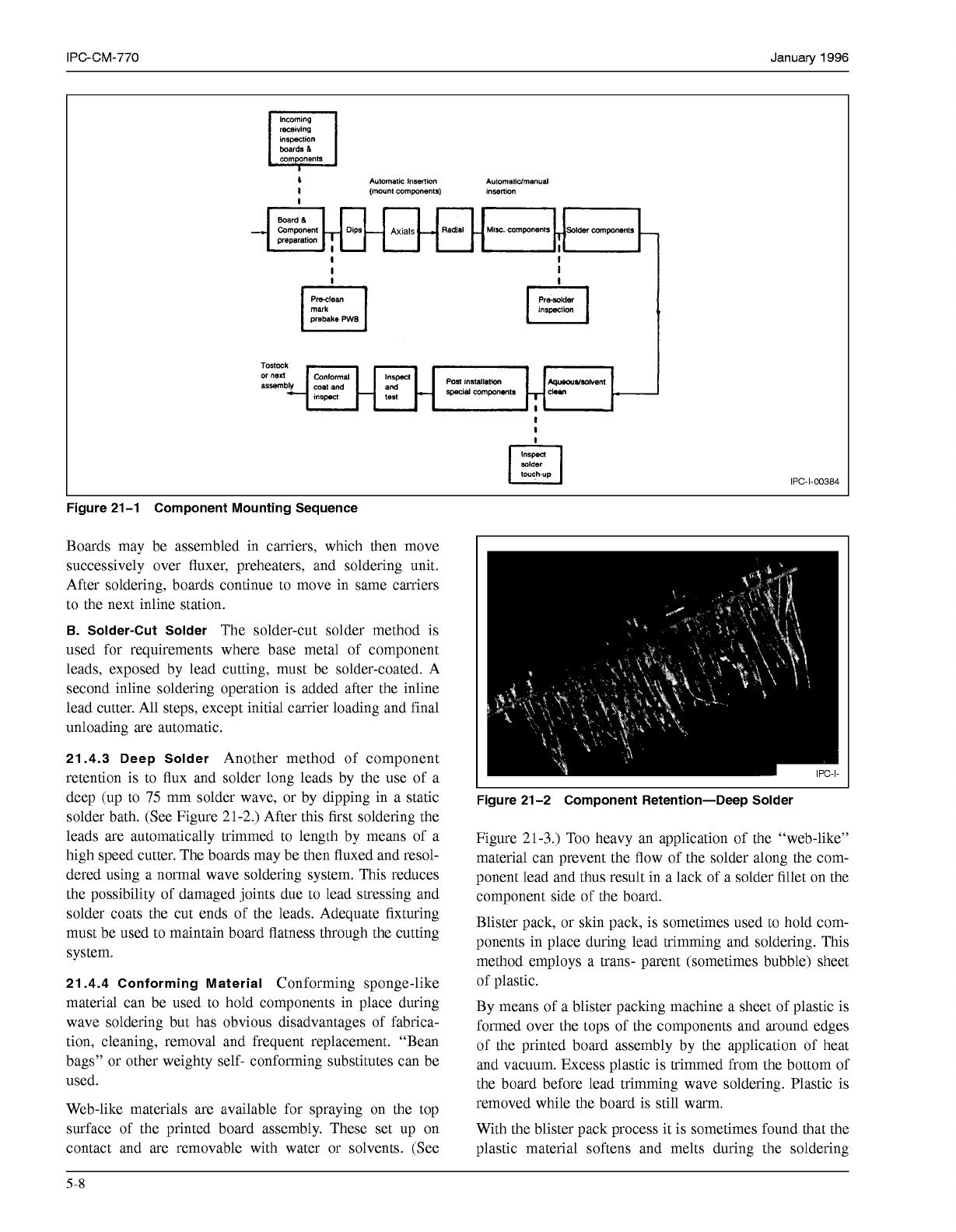
IPC-CM-770 Januaty 1996 lncommg receiving I boards S I inspaclion commnents L m. Board S preparation T - Solder components Misc. componenls - Radial - - Dips Component .I l I I 4 I l I Preclean prebake PWB inspection I l…
January
1996
IPC-CM-770
as larger gull-wing types). Conversely, the circuit may be
heated by convection or direct transfer. Liquid thermoset
adhesive materials are processed differently. The material is
coated or printed onto the circuit. The entire board can be
covered. Components are conventionally placed and heat-
ing them cures the adhesive. Electrical contact is made
between the circuit and the components. The conductive
particles in the unpopulated areas remain dispersed within
the resin
so
that it serves as an insulative coating. Caution
-
use only with manufacturer’s approved component and
land surface finishes. Other finishes may lead to reliable
connections.
21
.O
THROUGH-HOLE MOUNTING TECHNIQUES
The most significant advantage of using the through-the-
board mounting method is its compatibility with conven-
tional mass soldering techniques, such as dip and wave
soldering. In addition, replacement of flatpacks mounted in
this manner is readily accomplished by melting and remov-
ing the solder from each land individually or in multiples.
Parts and components should be mounted on the side of the
printed board opposite that which would be in contact with
the solder if the board is machine soldered. Except when
mounted in cordwood modules or on nonrepairable printed
boards, parts and components should be
so
spaced and
so
located that any part can be removed from the printed
board without removing another part.
21.1 General Considerations
The selection of a particu-
lar method for mounting and connecting components in
equipment will depend on the type of component package
involved: on the equipment available for mounting and
interconnecting; on the connection method used (soldered,
welded, crimped, etc.); on the size, shape, and weight of
the equipment package; on the degree of reliability and
maintainability (ease of replacement) required; and, of
course, on cost considerations. See Figure
21-1
for compo-
nent mounting sequence.
The size and shapes of the solder-land terminations for
flatpack integrated circuits will depend on whether
“inline” configurations or “staggered” terminals configu-
rations are used. The sizes and shapes of lands for “TO”
type packaged circuits will depend on the effective lead-
circle diameter. For applications where speed and ease of
installation and removal are major considerations, devices
can be mounted in suitable sockets.
In any method which involves bending or forming of the
device leads, it is extremely important that the lead be sup-
ported and clamped between the bend and the seal, and that
bending be done with extreme care to avoid damage to lead
plating. Bending, forming and clinching of component
leads produce stresses in the leads and can cause stresses in
the seals if precautions are not taken. In no case should the
radius of the bend be less than the diameter of the lead, or
in the case of rectangular leads such as those used in dual
inline or flat-packaged integrated circuits, less than the lead
thickness. It is also extremely important that the lead exit-
ing the body of the component is parallel to the axis of the
component, and that the ends of the bent leads be perfectly
straight and parallel to assure proper insertion through the
holes in the printed board.
Tests performed on clinched cover leads show that the pull
and yield stresses produced by lead-clinching operations
are
far
below the allowable limits for these leads.
21.2 Component Preparation
Care needs to be exer-
cised to assure leads are prepared and insertion controlled
such that insulation on component leads does not extend
into the hole. This condition can have adverse impacts on
the resultant solder joint. This condition is often a problem
with two leaded disk type components not retained firmly
in the hole. Such components tend to tilt before soldering
introducing insulation in one hole and less than adequate
protrusion in the other.
21.3 LeadlHole Relationships
The lead to hole clear-
ance must be such as to provide for good soldering condi-
tions. Generally
0.25
mm to
0.5
mm clearance in diameter
is used.
If
the clearance is too small or too large, adequate
wicking of solder does not result.
A
minimum protrusion
through the substrate is often specified. The maximum is
dependent on specific later process equipment used and end
product design clearances.
For rectangular leads the dimension across the diagonal
should be considered as being the lead diameter.
21.3.1 Unsupported Holes
In determining the difference
between the diameter of an unsupported hole and that of
the lead to be placed in the hole, the hole should be from
0.25
mm to
0.5
mm larger than the lead diameter.
21.3.2 Supported Holes
In determining the difference
between the diameter of a supported hole and that of the
lead to be placed in the hole, the hole should be from
0.25
mm to
0.7
mm larger than the lead diameter.
21.4 Component Retention.
21.4.1 Assembly Process Methods
Two methods of
using solder as a means for component retention for lead
cutting are in general use. Both methods are practical for
inline applications whereby printed boards can be
assembled, lead cut, soldered and cleaned on the same con-
veyorized system.
A. Solder-Cut
The solder-cut method is commonly used
throughout the electronics industry. It is preceded by a
printed board soldering assembly procedure, followed by
the cutting operation.
5-7
COPYRIGHT Association Connecting Electronics Industries
Licensed by Information Handling Services
COPYRIGHT Association Connecting Electronics Industries
Licensed by Information Handling Services
IPC-CM-770
Januaty
1996
lncommg
receiving
I
boards
S
I
inspaclion
commnents
L
m.
Board
S
preparation
T
-
Solder
components
Misc.
componenls
-
Radial
-
-
Dips
Component
.I
l
I
I
4
I
l
I
Preclean
prebake PWB
inspection
I
l
louc,h-up
IPC-1-00384
Figure 21-1 Component Mounting Sequence
Boards may be assembled in carriers, which then move
successively over fluxer, preheaters, and soldering unit.
After soldering, boards continue to move in same carriers
to the next inline station.
B.
Solder-Cut Solder
The solder-cut solder method is
used for requirements where base metal of component
leads, exposed by lead cutting, must be solder-coated. A
second inline soldering operation is added after the inline
lead cutter. All steps, except initial carrier loading and final
unloading are automatic.
21.4.3 Deep Solder
Another method of component
retention is to flux and solder long leads by the use of a
deep (up to
75
mm solder wave, or by dipping in a static
solder bath. (See Figure
21-2.)
After this first soldering the
leads are automatically trimmed to length by means of a
high speed cutter. The boards may be then fluxed and resol-
dered using a normal wave soldering system. This reduces
the possibility of damaged joints due to lead stressing and
solder coats the cut ends of the leads. Adequate fixturing
must be used to maintain board flatness through the cutting
system.
21.4.4 Conforming Material
Conforming sponge-like
material can be used to hold components in place during
wave soldering but has obvious disadvantages of fabrica-
tion, cleaning, removal and frequent replacement. “Bean
bags” or other weighty self- conforming substitutes can be
used.
Web-like materials are available for spraying on the top
surface of the printed board assembly. These set up on
contact and are removable with water or solvents. (See
Figure 21 -2 Component Retention-Deep Solder
Figure
21-3.)
Too heavy an application of the “web-like’’
material can prevent the flow of the solder along the com-
ponent lead and thus result in a lack of a solder fillet on the
component side of the board.
Blister pack, or skin pack, is sometimes used to hold com-
ponents in place during lead trimming and soldering. This
method employs a trans- parent (sometimes bubble) sheet
of plastic.
By means of a blister packing machine a sheet of plastic is
formed over the tops of the components and around edges
of the printed board assembly by the application of heat
and vacuum. Excess plastic is trimmed from the bottom of
the board before lead trimming wave soldering. Plastic is
removed while the board is still warm.
With the blister pack process it is sometimes found that the
plastic material softens and melts during the soldering
5-8
COPYRIGHT Association Connecting Electronics Industries
Licensed by Information Handling Services
COPYRIGHT Association Connecting Electronics Industries
Licensed by Information Handling Services
January
1996
-
IPC-CM-770
Figure 21-3 Conforming Web-like Material
operation and it then adheres to the components leads,
making it difficult to remove.
21.4.5 Wax Stabilizing
Stabilizing is a method by which
long and short component leads are held in position for
automatic lead cutting by a material, not solder, but simi-
larly applied, having adhesive-like holding power. The low
temperature plain wax is applied to the bottom surface by
a deep wave of wax after automatic wave (or spray) flux-
ing and preheating, then through a chiller which hardens
the wax, locking components securely in place for auto-
matic lead cutting which is followed by preheating and
wave soldering. The stabilizing process using flux mixed
with the wax eliminates the separate flux station. Most of
the flux and wax is removed during wave soldering and the
little remaining is removed by either solvent or water
cleaning as appropriate.
21.4.6 Heat Sinking
Excessive exposure time and tem-
perature can cause damage to heat sensitive parts. Thermal
shunts or heat sinks (Figure
21-4)
should be used, as
required, for the protection of heat sensitive parts. They
should be made of a material with good heat conductivity
(e.g. copper) and must be of a size and shape such that
adequate thermal protection and minimum mechanical
interference will be provided during the soldering
operation.
Thermal
Shunt
h(&
b
I
IPC-1-00364
I
Figure 21-4 Thermal Shunt
21.5 Lead Configuration After Assembly
The objectives
of lead termination are to form the lead and electrically
connect it to the conductors in such a manner that the
required circuit continuity is provided through the life of
the equipment regardless of the environments to which the
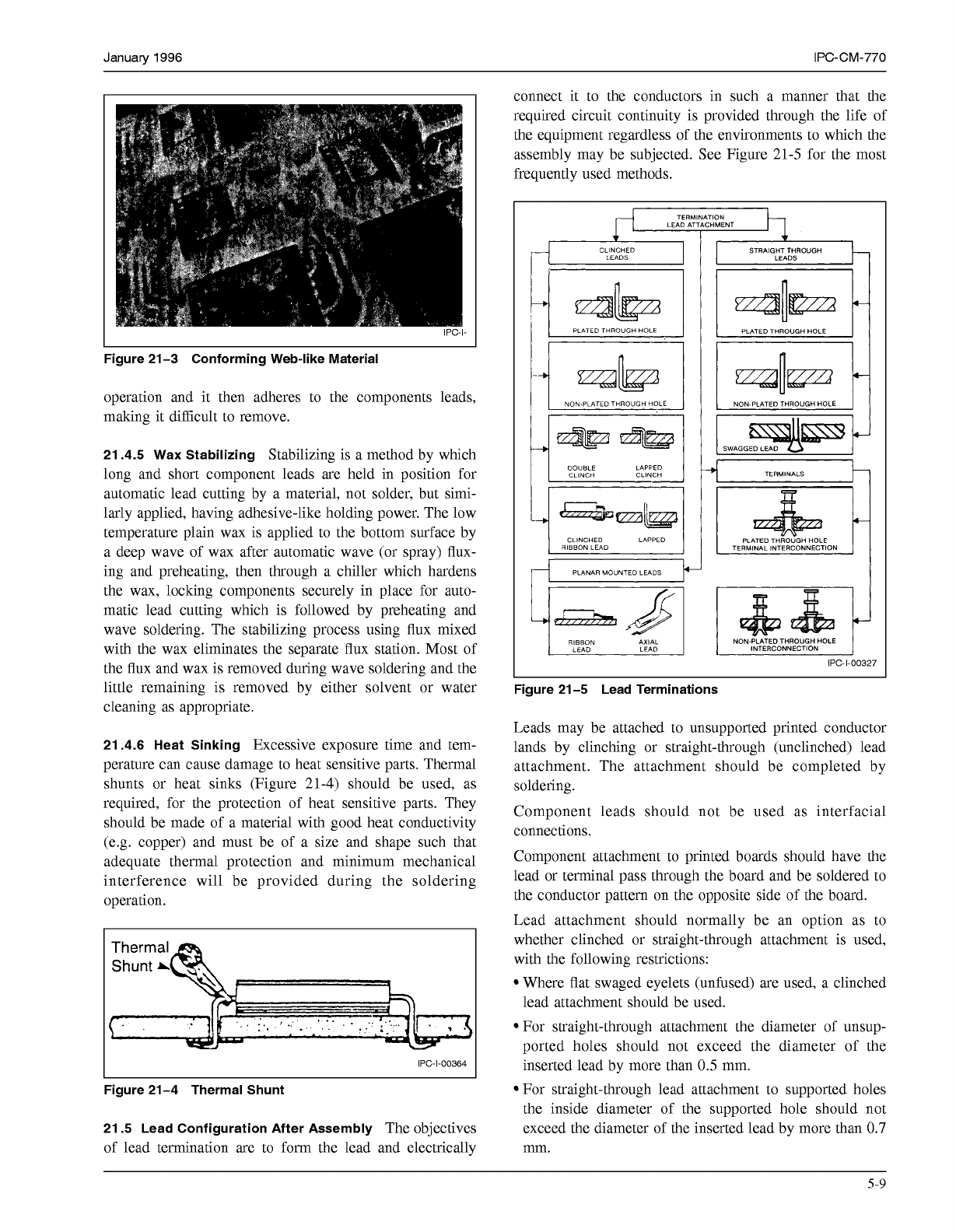
assembly may be subjected. See Figure
21-5
for the most
frequently used methods.
LEAD AT
i
CLINCHED
LEADS
I
PLATED THROUGH HOLE
I
I
1
NON-PLATED THROUGH HOLE1
I
I
CLINCHED
RIBBON LEAD
LAPPED
PLANAR MOUNTED LEADS
RIBBON AXIAL
LtAD LEAD
STRAIGHT THROUGH
PLATED THROUGH HOLE
I
I
NON~PLATED THROUGH HOLE
-
TERMINALS
IPC-1-00327
Figure 21
-5
Lead Terminations
Leads may be attached to unsupported printed conductor
lands by clinching or straight-through (unclinched) lead
attachment. The attachment should be completed by
soldering.
Component leads should not be used as interfacial
connections.
Component attachment to printed boards should have the
lead or terminal pass through the board and be soldered to
the conductor pattern on the opposite side of the board.
Lead attachment should normally be an option as to
whether clinched or straight-through attachment is used,
with the following restrictions:
Where flat swaged eyelets (unfused) are used, a clinched
lead attachment should be used.
For straight-through attachment the diameter of unsup-
ported holes should not exceed the diameter of the
inserted lead by more than
0.5
mm.
For straight-through lead attachment to supported holes
the inside diameter of the supported hole should not
exceed the diameter of the inserted lead by more than
0.7
mm.
5-9
COPYRIGHT Association Connecting Electronics Industries
Licensed by Information Handling Services
COPYRIGHT Association Connecting Electronics Industries
Licensed by Information Handling Services