IPC-CM-770D-1996 - 第15页
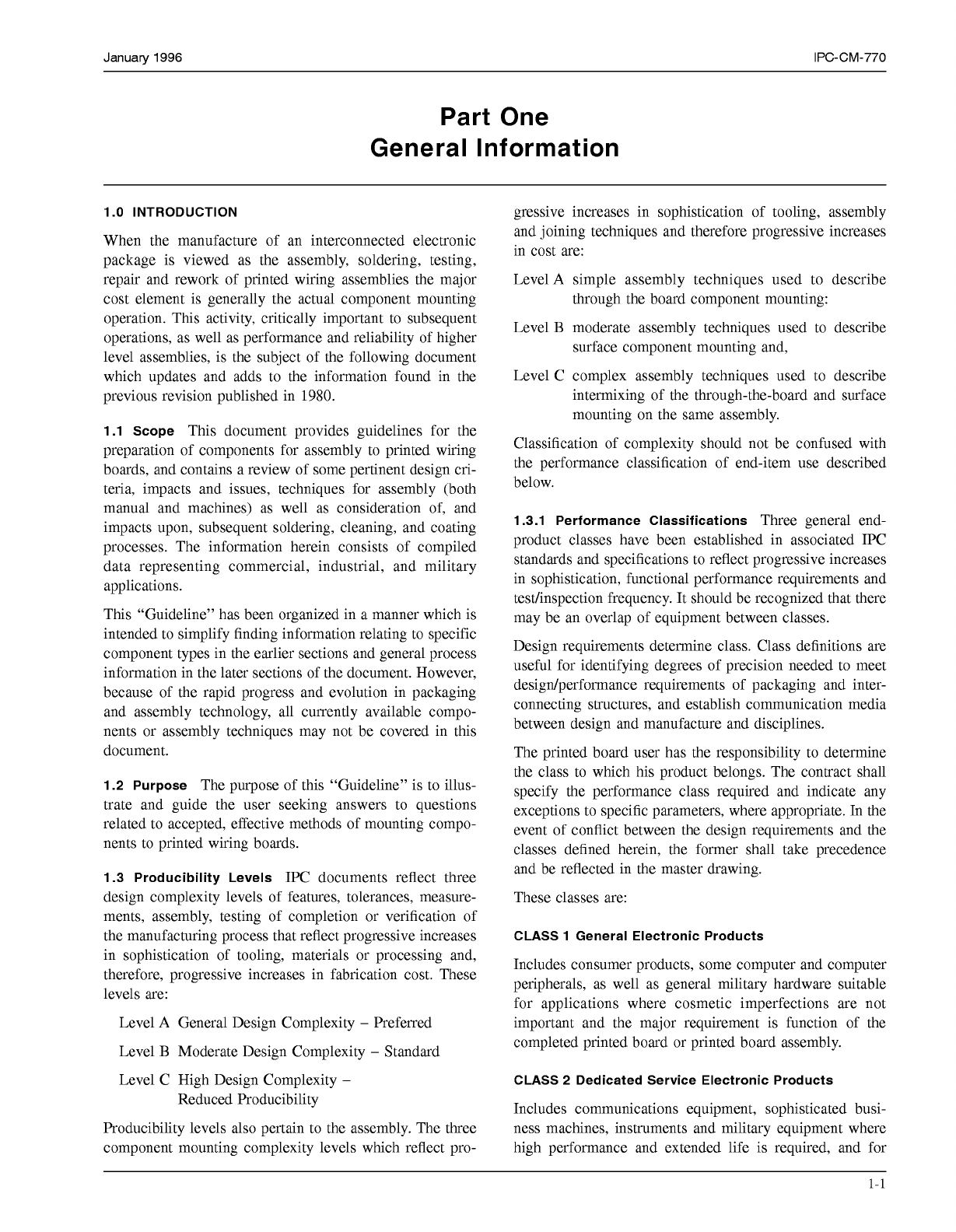
January 1996 IPC-CM-770 Part One General Information 1 .O INTRODUCTION When the manufacture of an interconnected electronic package is viewed as the assembly, soldering, testing, repair and rework of printed wiring assem…
IPC-CM-770
Januaty
1996
26.0
26.1
26.2
26.3
26.4
27.0
27.1
27.2
27.3
27.4
27.5
28.0
28.1
28.2
28.3
28.4
29.0
29.1
29.2
29.3
29.4
29.5
30.0
30.1
30.2
30.3
30.4
30.5
30.6
Table
of
Contents
.
Section
6
Figures
HANDLING AND STORAGE
.................................
6-1
General Considerations
.................................
6-1
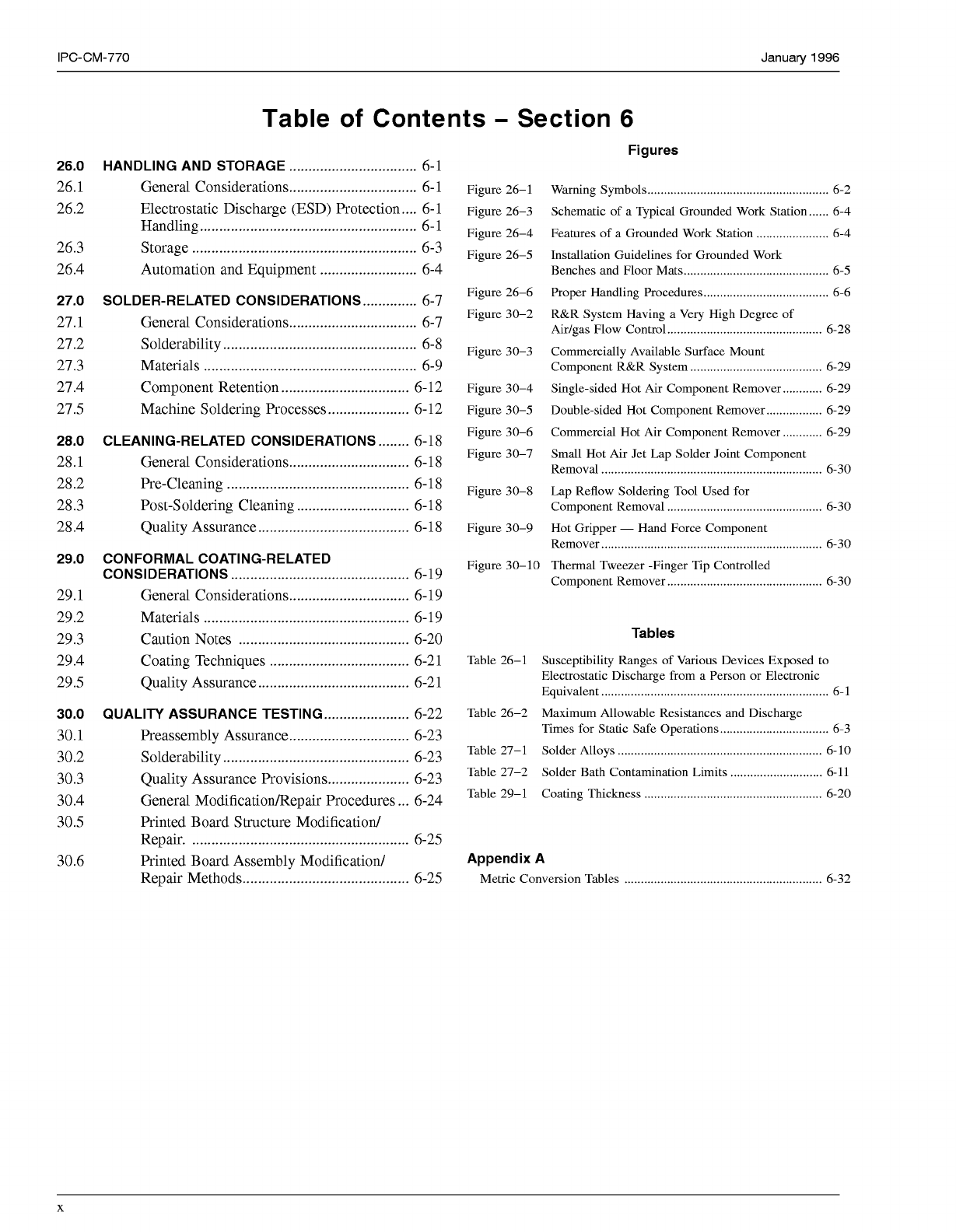
Figure 26-1 Warning Symbols
.......................................................
6-2
Electrostatic Discharge @SD) Protection
....
6-1
Figure 26-3 Schematic of a Typical Grounded Work Station
......
6-4
Handling
........................................................
6-
1
Figure 26-4 Features of a Grounded Work Station
......................
6-4
Storage
..........................................................
6-3
Figure 26-5 Installation Guidelines for Grounded Work
Automation and Equipment
.........................
6-4
Benches and Floor Mats
............................................
6-5
......................................
SOLDER-RELATED CONSIDERATIONS
6-7
Figure 26-6 Proper Handling Procedures 6-6
Figure 30-2 R&R System Having a Very High Degree of
..............
General Considerations 6-7
.................................
Airkas Flow Control
...............................................
6-28
.
Solderability
..................................................
6-8
Materials
.......................................................
6-9
Component R&R System
........................................
6-29
Figure 30-3 Commercially Available Surface Mount
Component Retention
.................................
6-12
Figure 30-4 Single-sided Hot Air Component Remover
............
6-29
Machine Soldering Processes
.....................
6-12
Figure 30-5 Double-sided Hot Component Remover
.................
6-29
............
CLEANING-RELATED CONSIDERATIONS
6-18
Figure 30-6 Commercial Hot Air Component Remover 6-29
........
~~
Figure 30-7 Small Hot Air Jet Lap Solder Joint Component
General Considerations
...............................
6-18
Removal
...................................................................
6-30
Pre-Cleaning
...............................................
6-18
Post-Soldering Cleaning
.............................
6-18
Component Removal
...............................................
6-30
Figure 30-8 Lap Reflow Soldering Tool Used for
Quality Assurance
.......................................
6-18
Figure 30-9 Hot Gripper
.
Hand Force Component
Remover
...................................................................
6-30
CONFORMAL COATING-RELATED
CONSIDERATIONS
..............................................
6-19
Figure 30-10 Thermal Tweezer -Finger Tip Controlled
Comoonent Remover
...............................................
6-30
General Considerations
...............................
6-19
Materials
.....................................................
6-19
Caution Notes 6-20
Tables
............................................
coating Techniques
....................................
6-21
Table 26-1 Susceptibility Ranges of Various Devices Exposed to
Quality Assurance 6-21
Electrostatic Discharge from a Person or Electronic
Equivalent
.....................................................................
6-1
.......................................
QUALITY ASSURANCE TESTING
......................
6-22
Table 26-2 Maximum Allowable Resistances and Discharge
.................................
Preassembly Assurance 6-23
Times for Static Safe Operations 6-3
Solderability 6-23
Table 27-1 Solder Alloys 6-10
Quality Assurance Provisions 6-23
Table 27-2 Solder Bath Contamination Limits 6-11
General
...
6-24
Table 29-1 Coating Thickness
......................................................
6-20
Printed Board Structure Modification/
Repair
.........................................................
6-25
Printed Board Assembly Modification/
Appendix A
Repair Methods
...........................................
6-25
Metric Conversion Tables
............................................................
6-32
...............................
..............................................................
................................................
............................
.....................
X
COPYRIGHT Association Connecting Electronics Industries
Licensed by Information Handling Services
COPYRIGHT Association Connecting Electronics Industries
Licensed by Information Handling Services
January
1996
IPC-CM-770
Part One
General Information
1
.O
INTRODUCTION
When the manufacture of an interconnected electronic
package is viewed as the assembly, soldering, testing,
repair and rework of printed wiring assemblies the major
cost element is generally the actual component mounting
operation. This activity, critically important to subsequent
operations, as well as performance and reliability of higher
level assemblies, is the subject of the following document
which updates and adds to the information found in the
previous revision published in
1980.
1.1 Scope
This document provides guidelines for the
preparation of components for assembly to printed wiring
boards, and contains a review of some pertinent design cri-
teria, impacts and issues, techniques for assembly (both
manual and machines) as well as consideration of, and
impacts upon, subsequent soldering, cleaning, and coating
processes. The information herein consists of compiled
data representing commercial, industrial, and military
applications.
This “Guideline” has been organized in a manner which is
intended to simplify finding information relating to specific
component types in the earlier sections and general process
information in the later sections of the document. However,
because of the rapid progress and evolution in packaging
and assembly technology, all currently available compo-
nents or assembly techniques may not be covered in this
document.
1.2 Purpose
The purpose of this “Guideline” is to illus-
trate and guide the user seeking answers to questions
related to accepted, effective methods of mounting compo-
nents to printed wiring boards.
1.3 Producibility Levels
IPC documents reflect three
design complexity levels of features, tolerances, measure-
ments, assembly, testing of completion or verification of
the manufacturing process that reflect progressive increases
in sophistication of tooling, materials or processing and,
therefore, progressive increases in fabrication cost. These
levels are:
Level
A
General Design Complexity
-
Preferred
Level
B
Moderate Design Complexity
-
Standard
Level C High Design Complexity
-
Reduced Producibility
Producibility levels also pertain to the assembly. The three
component mounting complexity levels which reflect pro-
gressive increases in sophistication of tooling, assembly
and joining techniques and therefore progressive increases
in cost are:
Level
A
simple assembly techniques used to describe
through the board component mounting:
Level
B
moderate assembly techniques used to describe
surface component mounting and,
Level C complex assembly techniques used to describe
intermixing of the through-the-board and surface
mounting on the same assembly.
Classification of complexity should not be confused with
the performance classification of end-item use described
below.
1.3.1 Performance Classifications
Three general end-
product classes have been established in associated IPC
standards and specifications to reflect progressive increases
in sophistication, functional performance requirements and
tesdinspection frequency. It should be recognized that there
may be an overlap of equipment between classes.
Design requirements determine class. Class definitions are
useful for identifying degrees of precision needed to meet
desigdperformance requirements of packaging and inter-
connecting structures, and establish communication media
between design and manufacture and disciplines.
The printed board user has the responsibility to determine
the class to which his product belongs. The contract shall
specify the performance class required and indicate any
exceptions to specific parameters, where appropriate. In the
event of conflict between the design requirements and the
classes defined herein, the former shall take precedence
and be reflected in the master drawing.
These classes are:
CLASS 1 General Electronic Products
Includes consumer products, some computer and computer
peripherals, as well as general military hardware suitable
for applications where cosmetic imperfections are not
important and the major requirement is function of the
completed printed board or printed board assembly.
CLASS 2 Dedicated Service Electronic Products
Includes communications equipment, sophisticated busi-
ness machines, instruments and military equipment where
high performance and extended life is required, and for
1-1
COPYRIGHT Association Connecting Electronics Industries
Licensed by Information Handling Services
COPYRIGHT Association Connecting Electronics Industries
Licensed by Information Handling Services
IPC-CM-770
Januaty
1996
which uninterrupted service is desired but is not critical.
Certain cosmetic imperfections are allowed.
CLASS 3 High Reliability Electronic Products
Includes the equipment for commercial and military prod-
ucts where continued performance or performance on
demand is critical. Equipment downtime cannot be toler-
ated, and functionality is required for such applications as
life support items, or missile systems. Printed boards and
printed board assemblies in this class are suitable for appli-
cations where high levels of assurance are required and
service is essential.
The land patterns in this standard have the capability of
accommodating all three performance classifications.
1.4 ASSEMBLY TYPES
A type designation signifies fur-
ther sophistication describing whether components are
mounted on one or both sides of the packaging and inter-
connecting structure. Type
1
defines an assembly that has
components mounted on only one side; type
2
is an assem-
bly with components on both sides. Type
2
is limited to
only class B or C assemblies.
Figure
1-1
shows the relationship of two types of assem-
blies.
The need to apply certain design concepts should depend
on the complexity and precision required to produce a par-
ticular land pattern or printed board structure. Any design
class may be applied to any of the end-product equipment
categories; therefore, a moderate complexity (Type 1B)
would define components mounted on one side (all surface
mounted) and when used in a Class
2
product (dedicated
service electronics) is referred to as type lB, Class
2.
The
product described as Type lB, Class
2
might be used in any
of the end-use applications; the selection of class being
dependent on the requirements of the customers using the
application.
1.5 Presentation
All dimensions and tolerances are
expressed in metric. Reference information is shown in
parentheses
(
).
2.0 REFERENCE DOCUMENTS
The following documents, of the issue currently in effect
form a part of this document to the extent specified herein.
Other documents listed are for reference purposes to assist
the user.
2.1 Institute for Interconnecting and Packaging Elec-
tronic Circuits (IPC)’
IPC-T-50
Terms and Definitions
IPC-SCIO
Post Solder Solvent Cleaning Handbook
IPC-AC-62
Post Solder Aqueous Cleaning Handbook
IPC-RF-245
Performance Specification for Rigid-Flex
Printed Boards
IPC-D-249
Design Standard for Flexible Single- and
Double-Sided Printed Boards
IPC-FC-250
Performance Specification for Single- and
Double-Sided Flexible Printed Wiring
IPC-D-275
Design Standard for Rigid Printed Boards and
Rigid Printed Board Assemblies
IPC-RB-276
Qualification and Performance Specification
for Rigid Printed Boards
IPC-D-322
Guidelines for Selecting Printed Wiring Board
Sizes Using Standard Panel Sizes
IPC-MC-324
Qualification and Performance Specification
for Metal Core Boards
IPC-D-325
Documentation Requirements for Printed
Boards, Assemblies, and Support Drawings
IPC-D-330
Design Guide
IPC-PD-335
Electronic Packaging Handbook
IPC-C-406
Design and Application Guidelines for Surface
Mount Connectors
IPC-A-600
Acceptability of Printed Boards
IPC-A-61
O
Acceptability of Electronic Assemblies
IPC-R-700
Suggested Guidelines for Modification,
Rework, and Repair of Printed Wiring Boards and Assem-
blies
IPC-SM-782
Surface Mount Design and Land Pattern
Standard
IPC-SM-784
Guidelines for Chip-On-Board Technology
Implementation
IPC-AJ-820
Assembly and Joining Handbook
IPC-CA-821
General Requirements for Thermally Con-
ductive Adhesives
IPC-CC-830
Electrical Insulating Compounds for Printed
Board Assemblies
IPC-SM-840
Qualification and Performance of Permanent
Polymer Coating (Solder Mask) for Printed Boards
IPC-H-855
Hybrid Microcircuit Design Guide
SMC-TR-001
An Introduction to Tape Automated Bonding
Find Pitch Technology
l.
Institute for Interconnecting and Packaging Electronic Circuits,
2215
Sanders Road, Northbrook,
IL
60062.
1-2
COPYRIGHT Association Connecting Electronics Industries
Licensed by Information Handling Services
COPYRIGHT Association Connecting Electronics Industries
Licensed by Information Handling Services