IPC-CM-770D-1996 - 第160页
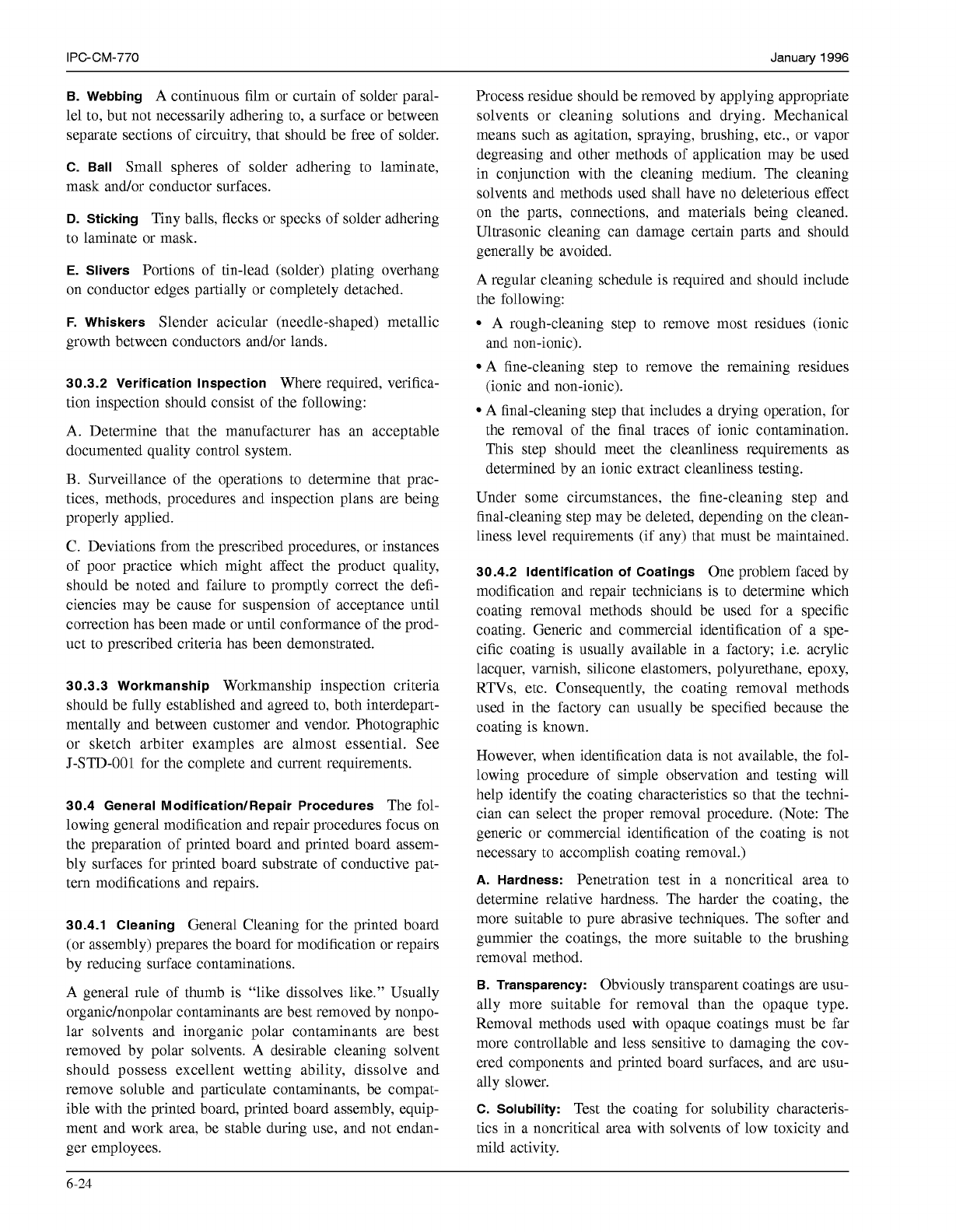
IPC-CM-770 Januaty 1996 B. Webbing A continuous film or curtain of solder paral- lel to, but not necessarily adhering to, a surface or between separate sections of circuitry, that should be free of solder. C. Ball Small …
January
1996
IPC-CM-770
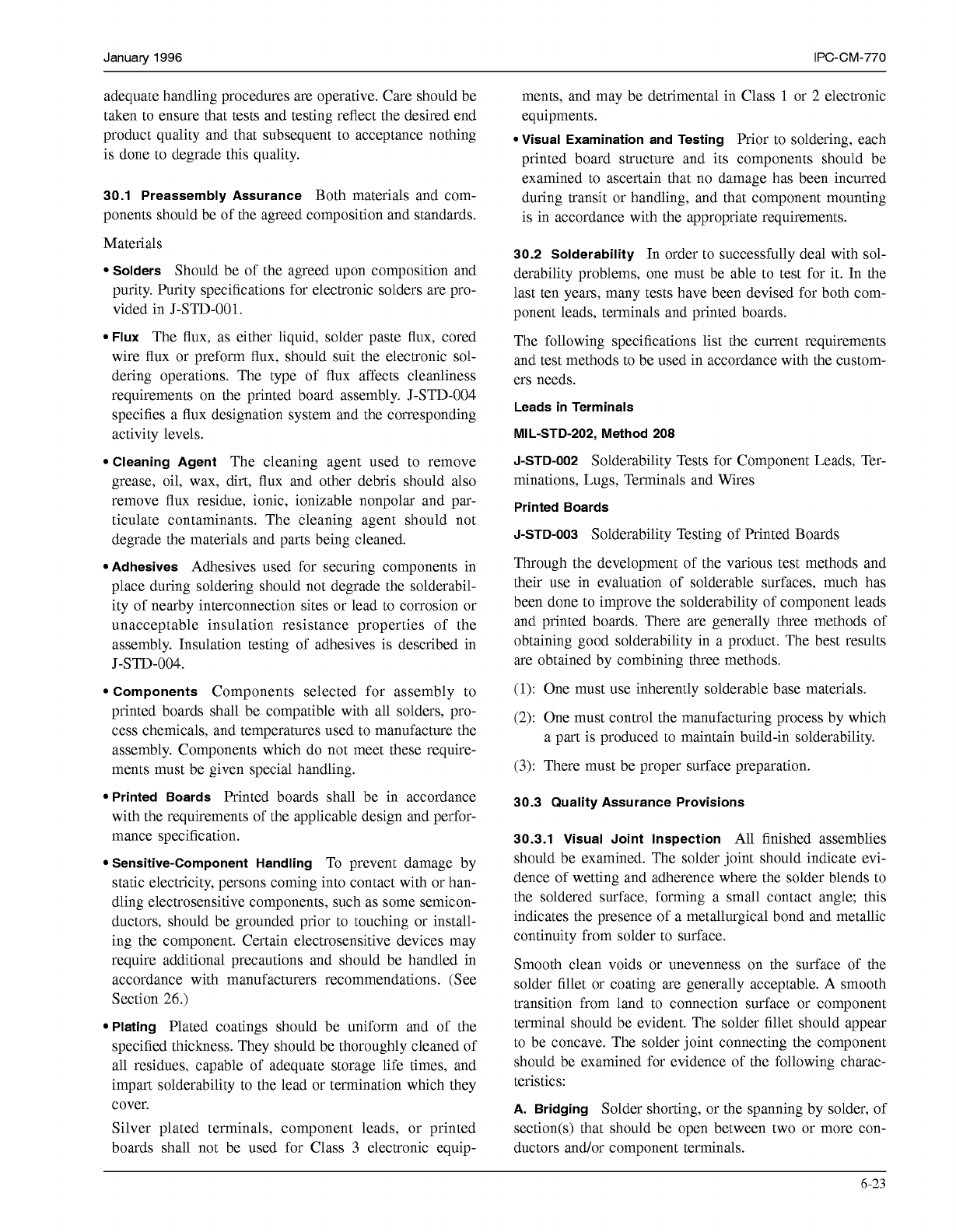
adequate handling procedures are operative. Care should be
taken to ensure that tests and testing reflect the desired end
product quality and that subsequent to acceptance nothing
is done to degrade this quality.
30.1 Preassembly Assurance
Both materials and com-
ponents should be of the agreed composition and standards.
Materials
Solders
Should be of the agreed upon composition and
purity. Purity specifications for electronic solders are pro-
vided in J-STD-001.
Flux
The flux, as either liquid, solder paste flux, cored
wire flux or preform flux, should suit the electronic sol-
dering operations. The type of flux affects cleanliness
requirements on the printed board assembly. J-STD-004
specifies a flux designation system and the corresponding
activity levels.
Cleaning Agent
The cleaning agent used to remove
grease, oil, wax, dirt, flux and other debris should also
remove flux residue, ionic, ionizable nonpolar and par-
ticulate contaminants. The cleaning agent should not
degrade the materials and parts being cleaned.
Adhesives
Adhesives used for securing components in
place during soldering should not degrade the solderabil-
ity of nearby interconnection sites or lead to corrosion or
unacceptable insulation resistance properties of the
assembly. Insulation testing of adhesives is described in
J-STD-004.
Components
Components selected for assembly to
printed boards shall be compatible with all solders, pro-
cess chemicals, and temperatures used to manufacture the
assembly. Components which do not meet these require-
ments must be given special handling.
Printed Boards
Printed boards shall be in accordance
with the requirements of the applicable design and perfor-
mance specification.
Sensitive-Component Handling
To prevent damage by
static electricity, persons coming into contact with or han-
dling electrosensitive components, such as some semicon-
ductors, should be grounded prior to touching or install-
ing the component. Certain electrosensitive devices may
require additional precautions and should be handled in
accordance with manufacturers recommendations. (See
Section
26.)
Plating
Plated coatings should be uniform and of the
specified thickness. They should be thoroughly cleaned of
all residues, capable of adequate storage life times, and
impart solderability to the lead or termination which they
cover.
Silver plated terminals, component leads, or printed
boards shall not be used for Class
3
electronic equip-
ments, and may be detrimental in Class
1
or
2
electronic
equipments.
Visual Examination and Testing
Prior to soldering, each
printed board structure and its components should be
examined to ascertain that no damage has been incurred
during transit or handling, and that component mounting
is in accordance with the appropriate requirements.
30.2 Solderability
In order to successfully deal with sol-
derability problems, one must be able to test for it. In the
last ten years, many tests have been devised for both com-
ponent leads, terminals and printed boards.
The following specifications list the current requirements
and test methods to be used in accordance with the custom-
ers needs.
Leads in Terminals
MIL-STD-202, Method 208
J-STD-002
Solderability Tests for Component Leads, Ter-
minations, Lugs, Terminals and Wires
Printed Boards
J-STD-003
Solderability Testing of Printed Boards
Through the development of the various test methods and
their use in evaluation of solderable surfaces, much has
been done to improve the solderability of component leads
and printed boards. There are generally three methods of
obtaining good solderability in a product. The best results
are obtained by combining three methods.
(1):
One must use inherently solderable base materials.
(2):
One must control the manufacturing process by which
a part is produced to maintain build-in solderability.
(3):
There must be proper surface preparation.
30.3 Quality Assurance Provisions
30.3.1 Visual Joint Inspection
All finished assemblies
should be examined. The solder joint should indicate evi-
dence of wetting and adherence where the solder blends to
the soldered surface, forming a small contact angle; this
indicates the presence of a metallurgical bond and metallic
continuity from solder to surface.
Smooth clean voids or unevenness on the surface of the
solder fillet or coating are generally acceptable. A smooth
transition from land to connection surface or component
terminal should be evident. The solder fillet should appear
to be concave. The solder joint connecting the component
should be examined for evidence of the following charac-
teristics:
A. Bridging
Solder shorting, or the spanning by solder, of
section(s) that should be open between two or more con-
ductors and/or component terminals.
6-23
COPYRIGHT Association Connecting Electronics Industries
Licensed by Information Handling Services
COPYRIGHT Association Connecting Electronics Industries
Licensed by Information Handling Services
IPC-CM-770
Januaty
1996
B. Webbing
A
continuous film or curtain of solder paral-
lel to, but not necessarily adhering to, a surface or between
separate sections of circuitry, that should be free of solder.
C. Ball
Small spheres of solder adhering to laminate,
mask and/or conductor surfaces.
D.
Sticking
Tiny balls, flecks or specks of solder adhering
to laminate or mask.
E.
Slivers
Portions of tin-lead (solder) plating overhang
on conductor edges partially or completely detached.
F.
Whiskers
Slender acicular (needle-shaped) metallic
growth between conductors and/or lands.
30.3.2 Verification Inspection
Where required, verifica-
tion inspection should consist of the following:
A.
Determine that the manufacturer has an acceptable
documented quality control system.
B.
Surveillance of the operations to determine that prac-
tices, methods, procedures and inspection plans are being
properly applied.
C. Deviations from the prescribed procedures, or instances
of poor practice which might affect the product quality,
should be noted and failure to promptly correct the defi-
ciencies may be cause for suspension of acceptance until
correction has been made or until conformance of the prod-
uct to prescribed criteria has been demonstrated.
30.3.3 Workmanship
Workmanship inspection criteria
should be fully established and agreed to, both interdepart-
mentally and between customer and vendor. Photographic
or sketch arbiter examples are almost essential. See
J-STD-001
for the complete and current requirements.
30.4 General ModificationlRepair Procedures
The fol-
lowing general modification and repair procedures focus on
the preparation of printed board and printed board assem-
bly surfaces for printed board substrate of conductive pat-
tem modifications and repairs.
30.4.1 Cleaning
General Cleaning for the printed board
(or assembly) prepares the board for modification or repairs
by reducing surface contaminations.
A
general rule of thumb is “like dissolves like.” Usually
organichonpolar contaminants are best removed by nonpo-
lar solvents and inorganic polar contaminants are best
removed by polar solvents.
A
desirable cleaning solvent
should possess excellent wetting ability, dissolve and
remove soluble and particulate contaminants, be compat-
ible with the printed board, printed board assembly, equip-
ment and work area, be stable during use, and not endan-
ger employees.
Process residue should be removed by applying appropriate
solvents or cleaning solutions and drying. Mechanical
means such as agitation, spraying, brushing, etc., or vapor
degreasing and other methods of application may be used
in conjunction with the cleaning medium. The cleaning
solvents and methods used shall have no deleterious effect
on the parts, connections, and materials being cleaned.
Ultrasonic cleaning can damage certain parts and should
generally be avoided.
A
regular cleaning schedule is required and should include
the following:
A
rough-cleaning step to remove most residues (ionic
and non-ionic).
A
fine-cleaning step to remove the remaining residues
(ionic and non-ionic).
A
final-cleaning step that includes a drying operation, for
the removal of the final traces of ionic contamination.
This step should meet the cleanliness requirements as
determined by an ionic extract cleanliness testing.
Under some circumstances, the fine-cleaning step and
final-cleaning step may be deleted, depending on the clean-
liness level requirements (if any) that must be maintained.
30.4.2 Identification of Coatings
One problem faced by
modification and repair technicians is to determine which
coating removal methods should be used for a specific
coating. Generic and commercial identification of a spe-
cific coating is usually available in a factory; i.e. acrylic
lacquer, varnish, silicone elastomers, polyurethane, epoxy,
RTVs, etc. Consequently, the coating removal methods
used in the factory can usually be specified because the
coating is known.
However, when identification data is not available, the fol-
lowing procedure of simple observation and testing will
help identify the coating characteristics
so
that the techni-
cian can select the proper removal procedure. (Note: The
generic or commercial identification of the coating is not
necessary to accomplish coating removal.)
A.
Hardness:
Penetration test in a noncritical area to
determine relative hardness. The harder the coating, the
more suitable to pure abrasive techniques. The softer and
gummier the coatings, the more suitable to the brushing
removal method.
B. Transparency:
Obviously transparent coatings are usu-
ally more suitable for removal than the opaque type.
Removal methods used with opaque coatings must be far
more controllable and less sensitive to damaging the cov-
ered components and printed board surfaces, and are usu-
ally slower.
C. Solubility:
Test the coating for solubility characteris-
tics in a noncritical area with solvents of low toxicity and
mild activity.
6-24
COPYRIGHT Association Connecting Electronics Industries
Licensed by Information Handling Services
COPYRIGHT Association Connecting Electronics Industries
Licensed by Information Handling Services
January
1996
IPC-CM-770
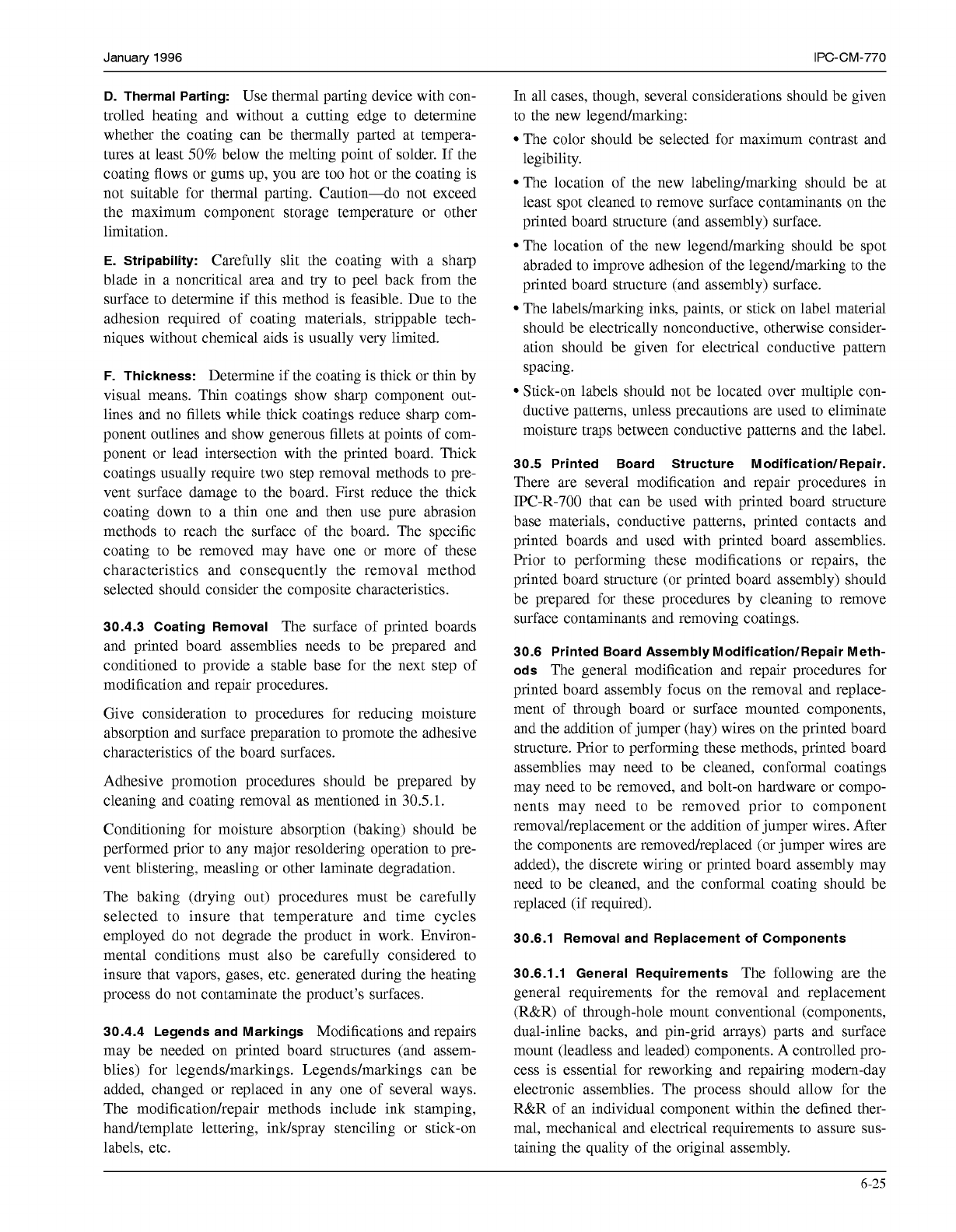
D.
Thermal Parting:
Use thermal parting device with con-
trolled heating and without a cutting edge to determine
whether the coating can be thermally parted at tempera-
tures at least
50%
below the melting point of solder.
If
the
coating flows or gums up, you are too hot or the coating is
not suitable for thermal parting. Caution40 not exceed
the maximum component storage temperature or other
limitation.
E.
Stripability:
Carefully slit the coating with a sharp
blade in a noncritical area and try to peel back from the
surface to determine if this method is feasible. Due to the
adhesion required of coating materials, strippable tech-
niques without chemical aids is usually very limited.
F.
Thickness:
Determine if the coating is thick or thin by
visual means. Thin coatings show sharp component out-
lines and no fillets while thick coatings reduce sharp com-
ponent outlines and show generous fillets at points of com-
ponent or lead intersection with the printed board. Thick
coatings usually require two step removal methods to pre-
vent surface damage to the board. First reduce the thick
coating down to a thin one and then use pure abrasion
methods to reach the surface of the board. The specific
coating to be removed may have one or more of these
characteristics and consequently the removal method
selected should consider the composite characteristics.
30.4.3 Coating Removal
The surface of printed boards
and printed board assemblies needs to be prepared and
conditioned to provide a stable base for the next step of
modification and repair procedures.
Give consideration to procedures for reducing moisture
absorption and surface preparation to promote the adhesive
characteristics of the board surfaces.
Adhesive promotion procedures should be prepared by
cleaning and coating removal as mentioned in
30.5.1.
Conditioning for moisture absorption (baking) should be
performed prior to any major resoldering operation to pre-
vent blistering, measling or other laminate degradation.
The baking (drying out) procedures must be carefully
selected to insure that temperature and time cycles
employed do not degrade the product in work. Environ-
mental conditions must also be carefully considered to
insure that vapors, gases, etc. generated during the heating
process do not contaminate the product’s surfaces.
30.4.4 Legends and Markings
Modifications and repairs
may be needed on printed board structures (and assem-
blies) for legenddmarkings. Legenddmarkings can be
added, changed or replaced in any one of several ways.
The modification/repair methods include ink stamping,
handtemplate lettering, inkhpray stenciling or stick-on
labels, etc.
In all cases, though, several considerations should be given
to the new legendmarking:
The color should be selected for maximum contrast and
legibility.
The location of the new labeling/marking should be at
least spot cleaned to remove surface contaminants on the
printed board structure (and assembly) surface.
The location of the new legendmarking should be spot
abraded to improve adhesion of the legendmarking to the
printed board structure (and assembly) surface.
The labeldmarking inks, paints, or stick on label material
should be electrically nonconductive, otherwise consider-
ation should be given for electrical conductive pattern
spacing.
Stick-on labels should not be located over multiple con-
ductive patterns, unless precautions are used to eliminate
moisture traps between conductive patterns and the label.
30.5 Printed Board Structure ModificationlRepair.
There are several modification and repair procedures in
IPC-R-700 that can be used with printed board structure
base materials, conductive patterns, printed contacts and
printed boards and used with printed board assemblies.
Prior to performing these modifications or repairs, the
printed board structure (or printed board assembly) should
be prepared for these procedures by cleaning to remove
surface contaminants and removing coatings.
30.6 Printed Board Assembly ModificationlRepair Meth-
ods
The general modification and repair procedures for
printed board assembly focus on the removal and replace-
ment of through board or surface mounted components,
and the addition of jumper (hay) wires on the printed board
structure. Prior to performing these methods, printed board
assemblies may need to be cleaned, conformal coatings
may need to be removed, and bolt-on hardware or compo-
nents may need to be removed prior to component
removal/replacement or the addition of jumper wires. After
the components are removedreplaced (or jumper wires are
added), the discrete wiring or printed board assembly may
need to be cleaned, and the conformal coating should be
replaced (if required).
30.6.1 Removal and Replacement of Components
30.6.1.1 General Requirements
The following are the
general requirements for the removal and replacement
(R&R) of through-hole mount conventional (components,
dual-inline backs, and pin-grid arrays) parts and surface
mount (leadless and leaded) components. A controlled pro-
cess is essential for reworking and repairing modem-day
electronic assemblies. The process should allow for the
R&R of an individual component within the defined ther-
mal, mechanical and electrical requirements to assure sus-
taining the quality of the original assembly.
6-25
COPYRIGHT Association Connecting Electronics Industries
Licensed by Information Handling Services
COPYRIGHT Association Connecting Electronics Industries
Licensed by Information Handling Services