IPC-CM-770D-1996 - 第19页
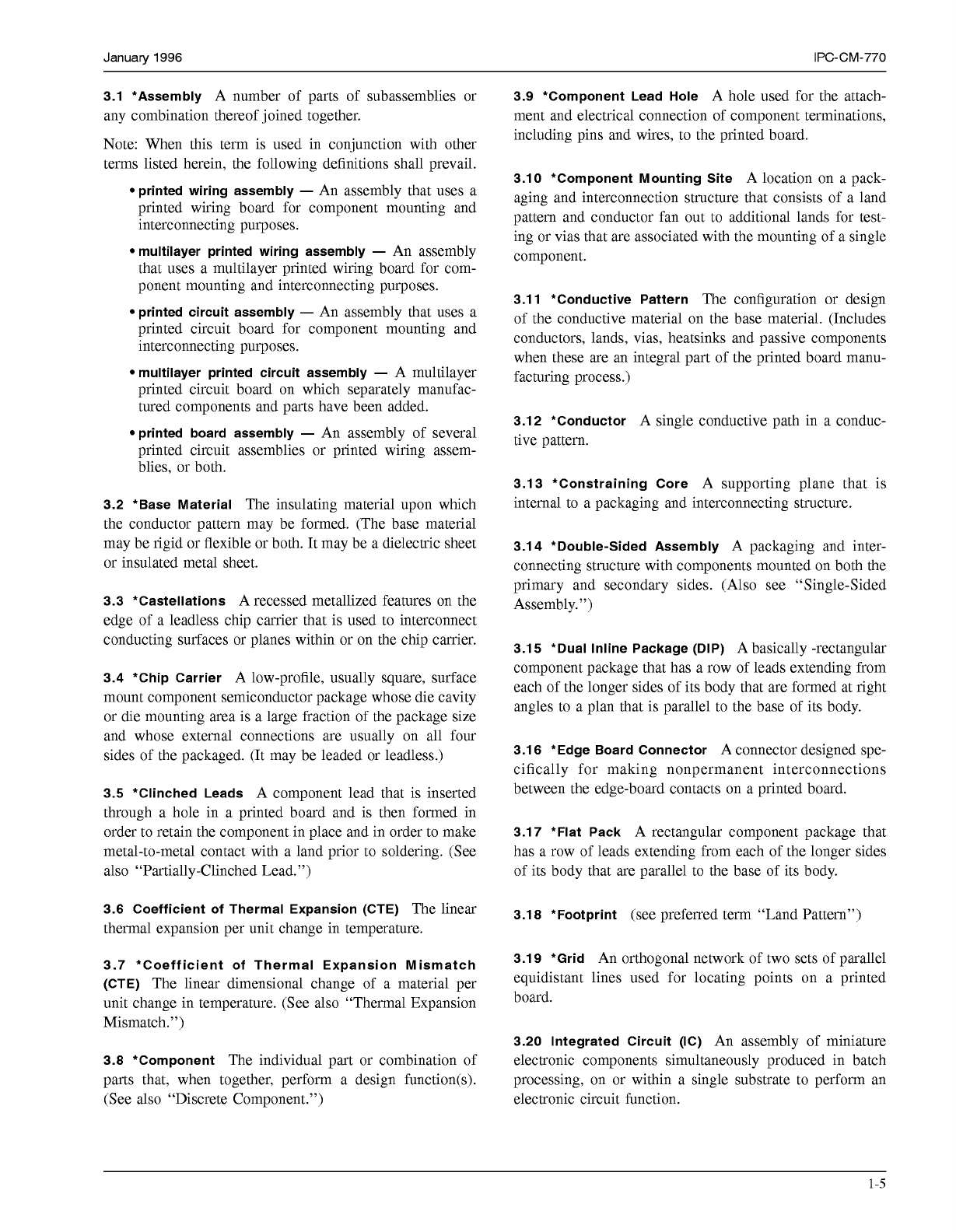
January 1996 IPC-CM-770 3.1 *Assembly A number of parts of subassemblies or any combination thereof joined together. Note: When this term is used in conjunction with other terms listed herein, the following definitions s…
IPC-CM-770
Januaty
1996
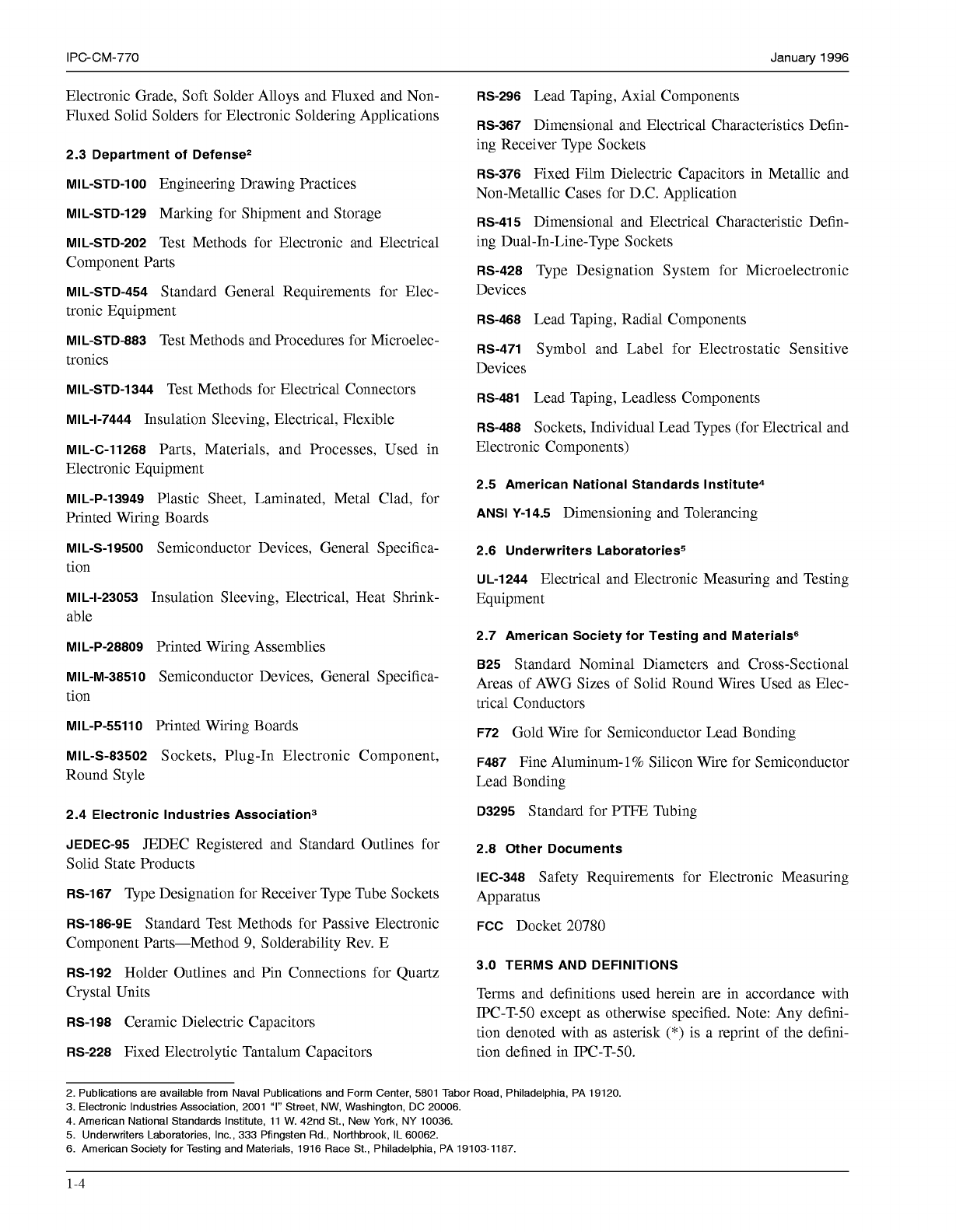
Electronic Grade, Soft Solder Alloys and Fluxed and Non-
Fluxed Solid Solders for Electronic Soldering Applications
2.3 Department of Defense2
MIL-STD-1
O0
Engineering Drawing Practices
MIL-STD-129
Marking for Shipment and Storage
MIL-STD-202
Test Methods for Electronic and Electrical
Component Parts
MIL-STD-454
Standard General Requirements for Elec-
tronic Equipment
MIL-STD-883
Test Methods and Procedures for Microelec-
tronics
MIL-STD-1344
Test Methods for Electrical Connectors
MIL-1-7444
Insulation Sleeving, Electrical, Flexible
MIL-C-11268
Parts, Materials, and Processes, Used in
Electronic Equipment
MIL-P-13949
Plastic Sheet, Laminated, Metal Clad, for
Printed Wiring Boards
MIL-S-1 9500
Semiconductor Devices, General Specifica-
tion
MIL-1-23053
Insulation Sleeving, Electrical, Heat Shrink-
able
MIL-P-28809
Printed Wiring Assemblies
MIL-M-3851
O
Semiconductor Devices, General Specifica-
tion
MIL-P-55110
Printed Wiring Boards
MIL-S-83502
Sockets, Plug-In Electronic Component,
Round Style
2.4 Electronic Industries Association3
JEDEC-95
JEDEC Registered and Standard Outlines for
Solid State Products
RS-167
Type Designation for Receiver Type Tube Sockets
RS-186-9E
Standard Test Methods for Passive Electronic
Component Parts-Method
9,
Solderability Rev. E
RS-192
Holder Outlines and Pin Connections for Quartz
Crystal Units
RS-198
Ceramic Dielectric Capacitors
RS-228
Fixed Electrolytic Tantalum Capacitors
RS-296
Lead Taping, Axial Components
RS-367
Dimensional and Electrical Characteristics Defin-
ing Receiver Type Sockets
RS-376
Fixed Film Dielectric Capacitors in Metallic and
Non-Metallic Cases for D.C. Application
RS-415
Dimensional and Electrical Characteristic Defin-
ing Dual-In-Line-Type Sockets
RS-428
Type Designation System for Microelectronic
Devices
RS-468
Lead Taping, Radial Components
RS-471
Symbol and Label for Electrostatic Sensitive
Devices
RS-481
Lead Taping, Leadless Components
RS-488
Sockets, Individual Lead Types (for Electrical and
Electronic Components)
2.5 American National Standards Institute4
ANSI Y-1 4.5
Dimensioning and Tolerancing
2.6 Underwriters Laboratories5
UL-1244
Electrical and Electronic Measuring and Testing
Equipment
2.7 American Society for Testing and Materials6
B25
Standard Nominal Diameters and Cross-Sectional
Areas of AWG Sizes of Solid Round Wires Used as Elec-
trical Conductors
F72
Gold Wire for Semiconductor Lead Bonding
F487
Fine Aluminum-
1
%
Silicon Wire for Semiconductor
Lead Bonding
D3295
Standard for PTFE Tubing
2.8 Other Documents
IEC-348
Safety Requirements for Electronic Measuring
Apparatus
FCC
Docket
20780
3.0 TERMS AND DEFINITIONS
Terms and definitions used herein are in accordance with
IPC-T-50 except as otherwise specified. Note: Any defini-
tion denoted with as asterisk
(*)
is a reprint of the defini-
tion defined in IPC-T-50.
2. Publications are available from Naval Publications and Form Center, 5801 Tabor Road, Philadelphia, PA 19120.
3. Electronic Industries Association, 2001
"I"
Street, NW, Washington, DC 20006.
4. American National Standards Institute, 11 W. 42nd St., New York, NY 10036.
5. Underwriters Laboratories, Inc., 333 Pfingsten Rd., Northbrook, IL 60062.
6. American Society for Testing and Materials, 1916 Race St., Philadelphia, PA 19103-1187.
1-4
COPYRIGHT Association Connecting Electronics Industries
Licensed by Information Handling Services
COPYRIGHT Association Connecting Electronics Industries
Licensed by Information Handling Services
January
1996
IPC-CM-770
3.1 *Assembly
A number of parts of subassemblies or
any combination thereof joined together.
Note: When this term is used in conjunction with other
terms listed herein, the following definitions shall prevail.
printed wiring assembly
-
An assembly that uses a
printed wiring board for component mounting and
interconnecting purposes.
multilayer printed wiring assembly
-
An assembly
that uses a multilayer printed wiring board for com-
ponent mounting and interconnecting purposes.
printed circuit assembly
-
An assembly that uses a
printed circuit board for component mounting and
interconnecting purposes.
multilayer printed circuit assembly
-
A multilayer
printed circuit board on which separately manufac-
tured components and parts have been added.
printed board assembly
-
An assembly of several
printed circuit assemblies or printed wiring assem-
blies, or both.
3.2 *Base Material
The insulating material upon which
the conductor pattern may be formed. (The base material
may be rigid or flexible or both. It may be a dielectric sheet
or insulated metal sheet.
3.3 *Castellations
A recessed metallized features on the
edge of a leadless chip carrier that is used to interconnect
conducting surfaces or planes within or on the chip carrier.
3.4 *Chip Carrier
A low-profile, usually square, surface
mount component semiconductor package whose die cavity
or die mounting area is a large fraction of the package size
and whose external connections are usually on all four
sides of the packaged. (It may be leaded or leadless.)
3.5 *Clinched Leads
A component lead that is inserted
through a hole in a printed board and is then formed in
order to retain the component in place and in order to make
metal-to-metal contact with a land prior to soldering. (See
also “Partially-Clinched Lead.”)
3.6 Coefficient of Thermal Expansion (CTE)
The linear
thermal expansion per unit change in temperature.
3.7 *Coefficient of Thermal Expansion Mismatch
(CTE)
The linear dimensional change of a material per
unit change in temperature. (See also “Thermal Expansion
Mismatch.”)
3.8 *Component
The individual part or combination of
parts that, when together, perform a design function(s).
(See also “Discrete Component.”)
3.9 *Component Lead Hole
A hole used for the attach-
ment and electrical connection of component terminations,
including pins and wires, to the printed board.
3.10 *Component Mounting Site
A location on a pack-
aging and interconnection structure that consists of a land
pattern and conductor fan out to additional lands for test-
ing or vias that are associated with the mounting of a single
component.
3.11 *Conductive Pattern
The configuration or design
of the conductive material on the base material. (Includes
conductors, lands, vias, heatsinks and passive components
when these are an integral part of the printed board manu-
facturing process.)
3.12 *Conductor
A single conductive path in a conduc-
tive pattern.
3.13 *Constraining Core
A supporting plane that is
internal to a packaging and interconnecting structure.
3.14 *Double-Sided Assembly
A packaging and inter-
connecting structure with components mounted on both the
primary and secondary sides. (Also see “Single-Sided
Assembly.”)
3.1
5
*Dual lnline Package (DIP)
A basically -rectangular
component package that has a row of leads extending from
each of the longer sides of its body that are formed at right
angles to a plan that is parallel to the base of its body.
3.1 6 *Edge Board Connector
A connector designed spe-
cifically for making nonpermanent interconnections
between the edge-board contacts on a printed board.
3.17 *Flat Pack
A rectangular component package that
has a row of leads extending from each of the longer sides
of its body that are parallel to the base of its body.
3.1 8 *Footprint
(see preferred term “Land Pattern”)
3.1 9 *Grid
An orthogonal network of two sets of parallel
equidistant lines used for locating points on a printed
board.
3.20 Integrated Circuit (IC)
An assembly of miniature
electronic components simultaneously produced in batch
processing, on or within a single substrate to perform an
electronic circuit function.
1-5
COPYRIGHT Association Connecting Electronics Industries
Licensed by Information Handling Services
COPYRIGHT Association Connecting Electronics Industries
Licensed by Information Handling Services
IPC-CM-770
Januaty
1996
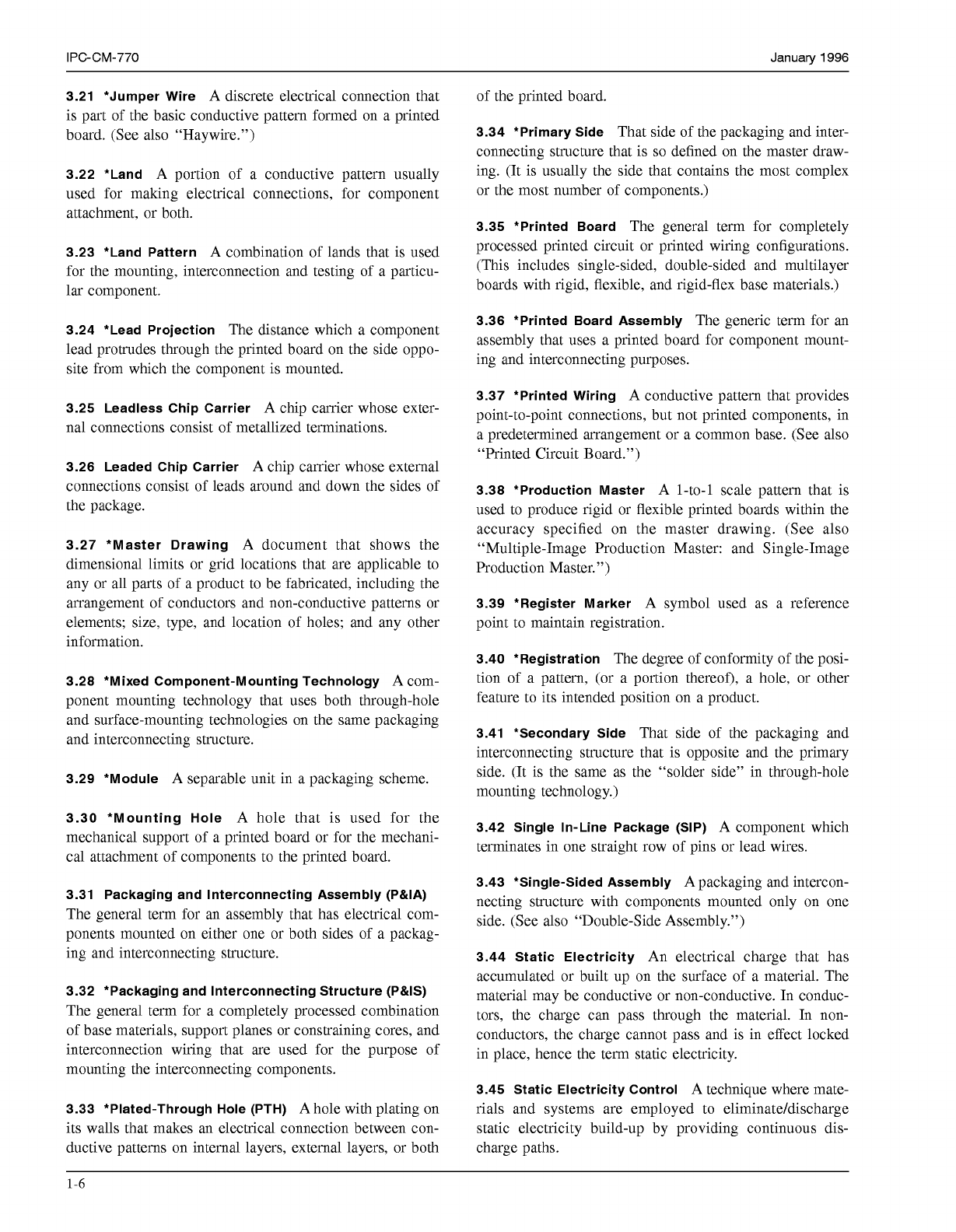
3.21 *Jumper Wire
A discrete electrical connection that
is part of the basic conductive pattern formed on a printed
board. (See also “Haywire.”)
3.22 *Land
A portion of a conductive pattern usually
used for making electrical connections, for component
attachment, or both.
3.23 *Land Pattern
A combination of lands that is used
for the mounting, interconnection and testing of a particu-
lar component.
3.24 *Lead Projection
The distance which a component
lead protrudes through the printed board on the side oppo-
site from which the component is mounted.
3.25 Leadless Chip Carrier
A chip carrier whose exter-
nal connections consist of metallized terminations.
3.26 Leaded Chip Carrier
A chip carrier whose external
connections consist of leads around and down the sides of
the package.
3.27 *Master Drawing
A document that shows the
dimensional limits or grid locations that are applicable to
any or all parts of a product to be fabricated, including the
arrangement of conductors and non-conductive patterns or
elements; size, type, and location of holes; and any other
information.
3.28 *Mixed Component-Mounting Technology
A com-
ponent mounting technology that uses both through-hole
and surface-mounting technologies on the same packaging
and interconnecting structure.
3.29 *Module
A separable unit in a packaging scheme.
3.30 *Mounting Hole
A hole that is used for the
mechanical support of a printed board or for the mechani-
cal attachment of components to the printed board.
3.31 Packaging and Interconnecting Assembly (P&lA)
The general term for an assembly that has electrical com-
ponents mounted on either one or both sides of a packag-
ing and interconnecting structure.
3.32 *Packaging and Interconnecting Structure (P&lS)
The general term for a completely processed combination
of base materials, support planes or constraining cores, and
interconnection wiring that are used for the purpose of
mounting the interconnecting components.
3.33 *Plated-Through Hole (PTH)
A hole with plating on
its walls that makes an electrical connection between con-
ductive patterns on internal layers, external layers, or both
of the printed board.
3.34 *Primary Side
That side of the packaging and inter-
connecting structure that is
so
defined on the master draw-
ing. (It is usually the side that contains the most complex
or the most number of components.)
3.35 *Printed Board
The general term for completely
processed printed circuit or printed wiring configurations.
(This includes single-sided, double-sided and multilayer
boards with rigid, flexible, and rigid-flex base materials.)
3.36 *Printed Board Assembly
The generic term for an
assembly that uses a printed board for component mount-
ing and interconnecting purposes.
3.37 *Printed Wiring
A conductive pattern that provides
point-to-point connections, but not printed components, in
a predetermined arrangement or a common base. (See also
“Printed Circuit Board.”)
3.38 *Production Master
A 1-to-1 scale pattern that is
used to produce rigid or flexible printed boards within the
accuracy specified on the master drawing. (See also
“Multiple-Image Production Master: and Single-Image
Production Master.”)
3.39 *Register Marker
A symbol used as a reference
point to maintain registration.
3.40 *Registration
The degree of conformity of the posi-
tion of a pattern, (or a portion thereof), a hole, or other
feature to its intended position on a product.
3.41 *Secondary Side
That side of the packaging and
interconnecting structure that is opposite and the primary
side. (It is the same as the “solder side” in through-hole
mounting technology.)
3.42 Single ln-Line Package (SIP)
A component which
terminates in one straight row of pins or lead wires.
3.43 *Single-Sided Assembly
A packaging and intercon-
necting structure with components mounted only on one
side. (See also “Double-Side Assembly.”)
3.44 Static Electricity
An electrical charge that has
accumulated or built up on the surface of a material. The
material may be conductive or non-conductive. In conduc-
tors, the charge can pass through the material. In non-
conductors, the charge cannot pass and is in effect locked
in place, hence the term static electricity.
3.45 Static Electricity Control
A technique where mate-
rials and systems are employed to eliminate/discharge
static electricity build-up by providing continuous dis-
charge paths.
1-6
COPYRIGHT Association Connecting Electronics Industries
Licensed by Information Handling Services
COPYRIGHT Association Connecting Electronics Industries
Licensed by Information Handling Services