IPC-CM-770D-1996 - 第29页
January 1996 IPC-CM-770 are used in the same assembly is rare to non-existent. Refer to general information related to class B/1 or B/2 assem- blies for consideration when leaded axial surface mount components are used w…
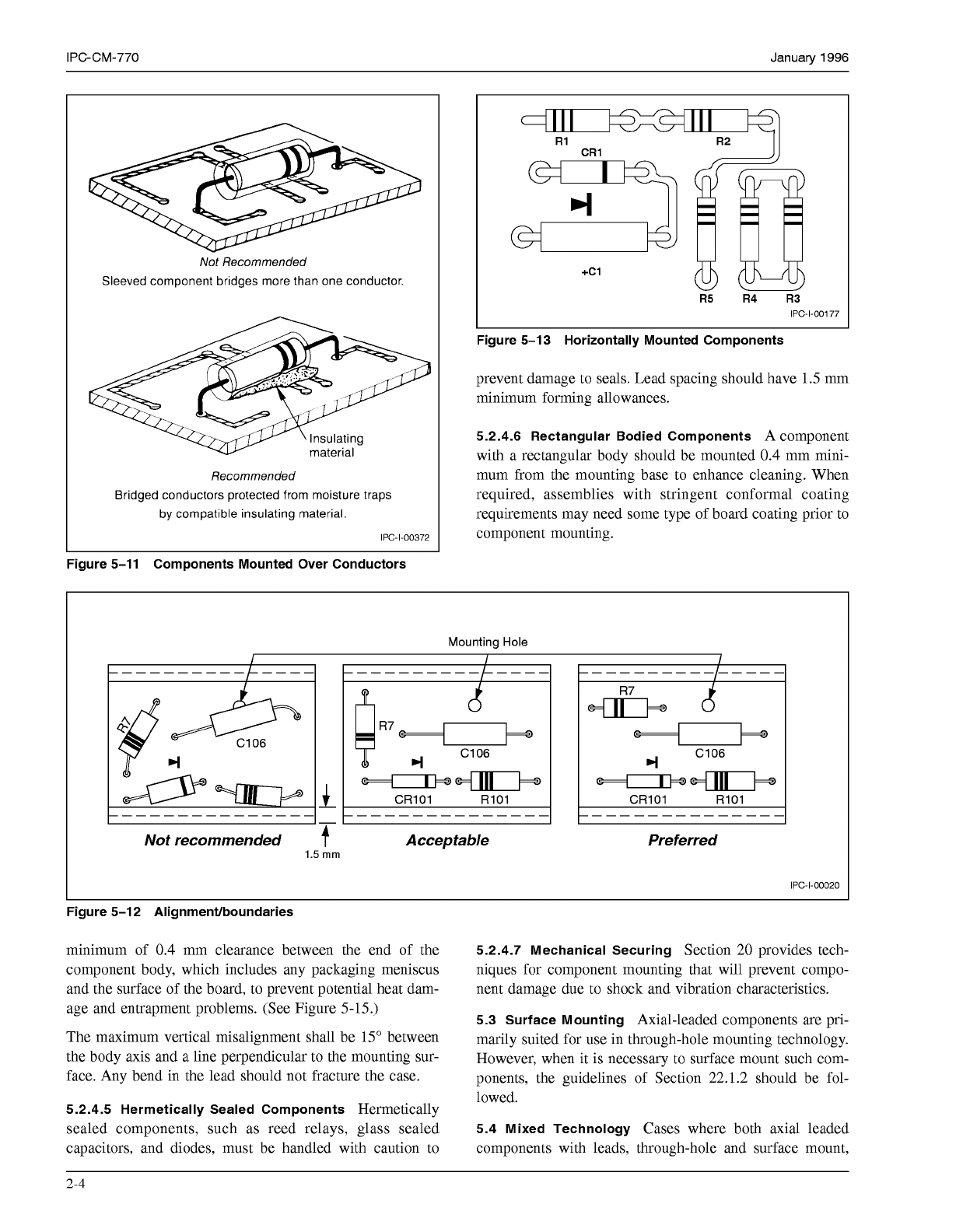
IPC-CM-770 Januaty
1996
R1
CR1
JI
9
R5
R4 R3
a
+Cl
Not
Recommended
Sleeved component bridges more than one conductor.
I
IPC-1-00177
Figure
5-1
3
Horizontally Mounted Components
prevent damage to seals. Lead spacing should have
1.5
mm
minimum forming allowances.
5.2.4.6 Rectangular Bodied Components
A component
with a rectangular body should be mounted
0.4
mm mini-
mum from the mounting base to enhance cleaning. When
required, assemblies with stringent conformal coating
requirements may need some type of board coating prior to
1
component mounting.
Recommended
Bridged conductors protected from moisture traps
by compatible insulating material.
IPC-1-00372
Figure
5-11
Components Mounted Over Conductors
Mounting
Hole
C
""""_
/
""_
I
""""_
""
""""_
""
¿
R7
4
Cl
06
I
R101
I
CR101
-+IlEl-
C"""""""1 C"""""""1 C"""""""1
Not recommended
f
Acceptable
1.5
mm
Preferred
IPc-I-00020
Figure
5-1
2 Alignmentlboundaries
minimum of
0.4
mm clearance between the end of the
component body, which includes any packaging meniscus
and the surface of the board, to prevent potential heat dam-
age and entrapment problems. (See Figure
5-15.)
The maximum vertical misalignment shall be
15"
between
the body axis and a line perpendicular to the mounting sur-
face. Any bend in the lead should not fracture the case.
5.2.4.7 Mechanical Securing
Section
20
provides tech-
niques for component mounting that will prevent compo-
nent damage due to shock and vibration characteristics.
5.3
Surface Mounting
Axial-leaded components are pri-
marily suited for use in through-hole mounting technology.
However, when it is necessary to surface mount such com-
ponents, the guidelines of Section
22.1.2
should be fol-
lowed.
5.2.4.5 Hermetically Sealed Components
Hermetically
sealed components, such as reed relays, glass sealed
capacitors, and diodes, must be handled with caution to
5.4 Mixed Technology
Cases where both axial leaded
components with leads, through-hole and surface mount,
2-4
COPYRIGHT Association Connecting Electronics Industries
Licensed by Information Handling Services
COPYRIGHT Association Connecting Electronics Industries
Licensed by Information Handling Services
January
1996
IPC-CM-770
are used in the same assembly is rare to non-existent. Refer
to general information related to class B/1 or
B/2
assem-
blies for consideration when leaded axial surface mount
components are used with chip components. When
through-hole axial components and chip components are
used in the same assembly, care must be taken to establish
proper assembly sequence, design for tool clearances and
shock resistance before soldering, cleaning, inspection/
testing, and rework.
5.5
Manual Assembly
Manual techniques for axial com-
ponents mounting are covered in Section 20.5 of this
guideline.
5.6 Automated Assembly
Automated techniques for
axial component mounting are covered in Section 20.6 of
this guideline. In addition, the following paragraphs repre-
sent additional considerations.
Multiple station sequencers and automatic variable center
distance (VCD) axial component insertion machines can be
utilized to perform high labor content kitting and compo-
nent preparation automatically for manual or operator
assisted component assembly. For this application, the cut
and clinch head of the VCD machine is removed and a
multiple cavity tray is placed in a modified board holder in
place of a printed board.
5.7
Handling and Storage
The handling and storage of
axial-leaded components should be in accordance with the
guidelines of Section 25.
5.10 Conformal Coating
General techniques for confor-
mal coating for all types of assemblies are described in
Section 28.
5.11 Quality Assurance
General quality assurance con-
siderations are described in Section 30.
6.0 RADIAL-LEADED DISCRETE COMPONENTS
Radial-leaded components come in a variety of shapes
from cylindrical, square, rectangular, wafer and kidney.
Leads exit from a common side of the component. The lead
is either ribbon or cylindrical. Selected devices can be
automatically inserted during assembly and also can be
modified with coined leads for surface mounting.
6.1 Part Type Description
Typical types of radial-lead
components are electrolytic, plastic, dipped, molded,
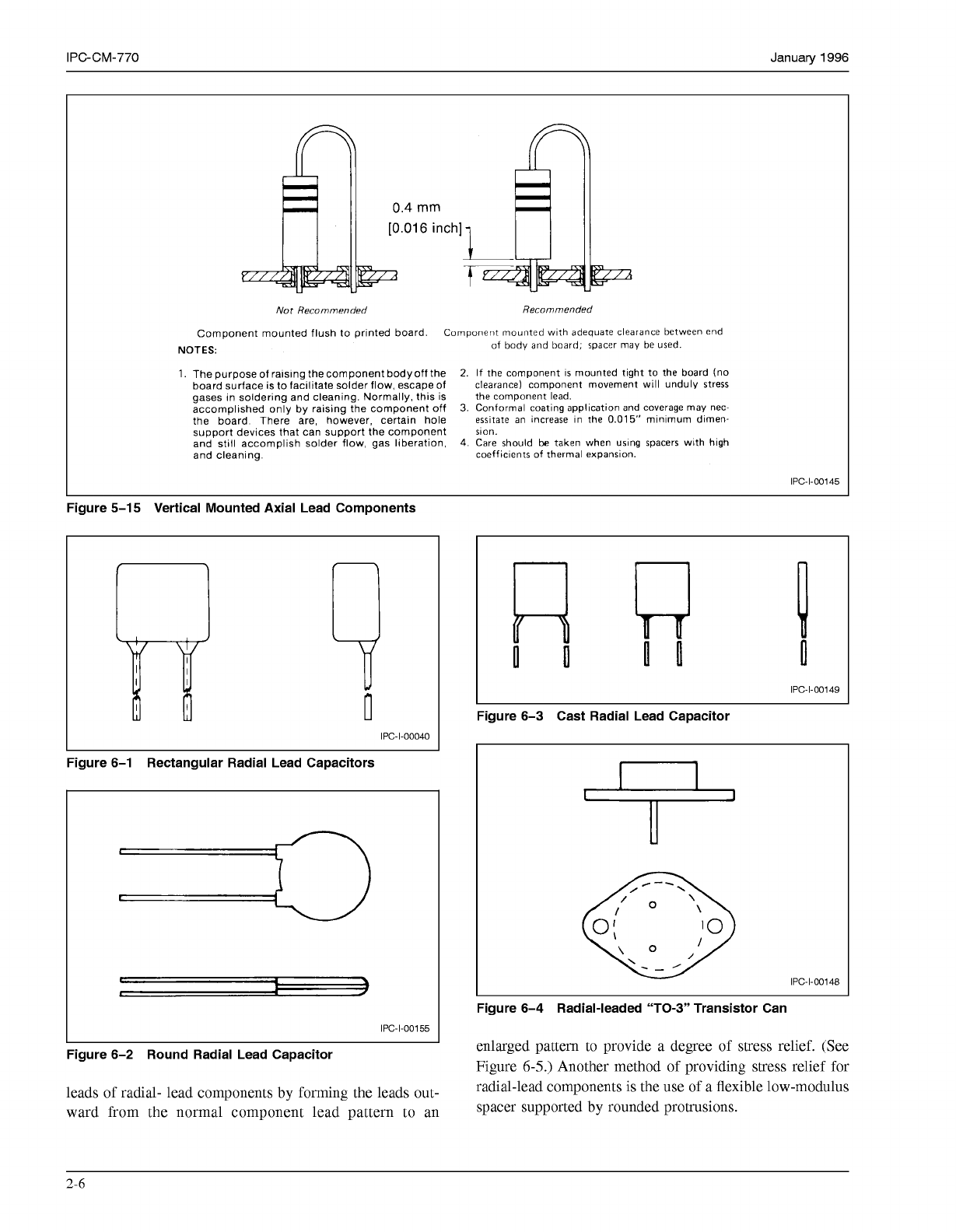
encapsulated capacitors, Figures 6-1, 6-2, 6-3, and transis-
tors, Figure 6-4.
6.1.1 Hermetically Sealed Components
Hermetically
sealed components such as electrolytic capacitors shall be
handled with caution to prevent damage to seals.
Bi-metallic welds should not be stressed.
6.1.2 Plastic Package Components
The integrity of the
interfacial adhesion between the plastic dip coating or
encapsulants to packaging or leads shall be maintained dur-
ing handling.
Washer or other mechanical hardware
1.5rnm
or more
Spacing less
(0.06
inches)
than
electrical
clearance
requirements
Not
Recommended
Spacing less than electrical
clearance requirements
Recommended
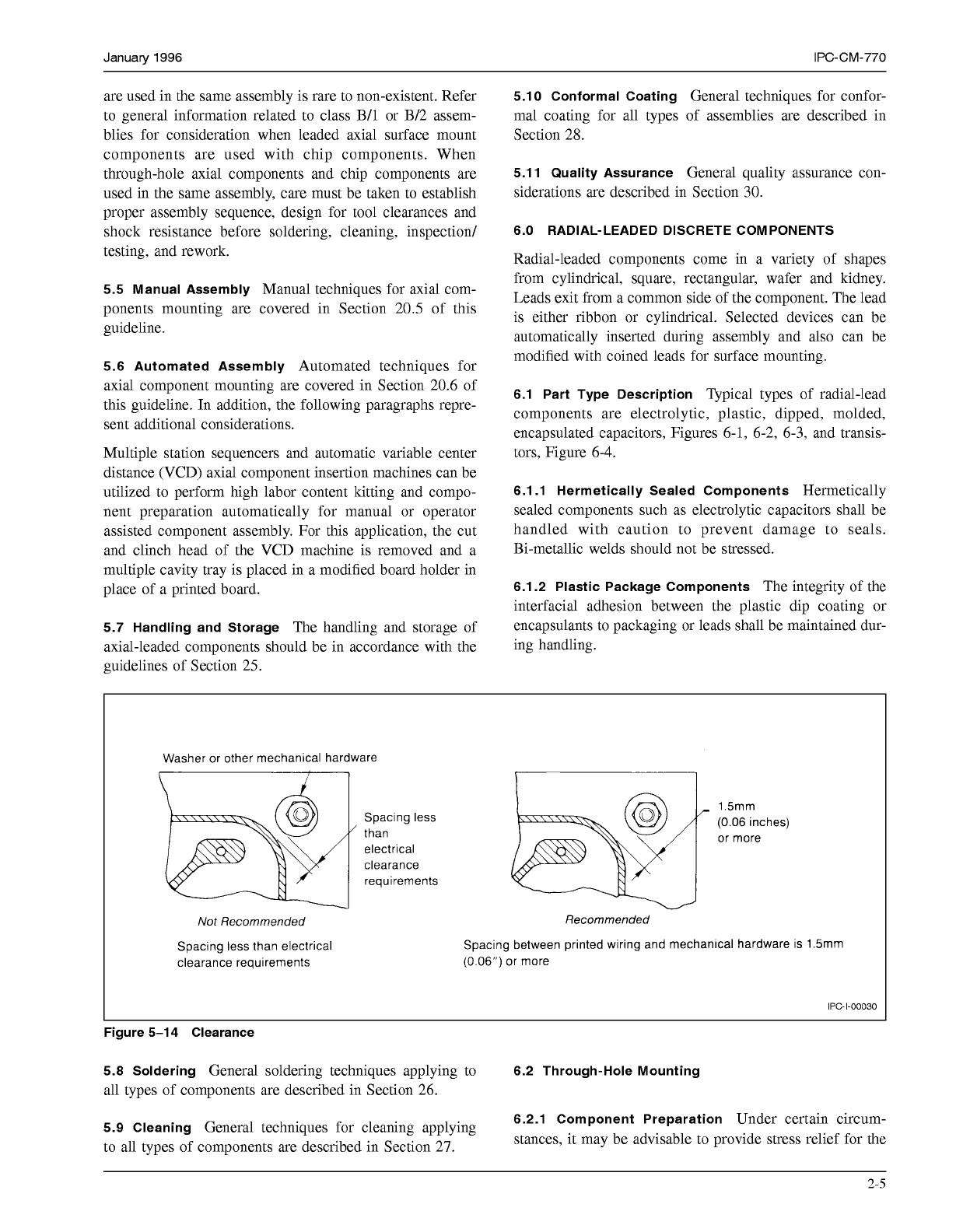
Spacing between printed wiring and mechancal hardware is 1.5rnm
(0.06")
or
more
IPC-I-O0030
Figure 5-1
4
Clearance
5.8 Soldering
General soldering techniques applying to
6.2 Through-Hole Mounting
all types of components are described in Section 26.
5.9 Cleaning
General techniques for cleaning applying
to all types of components are described in Section 27.
6.2.1 Component Preparation
Under certain circum-
stances, it may be advisable to provide stress relief for the
2-5
COPYRIGHT Association Connecting Electronics Industries
Licensed by Information Handling Services
COPYRIGHT Association Connecting Electronics Industries
Licensed by Information Handling Services
IPC-CM-770
Januaty
1996
0.4
mm
Not
Recommended Recommended
Component mounted flush to prlnted board. Component mounted wlth adequate clearance between end
NOTES:
1.
The purpose of ralslng the component body off the
2.
If the component
IS
mounted tight to the board
(no
board surface is to facilitate solder flow, escape of
clearance) component movement will unduly Stress
gases in soldering and cleaning. Normally, this
is
the component lead.
accomplished only by raising the component
off
3.
Conformal coating
application
and coverage may nec-
the board There are, however, certain hole
essitate
an increase
In
the
0.015’’
mlnlmum
dlmen-
support devices that can support the component
son.
and still accomplish solder flow, gas liberation,
4.
Care should
be
taken when uslng spacers with
hlgh
and cleaning.
coefficlents of thermal expansion.
of
body and board; spacer may
be
used.
IPC-1-00145
Figure 5-1
5
Vertical Mounted Axial Lead Components
IPc-I-00040
Figure 6-1 Rectangular Radial Lead Capacitors
1
IPC-1-00155
Figure 6-2 Round Radial Lead Capacitor
leads of radial- lead components by forming the leads out-
ward from the normal component lead pattern to an
I
IPC-1-00149
I
Figure 6-3 Cast Radial Lead Capacitor
0
\
/
r”
IPC-1-00148
Figure 6-4 Radial-leaded “TO-3” Transistor Can
enlarged pattern to provide a degree of stress relief. (See
Figure
6-5.)
Another method of providing stress relief for
radial-lead components is the use of a flexible low-modulus
spacer supported by rounded protrusions.
2-6
COPYRIGHT Association Connecting Electronics Industries
Licensed by Information Handling Services
COPYRIGHT Association Connecting Electronics Industries
Licensed by Information Handling Services