IPC-CM-770D-1996 - 第47页
January 1996 IPC-CM-770 PROGRAM ZERO IPC-I-O0209 I Figure 10-10 DIP Layout in Rows and Columns For automatic insertion, the DIP components should be obtained from the supplier in slide magazines (see Figure 10-11) for fe…
IPC-CM-770
Januaty
1996
contact with the solder paste or tin/lead plating being
reflowed. Proper handling is required
so
that components
do not move prior to the reflow soldering operation.
í
-
-
I-
o-
I’
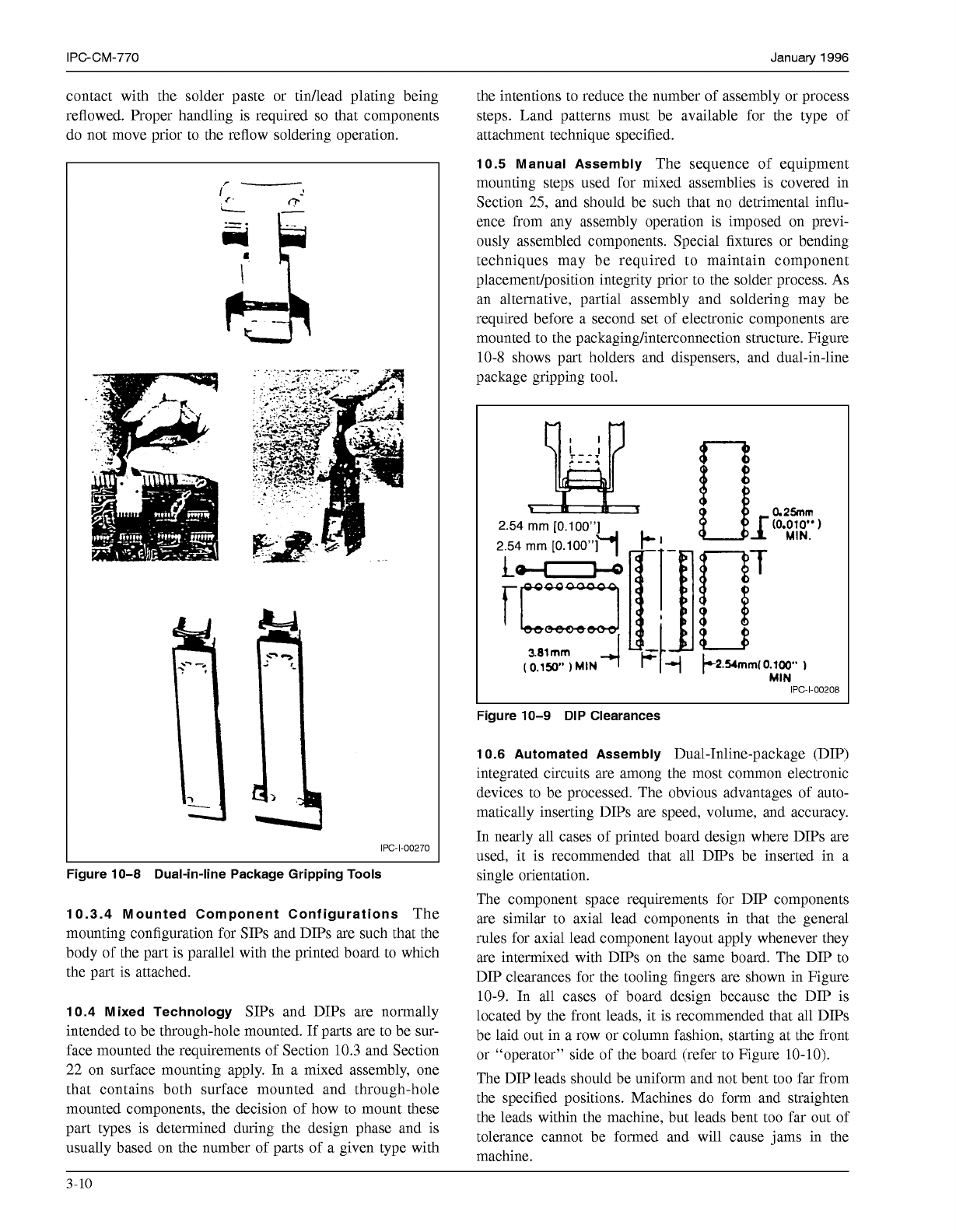
IPC-I-O0270
Figure 10-8 Dual-in-line Package Gripping Tools
10.3.4 Mounted Component Configurations
The
mounting configuration for SIPS and DIPs are such that the
body of the part is parallel with the printed board to which
the part is attached.
10.4 Mixed Technology
SIPS and DIPS are normally
intended to be through-hole mounted. If parts are to be sur-
face mounted the requirements of Section
10.3
and Section
22
on surface mounting apply. In a mixed assembly, one
that contains both surface mounted and through-hole
mounted components, the decision of how to mount these
part types is determined during the design phase and is
usually based on the number of parts of a given type with
the intentions to reduce the number of assembly or process
steps. Land patterns must be available for the type of
attachment technique specified.
10.5 Manual Assembly
The sequence of equipment
mounting steps used for mixed assemblies is covered in
Section
25,
and should be such that no detrimental influ-
ence from any assembly operation is imposed on previ-
ously assembled components. Special fixtures or bending
techniques may be required to maintain component
placemendposition integrity prior to the solder process.
As
an alternative, partial assembly and soldering may be
required before a second set of electronic components are
mounted to the
packaging/interconnection
structure. Figure
10-8
shows part holders and dispensers, and dual-in-line
package gripping tool.
I
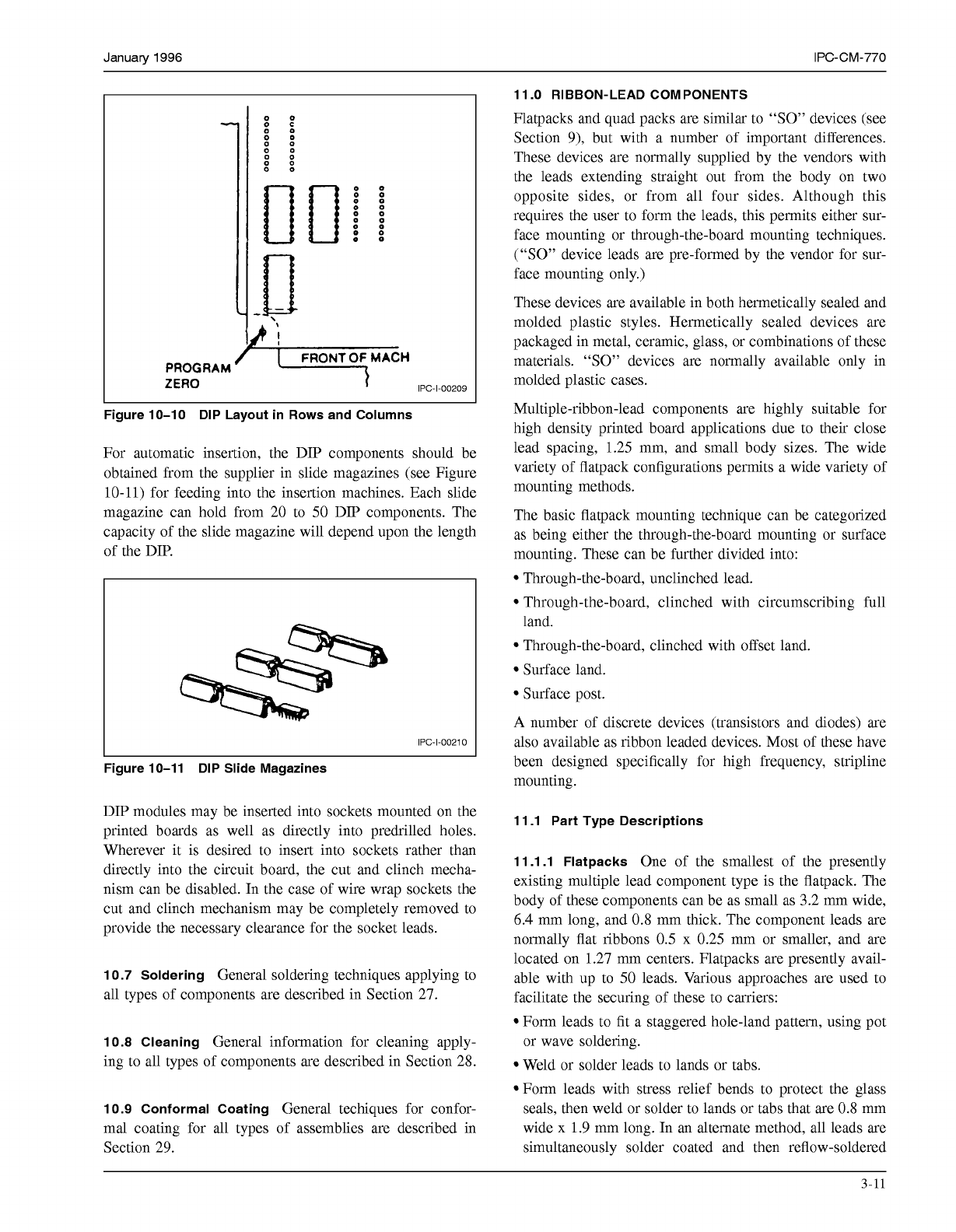
IPC-I-O0208
Figure 10-9 DIP Clearances
10.6 Automated Assembly
Dual-Inline-package (DIP)
integrated circuits are among the most common electronic
devices to be processed. The obvious advantages of auto-
matically inserting DIPs are speed, volume, and accuracy.
In nearly all cases of printed board design where DIPs are
used, it is recommended that all DIPs be inserted in a
single orientation.
The component space requirements for DIP components
are similar to axial lead components in that the general
rules for axial lead component layout apply whenever they
are intermixed with DIPs on the same board. The DIP to
DIP clearances for the tooling fingers are shown in Figure
10-9.
In all cases of board design because the DIP is
located by the front leads, it is recommended that all DIPs
be laid out in a row or column fashion, starting at the front
or “operator” side of the board (refer to Figure
10-10).
The DIP leads should be uniform and not bent too far from
the specified positions. Machines do form and straighten
the leads within the machine, but leads bent too
far
out of
tolerance cannot be formed and will cause jams in the
machine.
3-10
COPYRIGHT Association Connecting Electronics Industries
Licensed by Information Handling Services
COPYRIGHT Association Connecting Electronics Industries
Licensed by Information Handling Services
January
1996
IPC-CM-770
PROGRAM
ZERO
IPC-I-O0209
I
Figure
10-10
DIP Layout in
Rows
and Columns
For automatic insertion, the DIP components should be
obtained from the supplier in slide magazines (see Figure
10-11)
for feeding into the insertion machines. Each slide
magazine can hold from 20 to
50
DIP components. The
capacity of the slide magazine will depend upon the length
of the DIP.
IPC-I-O0210
I
L
Figure
10-11
DIP Slide Magazines
DIP modules may be inserted into sockets mounted on the
printed boards as well as directly into predrilled holes.
Wherever it is desired to insert into sockets rather than
directly into the circuit board, the cut and clinch mecha-
nism can be disabled. In the case of wire wrap sockets the
cut and clinch mechanism may be completely removed to
provide the necessary clearance for the socket leads.
10.7
Soldering
General soldering techniques applying to
all types of components are described in Section 27.
10.8
Cleaning
General information for cleaning apply-
ing to all types of components are described in Section 28.
10.9
Conformal Coating
General techiques for confor-
mal coating for all types of assemblies are described in
Section 29.
11
.O
RIBBON-LEAD COMPONENTS
Flatpacks and quad packs are similar to
“SO”
devices (see
Section 9), but with a number of important differences.
These devices are normally supplied by the vendors with
the leads extending straight out from the body on two
opposite sides, or from all four sides. Although this
requires the user to form the leads, this permits either sur-
face mounting or through-the-board mounting techniques.
(“SO”
device leads are pre-formed by the vendor for sur-
face mounting only.)
These devices are available in both hermetically sealed and
molded plastic styles. Hermetically sealed devices are
packaged in metal, ceramic, glass, or combinations of these
materials.
“SO”
devices are normally available only in
molded plastic cases.
Multiple-ribbon-lead components are highly suitable for
high density printed board applications due to their close
lead spacing, 1.25 mm, and small body sizes. The wide
variety of flatpack configurations permits a wide variety of
mounting methods.
The basic flatpack mounting technique can be categorized
as being either the through-the-board mounting or surface
mounting. These can be further divided into:
Through-the-board, unclinched lead.
Through-the-board, clinched with circumscribing full
land.
Through-the-board, clinched with offset land.
Surface land.
Surface post.
A number of discrete devices (transistors and diodes) are
also available as ribbon leaded devices. Most of these have
been designed specifically for high frequency, stripline
mounting.
11.1 Part Type Descriptions
11.1.1 Flatpacks
One of the smallest of the presently
existing multiple lead component type is the flatpack. The
body of these components can be as small as 3.2 mm wide,
6.4
mm long, and 0.8 mm thick. The component leads are
normally flat ribbons
0.5
x 0.25 mm or smaller, and are
located on 1.27 mm centers. Flatpacks are presently avail-
able with up to
50
leads. Various approaches are used to
facilitate the securing of these to carriers:
Form leads to fit a staggered hole-land pattern, using pot
or wave soldering.
Weld or solder leads to lands or tabs.
Form leads with stress relief bends to protect the glass
seals, then weld or solder to lands or tabs that are 0.8 mm
wide x 1.9 mm long. In an alternate method, all leads are
simultaneously solder coated and then reflow-soldered
3-11
COPYRIGHT Association Connecting Electronics Industries
Licensed by Information Handling Services
COPYRIGHT Association Connecting Electronics Industries
Licensed by Information Handling Services
IPC-CM-770
Januaty
1996
with semiautomatic insertion equipment.
Flatpacks must be insulated when placed over conductive
traces. Unless the user has control over the particular pack-
age material, it may be appropriate to provide insulation
between the bottom of the flatpack and any conductive
traces, regardless of the case material being used.
Users of flatpacks have had problems from non-standard
shipping containers. Another flatpack problem is that the
automated assembly cost is very high compared to other
packages, owing to the fragile leads and the special care
required in assembly.
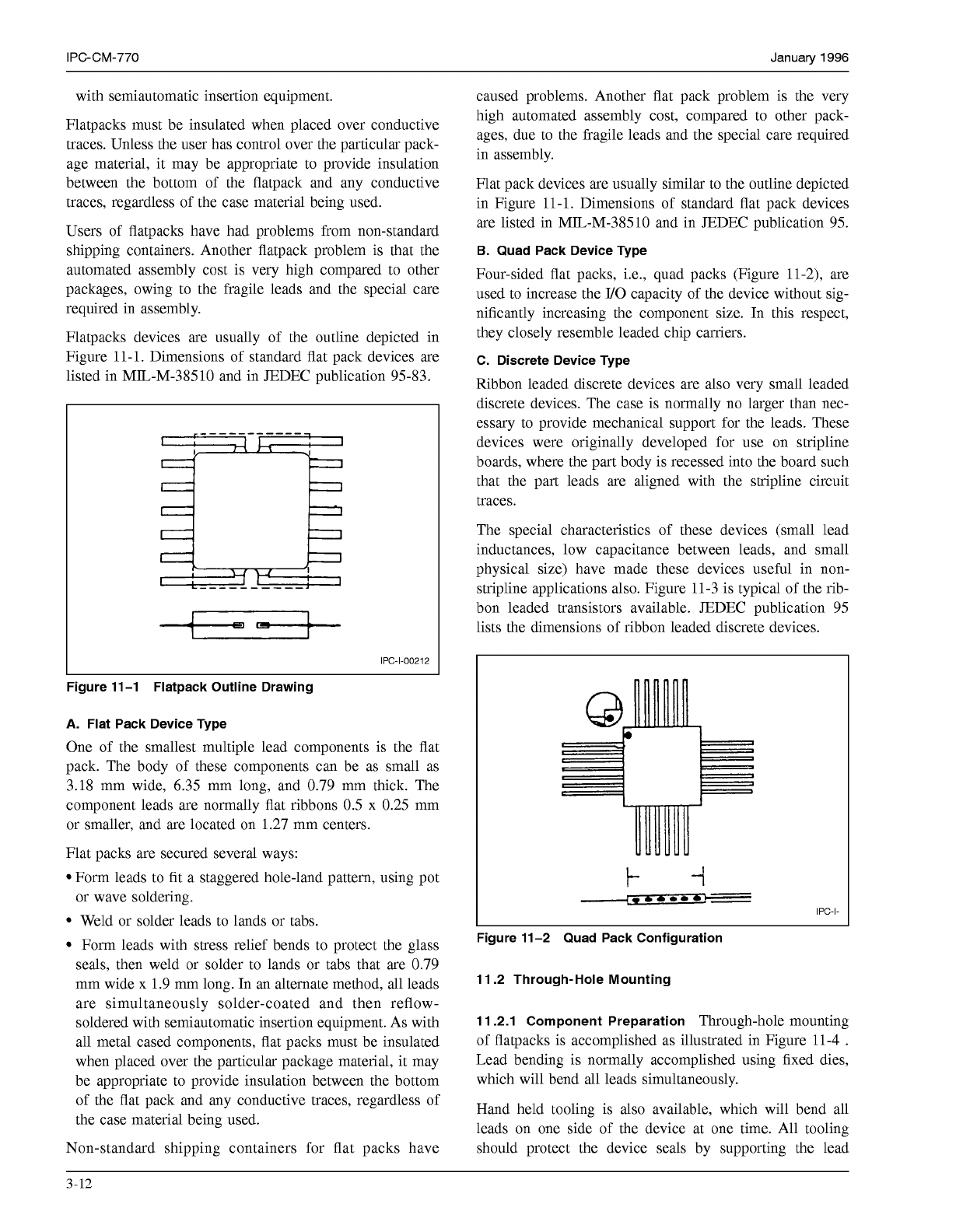
Flatpacks devices are usually of the outline depicted in
Figure
11-1.
Dimensions of standard flat pack devices are
listed in MIL-M-38510 and in JEDEC publication 95-83.
E
IPC-I-O0212
Figure 11-1 Flatpack Outline Drawing
A.
Flat Pack Device Type
One of the smallest multiple lead components is the flat
pack. The body of these components can be as small as
3.18 mm wide, 6.35 mm long, and 0.79 mm thick. The
component leads are normally flat ribbons
0.5
x 0.25 mm
or smaller, and are located on 1.27 mm centers.
Flat packs are secured several ways:
Form leads to fit a staggered hole-land pattern, using pot
or wave soldering.
Weld or solder leads to lands or tabs.
Form leads with stress relief bends to protect the glass
seals, then weld or solder to lands or tabs that are 0.79
mm wide x 1.9 mm long. In an alternate method, all leads
are simultaneously solder-coated and then reflow-
soldered with semiautomatic insertion equipment. As with
all metal cased components, flat packs must be insulated
when placed over the particular package material, it may
be appropriate to provide insulation between the bottom
of the flat pack and any conductive traces, regardless
of
the case material being used.
Non-standard shipping containers for flat packs have
caused problems. Another flat pack problem is the very
high automated assembly cost, compared to other pack-
ages, due to the fragile leads and the special care required
in assembly.
Flat pack devices are usually similar to the outline depicted
in Figure
11-1.
Dimensions of standard flat pack devices
are listed in MIL-M-38510 and in JEDEC publication 95.
B.
Quad Pack Device Type
Four-sided flat packs, i.e., quad packs (Figure 11-2), are
used to increase the
Il0
capacity of the device without sig-
nificantly increasing the component size. In this respect,
they closely resemble leaded chip carriers.
C. Discrete Device Type
Ribbon leaded discrete devices are also very small leaded
discrete devices. The case is normally no larger than nec-
essary to provide mechanical support for the leads. These
devices were originally developed for use on stripline
boards, where the part body is recessed into the board such
that the part leads are aligned with the stripline circuit
traces.
The special characteristics of these devices (small lead
inductances, low capacitance between leads, and small
physical size) have made these devices useful in non-
stripline applications also. Figure 11-3 is typical of the rib-
bon leaded transistors available. JEDEC publication 95
lists the dimensions of ribbon leaded discrete devices.
t-
-1
Figure 11-2 Quad Pack Configuration
11.2 Through-Hole Mounting
11 2.1 Component Preparation
Through-hole mounting
of flatpacks is accomplished as illustrated in Figure
11-4
.
Lead bending is normally accomplished using fixed dies,
which will bend all leads simultaneously.
Hand held tooling is also available, which will bend all
leads on one side of the device at one time. All tooling
should protect the device seals by supporting the lead
3-12
COPYRIGHT Association Connecting Electronics Industries
Licensed by Information Handling Services
COPYRIGHT Association Connecting Electronics Industries
Licensed by Information Handling Services