IPC-CM-770D-1996 - 第63页
January 1996 IPC-CM-770 O00 % -1 DETAXL *A8 -m 1' 4 B A "i r. 1 I r B6 A I 7 9 Il 131S17192l 8 10 '12141618202 00660000000 iooooreo0.o ooomw~o+ooo mrw~~mooo~~ oomommmommo maommmooooo ~e~oooooooo ooeommomaa…
IPC-CM-770
Januaty
1996
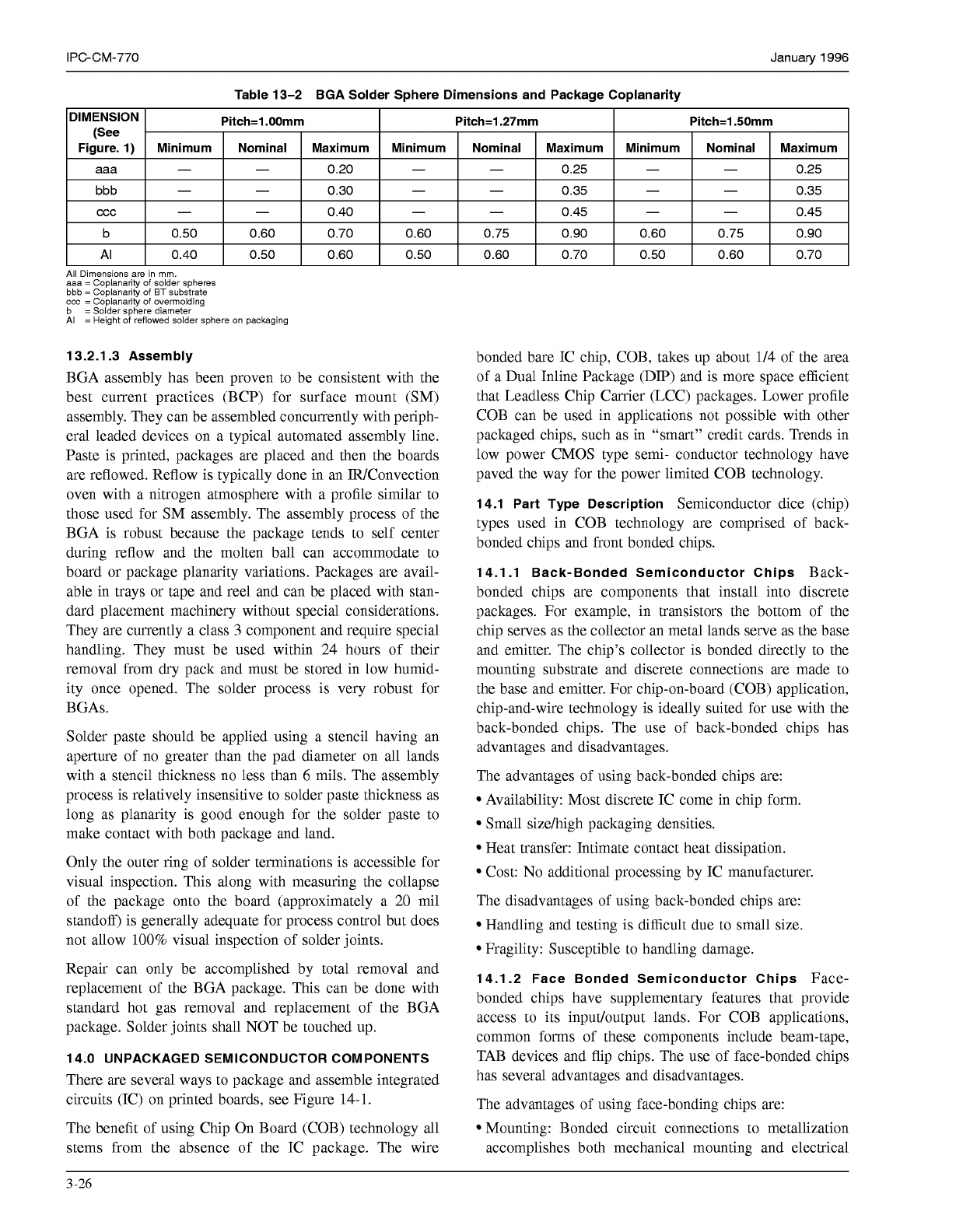
Table 13-2 BGA Solder Sphere Dimensions and Package Coplanarity
All
Dimensions are in mm.
aaa =Coplanarity of solder spheres
bbb =Coplanarity of
BT
substrate
ccc =Coplanarity of overmolding
AI
=
Height of reflowed solder sphere on packaging
b
=
Solder sphere diameter
13.2.1.3 Assembly
BGA assembly has been proven to be consistent with the
best current practices (BCP) for surface mount (SM)
assembly. They can be assembled concurrently with periph-
eral leaded devices on a typical automated assembly line.
Paste is printed, packages are placed and then the boards
are reflowed. Reflow is typically done in an IRIConvection
oven with a nitrogen atmosphere with a profile similar to
those used for SM assembly. The assembly process of the
BGA is robust because the package tends to self center
during reflow and the molten ball can accommodate to
board or package planarity variations. Packages are avail-
able in trays or tape and reel and can be placed with stan-
dard placement machinery without special considerations.
They are currently a class
3
component and require special
handling. They must be used within 24 hours of their
removal from dry pack and must be stored in low humid-
ity once opened. The solder process is very robust for
BGAs.
Solder paste should be applied using a stencil having an
aperture of no greater than the pad diameter on all lands
with a stencil thickness no less than
6
mils. The assembly
process is relatively insensitive to solder paste thickness as
long as planarity is good enough for the solder paste to
make contact with both package and land.
Only the outer ring of solder terminations is accessible for
visual inspection. This along with measuring the collapse
of the package onto the board (approximately a 20 mil
standoff) is generally adequate for process control but does
not allow
100%
visual inspection of solder joints.
Repair can only be accomplished by total removal and
replacement of the BGA package. This can be done with
standard hot gas removal and replacement of the BGA
package. Solder joints shall NOT be touched up.
14.0 UNPACKAGED SEMICONDUCTOR COMPONENTS
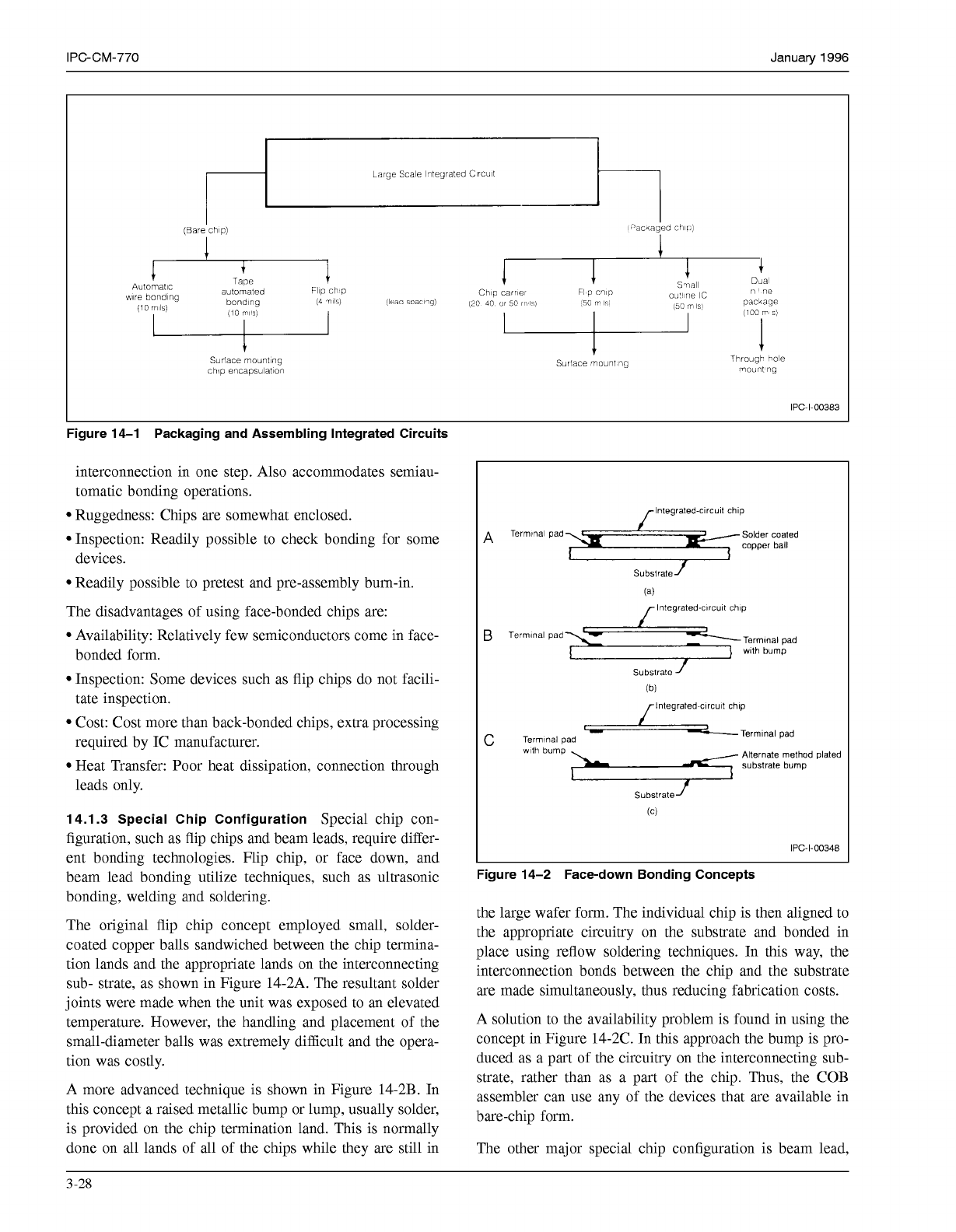
There are several ways to package and assemble integrated
circuits (IC) on printed boards, see Figure 14-1.
The benefit of using Chip On Board (COB) technology all
stems from the absence of the IC package. The wire
bonded bare IC chip, COB, takes up about 114 of the area
of a Dual Inline Package (DIP) and is more space efficient
that Leadless Chip Carrier (LCC) packages. Lower profile
COB can be used in applications not possible with other
packaged chips, such as in “smart” credit cards. Trends in
low power CMOS type semi- conductor technology have
paved the way for the power limited COB technology.
14.1 Part Type Description
Semiconductor dice (chip)
types used in COB technology are comprised of back-
bonded chips and front bonded chips.
14.1.1 Back-Bonded Semiconductor Chips
Back-
bonded chips are components that install into discrete
packages. For example, in transistors the bottom of the
chip serves as the collector an metal lands serve as the base
and emitter. The chip’s collector is bonded directly to the
mounting substrate and discrete connections are made to
the base and emitter. For chip-on-board (COB) application,
chip-and-wire technology is ideally suited for use with the
back-bonded chips. The use of back-bonded chips has
advantages and disadvantages.
The advantages of using back-bonded chips are:
Availability: Most discrete IC come in chip form.
Small sizelhigh packaging densities.
Heat transfer: Intimate contact heat dissipation.
Cost: No additional processing by IC manufacturer.
The disadvantages of using back-bonded chips are:
Handling and testing is difficult due to small size.
Fragility: Susceptible to handling damage.
14.1.2 Face Bonded Semiconductor Chips
Face-
bonded chips have supplementary features that provide
access to its inputloutput lands. For COB applications,
common forms of these components include beam-tape,
TAB devices and flip chips. The use of face-bonded chips
has several advantages and disadvantages.
The advantages of using face-bonding chips are:
Mounting: Bonded circuit connections to metallization
accomplishes both mechanical mounting and electrical
3-26
COPYRIGHT Association Connecting Electronics Industries
Licensed by Information Handling Services
COPYRIGHT Association Connecting Electronics Industries
Licensed by Information Handling Services
January
1996
IPC-CM-770
O00
%
-1
DETAXL
*A8
-m
1'
4
B
A
"i
r.
1
I
r
B6
A
I
7
9
Il
131S17192l
8
10
'12141618202
00660000000
iooooreo0.o
ooomw~o+ooo
mrw~~mooo~~
oomommmommo
maommmooooo
~e~oooooooo
ooeommomaao
eo00
0.00
o000
0000
OOOC
o...
0.00
eo00
.OSO
sees
aamm
000.
m...
00eo
00.0
.amo
00.0
OO*O
oooemo
oommoeoooeo
"i
7
'Q
t
IPC-I-
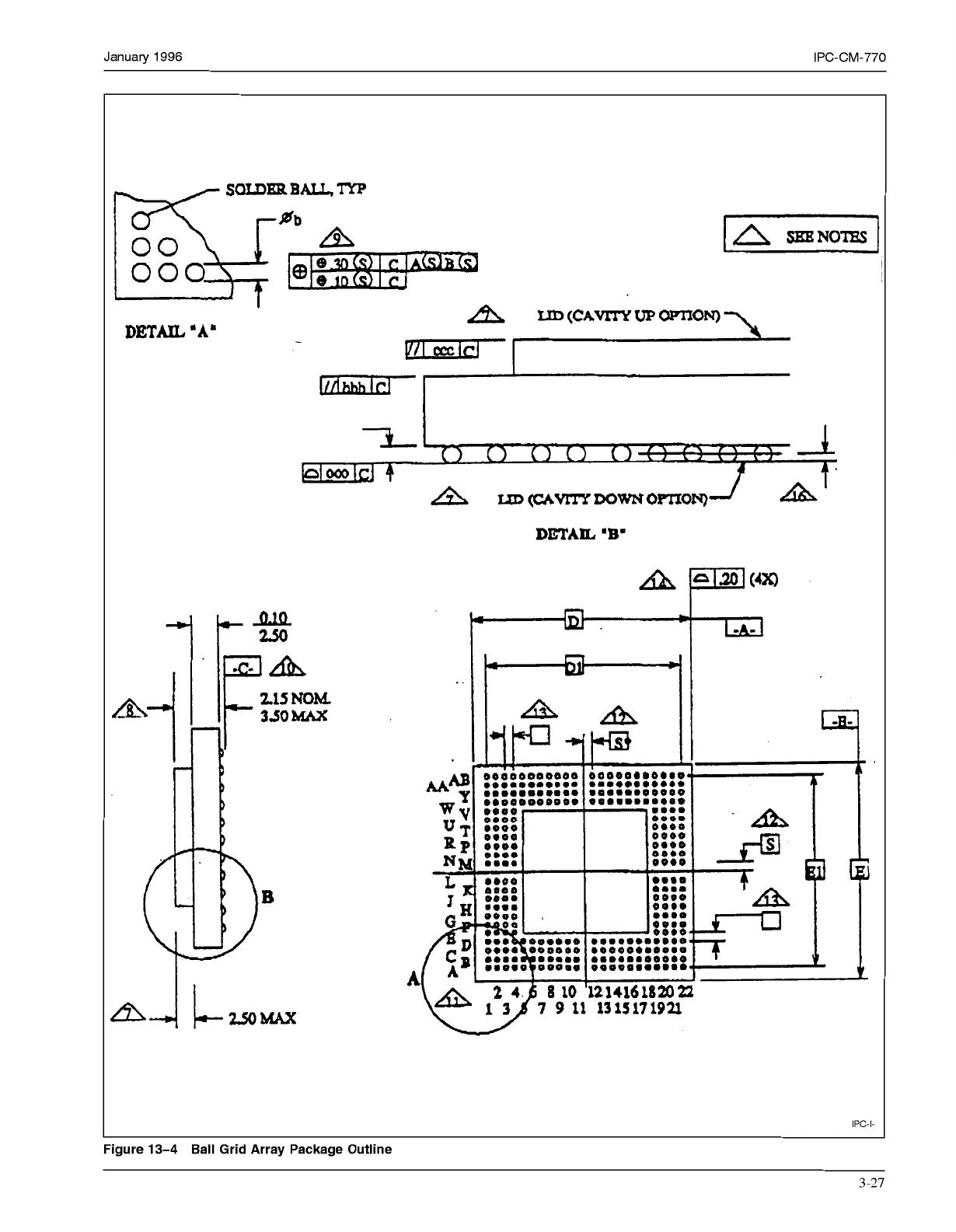
Figure 13-4 Ball Grid Array Package Outline
3-27
COPYRIGHT Association Connecting Electronics Industries
Licensed by Information Handling Services
COPYRIGHT Association Connecting Electronics Industries
Licensed by Information Handling Services
IPC-CM-770
Januaty
1996
i
*
(Bare chlp)
b'acxnged
chIr:)
1
4
Autornatlc
wlre
bondlng
(10
111llb)
automated Fl~p
ch
p
D&
r
'
ne
bondlng
(10
r,'$
Chlp carrler
(4
TIIS)
FI
p
CIIP
Ilpan snacllg)
(20
40
or
50
1%)
(50
m
158
ouIlrie IC
(53
m
IS1
+
pat:
(100
r's!
chip encapsulatlon
Surface
mountlng
Surface mount
ng
Througi-
bole
mount
ng
IPC-1-00383
Figure 14-1 Packaging and Assembling Integrated Circuits
interconnection in one step. Also accommodates semiau-
tomatic bonding operations.
Ruggedness: Chips are somewhat enclosed.
Inspection: Readily possible to check bonding for some
devices.
Readily possible to pretest and pre-assembly bum-in.
The disadvantages of using face-bonded chips are:
Availability: Relatively few semiconductors come in face-
bonded form.
Inspection: Some devices such as flip chips do not facili-
tate inspection.
Cost: Cost more than back-bonded chips, extra processing
required by IC manufacturer.
Heat Transfer: Poor heat dissipation, connection through
leads only.
14.1.3 Special Chip Configuration
Special chip con-
figuration, such as flip chips and beam leads, require differ-
ent bonding technologies. Flip chip, or face down, and
beam lead bonding utilize techniques, such as ultrasonic
bonding, welding and soldering.
The original flip chip concept employed small, solder-
coated copper balls sandwiched between the chip termina-
tion lands and the appropriate lands on the interconnecting
sub- strate, as shown in Figure 14-2A. The resultant solder
joints were made when the unit was exposed to an elevated
temperature. However, the handling and placement of the
small-diameter balls was extremely difficult and the opera-
tion was costly.
A more advanced technique is shown in Figure 14-2B. In
this concept a raised metallic bump or lump, usually solder,
is provided on the chip termination land. This is normally
done on all lands of all of the chips while they are still in
Integrated-clrcult chlp
A
Termlnal pad
1
Solder coaled
I
v
copper ball
Substrate
(a)
r
Integrated-clrcult chlp
I
Substrate
(b)
lntegrated~clrcult chlp
r
a
c
Terminal pad
C-Termlnal pad
Alternate method plated
substrate bump
IPC-1-00348
gure 14-2 Face-down Bonding Concepts
the large wafer form. The individual chip is then aligned to
the appropriate circuitry on the substrate and bonded in
place using reflow soldering techniques. In this way, the
interconnection bonds between the chip and the substrate
are made simultaneously, thus reducing fabrication costs.
A solution to the availability problem is found in using the
concept in Figure 14-2C. In this approach the bump is pro-
duced as a part of the circuitry on the interconnecting sub-
strate, rather than as a part of the chip. Thus, the COB
assembler can use any of the devices that are available in
bare-chip form.
The other major special chip configuration is beam lead,
3-28
COPYRIGHT Association Connecting Electronics Industries
Licensed by Information Handling Services
COPYRIGHT Association Connecting Electronics Industries
Licensed by Information Handling Services