IPC-CM-770D-1996 - 第70页
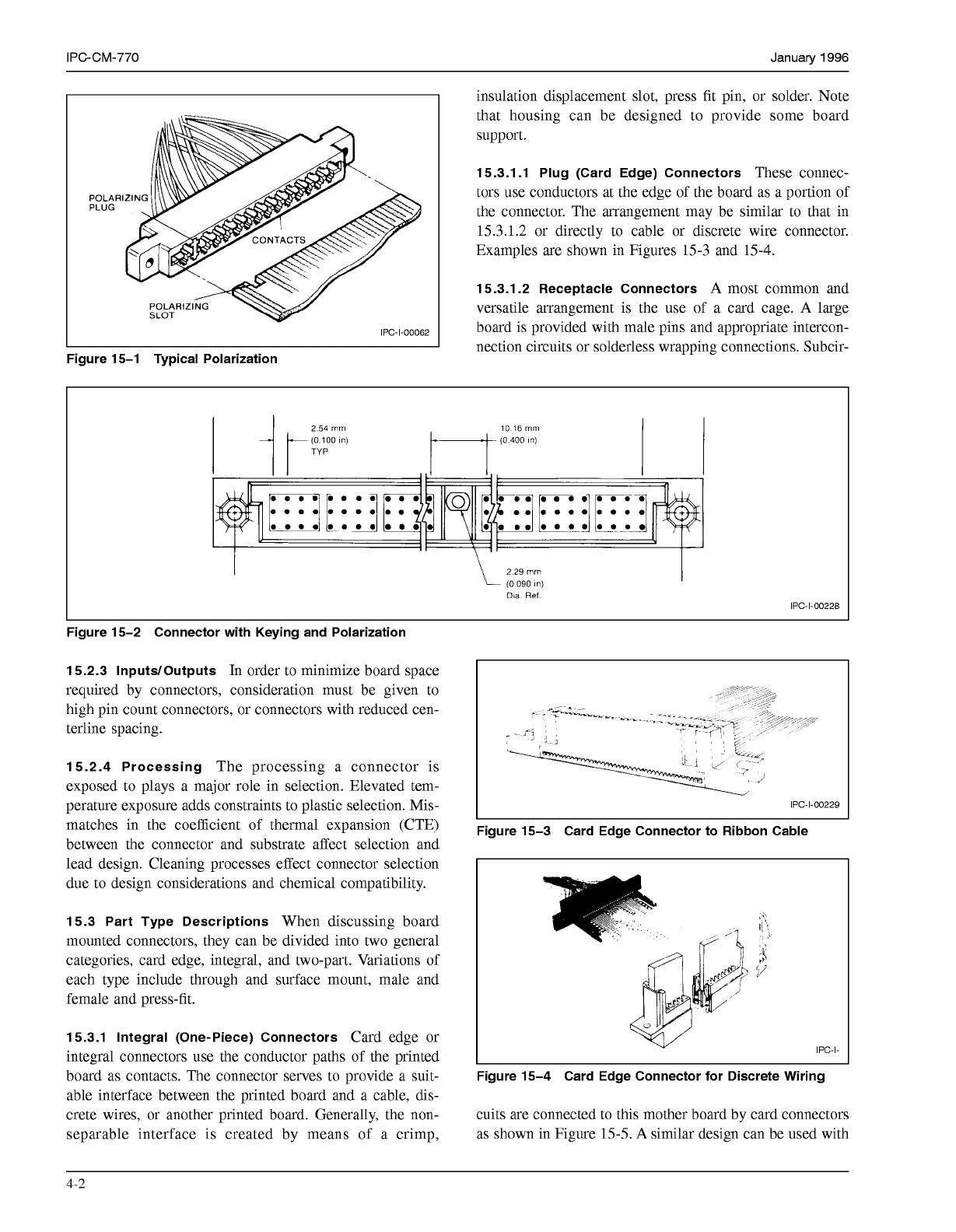
IPC-CM-770 Januaty 1996 I I insulation displacement slot, press fit pin, or solder. Note IPC-I-O0062 Figure 15-1 Typical Polarization that housing can be designed to provide some board support. 15.3.1.1 Plug (Card Edge) …
January
1996
IPC-CM-770
Part Four
Electromechanical and Interconnect Components
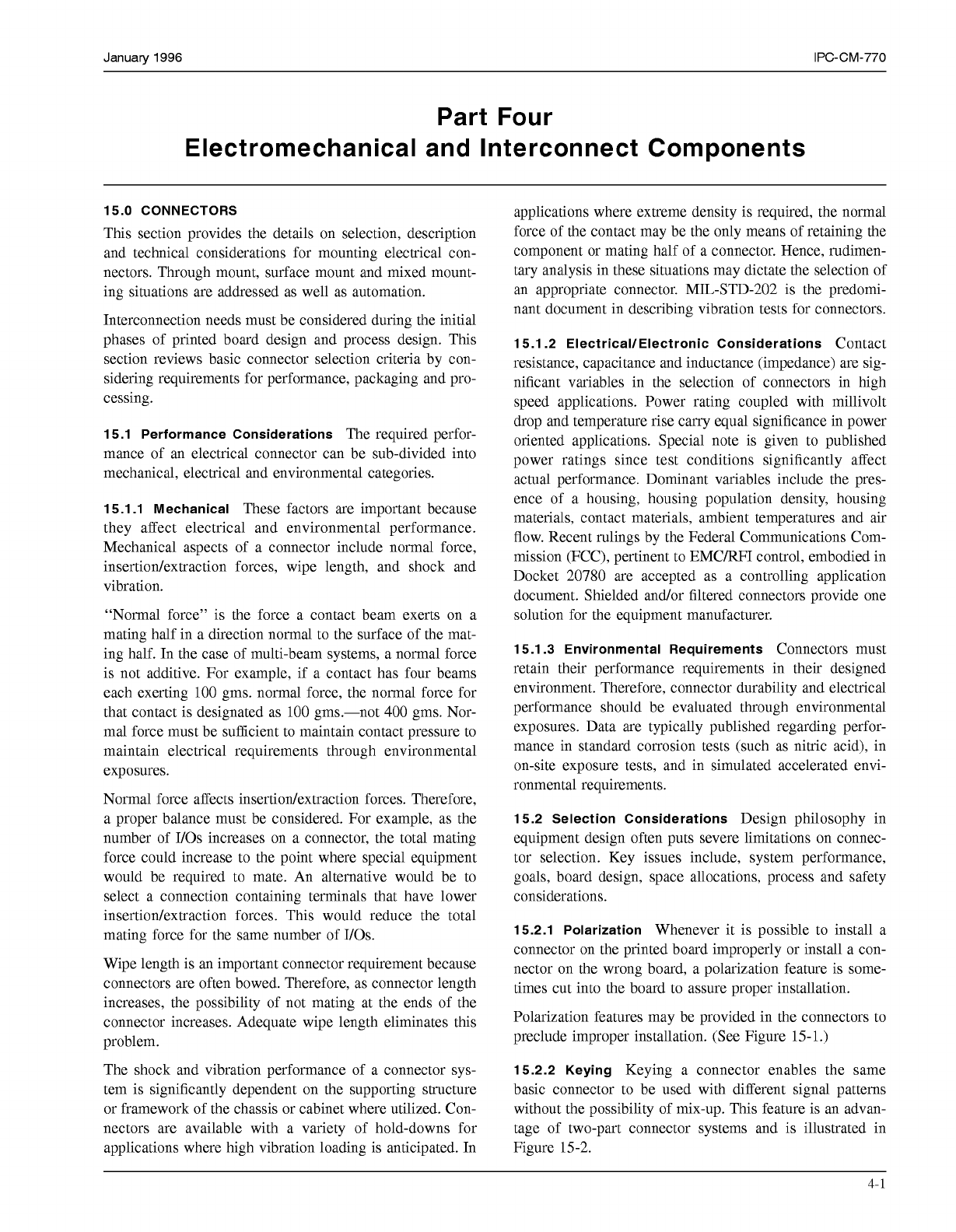
15.0 CONNECTORS
This section provides the details on selection, description
and technical considerations for mounting electrical con-
nectors. Through mount, surface mount and mixed mount-
ing situations are addressed as well as automation.
Interconnection needs must be considered during the initial
phases of printed board design and process design. This
section reviews basic connector selection criteria by con-
sidering requirements for performance, packaging and pro-
cessing.
15.1 Performance Considerations
The required perfor-
mance of an electrical connector can be sub-divided into
mechanical, electrical and environmental categories.
15.1.1 Mechanical
These factors are important because
they affect electrical and environmental performance.
Mechanical aspects of a connector include normal force,
insertion/extraction forces, wipe length, and shock and
vibration.
“Normal force” is the force a contact beam exerts on a
mating half in a direction normal to the surface of the mat-
ing half. In the case of multi-beam systems, a normal force
is not additive. For example, if a contact has four beams
each exerting
100
gms. normal force, the normal force for
that contact is designated as
100
gms.-not
400
gms. Nor-
mal force must be sufficient to maintain contact pressure to
maintain electrical requirements through environmental
exposures.
Normal force affects insertiodextraction forces. Therefore,
a proper balance must be considered. For example, as the
number of I/Os increases on a connector, the total mating
force could increase to the point where special equipment
would be required to mate. An alternative would be to
select a connection containing terminals that have lower
insertion/extraction forces. This would reduce the total
mating force for the same number of I/Os.
Wipe length is an important connector requirement because
connectors are often bowed. Therefore, as connector length
increases, the possibility of not mating at the ends of the
connector increases. Adequate wipe length eliminates this
problem.
The shock and vibration performance of a connector sys-
tem is significantly dependent on the supporting structure
or framework of the chassis or cabinet where utilized. Con-
nectors are available with a variety of hold-downs for
applications where high vibration loading is anticipated. In
applications where extreme density is required, the normal
force of the contact may be the only means of retaining the
component or mating half of a connector. Hence, rudimen-
tary analysis in these situations may dictate the selection of
an appropriate connector. MIL-STD-202 is the predomi-
nant document in describing vibration tests for connectors.
15.1.2 ElectricallElectronic Considerations
Contact
resistance, capacitance and inductance (impedance) are sig-
nificant variables in the selection of connectors in high
speed applications. Power rating coupled with millivolt
drop and temperature rise carry equal significance in power
oriented applications. Special note is given to published
power ratings since test conditions significantly affect
actual performance. Dominant variables include the pres-
ence of a housing, housing population density, housing
materials, contact materials, ambient temperatures and air
flow. Recent rulings by the Federal Communications Com-
mission (FCC), pertinent to EMCRFI control, embodied in
Docket 20780 are accepted as a controlling application
document. Shielded and/or filtered connectors provide one
solution for the equipment manufacturer.
15.1.3 Environmental Requirements
Connectors must
retain their performance requirements in their designed
environment. Therefore, connector durability and electrical
performance should be evaluated through environmental
exposures. Data are typically published regarding perfor-
mance in standard corrosion tests (such as nitric acid), in
on-site exposure tests, and in simulated accelerated envi-
ronmental requirements.
15.2 Selection Considerations
Design philosophy in
equipment design often puts severe limitations on connec-
tor selection. Key issues include, system performance,
goals, board design, space allocations, process and safety
considerations.
15.2.1 Polarization
Whenever it is possible to install a
connector on the printed board improperly or install a con-
nector on the wrong board, a polarization feature is some-
times cut into the board to assure proper installation.
Polarization features may be provided in the connectors to
preclude improper installation. (See Figure
15-1.)
15.2.2 Keying
Keying a connector enables the same
basic connector to be used with different signal patterns
without the possibility of mix-up. This feature is an advan-
tage of two-part connector systems and is illustrated in
Figure 15-2.
4-
1
COPYRIGHT Association Connecting Electronics Industries
Licensed by Information Handling Services
COPYRIGHT Association Connecting Electronics Industries
Licensed by Information Handling Services
IPC-CM-770
Januaty
1996
I I
insulation displacement slot, press fit pin, or solder. Note
IPC-I-O0062
Figure 15-1 Typical Polarization
that housing can be designed to provide some board
support.
15.3.1.1 Plug (Card Edge) Connectors
These connec-
tors use conductors at the edge of the board as a portion of
the connector. The arrangement may be similar to that in
15.3.1.2
or directly to cable or discrete wire connector.
Examples are shown in Figures
15-3
and
15-4.
15.3.1.2 Receptacle Connectors
A
most common and
versatile arrangement is the use of a card cage.
A
large
board is provided with male pins and appropriate intercon-
nection circuits or solderless wrapping connections. Subcir-
2
54
mm
(O
100
In)
(O
400
In)
10 16
mm
TYP
Dia
Ref
IPC-I-O0228
L
Figure 15-2 Connector with Keying and Polarization
15.2.3 InputdOutputs
In order to minimize board space
required by connectors, consideration must be given to
high pin count connectors, or connectors with reduced cen-
terline spacing.
15.2.4 Processing
The processing a connector is
exposed to plays a major role in selection. Elevated tem-
perature exposure adds constraints to plastic selection. Mis-
matches in the coefficient of thermal expansion (CTE)
I
IPC-I-O0229
Figure 15-3 Card Edge Connector to Ribbon Cable
between the connector and substrate affect selection and
lead design. Cleaning processes effect connector selection
due to design considerations and chemical compatibility.
15.3 Part Type Descriptions
When discussing board
I!
-,
mounted connectors, they can be divided into two general
categories, card edge, integral, and two-part. Variations of
;i
each type include through and surface mount, male and
y
female and press-fit.
15.3.1 Integral (One-Piece) Connectors
Card edge or
integral connectors use the conductor paths of the printed
board as contacts. The connector serves to provide a suit-
Figure 15-4 Card Edge Connector for Discrete Wiring
able interface between the printed board and a cable, dis-
crete wires, or another printed board. Generally, the non- cuits are connected to this mother board by card connectors
separable interface is created by means of a crimp, as shown in Figure
15-5.
A
similar design can be used with
- -
.
.\
IPC-I-
4-2
COPYRIGHT Association Connecting Electronics Industries
Licensed by Information Handling Services
COPYRIGHT Association Connecting Electronics Industries
Licensed by Information Handling Services
January
1996
IPC-CM-770
internal connectors, but the special board preparation usu-
ally results in higher costs.
wrap, press-fit pin or solder. Housing enhancements may
include card support, printed board, or connector latches
(locks) and polarizationkeying features. (See Figure
15-7.)
-1-00085
Figure 15-5 Card Guide Connector
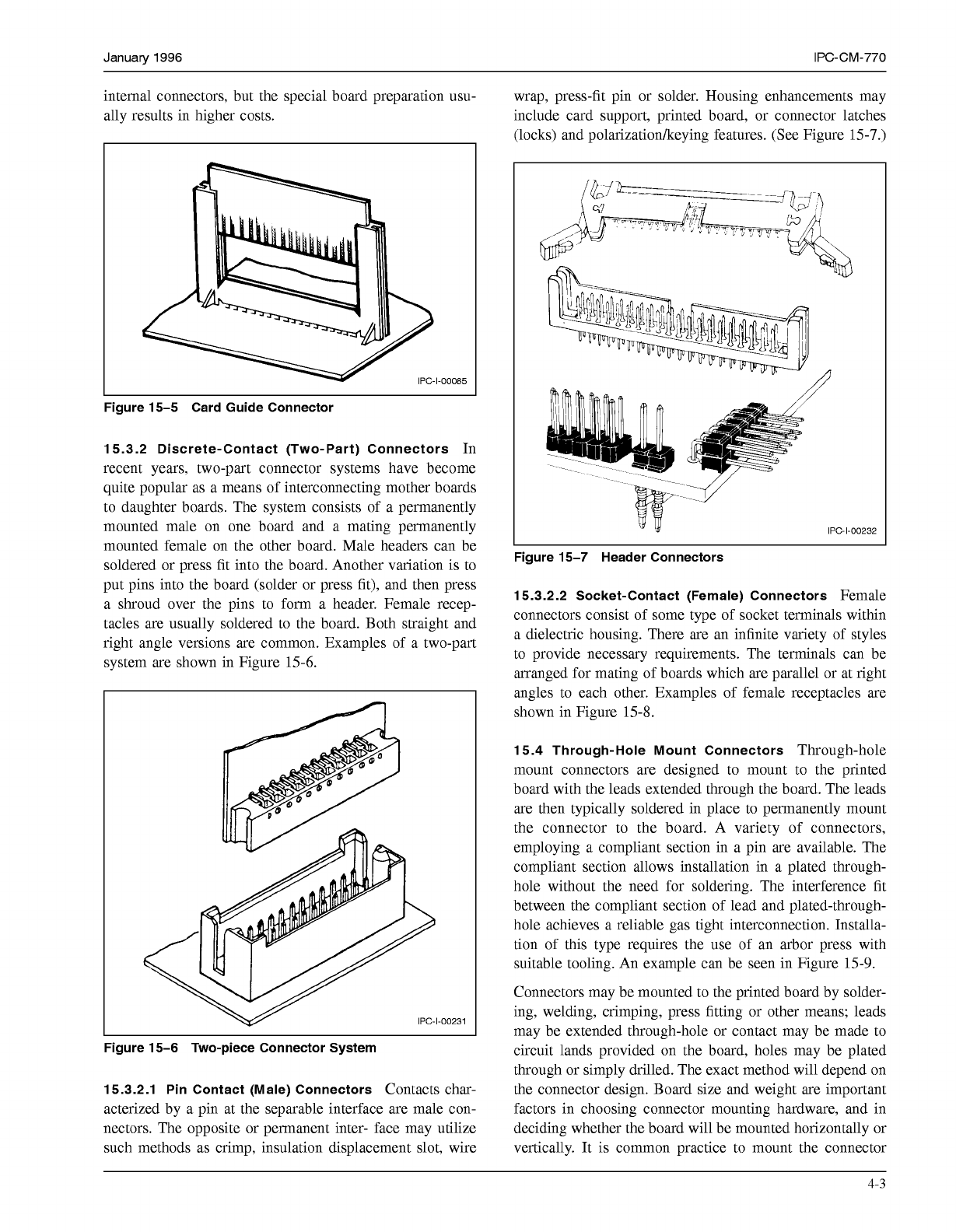
15.3.2 Discrete-Contact (Two-Part) Connectors
In
recent years, two-part connector systems have become
quite popular as a means of interconnecting mother boards
to daughter boards. The system consists of a permanently
mounted male on one board and a mating permanently
mounted female on the other board. Male headers can be
soldered or press fit into the board. Another variation is to
put pins into the board (solder or press fit), and then press
a shroud over the pins to form a header. Female recep-
tacles are usually soldered to the board. Both straight and
right angle versions are common. Examples of a two-part
system are shown in Figure
15-6.
r
Figure 15-6 Two-piece Connector System
15.3.2.1 Pin Contact (Male) Connectors
Contacts char-
acterized by a pin at the separable interface are male con-
nectors. The opposite or permanent inter- face may utilize
such methods as crimp, insulation displacement slot, wire
IPC-1-00232
Figure 15-7 Header Connectors
15.3.2.2 Socket-Contact (Female) Connectors
Female
connectors consist of some type of socket terminals within
a dielectric housing. There are an infinite variety of styles
to provide necessary requirements. The terminals can be
arranged for mating of boards which are parallel or at right
angles to each other. Examples of female receptacles are
shown in Figure
15-8.
15.4 Through-Hole Mount Connectors
Through-hole
mount connectors are designed to mount to the printed
board with the leads extended through the board. The leads
are then typically soldered in place to permanently mount
the connector to the board. A variety of connectors,
employing a compliant section in a pin are available. The
compliant section allows installation in a plated through-
hole without the need for soldering. The interference fit
between the compliant section of lead and plated-through-
hole achieves a reliable gas tight interconnection. Installa-
tion of this type requires the use of an arbor press with
suitable tooling. An example can be seen in Figure
15-9.
Connectors may be mounted to the printed board by solder-
ing, welding, crimping, press fitting or other means; leads
may be extended through-hole or contact may be made to
circuit lands provided on the board, holes may be plated
through or simply drilled. The exact method will depend on
the connector design. Board size and weight are important
factors in choosing connector mounting hardware, and in
deciding whether the board will be mounted horizontally or
vertically. It is common practice to mount the connector
4-3
COPYRIGHT Association Connecting Electronics Industries
Licensed by Information Handling Services
COPYRIGHT Association Connecting Electronics Industries
Licensed by Information Handling Services