IPC-CM-770D-1996 - 第79页
January 1996 IPC-CM-770 16.1.2.3 Pin Grid Array (PGA) Sockets Sockets for PGAs are designed to match pin configurations of the packages. In situations where polarization is desired, a non- active pin serves the function.…
IPC-CM-770
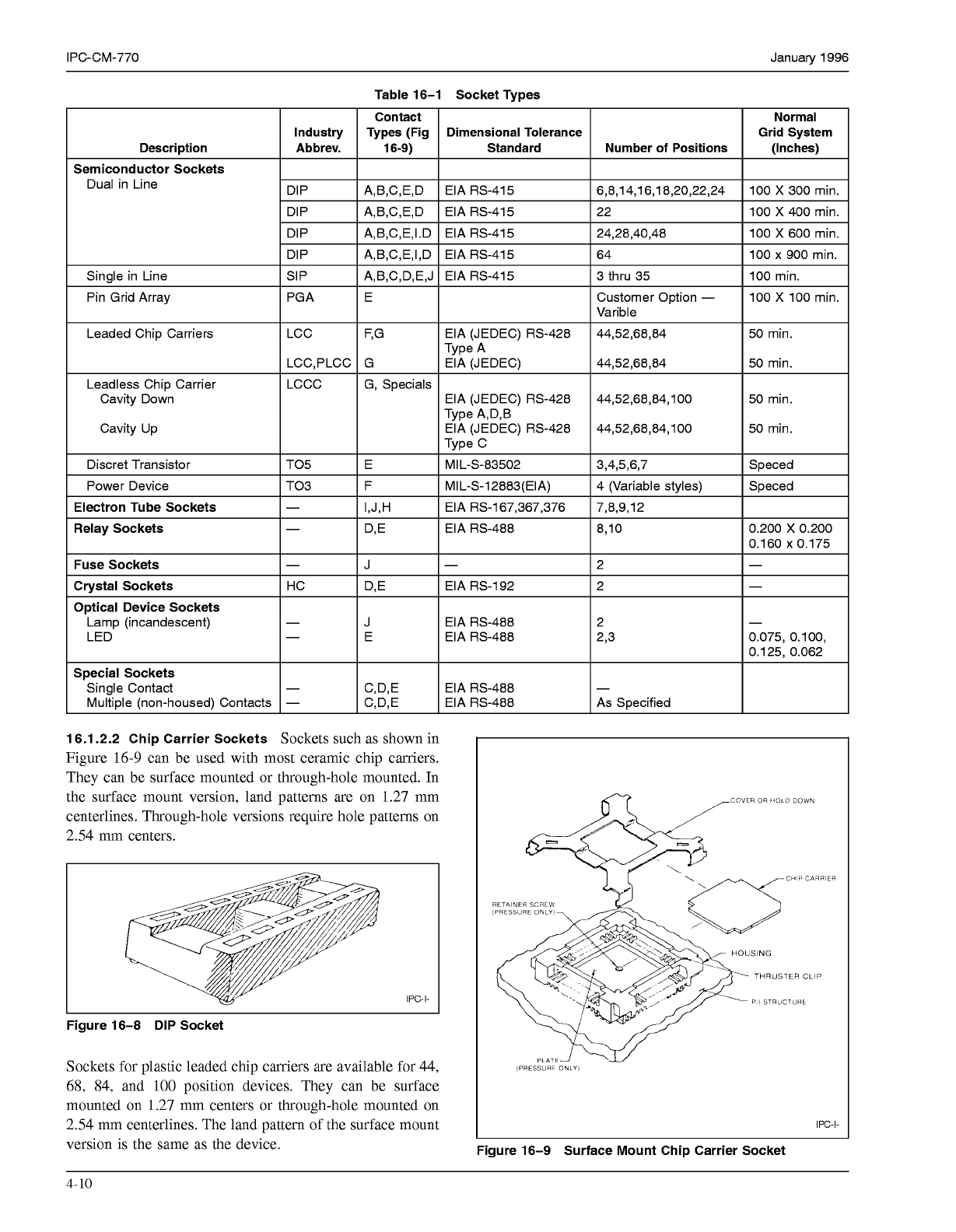
Table 16-1 Socket Types
16.1.2.2 Chip Carrier Sockets
Sockets such as shown in
Figure 16-9 can be used with most ceramic chip carriers.
They can be surface mounted or through-hole mounted. In
the surface mount version, land patterns are on 1.27 mm
centerlines. Through-hole versions require hole patterns on
2.54 mm centers.
IPC-I-
I I
Figure 16-8
DIP
Socket
Sockets for plastic leaded chip carriers are available for 44,
68, 84, and
100
position devices. They can be surface
mounted on 1.27 mm centers or through-hole mounted on
2.54 mm centerlines. The land pattern of the surface mount
Januaty 1996
Normal
Grid System
(Inches)
100
X
300
min.
100
X
400
min.
100
X
600 min.
100
x
900 min.
100 min.
100
X
100 min.
50 min.
50 min.
50 min.
50 min.
Speced
Speced
7
0.200
x
0.200
0.160
x
0.175
-
0.075, 0.100,
0.125, 0.062
CHIP
CARPIER
(PRESSURE
ONLY
RETAINER SCREW
THRUSTER
CLIP
P
I
STRUCTURE
(PRESSURF
ONLY
IPC-I-
4-10
COPYRIGHT Association Connecting Electronics Industries
Licensed by Information Handling Services
COPYRIGHT Association Connecting Electronics Industries
Licensed by Information Handling Services
January
1996
IPC-CM-770
16.1.2.3 Pin Grid Array (PGA) Sockets
Sockets for
PGAs are designed to match pin configurations of the
packages. In situations where polarization is desired, a non-
active pin serves the function. Three types are available
including a standard, low insertion force and zero insertion
force. PGAs and corresponding sockets are available in
sizes from
10
x
10
to 215 x 25. At higher pin counts, zero
insertion force types are preferred. The use of high tem-
perature materials adds utility to the zero insertion force
(ZIF) style for test, conditioning, and bum-in applications.
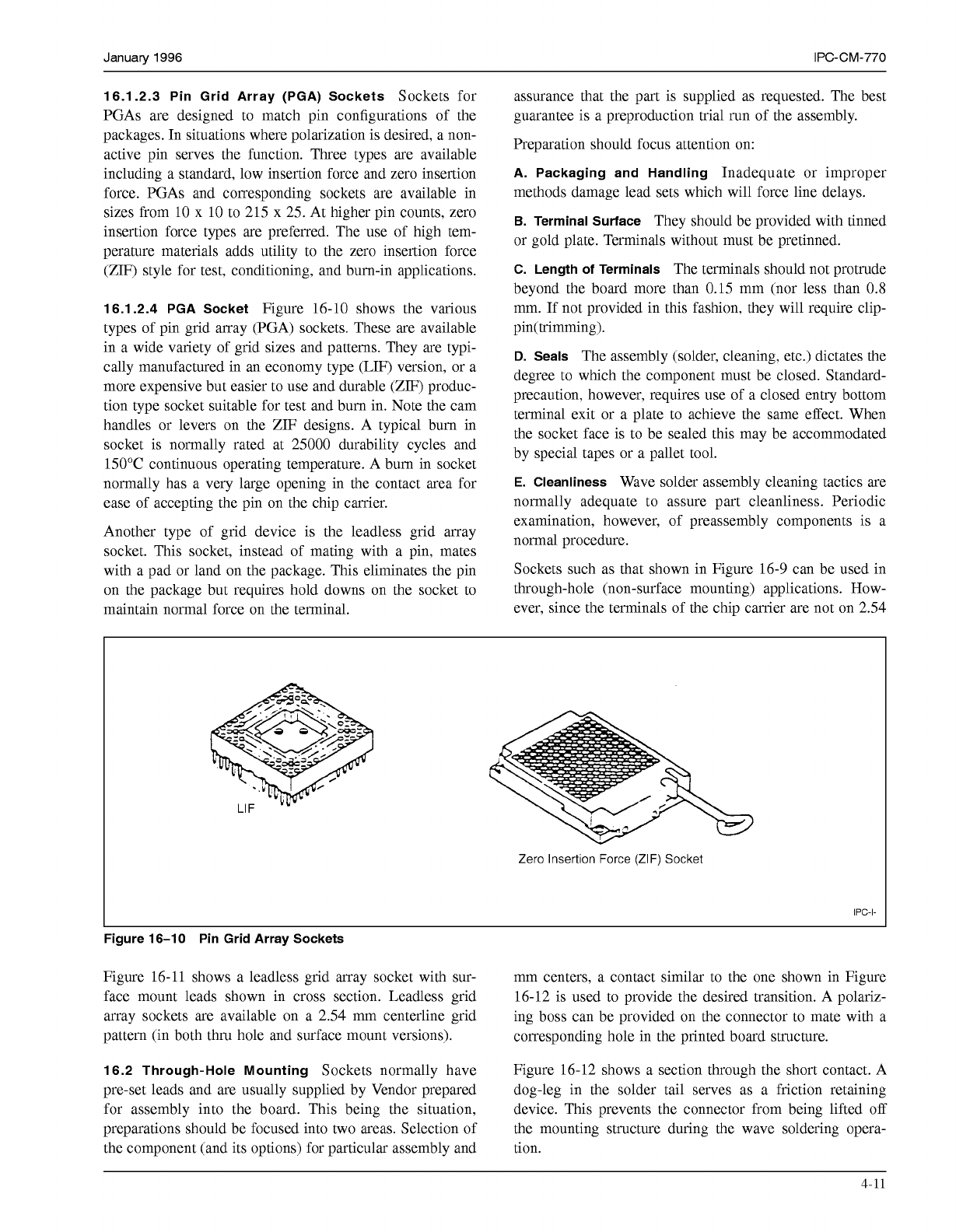
16.1.2.4 PGA Socket
Figure 16-10 shows the various
types of pin grid array (PGA) sockets. These are available
in a wide variety of grid sizes and patterns. They are typi-
cally manufactured in an economy type (LIF) version, or a
more expensive but easier to use and durable (ZIF) produc-
tion type socket suitable for test and bum in. Note the cam
handles or levers on the ZIF designs. A typical bum in
socket is normally rated at 25000 durability cycles and
150°C
continuous operating temperature. A bum in socket
normally has a very large opening in the contact area for
ease of accepting the pin on the chip carrier.
Another type of grid device is the leadless grid array
socket. This socket, instead of mating with a pin, mates
with a pad or land on the package. This eliminates the pin
on the package but requires hold downs on the socket to
maintain normal force on the terminal.
assurance that the part is supplied as requested. The best
guarantee is a preproduction trial run of the assembly.
Preparation should focus attention on:
A. Packaging and Handling
Inadequate or improper
methods damage lead sets which will force line delays.
B.
Terminal Surface
They should be provided with tinned
or gold plate. Terminals without must be pretinned.
C. Length
of
Terminals
The terminals should not protrude
beyond the board more than
0.15
mm (nor less than
0.8
mm.
If
not provided in this fashion, they will require clip-
pin(trimming).
D.
Seals
The assembly (solder, cleaning, etc.) dictates the
degree to which the component must be closed. Standard-
precaution, however, requires use of a closed entry bottom
terminal exit or a plate to achieve the same effect. When
the socket face is to be sealed this may be accommodated
by special tapes or a pallet tool.
E.
Cleanliness
Wave solder assembly cleaning tactics are
normally adequate to assure part cleanliness. Periodic
examination, however, of preassembly components is a
normal procedure.
Sockets such as that shown in Figure 16-9 can be used in
through-hole (non-surface mounting) applications. How-
ever, since the terminals of the chip carrier are not on 2.54
Zero Insertion Force (ZIF) Socket
IPC-I-
Figure 16-1
O
Pin Grid Array Sockets
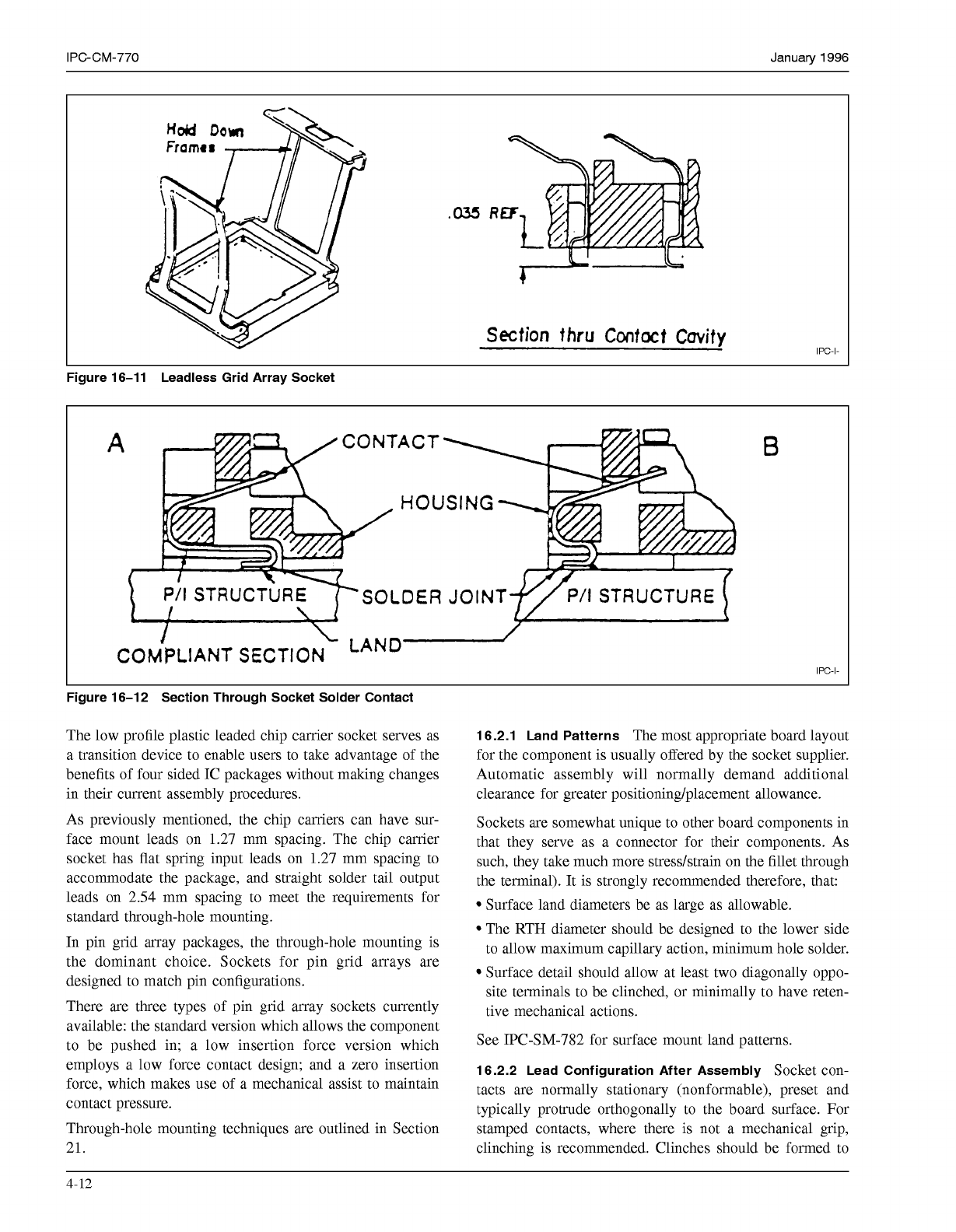
Figure 16-11 shows a leadless grid array socket with sur-
face mount leads shown in cross section. Leadless grid
array sockets are available on a 2.54 mm centerline grid
pattern (in both thru hole and surface mount versions).
16.2 Through-Hole Mounting
Sockets normally have
pre-set leads and are usually supplied by Vendor prepared
for assembly into the board. This being the situation,
preparations should be focused into two areas. Selection of
the component (and its options) for particular assembly and
mm centers, a contact similar to the one shown in Figure
16-12 is used to provide the desired transition. A polariz-
ing boss can be provided on the connector to mate with a
corresponding hole in the printed board structure.
Figure 16-12 shows a section through the short contact. A
dog-leg in the solder tail serves as a friction retaining
device. This prevents the connector from being lifted off
the mounting structure during the wave soldering opera-
tion.
4-11
COPYRIGHT Association Connecting Electronics Industries
Licensed by Information Handling Services
COPYRIGHT Association Connecting Electronics Industries
Licensed by Information Handling Services
IPC-CM-770
Januaty
1996
.a35
Section
fhru
Contact
Cuvitv
IPC-I-
Figure 16-11 Leadless Grid Array Socket
A
r
'ACT-
HOUS
PA
STRUCTURE
?SOLDER
J
\
ING
OIN
T
P/I
STRUCTURE
COMPLIANT SECTION
L
LAND
B
IPC-I-
Figure 16-1 2 Section Through Socket Solder Contact
The low profile plastic leaded chip carrier socket serves as
a transition device to enable users to take advantage of the
benefits of four sided IC packages without making changes
in their current assembly procedures.
As previously mentioned, the chip carriers can have sur-
face mount leads on 1.27 mm spacing. The chip carrier
socket has flat spring input leads on 1.27 mm spacing to
accommodate the package, and straight solder tail output
leads on 2.54 mm spacing to meet the requirements for
standard through-hole mounting.
In pin grid array packages, the through-hole mounting is
the dominant choice. Sockets for pin grid arrays are
designed to match pin configurations.
There are three types of pin grid array sockets currently
available: the standard version which allows the component
to be pushed in; a low insertion force version which
employs a low force contact design; and a zero insertion
force, which makes use of a mechanical assist to maintain
contact pressure.
Through-hole mounting techniques are outlined in Section
21.
16.2.1 Land Patterns
The most appropriate board layout
for the component is usually offered by the socket supplier.
Automatic assembly will normally demand additional
clearance for greater positioning/placement allowance.
Sockets are somewhat unique to other board components in
that they serve as a connector for their components. As
such, they take much more stresdstrain on the fillet through
the terminal). It is strongly recommended therefore, that:
Surface land diameters be as large as allowable.
The RTH diameter should be designed to the lower side
to allow maximum capillary action, minimum hole solder.
Surface detail should allow at least two diagonally oppo-
site terminals to be clinched, or minimally to have reten-
tive mechanical actions.
See IPC-SM-782 for surface mount land patterns.
16.2.2 Lead Configuration After Assembly
Socket con-
tacts are normally stationary (nonformable), preset and
typically protrude orthogonally to the board surface. For
stamped contacts, where there is not a mechanical grip,
clinching is recommended. Clinches should be formed to
4-12
COPYRIGHT Association Connecting Electronics Industries
Licensed by Information Handling Services
COPYRIGHT Association Connecting Electronics Industries
Licensed by Information Handling Services