IPC 7711A.pdf - 第229页
OUTLINE This method is used to rebond a lifted conductor. Liquid epoxy is inserted under and around the conductor to bond it back down to the printed wiring board surface. CAUTION This method should not be used to rebond…
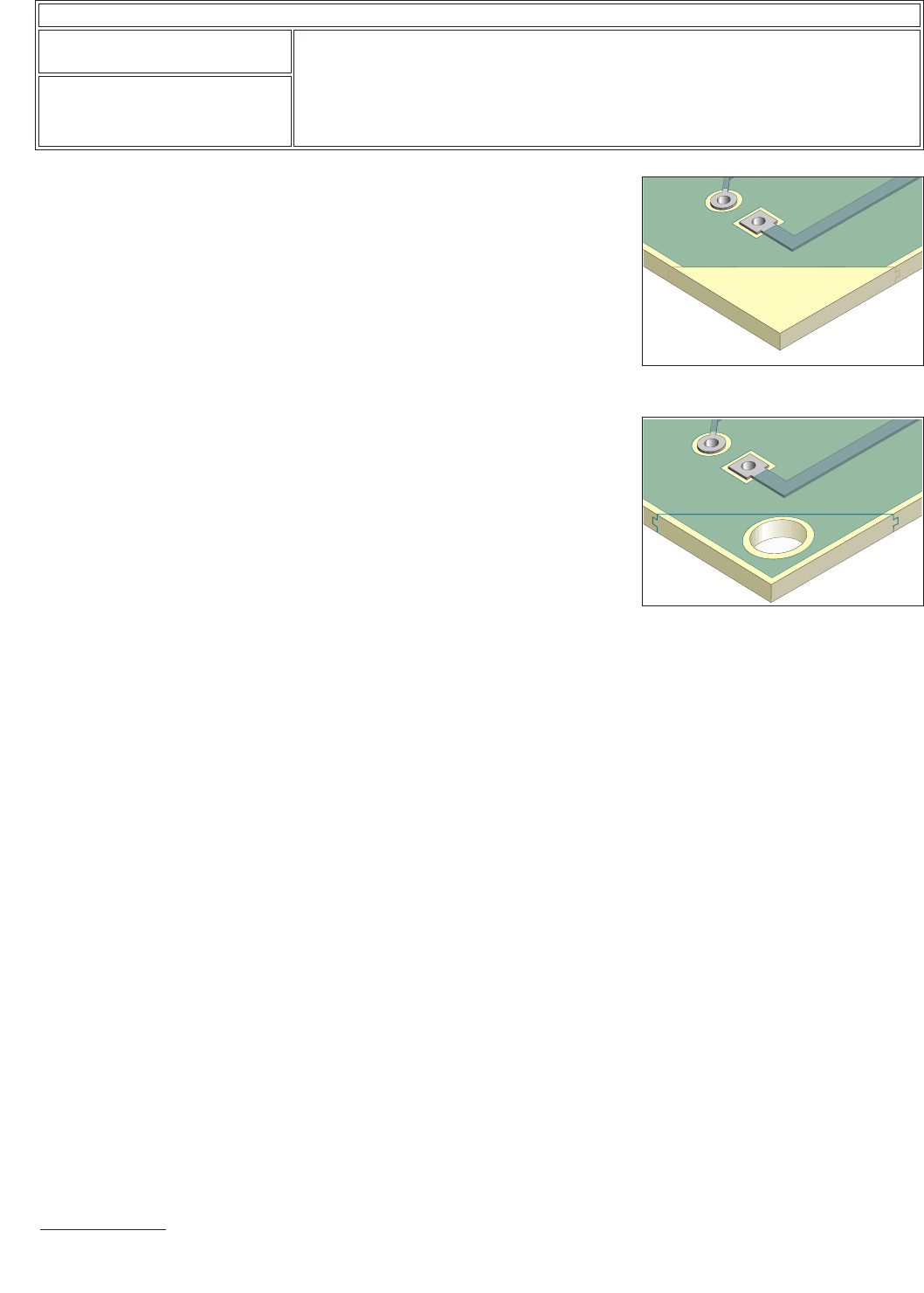
4. Install a carbide saw into the hand held drill. Set the speed to maximum and
machine a groove in the edge of the printed wiring board where the new base
material will be installed. The groove must be centered in the edge to ensure
that the new piece will fit properly. The groove width should be approximately
1/3 of the printed wiring board thickness. The groove depth should be approxi-
mately double the groove width. (See Figure 2.)
5. Cut a piece of replacement base board material that is the same thickness and
type as the piece removed. The replacement piece may be oversized, the
excess material will be removed after the replacement piece has been epoxied
in place.
6. Install an end mill into the chuck of a precision drill press. Machine a tongue
onto the entire mating edge of the replacement base material. The dimensions
of the tongue should match the size of the milled groove. (See Figure 3.)
7. Where required apply Polyimide tape to protect exposed parts of printed wiring
board bordering the prepared area.
8. Check the fit to be sure the new base material properly mates with the groove
in the printed wiring board. (See Figure 4.)
9. Mix the epoxy.
10. Coat both the tongue and groove surfaces with epoxy and fit together. Remove
excess epoxy.
11. Cure the epoxy per the manufacturers instructions.
CAUTION
Some components may be sensitive to high temperature.
12. After the epoxy has cured remove the Polyimide tape.
13. If needed, scrape off any excess epoxy using a scraper or knife.
NOTE
If needed, apply additional thin coating to seal any scrapped areas.
14. Saw or mill off excess base material and file flush with existing edge. (See Fig-
ure 5.)
15. Clean the area.
16. Complete by drilling holes, slots, etc. or adding circuitry as required. (See Figure
6.)
17. If needed, replace solder resist or conformal coating.
EVALUATION
1. Dimensions of area replaced should be checked to conform to specifications
required.
NOTES
Figure 5 Saw off excess new base
material.
Figure 6 Complete by drilling holes,
or adding circuitry as required.
IPC-7721A
Number: 3.5.3
Revision:
Date: 2/98
Subject: Base Material Repair, Edge Transplant Method
Page2of2
Copyright Association Connecting Electronics Industries
Provided by IHS under license with IPC
Not for Resale
No reproduction or networking permitted without license from IHS
--``,``,-`-`,,`,,`,`,,`---
OUTLINE
This method is used to rebond a lifted conductor. Liquid epoxy is inserted under and
around the conductor to bond it back down to the printed wiring board surface.
CAUTION
This method should not be used to rebond a conductor that has been stretched or
damaged.
REFERENCES
2.1 Handling Electronic Assemblies
2.2 Cleaning
2.5 Baking and Preheating
2.6 Epoxy Mixing and Handling
TOOLS AND MATERIALS
Cleaner
Cleaning Wipes
Epoxy
Heat Lamp or Oven
Knife
Pick
PROCEDURE
1. Clean the area.
2. Remove any obstructions that prevent the lifted conductor from making contact
with the base board surface.
CAUTION
Be careful while cleaning and removing all obstructions, not to stretch or dam-
age the lifted conductor.
3. Clean the area.
4. Mix the epoxy.
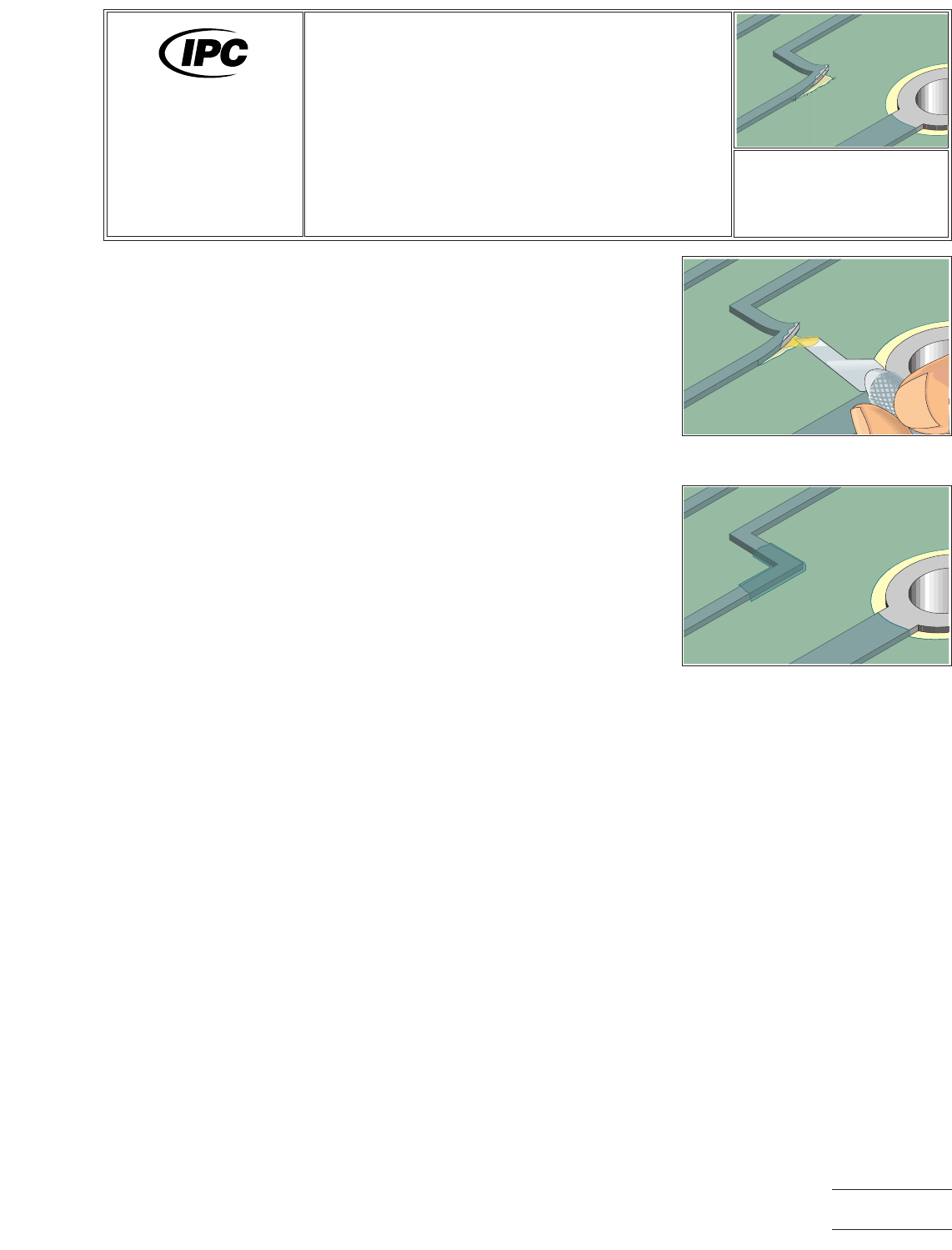
5. Carefully apply a small amount of epoxy under the entire length of the lifted
conductor. The tip of a knife may be used to apply the epoxy. (See Figure 1.)
6. Press the lifted conductor down into the epoxy and into contact with the base
board material.
7. Apply additional epoxy to the surface of the lifted conductor and to all sides as
needed.
8. Cure the epoxy per the manufacturer’s instructions.
CAUTION
Some components may be sensitive to high temperature.
9. Apply surface coating to match prior coating as required.
Figure 1 Apply a small amount of
epoxy under the lifted conductor.
Figure 2 Completed repair.
7721A
Repair and
Modification of
Printed Boards and
Electronic Assemblies
Revision:
Date: 2/98
Lifted Conductor Repair,
Epoxy Seal Method
Number: 4.1.1
Product Class: R, F
Skill Level: Intermediated
Level of Conformance: Medium
Material in this manual was voluntarily established by Technical Committees of IPC. This material is advisory only and its use
or adaptation is entirely voluntary. IPC disclaims all liability of any kind as to the use, application, or adaptation of this material.
Users are also wholly responsible for protecting themselves against all claims or liabilities for patent infringement. Equipment
referenced is for the convenience of the user and does not imply endorsement by IPC.
Page1of2
Copyright Association Connecting Electronics Industries
Provided by IHS under license with IPC
Not for Resale
No reproduction or networking permitted without license from IHS
--``,``,-`-`,,`,,`,`,,`---

EVALUATION
1. Visual examination and tape test per IPC-TM-650, Test Method 2.4.1.
2. Electrical tests as applicable.
NOTES
IPC-7721A
Number: 4.1.1
Revision:
Date: 2/98
Subject: Lifted Conductor Repair, Epoxy Seal Method
Page2of2
Copyright Association Connecting Electronics Industries
Provided by IHS under license with IPC
Not for Resale
No reproduction or networking permitted without license from IHS
--``,``,-`-`,,`,,`,`,,`---