IPC 7711A.pdf - 第253页
OUTLINE This method is used to replace damaged or missing conductors on internal layers of multilayer printed wiring boards. CAUTION The conductor widths, spacing and current carrying capacity must not be reduced below a…

2. Expose CAD generated additive conductor patterns of new conductor revision
in isolation layer, copper and solder screens.
3 Print and cure isolation layer of protective epoxy.
4 Print, metalize and cure the new conductive ink pattern which establishes the
modified/repaired conductor.
5. Print the SMT compatible solder paste on to the cured conductive ink pattern,
totally encompassing the underlying material.
6 Fuse the printed solder paste to form the electrical optimization of the new con-
ductor and the interconnection to the original etched conductor. See reflow sol-
dering (IPC-J-STD-001).
CAUTION
Care should be taken not to add any solder to any unmodified or un-repaired areas
on the printed wiring board. All solder flux residue should be removed to meet IPC-
TM-650, Test Methods 2.3.25 and 2.3.26, ionic contamination requirements.
EVALUATION
Visually examine and conduct dimensional measurement of conductor width and
spacing. Ring-out for electrical continuity to detect for ‘shorts’ or ‘opens.’ This test-
ing can be affected manually via continuity meter, automated electronic point-to-
point tester or via a universal bed of nails electronic tester.
NOTE
Additive Conductor Modification Operations has become an industry standard for
production quantities of PCB modification/repair revisions.
NOTE
Because of the expert level of workmanship required, qualified vendors of the ser-
vice should be considered or the acquisition of dedicated in-house systems and
personnel to perform this work.
NOTES
IPC-7721A
Number: 4.2.6
Revision:
Date: 2/98
Subject: Conductor Repair/Modification, Conductive Ink Method
Page2of2
Copyright Association Connecting Electronics Industries
Provided by IHS under license with IPC
Not for Resale
No reproduction or networking permitted without license from IHS
--``,``,-`-`,,`,,`,`,,`---
OUTLINE
This method is used to replace damaged or missing conductors on internal layers of
multilayer printed wiring boards.
CAUTION
The conductor widths, spacing and current carrying capacity must not be reduced
below allowable tolerances.
CAUTION
The overlap joint used in this method may cause problems with high frequency cir-
cuitry.
CAUTION
This procedure is complicated and should be attempted only by properly skilled
repair personnel using the best tools and equipment.
REFERENCES
2.1 Handling Electronic Assemblies
2.2 Cleaning
2.5 Baking and Preheating
2.6 Epoxy Mixing and Handling
TOOLS AND MATERIALS
Ball Mills
Buffer
Conductor Foil Jumpers
Cleaner
Cleaning Wipes
Color Agent
Epoxy
Hand Held Drill
Heat Lamp
Polyimide Tape
Knife
Liquid Flux
Microscope
Oven
Scraper
Solder
Soldering Iron
PROCEDURE
1. Locate and determine the coordinates where the repair is to be made. Use films
or master drawings of the board as needed.
NOTE
Obtain as much information as possible on the conductive and non-conductive
layers prior to starting the procedure.
2. Remove components from the immediate area if necessary and clean the area.
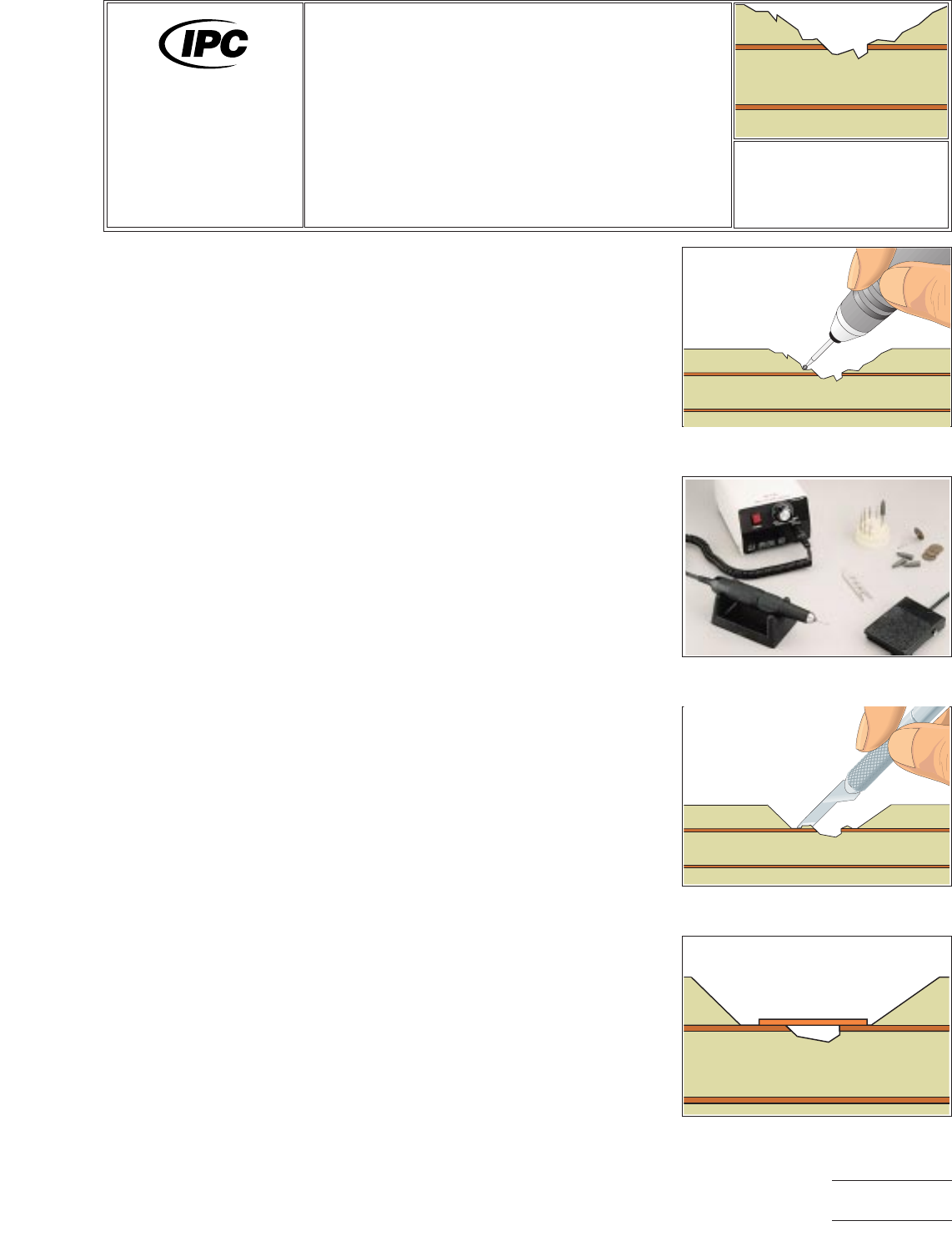
Figure 1 Milling into multilayer board
to expose the damaged conductors.
Figure 2 A high quality, hand held
drill.
Figure 3 Remove the remaining board
material with a knife.
Figure 4 Conductor foil jumper in
place ready to be soldered.
7721A
Repair and
Modification of
Printed Boards and
Electronic Assemblies
Revision:
Date: 2/98
Conductor Repair,
Inner Layer Method
Number: 4.2.7
Product Class: R, F
Skill Level: Expert
Level of Conformance: High
Material in this manual was voluntarily established by Technical Committees of IPC. This material is advisory only and its use
or adaptation is entirely voluntary. IPC disclaims all liability of any kind as to the use, application, or adaptation of this material.
Users are also wholly responsible for protecting themselves against all claims or liabilities for patent infringement. Equipment
referenced is for the convenience of the user and does not imply endorsement by IPC.
Page1of4
Copyright Association Connecting Electronics Industries
Provided by IHS under license with IPC
Not for Resale
No reproduction or networking permitted without license from IHS
--``,``,-`-`,,`,,`,`,,`---
3. Use the microscope and hand held drill and cut through the base material, one
layer at a time, until the desired inner layer has been reached. (See Figure 1 and
2.)
CAUTION
Great care should be taken to prevent further damage to internal conductors.
4. Each internal conductor should have a flat section exposed to allow the new
conductor to be soldered in place. (See Figure 3.)
NOTE
To reduce damage to the internal conductor, complete the final exposure of the
internal conductor using a knife. (See Figure 3.)
5. Remove all loose material. Clean the area.
6. Apply a small amount of liquid flux to the ends of the internal conductor. Tin the
exposed end of each conductor using solder and a soldering iron.
7. Clean the area.
8. Select a replacement conductor foil jumper that most closely matches the size
of the conductor to be replaced. Cut length approximately as needed.
9. Gently abrade the top and bottom of the conductor foil jumper with a buffer to
remove any protective coating and clean.
NOTE
If needed, the ends of the conductor foil jumper may be tinned with solder prior
to lap soldering in place.
10. Place the conductor foil jumper in position. The conductor foil jumper should
overlap the existing conductor a minimum of 2 times the conductor width. (See
Figure 4.)
NOTE
If spacing is critical or the printed wiring board uses high frequency conductors,
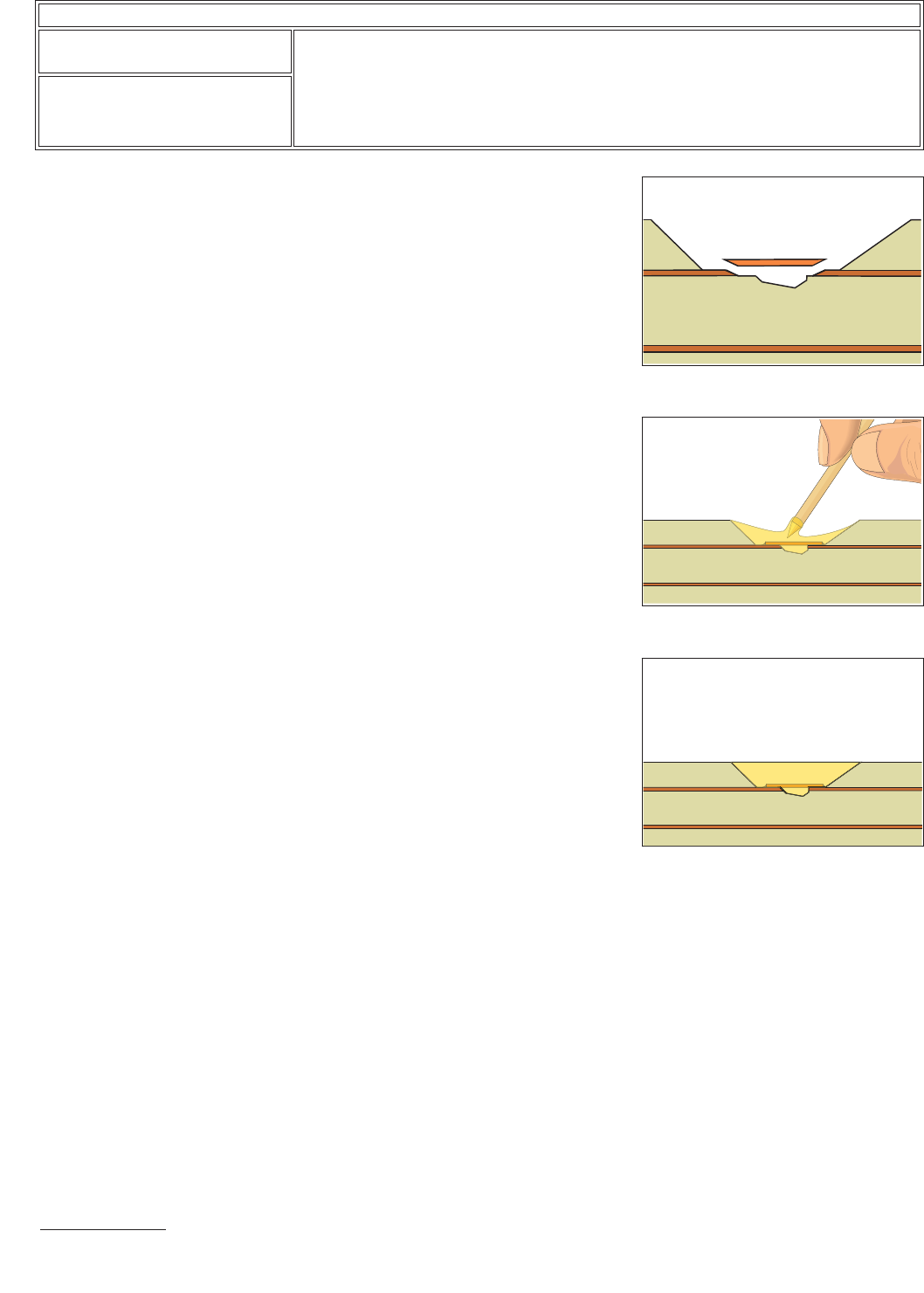
bevel the joint. (See Figure 5.)
CAUTION
This bevel joint method may cause problems with printed wiring boards
exposed to extreme temperature fluctuations.
11. Apply a small amount of liquid flux to the overlap joint.
12. Lap solder the conductor foil jumper to the exposed internal conductor using
solder and a soldering iron. Make sure the new conductor is properly aligned.
13. Clean the area.
NOTE
The printed wiring board may be preheated prior to filling the area with epoxy.
A preheated printed wiring board will allow the epoxy to easily flow and level out.
Epoxy applied to an unheated printed wiring board may settle below the printed
wiring board surface as the epoxy cures.
14. Mix epoxy. If desired, add color agent to the mixed epoxy to match the printed
wiring board color.
Figure 5 Bevel end joint.
Figure 6 Coat the top and sides of the
new conductor with epoxy.
Figure 7 Completed repair.
IPC-7721A
Number: 4.2.7
Revision:
Date: 2/98
Subject: Conductor Repair, Inner Layer Method
Page2of4
Copyright Association Connecting Electronics Industries
Provided by IHS under license with IPC
Not for Resale
No reproduction or networking permitted without license from IHS
--``,``,-`-`,,`,,`,`,,`---