IPC 7711A.pdf - 第257页
OUTLINE This method is used to sever a conductor or short. A small section of the conduc- tor is removed forming a break. The width of the break should be at least as wide as the minimum conductor spacing. A knife or hig…

NOTES
IPC-7721A
Number: 4.2.7
Revision:
Date: 2/98
Subject: Conductor Repair, Inner Layer Method
Page4of4
Copyright Association Connecting Electronics Industries
Provided by IHS under license with IPC
Not for Resale
No reproduction or networking permitted without license from IHS
--``,``,-`-`,,`,,`,`,,`---
OUTLINE
This method is used to sever a conductor or short. A small section of the conduc-
tor is removed forming a break. The width of the break should be at least as wide as
the minimum conductor spacing. A knife or high speed, hand held drill is used. This
method is recommended for surface conductor cuts only. After cutting, the area is
sealed with epoxy.
NOTE
This method is recommended for surface conductor cuts only.
REFERENCES
2.1 Handling Electronic Assemblies
2.2 Cleaning
2.6 Epoxy Mixing and Handling
TOOLS AND MATERIALS
Ball Mills, Carbide
Cleaner
Cleaner Wipes
Color Agent
Continuity Meter
Epoxy
Epoxy Dispensing System
Hand Held Drill
Heat Lamp
Knife
Microscope
Oven
PROCEDURE
1. Identify the conductor or short to be cut. Determine from the artwork or draw-
ings where the best location is to make the break. The width of the break should
at least match the minimum required electrical spacing.
2. Clean the area.
3A. Carefully make two small cuts with the knife and remove the short section of
conductor. (See Figure 1.) An alternate method is to use a handheld drill as dis-
cussed in Step 4 and shown in Figure 3.
NOTE
If desired, remove a second section of the conductor at the opposite end to
eliminate the potential of the conductor acting as an antenna.
↑
OR
↓
3B. Select the appropriate size ball mill and insert it into the dental style drill. Set the
speed to high. (See Figure 2.) The ball mill should be approximately the same
width as the conductor to be cut. (See Table 1 for standard ball mill sizes.)
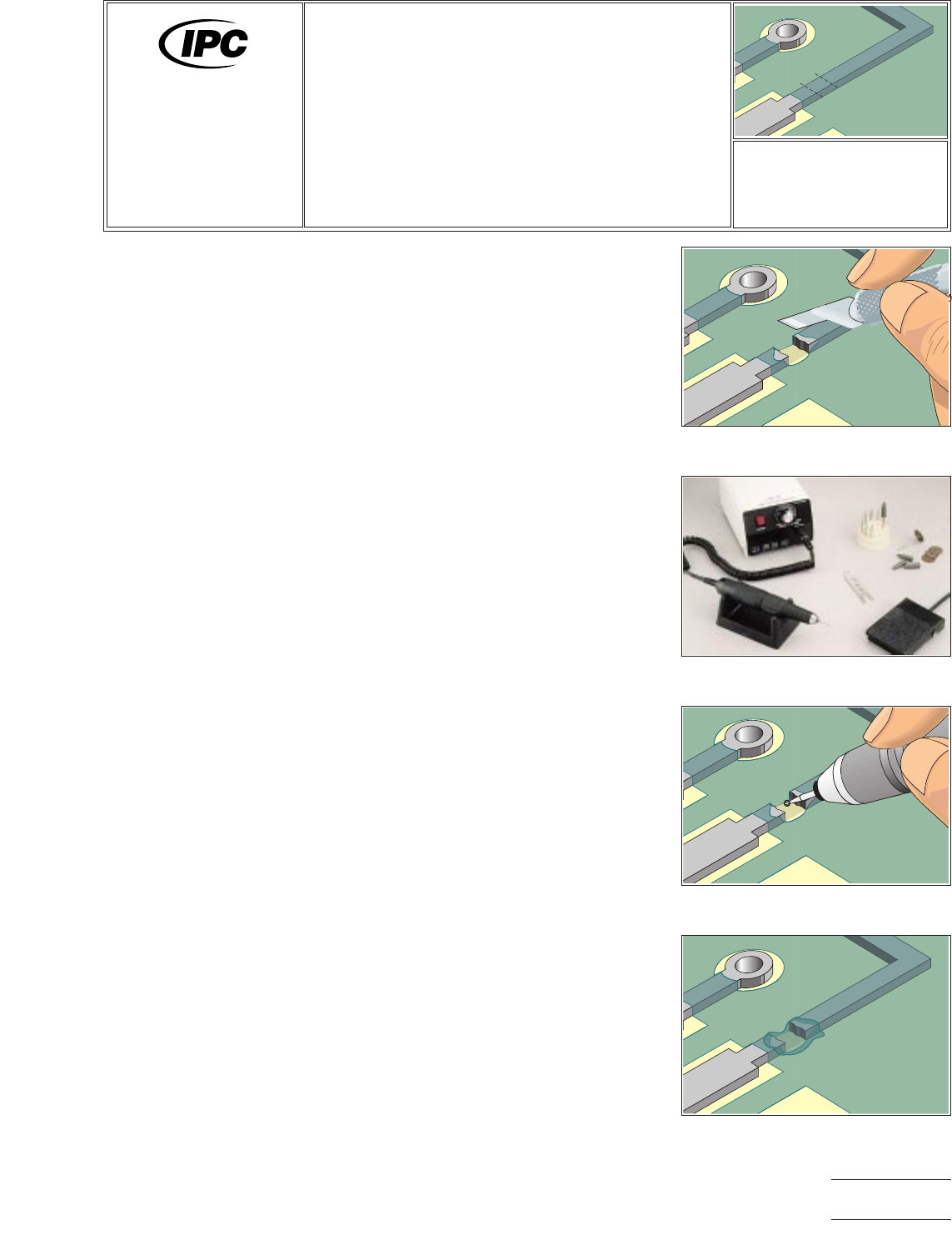
Figure 1 Make two small cuts with a
knife and remove section of conductor.
Figure 2 A high quality, hand held
drill.
Figure 3 Make one or two cuts as
needed to cut conductor.
Figure 4 Completed repair.
7721A
Repair and
Modification of
Printed Boards and
Electronic Assemblies
Revision: A
Date: 10/03
Conductor Cut,
Surface Conductors
Number: 4.3.1
Product Class: R, F
Skill Level: Advanced
Level of Conformance: High
Material in this manual was voluntarily established by Technical Committees of IPC. This material is advisory only and its use
or adaptation is entirely voluntary. IPC disclaims all liability of any kind as to the use, application, or adaptation of this material.
Users are also wholly responsible for protecting themselves against all claims or liabilities for patent infringement. Equipment
referenced is for the convenience of the user and does not imply endorsement by IPC.
Page1of2
Copyright Association Connecting Electronics Industries
Provided by IHS under license with IPC
Not for Resale
No reproduction or networking permitted without license from IHS
--``,``,-`-`,,`,,`,`,,`---

CAUTION
Abrasion operations can generate electrostatic charges.
NOTE
Ball mills should be dental grade carbide steel for precision cutting and long life.
4. Carefully make 1 or 2 cuts as needed. (See Figure 3.)
CAUTION
Exercise care to avoid damage to adjoining conductors.
NOTE
If desired, remove a second section of the conductor at the opposite end to
eliminate the potential of the conductor acting as an antenna.
5. Check continuity to be sure that the conductor has been cut.
6. Clean the area.
7. Mix epoxy. If desired, add color agent to the mixed epoxy to match the printed
wiring board color.
8. Coat the area with epoxy if needed. An epoxy dispenser may be used to accu-
rately control the application of epoxy. Remove any excess epoxy.
9. Cure the epoxy per the manufacturer’s instructions.
CAUTION
Some components may be sensitive to high temperatures.
EVALUATION
1. Visual examination of cuts for spacing, and unintended damage to surrounding
conductors.
2. Electrical tests as applicable.
NOTES
Table 1 Standard Ball Mill Sizes
0.50 mm Diameter
0.70 mm Diameter
0.80 mm Diameter
1.00 mm Diameter
1.20 mm Diameter
1.40 mm Diameter
1.60 mm Diameter
1.80 mm Diameter
2.10 mm Diameter
IPC-7721A
Number: 4.3.1
Revision: A
Date: 10/03
Subject: Conductor Cut, Surface Conductors
Page2of2
Copyright Association Connecting Electronics Industries
Provided by IHS under license with IPC
Not for Resale
No reproduction or networking permitted without license from IHS
--``,``,-`-`,,`,,`,`,,`---