IPC 7711A.pdf - 第300页
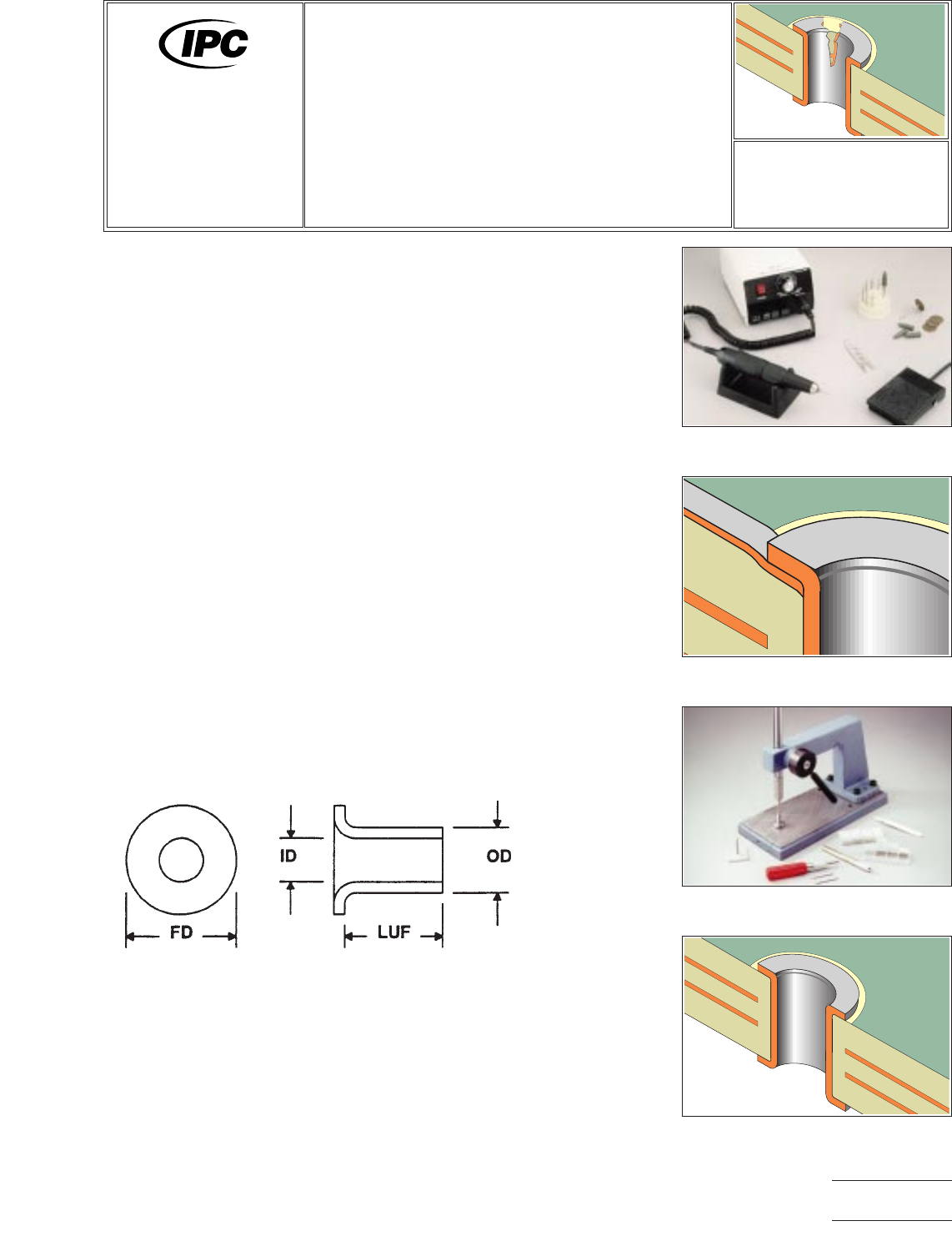
FD Flange Diameter The eyelet flange diameter should be small enough to prevent interference with adja- cent pads or conductors. OD Outside Diameter The clearance hole should allow the eyelet to be inserted without force…
OUTLINE
This procedure covers the repair of a damaged hole that has no inner layer connec-
tion. An eyelet is used to repair the damage to the hole and the eyelet flanges replace
the pads on the printed wiring board surface.
CAUTION
This procedure is used only to restore the integrity of a through connection in a
double sided board or a multilayer board where there is no inner layer connection. If
there is an inner layer connection see appropriate procedure.
REFERENCES
2.1 Handling Electronic Assemblies
2.2 Cleaning
TOOLS & MATERIALS
Ball Mills, Carbide
Caliper
Cleaner
Eyelets
Eyelet Press System
Eyelet Repair Kit
Eyelet Setting Tools
Hand Held Drill
Liquid Flux
Knife
Microscope
Pin Gauges
Solder
Solder Iron
Wipes
EYELET SELECTION CRITERIA
ID Inside Diameter
The eyelet inside diameter should be a 0.075 - 0.500 mm greater than the compo-
nent lead diameter.
LUF Length Under Flange
The length of the eyelet barrel under the flange should be 0.630 - 0.890 mm greater
than the thickness of the printed wiring board. This added length allows for proper
protrusion when setting the eyelet.
Figure 1 Drill out the hole using a
hand held drill and ball mill.
Figure 2
The eyelet flange can be used
to secure a new conductor in place.
Figure 3 Set the eyelet using an
eyelet press.
Figure 4 Completed repair.
7721A
Repair and
Modification of
Printed Boards and
Electronic Assemblies
Revision:
Date: 2/98
Plated Hole Repair,
No Inner Layer
Connection
Number: 5.1
Product Class: R, F, W
Skill Level: Intermediate
Level of Conformance: High
Material in this manual was voluntarily established by Technical Committees of IPC. This material is advisory only and its use
or adaptation is entirely voluntary. IPC disclaims all liability of any kind as to the use, application, or adaptation of this material.
Users are also wholly responsible for protecting themselves against all claims or liabilities for patent infringement. Equipment
referenced is for the convenience of the user and does not imply endorsement by IPC.
Page1of4
Copyright Association Connecting Electronics Industries
Provided by IHS under license with IPC
Not for Resale
No reproduction or networking permitted without license from IHS
--``,``,-`-`,,`,,`,`,,`---

FD Flange Diameter
The eyelet flange diameter should be small enough to prevent interference with adja-
cent pads or conductors.
OD Outside Diameter
The clearance hole should allow the eyelet to be inserted without force but should
not exceed 0.125 mm greater than the eyelet outside diameter.
NOTE
Be sure to select an eyelet meeting the proper criteria. An eyelet with an oversize
flange may interfere with adjacent conductors. An eyelet that is too short will not
protrude through the printed wiring board for proper setting.
PROCEDURE
1. Clean the area.
2. Select an eyelet using the Eyelet Selection Criteria. Use a pin gauge and caliper
to measure the existing plated hole dimensions.
3. Insert the appropriate ball mill into the hand held drill. Drill out the hole remov-
ing all the plating. The drilled hole should be 0.025 - 0.125 mm larger than the
eyelet O.D. (See Figure 1.)
CAUTION
This procedure may isolate internal connections on multilayer printed wiring
boards.
4. Clean the area.
5. Apply a small amount of liquid flux to the pad or conductor on the printed wir-
ing board surface, if any, and tin with solder using a soldering iron and solder.
Clean the area.
6. Insert the eyelet into the hole. If a new conductor is required, the new conduc-
tor may extend into the drilled hole and the flange of the eyelet will secure the
new conductor in place. (See Figure 2.) The eyelet may be inserted from either
side.
7. Select the proper setting tools and insert them into an eyelet press system. (See
Figure 3.)
8. Turn the printed wiring board over and rest the eyelet flange on the lower set-
ting tool.
9. Apply firm even pressure to form the eyelet barrel.
NOTE
Inspect the eyelet flange for evidence of damage. Refer to IPC-A-610 Accept-
ability of Electronic Assemblies.
10. Apply a small amount of liquid flux and solder the eyelet flanges to the pads on
the printed wiring board surface if necessary. Clean the area. Inspect for good
solder flow and wetting around the eyelet flanges and lands.
IPC-7721A
Number: 5.1
Revision:
Date: 2/98
Subject: Plated Hole Repair, No Inner Layer Connection
Page2of4
Copyright Association Connecting Electronics Industries
Provided by IHS under license with IPC
Not for Resale
No reproduction or networking permitted without license from IHS
--``,``,-`-`,,`,,`,`,,`---

EVALUATION
1. Visual examination, dimensional requirement of pad diameter and inside diam-
eter.
2. Electrical continuity measurement.
IPC-7721A
Number: 5.1
Revision:
Date: 2/98
Subject: Plated Hole Repair, No Inner Layer Connection
Page3of4
Copyright Association Connecting Electronics Industries
Provided by IHS under license with IPC
Not for Resale
No reproduction or networking permitted without license from IHS
--``,``,-`-`,,`,,`,`,,`---