IPC 7711A.pdf - 第47页
OUTLINE This coating removal method uses a micro abrasive blasting system and a very fine soft abrasive powder. The powder is propelled through a small nozzle toward the area where the coating needs to be removed. To det…

NOTE
Rubberized abrasives of the proper grade and grit are ideally suited for removing thin
hard coatings from flat surfaces but not for soft coatings since these would cause
the abrasive to ‘‘load up’’ with coating material and become ineffective.
Rotary brushes are better suited than rubberized abrasives on contoured or irregu-
lar surfaces, such as soldered connections, etc., since the bristles will conform to
surface irregularities while removing hard or soft coatings. (See Figure 3.)
NOTE
The procedure for removing thick coatings is primarily to reduce their thickness to a
thin coating and then to remove the remaining thin coating by the scraping method.
EVALUATION
1. Visual examination or UV light may be used to verify complete removal of coating.
NOTES
IPC-7711A/7721A
Number: 2.3.5
Revision:
Date: 2/98
Subject: Coating Removal, Grinding/Scraping Method
Page2of2
Copyright Association Connecting Electronics Industries
Provided by IHS under license with IPC
Not for Resale
No reproduction or networking permitted without license from IHS
--``,``,-`-`,,`,,`,`,,`---
OUTLINE
This coating removal method uses a micro abrasive blasting system and a very fine
soft abrasive powder. The powder is propelled through a small nozzle toward the
area where the coating needs to be removed.
To determine the appropriate coating removal procedure the coating must first be
identified. Refer to procedure number 2.3.1.
CAUTION
Micro blasting will generate substantial static charges. The work area should be
flooded with ionized air and the printed wiring board assembly should be grounded
whenever possible.
REFERENCES
2.1 Handling Electronic Assemblies
2.2 Cleaning
2.3.1 Coating Removal, Identification of Conformal Coatings
2.4.1 Coating Replacement, Solder Resist
2.4.2 Coating Replacement, Conformal Coatings/Encapsulants
TOOLS AND MATERIALS
Abrasive Powder
Polyimide Tape
Micro Blasting System
Removable Mask
Stencils
PROCEDURE
1. Clean the area.
2. Select the appropriate abrasive blasting powder and nozzle size. Set the air pres-
sure at the desired setting per equipment manufacturer’s instructions.
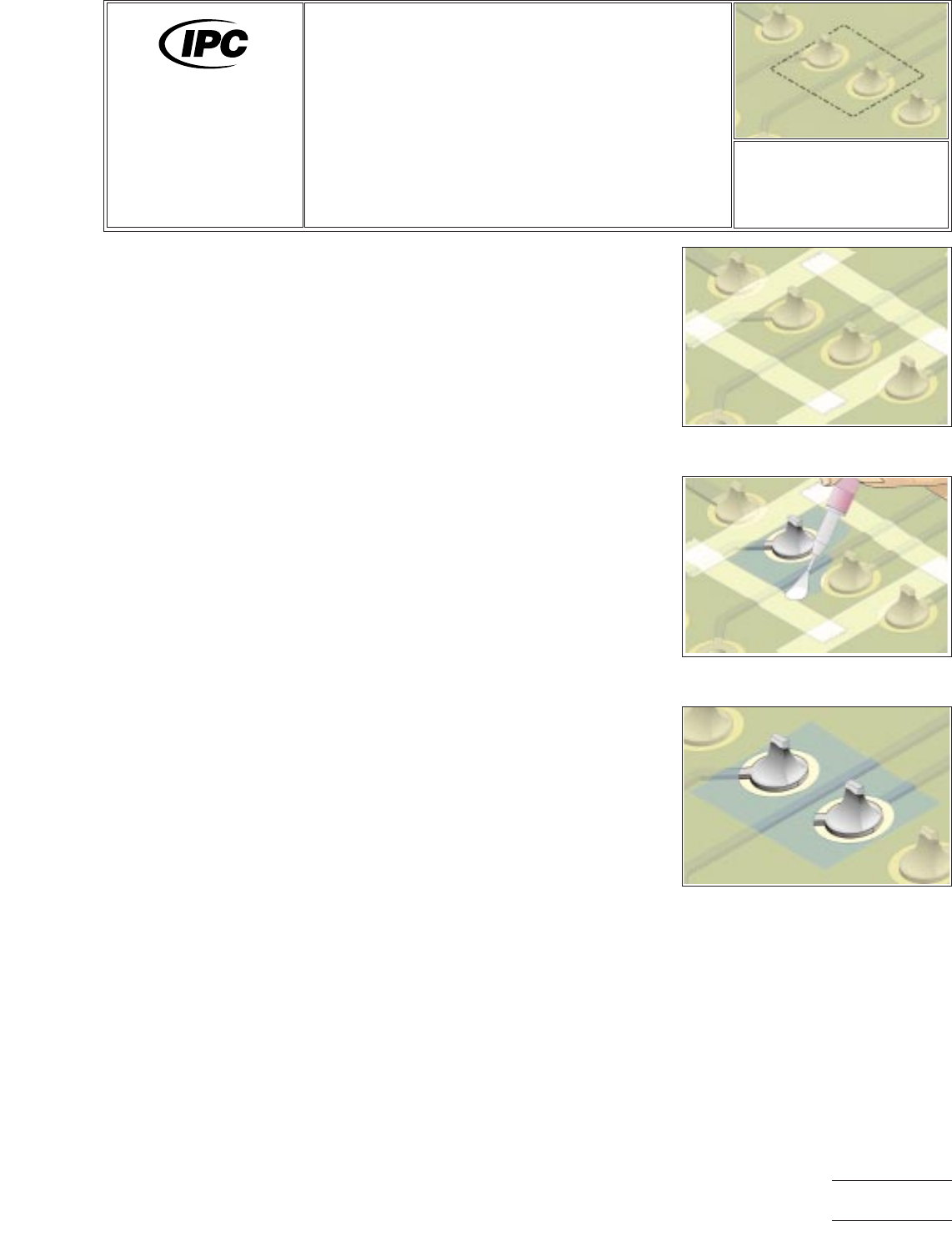
3. Apply polyimide tape or other masking material to protect the printed wiring board
surface as needed. (See Figure 1.) Masking materials can consist of tapes, cur-
able liquid masks or reusable stencils.
4. If the printed wiring board has static sensitive components, insert the entire
printed wiring board into a shielded bag. Only the area needing rework should be
exposed. Ground the printed wiring board to dissipate static charges if needed.
5. Insert the printed wiring board into the blasting chamber and blast away the
damaged or unwanted coating or solder resist. Slowly move the nozzle along the
area where the coating is to be removed. (See Figure 2.)
6. Blow off the blasting dust and clean the area.
Figure 1 Apply tape to outline area for
coating removal.
Figure 2 Remove coating using micro
blasting system.
Figure 3 Removal complete.
7711A/7721A
General
Information and
Common Procedures
Revision:
Date: 2/98
Coating Removal,
Micro Blasting
Method
Number: 2.3.6
Product Class: R, F, W, C
Skill Level: Advanced
Level of Conformance: High
Material in this manual was voluntarily established by Technical Committees of IPC. This material is advisory only and its use
or adaptation is entirely voluntary. IPC disclaims all liability of any kind as to the use, application, or adaptation of this material.
Users are also wholly responsible for protecting themselves against all claims or liabilities for patent infringement. Equipment
referenced is for the convenience of the user and does not imply endorsement by IPC.
Page1of2
Copyright Association Connecting Electronics Industries
Provided by IHS under license with IPC
Not for Resale
No reproduction or networking permitted without license from IHS
--``,``,-`-`,,`,,`,`,,`---

EVALUATION
1. Visual examination or UV light may be used to verify complete removal of coating.
NOTES
IPC-7711A/7721A
Number: 2.3.6
Revision:
Date: 2/98
Subject: Coating Removal, Macro Blasting Method
Page2of2
Copyright Association Connecting Electronics Industries
Provided by IHS under license with IPC
Not for Resale
No reproduction or networking permitted without license from IHS
--``,``,-`-`,,`,,`,`,,`---