IPC 7711A.pdf - 第60页
NOTES IPC-771 1A Number: 3.1.2 Revision: Date: 5/02 Subject: Through-Hole Desoldering P a g e2o f2 Copyright Association Connecting Electronics Industries Provided by IHS under license with IPC Not for Resale No reproduc…
EQUIPMENT REQUIRED
Continuous vacuum desoldering system
Desoldering tip
Damp sponge
OPTIONAL EQUIPMENT
N/A
MATERIALS
Flux-cored solder
Flux
Cleaner
Tissue/wipes
NOTE
On multileaded devices a skipping/alternating pattern may be needed to reduce heat
buildup.
PROCEDURE
1. Remove conformal coating (if any) and clean work area of any contamination,
oxides, residues or fluxes.
2. Install desoldering tip handpiece.
3. Start with tip temperature of approximately 315°C and change as necessary.
4. Apply flux to all solder connections (optional).
5. Thermal shock tip with damp sponge.
6. Tin tip with solder.
7. Lower tip contacting solder connection.
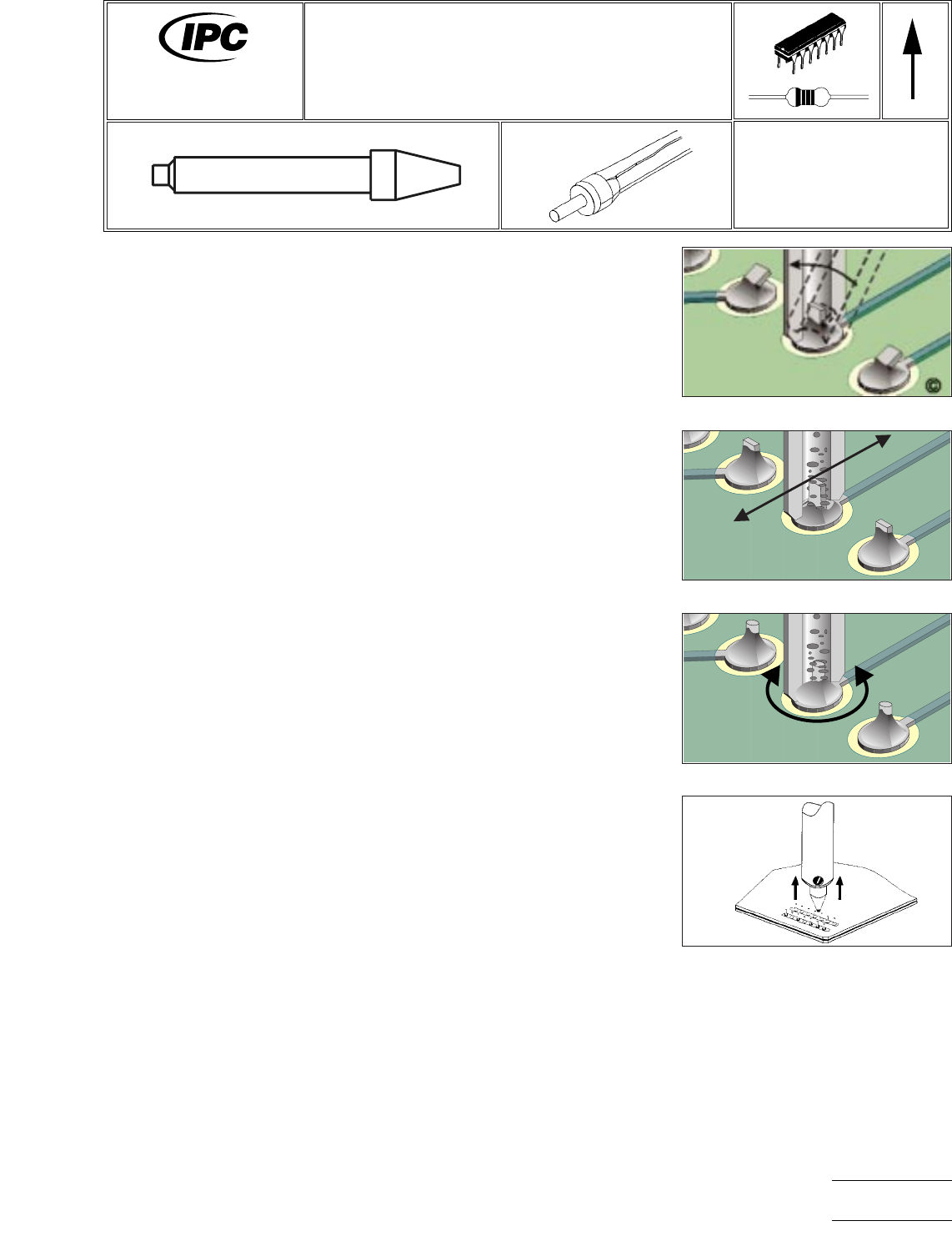
8. Confirm complete solder melt of contacted lead and gently straighten the lead
to a vertical position. (See Figure 1.)
9. For a flat lead, move lead back and forth; for a round lead, use a circular motion
and apply vacuum while continuing lead movement. (See Figures2&3.)
10. Lift tip from lead, hold vacuum for sufficient time to clear all molten solder from
heater chamber. (See Figure 4.)
11. Repeat for all solder connections.
12. Re-tin tip end with solder and return handpiece to its stand.
13. Clean lands as required for component replacement.
Figure 1
Figure 2
Flat Lead
Figure 3
Round Lead
Figure 4
7711A
Rework of
Electronic Assemblies
Revision:
Date: 5/02
Through-Hole Desoldering
Continuous Vacuum Method – Partial Clinch
Number: 3.1.2
Product Class: R, F, W
Skill Level: Intermediate
Level of Conformance: High
Material in this manual, IPC-7711 Rework of Electronic Assemblies, was voluntarily established by Technical Committees of
IPC. This material is advisory only and its use or adaptation is entirely voluntary. IPC disclaims all liability of any kind as to the
use, application, or adaptation of this material. Users are also wholly responsible for protecting themselves against all claims
or liabilities for patent infringement. Equipment referenced is for the convenience of the user and does not imply endorsement
by IPC.
Page1of2
Copyright Association Connecting Electronics Industries
Provided by IHS under license with IPC
Not for Resale
No reproduction or networking permitted without license from IHS
--``,``,-`-`,,`,,`,`,,`---

NOTES
IPC-7711A
Number: 3.1.2
Revision:
Date: 5/02
Subject: Through-Hole Desoldering
Page2of2
Copyright Association Connecting Electronics Industries
Provided by IHS under license with IPC
Not for Resale
No reproduction or networking permitted without license from IHS
--``,``,-`-`,,`,,`,`,,`---
EQUIPMENT REQUIRED
Continuous vacuum desoldering system
Desoldering tip
Damp sponge
Non-metallic tool (wood stick or spudger)
Flat nose pliers
OPTIONAL EQUIPMENT
N/A
MATERIALS
Flux-cored solder
Flux
Cleaner
Tissue/wipes
NOTES
On multileaded devices a skipping/alternating pattern may be needed to reduce heat
buildup.
PROCEDURE
1. Remove conformal coating (if any) and clean work area of any contamination,
oxides, residues or fluxes.
2. Install desoldering tip handpiece.
3. Start with tip temperature of approximately 315°C and change as necessary.
4. Apply flux to all solder connections (optional).
5. Thermal shock tip with damp sponge.
6. Tin tip with solder.
7. Lower tip contacting solder connection.
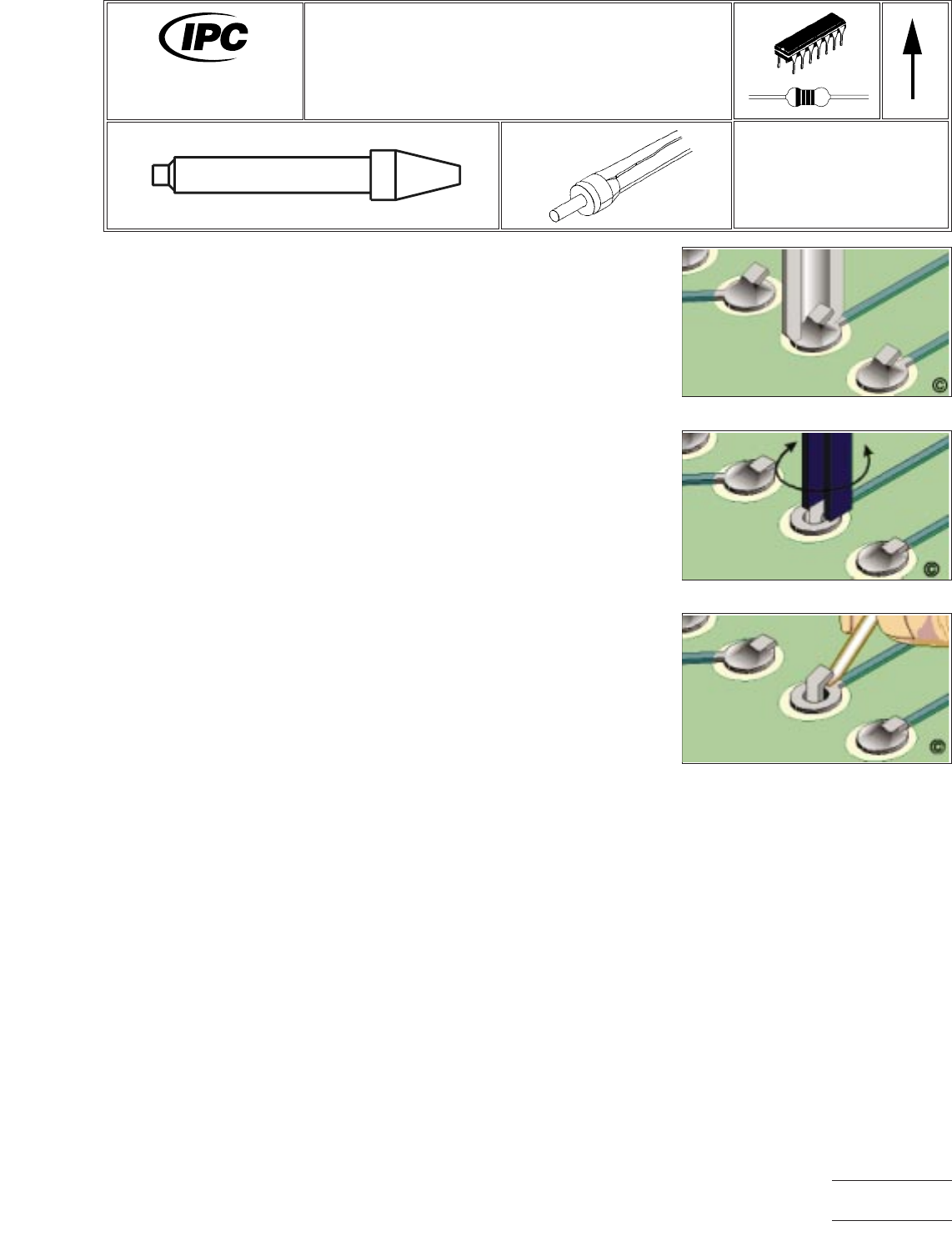
8. Confirm complete solder melt of contacted lead and apply vacuum. (See Figure
1.)
9. Lift tip from lead, hold vacuum for sufficient time to clear all molten solder from
heater chamber.
10. Inspect connection to ensure only a small amount of solder remains between
lead and land area.
NOTE: If excess solder exists use wicking braid and iron to remove solder. (See
3.1.5.)
11. Using a Flat Nose pliers gently rotate the lead laterally until the joint separates.
(See Figure 2.)
Figure 1
Figure 2
Figure 3
7711A
Rework of
Electronic Assemblies
Revision:
Date: 5/02
Through-Hole Desoldering
Continuous Vacuum Method – Full Clinch
Number: 3.1.3
Product Class: R, F, W
Skill Level: Intermediate
Level of Conformance: High
Material in this manual, IPC-7711 Rework of Electronic Assemblies, was voluntarily established by Technical Committees of
IPC. This material is advisory only and its use or adaptation is entirely voluntary. IPC disclaims all liability of any kind as to the
use, application, or adaptation of this material. Users are also wholly responsible for protecting themselves against all claims
or liabilities for patent infringement. Equipment referenced is for the convenience of the user and does not imply endorsement
by IPC.
Page1of2
Copyright Association Connecting Electronics Industries
Provided by IHS under license with IPC
Not for Resale
No reproduction or networking permitted without license from IHS
--``,``,-`-`,,`,,`,`,,`---