00198368-01_UM_SIPLACESX12-DockingStation_DE_EN_ZH - 第56页
2 Operational safety User manual Docking station fo r SIPLACE SX component trolleys 2.1 Safety instructions Edition 02/2018 56 2.1.2 Qualified personnel In accordance with the user manual for the SIPL ACE placement machi…
User manual Docking station for SIPLACE SX component trolleys 2 Operational safety
Edition 02/2018 2.1 Safety instructions
55
2 Operational safety
2.1 Safety instructions
2.1.1 Conventions for the use of hazard symbols
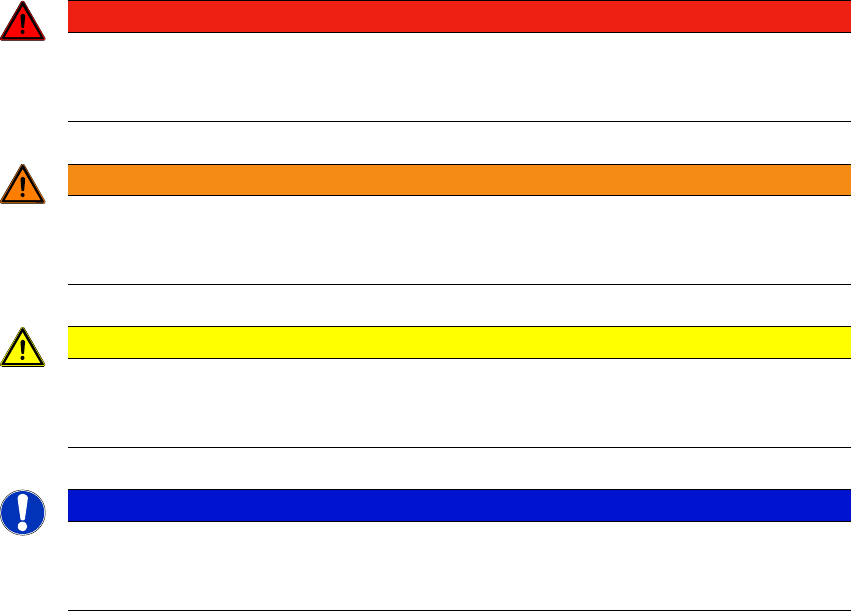
This user manual contains notes that must be observed to guarantee your personal safety and to
avoid damage to equipment. These notes are highlighted by warning triangles and are indicated
as follows according to the level of risk:
2
2
2
2
DANGER
Definition
Danger, as used in this user manual, means that death, severe injury or considerable
damage to equipment will occur if the danger instructions are not followed.
WARNING
Definition
Warning, as used in this user manual, means that death, severe injury or considerable
damage to equipment may occur if the warning instructions are not followed.
CAUTION
Definition
Caution, as used in this user manual, means that slight injury or damage to equipment
may occur if the caution instructions are not followed.
PLEASE NOTE
Definition
A note, as used in this user manual, provides information on the product or indicates a
part of the user manual that requires particular attention.

2 Operational safety User manual Docking station for SIPLACE SX component trolleys
2.1 Safety instructions Edition 02/2018
56
2.1.2 Qualified personnel
In accordance with the user manual for the SIPLACE placement machine, qualified or adequately
trained personnel means that these people are familiar with the setting up, operation and preven-
tive maintenance of the docking station, including the SIPLACE placement machines and add-on
devices and are suitably qualified, e.g.:
– Have been trained, instructed or authorized to switch on and off, isolate, earth and identify
electrical circuits and system components in accordance with normal safety standards.
– Have been trained or instructed in the upkeep and use of appropriate safety equipment in ac-
cordance with normal safety standards and the "required safety equipment" available at the
docking station.
– Have completed the manufacturer's training for setup staff or service engineers working with
the docking station and SIPLACE placement machines.
– Have received first aid training.
To guarantee safety, we set mandatory requirements for the operators of the machine, which must
be adhered to. Only those persons which fulfill these requirements are authorized to work with the
machine.
We define an operator as any person who works with the machine. Since the requirements for
these operators depend greatly on their specific work tasks, we differentiate between the following
operator roles:
Operator 2
The operator may only perform those tasks at the machine which are necessary in normal oper-
ation, to ensure automatic running of the machine. Any other tasks required are usually performed
together with the person qualified for them. If tools are required to solve a malfunction (e.g. un-
screwing covers), this work is performed in "special operating mode" and may only be conducted
by a person qualified for this.
Operating company 2
2
The operating company is the contract partner for the manufacturer. When the operating company
purchases the machine, the manufacturer can legally require the operating company to adhere to
certain obligations.
The operating company orders the prescribed usage of the machine and authorizes persons to
work with the machine in one of the defined operator roles. The operating company is also respon-
sible for instructing the operators accordingly.
PLEASE NOTE
The operator is also required to read the chapter "Safety".
User manual Docking station for SIPLACE SX component trolleys 2 Operational safety
Edition 02/2018 2.1 Safety instructions
57
Service engineers 2
The service engineer is employed by the manufacturer and takes care of the machine when it is
in special operating mode, during the solving of malfunctions and subsequent return to operation.
The service engineer is obliged to attach any available transportation and installation safety fea-
tures when performing work to the machine.
The service engineer is a specialist with mechanical or technical electrician qualifications.
2
2.1.3 Important notes on operational safety
The following points MUST be observed in order to maintain operational safety:
2.1.3.1 General
2
Observe the safety regulations specified in the manuals.
Always follow any safety regulations specific to your country.
Never modify the machine in any way without written authorization from the manufacturer.
The mains power cable must be marked so that it can be clearly assigned to the individual
modules of the placement/production line.
All cables (power and interface cables) for the docking station must be run and fixed so that
nobody can stumble over them.
Replace any incorrectly attached, missing or illegible warning or hazard labels without delay.
Clean the labels as specified in this manual.
Covers on the docking station, which may only be removed or opened with tools or the ma-
chine key, may only be removed by personnel authorized to do so.
It is expressly prohibited to modify/bypass protective measures (including query features,
such as safety limit switches and light barriers).
A test run is to be performed after any work performed to the machine (maintenance, repair
etc.). This test run is to be conducted by the "service engineer"“ or the "qualified person".
PLEASE NOTE
In addition to the operator roles, observe the chapters "User classification", "Operational
safety" and "Training" in the user manual for the placement machine.
DANGER
Severe injuries and damage to equipment in the case of incorrect usage!
Despite all the safety measures prescribed by the manufacturer, non-prescribed opera-
tion of the docking station or non-prescribed execution of maintenance, setting, service
or installation tasks could lead to severe or even lethal injuries and/or significant damage
to equipment.