YRM20_Mainte_E.pdf - 第19页
4. Safety xvi Safety instructions 4.9 Handling solvents (including solder , adhesive, and flux) Cleaning organic solvents, suc h as isopropyl alcohol (IP A) and ethanol are used for the maintenance of this machine (inclu…
4. Safety
xv
Safety instructions
►
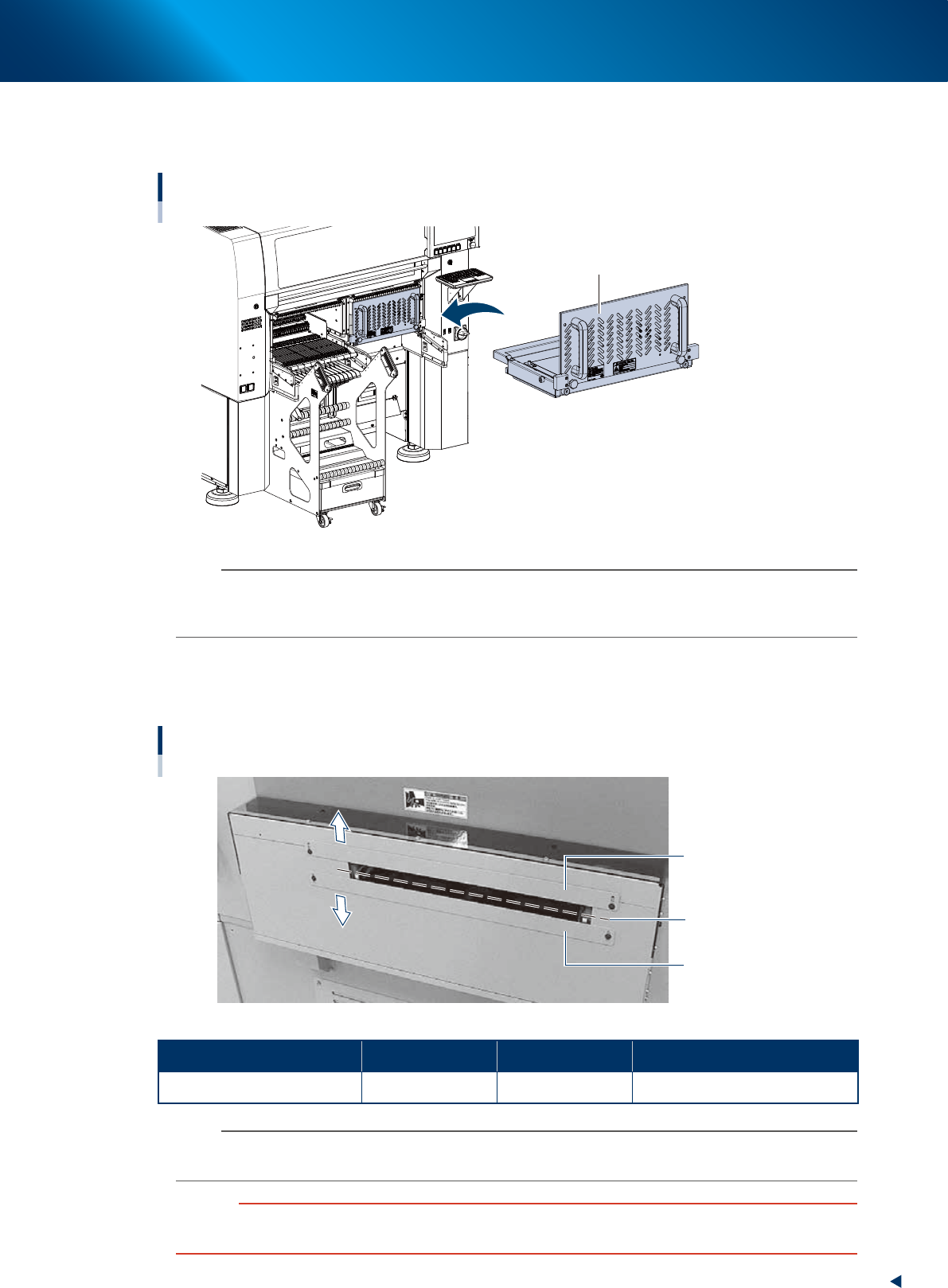
One-stop cover (for machines with feeder exchange carriage)
If not using a feeder exchange carriage in the machine that is to be used with feeder exchange
carriages, install a one-stop cover in the position where a feeder exchange carriage is to be installed.
Prevention of hand entry
One-stop cover
One-stop cover
93005-YRM-00
n
NOTE
One-stop covers cannot be installed or removed during operation. The machine must be in a stopped state because
the section where a feeder exchange carriage is to be installed will move up and down for the installation or removal
of the feeder exchange carriage.
►
Muzzle plate
Use these plates as a safety measure for the board conveyor entrance and exit openings. Each plate is
movable, so adjust the mounting position to match the boards to be produced.
Muzzle plate
Upper muzzle plate
Lower muzzle plate
Board conveyance plane
93006-YRM-00
Machine Upper clearance Lower clearance Remarks
YRM20
0 to 40mm 0 to 40mm From board conveyor plane
n
NOTE
The values above show the maximum adjustable range of the muzzle plate.
See the product specification of each machine for the component mountable height and the restrictions of the substrate.
c
CAUTION
When installing a unit such as a loader or an unloader on the upstream or the downstream side of the machine, set the
muzzle plates to the opening of the board conveyor entrance or the board conveyor exit to make the opening small.

4. Safety
xvi
Safety instructions
4.9 Handling solvents (including solder, adhesive, and flux)
Cleaning organic solvents, such as isopropyl alcohol (IPA) and ethanol are used for the maintenance of this
machine (including optional units). Additionally, the solder paste printers, dispensers, and some hybrid
placers and flip chip bonders use solder, flux, or bond, etc. during normal production. As many of these
materials include organic solvents, great care should be taken when handling them.
►
Cautions on handling solvents
1. Harmful to human body
Organic solvents constantly vaporize and contaminate the surrounding atmosphere. Inhaling or
coming in contact with organic solvent vapor may cause serious damage to human health.
2. Flammability
Organic solvents are highly flammable substances and can easily catch fire if handled improperly.
3. Adverse effects on machines
Some kind of solvent may deteriorate parts used in the machine, electric cable sheathes, and other
resin parts.
►
To prevent accidents caused by solvents
1. Be careful not to inhale toxic vapors of solvents for extended periods.
2. Do not use solvents near fire or flame. Keep solvents away from flame or fire.
3. Use only the specified solvent in the correct manner. Do not reuse any solvent repeatedly, and do not
mix with other solvents or chemicals.
4. Check the contents of the safety data sheet (SDS), thoroughly notify work personnel of toxicities of
included chemical materials and measures to be taken in case of an accident, and take necessary
countermeasures.
5. Use appropriate safety gear (safety goggles, protective gloves, and respiratory protective devices)
corresponding to the solvent or material types.
6. See the safety data sheet for how to dispose the solvents and the cloths used for wiping off the
solvents.
c
CAUTION
If no safety data sheets are supplied with solvents or materials you have purchased, be sure to acquire the safety data
sheets from the suppliers.
4.10 Handling the laser
This machine (including optional units) has portions using the laser, such as a sensor and barcode reader.
c
CAUTION
The laser to be used in this machine is class 2 (visible light and low output) at a maximum.
►
Knowledge and information about laser
1. Harmful to human body
Never look at the laser directly even when it is weak. In particular, if the laser is irradiated to an eye
for a long time, this may cause serious injury.
2. Reflection of laser
The laser is reflected by a glass or metal surface. Pay special attention to the reflected laser light
during maintenance work.
►
To prevent accidents caused by laser
1. Do not align your eye with the laser height so that you do not look at the laser directly.
2. Wear safety goggles during work, when necessary.
3. Shield the laser during work, when necessary.

4. Safety
xvii
Safety instructions
4.11 Handling grease and oil
Grease or oil is applied to the operating axes of this machine. When performing the lubrication work,
strictly observe the cautions shown below.
►
Cautions on handling grease and oil
1. If grease or oil enters your eye or sticks to your skin, this may cause inflammation. Be sure to wear
safety goggles and protective gloves during work. Additionally, if you swallow grease or oil by
mistake, this may cause vomiting or diarrhea.
2. If grease other than specified is used, this may cause damage to the machine.
3. If grease with different characteristics is mixed with proper grease, this may cause the machine
performance to lower.
4. Be sure to cap tightly after use to prevent entry of dust or water content. When storing the grease or
oil, avoid the direct sunlight, keep it away from a fire, and store it in a dark place.
n
NOTE
When the safety data sheet (SDS) about the grease or oil that is used for the maintenance wok is needed, contact
YAMAHA sales representatives.
4.12 Handling batteries
Batteries are used for some motors of this machine and the optional uninterruptible power supply (UPS).
►
Cautions on handling batteries
1. Do not disassemble the battery or touch its inside. Otherwise, electrical shock may result.
2. Do not over-heat or apply a strong impact to the battery. Otherwise, fluid leakage, explosion, or
heat generation, etc. may result. Never use the battery, to which a strong impact has been applied,
such as dropping to the floor since its battery fluid may leak.
3. Only engineers who have the experience and knowledge about electrical work are allowed to
replace the battery.
4. The battery may discharge naturally. When purchasing a spare battery, do not store it for a long
period and prepare it 1 to 2 months before the scheduled replacement work. Additionally, when
storing the battery, avoid a place where the temperature increases and be sure to store it at room
temperature.
n
NOTE
When the safety data sheet (SDS) about the battery is needed, contact YAMAHA sales representatives.
c
CAUTION
See the user's manual prepared by the manufacturer that is supplied with the UPS for details about how to handle UPS.
c
CAUTION
Dispose of a battery in compliance with the laws and regulations of the country where the machine is used.
Contact YAMAHA sales representatives for any questions about disposal of the battery.