00195760-0102_UM_D3_SR605_EN.pdf - 第23页
User Manual SIPLACE D3 1 Introduction From software version SR.605.xx 07/2008 EN Edition 1.2 Line concept 23 1.2 Line concept 1.2.1 Description of the re commended line concept 1 The SIPLACE concept is characterized by i…

1 Introduction User Manual SIPLACE D3
1.1 Description of the machine From software version SR.605.xx 07/2008 EN Edition
22
– operation of the placement machine without the hand guard (dummy feeder module) if not
every location is occupied with a feeder module.
– unclear allocation of electrical connecting cables to each machine and the installed options.
– if there are two or more people standing at a component trolley location at the same time dur-
ing the retrofit.
1
1.1.9 Noise emissions
1
1.1.10 Important notes on environmentally-friendly disposal of materials
and components
SIPLACE systems are manufactured using only materials and parts that can be easily separated
and disposed of in an environmentally-friendly way.
PLEASE NOTE 1
The owner of the system has sole responsibility for the proper environmentally-friendly disposal
of machines, working materials, consumables and wear parts.
→ Please observe your national statutory provisions for waste disposal and environmental pro-
tection.
1.1.11 Electromagnetic compatibility (EMC)
SIPLACE placement machines are designed and tested for professional use in industrial applica-
tions. Electromagnetic compatibility in terms of the emission of interference cannot be guaranteed
in any other environment.
1.1.12 Note on original SIPLACE accessories
→ Only use SIPLACE original spare parts and authorized accessories. The use of other parts
will affect safety and will invalidate the liability for any consequential damage.
Max. noise emissions 75 dB (A)
User Manual SIPLACE D3 1 Introduction
From software version SR.605.xx 07/2008 EN Edition 1.2 Line concept
23
1.2 Line concept
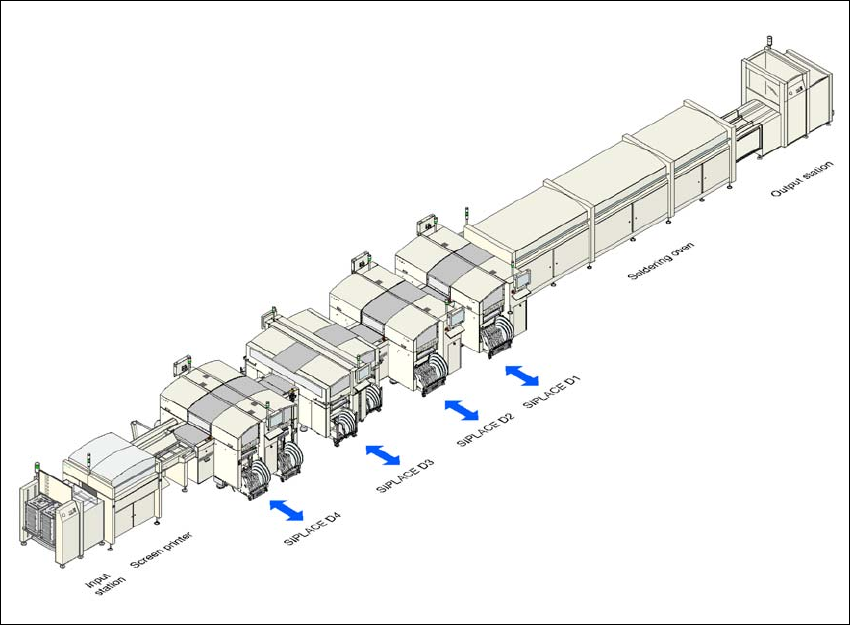
1.2.1 Description of the recommended line concept
1
The SIPLACE concept is characterized by its flexibility, modularity, compactness and high power
density. It allows a production line to be individually configured from identical and different mod-
ules. If the production requirements change, the individual placement machines are so compact
that they can be recombined quickly and easily.
1
Fig. 1.2 - 1 Sample line concept
1
The SIPLACE family has exactly the right placement machine, whatever the output requirements:
SIPLACE D-series machines can be used to place IC, flip-chip, bare die and exotic components
(OSC). They cover the spectrum of components from 01005 to 85 x 85 / 125 x 10 mm² with a very
high placement rate.
1 Introduction User Manual SIPLACE D3
1.2 Line concept From software version SR.605.xx 07/2008 EN Edition
24
1.2.2 SIPLACE line and software solutions
SIPLACE offers holistic solutions based on modular software tools for SMT machine, line and pro-
duction management: the SIPLACE software suite.
1.2.2.1 Product definition, optimization and line control
Fast, fault-free introduction of products and optimum utilization of production lines are essential to
maximize production output. The programs from the SIPLACE software suite allow you to easily
program products, fine-tune the programs you have created and then find the balance for them
within your SMT production lines.
1.2.2.2 Production monitoring & process control
To achieve the production targets that are set, it is important to constantly monitor and check the
production facilities. The SIPLACE software suite contains monitoring products tailored to suit the
user group. These signal immediately if limits are exceeded on the machine or the production line.
1.2.2.3 Setup verification & traceability
Setup errors lead to series errors. The user-friendly SIPLACE software programs help you to
avoid such errors, and thus ensure high quality in your electronics production.
1.2.2.4 The benefits of the SIPLACE software suite at a glance:
– Fast programming and error detection
– Reduces changeover times and stoppages
– Ensures optimum utilization of your production line's productivity
– Real-time information from the production area
– Incredibly fast distribution of information
– Optimum use of resources
– Timely notification when production materials need to be re-ordered
– Coordination of maintenance measures