Nordson_EFD_7_Critical_Steps_to_Implement_Semi_Automation - 第5页
Automated Fluid Dispensing | 7 Cri tical S t e ps to Implem ent Sem i-Automation to Y our D ispen sing Proc ess 5 2 . E valuate Y our Automation Options Choose a suitable platform Choo sing a su itabl e plat form me ans …
Automated Fluid Dispensing | 7 Critical Steps to Implement Semi-Automation to Your Dispensing Process
4
1. IS THERE A GOOD PLANT AIR SUPPLY?
Dispensing from a valve or syringe barrel requires dry,
ltered air.
2. WHAT TYPE OF ELECTRICAL SERVICE IS AVAILABLE?
This varies by country.
3. HOW CLEAN IS THE ENVIRONMENT? DOES THE ROBOT
NEED TO BE UNDER A VENT HOOD?
Robots are actually an excellent choice if the environment
is potentially hazardous to human operators.
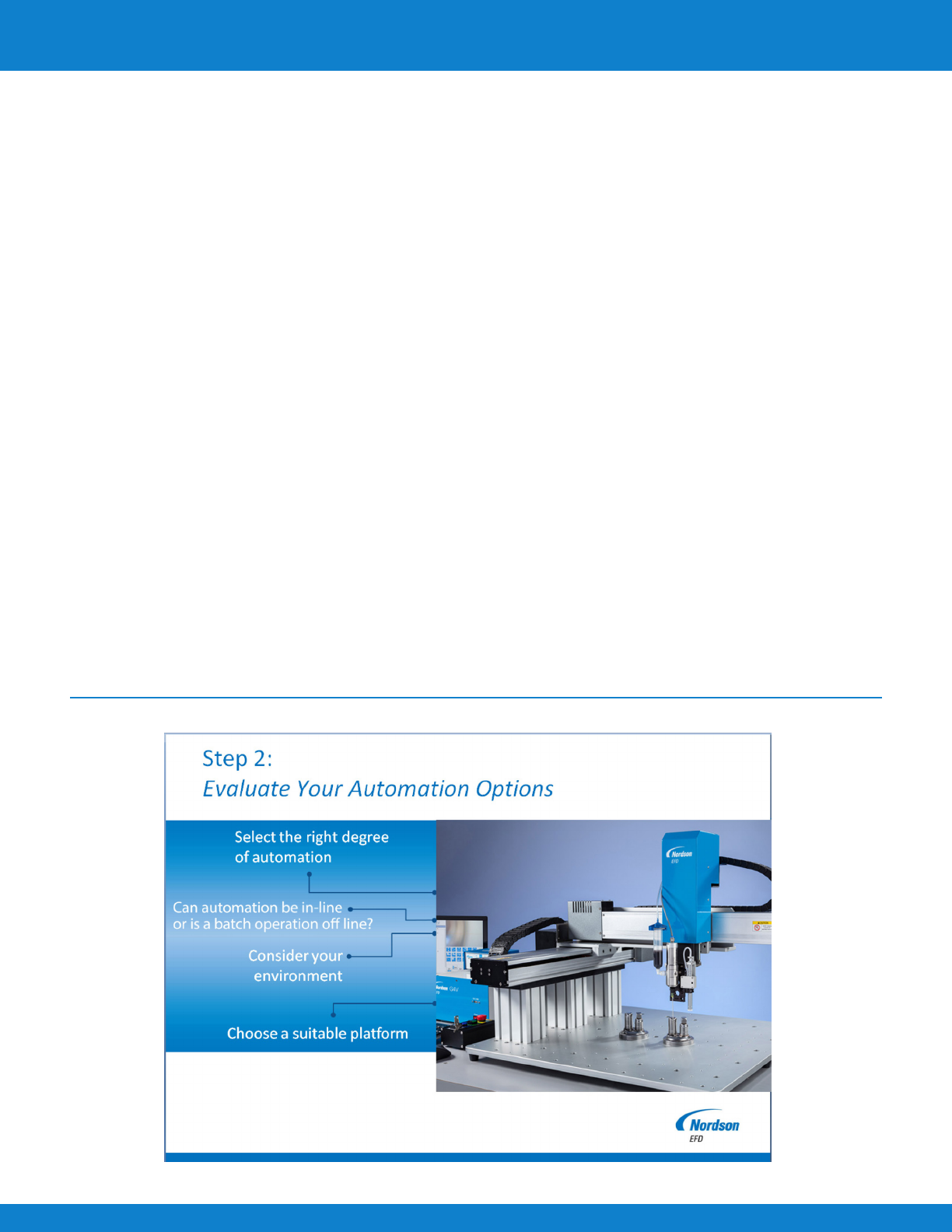
2. Evaluate Your Automation Options
Choose the right degree of automation
Once you have identified a process that would benefit from automation, consider the degree of automation� It is generally best to
start small� For example, a process that requires the application of adhesive to a part, then the adhesion of that part to another
part, can be automated, but implementation could be time consuming and complex� It might be better to begin by automating
just one step in that process, such as the fluid dispensing step� This is known as semi-automation� Semi-automation describes a
system in which a human operator or a small production line feeds a product to a robot, the robot performs a single task on that
product, and then the human operator removes the product and completes the task�
Consider your environment
Before choosing any automation products, you need to know the physical environment of the work location:
4. HOW WILL PEOPLE MOVE AROUND THE AUTOMATION
EQUIPMENT? WHAT SIZE FOOTPRINT IS AVAILABLE?
There needs to be enough room for an operator to work
with a robot without being bumped or jostled by other
workers.
5. HOW HUMID IS THE AMBIENT TEMPERATURE?
There is a good robot option for every environment, but
you need to know what the environmental challenges are
in order to choose the right robot.
Continued next page
Automated Fluid Dispensing | 7 Critical Steps to Implement Semi-Automation to Your Dispensing Process
5
2. Evaluate Your Automation Options
Choose a suitable platform
Choosing a suitable platform means choosing the right type of robot� The most widely used types of fluid dispensing robots are
cartesian (3 and 4 axis) tabletop robots and gantry robots (allow for production line integration)� Tabletop robots, also known as
XYZ tables, apply material to one component, or one pallet of components, at a time�
Once you choose a platform, there will be additional considerations, such as the size of the robot, the number of axes, the
available inputs/outputs, and so on� Expert-level familiarity with the process for which the robot will be used is the key to selecting
the best platform� In other words, to choose the best robot, you need to know exactly where it’s going and how it will be used�
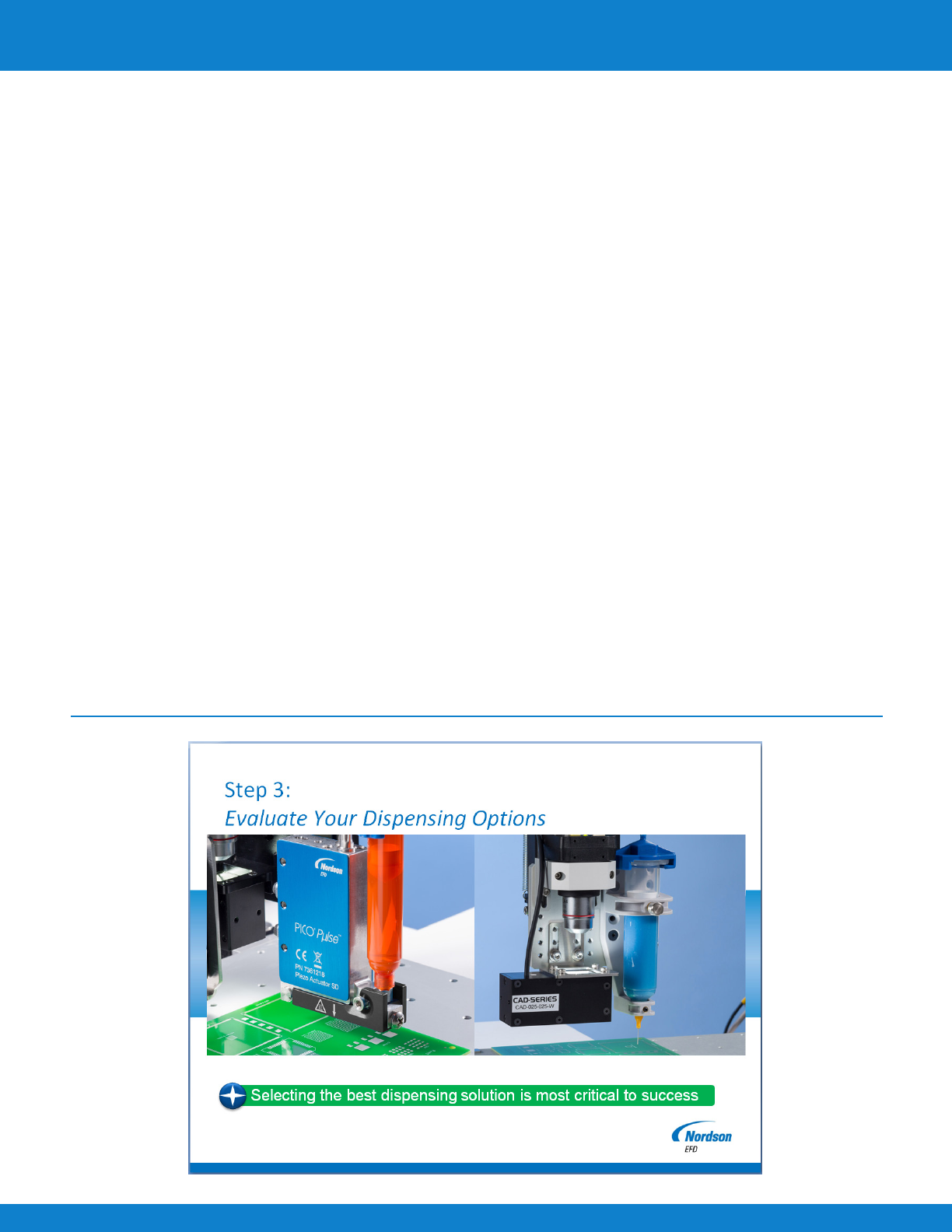
3. Evaluate Your Dispensing Options
You will also need expert-level familiarity with your process to make the best fluid dispensing choices�
Know your application
To effectively automate, you need to know what the product looks like:
• What is its shape?
• What is its color?
• What is its composition?
• Where on the product does material need to be applied?
• Is the substrate reflective or translucent?
For example, a translucent substrate can be difficult for optical equipment to identify so an upgraded vision system may be required�
Continued next page
From previous page

Automated Fluid Dispensing | 7 Critical Steps to Implement Semi-Automation to Your Dispensing Process
6
3. Evaluate Your Dispensing Options
Know your fluid
Exact knowledge of the material to be applied is just as important as exact knowledge of the product:
• What is the viscosity? Does its viscosity change significantly over time because of temperature swings in the production area?
What is the useful working life of the fluid? Minutes? Hours?
• What is the fluid color?
• What is the composition? Is it a reactive adhesive like cyanoacrylate or an anaerobic adhesive? Does it require UV curing?
Is the fluid particle filled? If so, does the fluid have to be agitated to keep particles in suspension or is it a homogenous
composition?
• What are the hazards?
• What are the unique requirements of the fluid? Is it self-leveling or would it require a piston or follower in the reservoir to
provide a wiping action on the side walls of the reservoir?
Choose your dispensing system
When you know the specifics of the component and fluid, you can choose the best method for dispensing the fluid onto the
component� Robots are well-suited for syringe barrel-style or valve-style dispensing configurations� The best valve configuration
choice depends intimately on the specifics of the process and the fluid:
• Difficult fluids, such as medical-grade cyanoacrylates (superglues) must be dispensed through systems of compatible
composition; nylon or metal fluid fittings should never be used with cyanoacrylates�
• For thin to medium fluids, needle valves are often best because shutoff occurs close to the valve outlet or dispense tip�
• For thick fluids, a high-pressure valve with a balanced spool design will provide good control�
• If the dispensing equipment should not make contact with the product, high-speed jetting systems are a good option�
• If your process needs extremely consistent deposit results, a valve system with a dedicated controller is a more efficient
approach than using a human operator�
• If your current system allows air into the process, then using a valve system with a purge function will greatly improve
operation�
From previous page