Nordson_EFD_7_Critical_Steps_to_Implement_Semi_Automation - 第7页
Automated Fluid Dispensing | 7 Cri tical S t e ps to Implem ent Sem i-Automation to Y our D ispen sing Proc ess 7 4. Des ign t he S ystem Integrate the technologies, and don’t forget the accessories Onc e you have chose …

Automated Fluid Dispensing | 7 Critical Steps to Implement Semi-Automation to Your Dispensing Process
6
3. Evaluate Your Dispensing Options
Know your fluid
Exact knowledge of the material to be applied is just as important as exact knowledge of the product:
• What is the viscosity? Does its viscosity change significantly over time because of temperature swings in the production area?
What is the useful working life of the fluid? Minutes? Hours?
• What is the fluid color?
• What is the composition? Is it a reactive adhesive like cyanoacrylate or an anaerobic adhesive? Does it require UV curing?
Is the fluid particle filled? If so, does the fluid have to be agitated to keep particles in suspension or is it a homogenous
composition?
• What are the hazards?
• What are the unique requirements of the fluid? Is it self-leveling or would it require a piston or follower in the reservoir to
provide a wiping action on the side walls of the reservoir?
Choose your dispensing system
When you know the specifics of the component and fluid, you can choose the best method for dispensing the fluid onto the
component� Robots are well-suited for syringe barrel-style or valve-style dispensing configurations� The best valve configuration
choice depends intimately on the specifics of the process and the fluid:
• Difficult fluids, such as medical-grade cyanoacrylates (superglues) must be dispensed through systems of compatible
composition; nylon or metal fluid fittings should never be used with cyanoacrylates�
• For thin to medium fluids, needle valves are often best because shutoff occurs close to the valve outlet or dispense tip�
• For thick fluids, a high-pressure valve with a balanced spool design will provide good control�
• If the dispensing equipment should not make contact with the product, high-speed jetting systems are a good option�
• If your process needs extremely consistent deposit results, a valve system with a dedicated controller is a more efficient
approach than using a human operator�
• If your current system allows air into the process, then using a valve system with a purge function will greatly improve
operation�
From previous page
Automated Fluid Dispensing | 7 Critical Steps to Implement Semi-Automation to Your Dispensing Process
7
4. Design the System
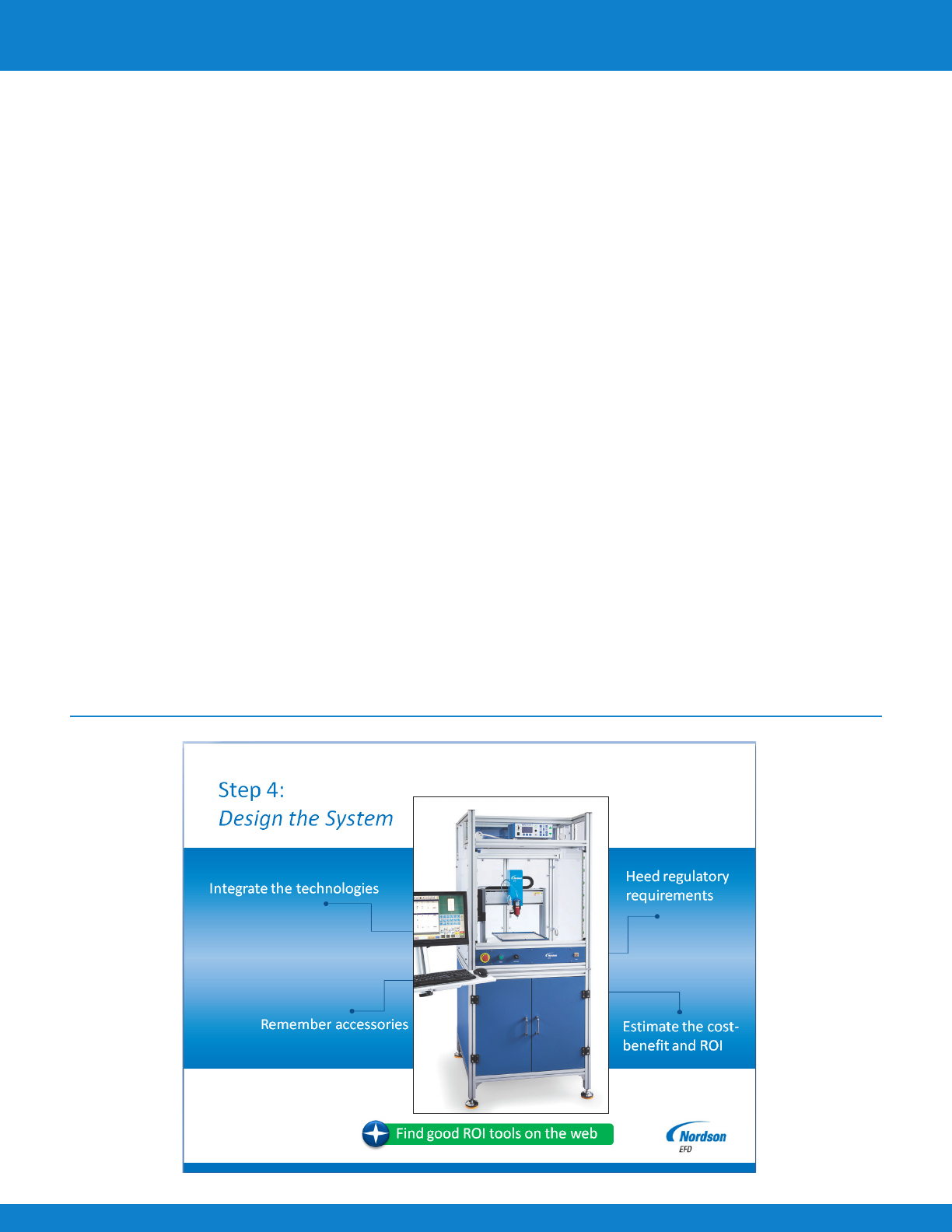
Integrate the technologies, and don’t forget the accessories
Once you have chosen a platform and a fluid dispensing technology, it will be time to integrate the two by installing the fluid
dispensing system on the robot� Be sure to consider which necessary and optional accessories may be needed, such as:
Heed regulatory requirements
Be aware that the automation system must meet the applicable regulatory requirements of the location where it will be installed
and used, not the location where it was purchased� This means it needs to meet OSHA standards in the U�S�, CE requirements in
the European Union, CSA or TUV standards in Canada, and so on� Additional accessories or safety equipment may be required
depending on the installation location�
Estimate the cost-benefit and ROI
Now that you have a good idea what the system will look like, it’s a good time to estimate how much it can reduce cost and
improve productivity� There are a variety of automation return-on-investment (ROI) calculators freely available via the Internet, as
well as plenty of general information on how to do this� Try using an ROI calculator to determine the following:
• How much more throughput might be obtained?
• How much more productivity?
• How much time reduction?
• How much fluid savings? Nordson EFD can provide you with a basic tool that assists with fluid savings estimates�
• What percentage yield increase can be achieved?
• Regulators
• Pumps
• Reservoirs
• Safety guarding
• An emergency
stop button
• A light curtain
• Fixture plates
• Cables
• Vision systems
• Tip detectors
• Height detection
Automated Fluid Dispensing | 7 Critical Steps to Implement Semi-Automation to Your Dispensing Process
8
5. Pilot Testing
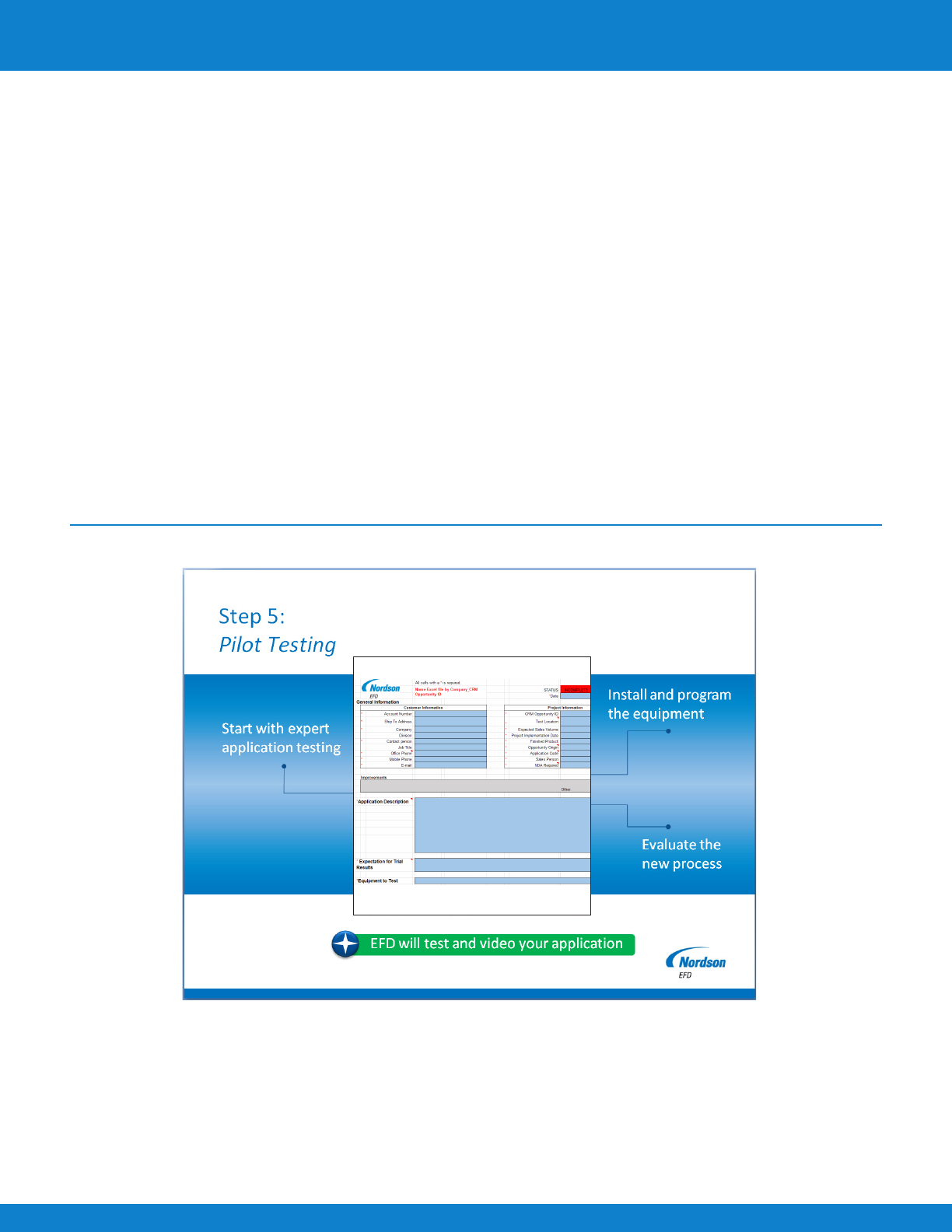
Start with expert application testing
After all the system decisions are made, it’s time to let the experts test it� Successful automation of a process requires up-front
setup and testing by knowledgeable and experienced engineers� If you select a Nordson EFD system, EFD will set up and perform
the application in our lab and then provide video of the operation to you, at no charge�
Install and program the equipment
Once you know the automation works, it can be installed at your facility and integrated into your production processes� Look for
automation vendors who will install and set up their equipment for you� EFD offers guided installation for a minimal fee� Automation
can be challenging, and you will want to be sure that the process runs smoothly after installation and setup are completed and
before you run the system on your own�
Evaluate the new process
When you add automation, it is best to implement on only one assembly line at a time; this way you can evaluate the new process
and compare it to your existing processes� For example, if you hoped to achieve 50 % faster throughput, you want to make sure
that’s what you’re getting� You may need to tweak one or more variables to achieve your desired goals� This usually takes a week
or two� A good automation vendor will work with you until the newly automated process meets your expectations�