00196044-05 - sg x und x4i fse_en.pdf - 第308页
Collect, Pick and Place Head (CPP) Overview Overvi ew of Parts S tudent Guide (FSE) SI PL ACE X Series and X4I Collect, Pick and Place Head (CPP) Edition 01/2 009 EN 308 8.2.7.6 Hold circuit 8.2.7.7 St ar The star consis…
Collect, Pick and Place Head (CPP)
Overview of Parts Overview
Student Guide (FSE) SIPLACE X Series and X4I
Edition 01/2009 EN Collect, Pick and Place Head (CPP)
307
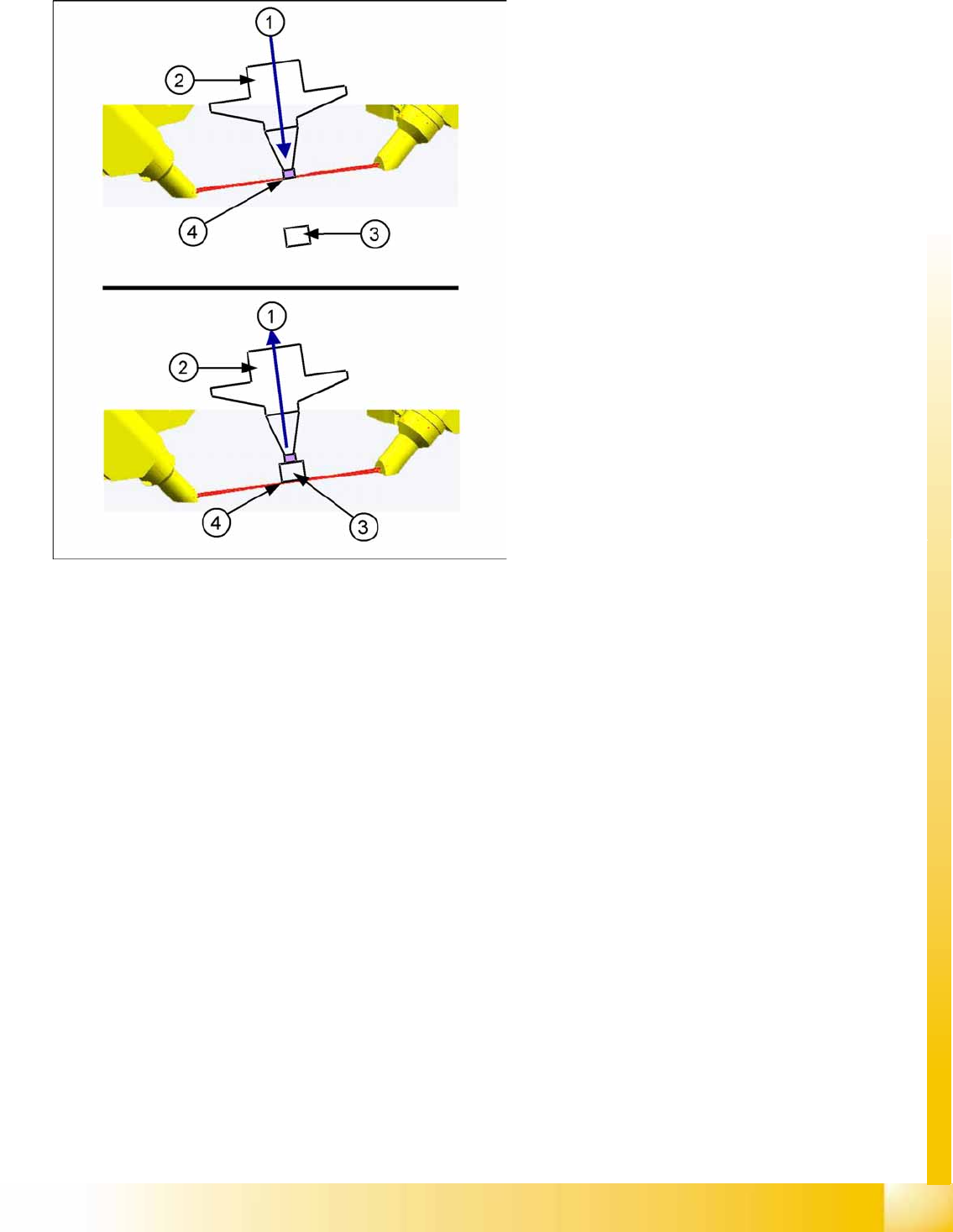
Component Sensor Functions
Pickup Process:
When the Z axis moves downwards, the nozzle interrupts the IR beam. At this exact moment, this Z axis
position is recorded and compared to the reference value, from the height reference run, or from this
segment after placement. This determines whether there is still a component on the nozzle or not. If the
Z axis position indicates that there is a component on the nozzle, the Z axis will be immediately stopped.
An error message will appear or the component will be rejected and added to the repair cycle as not
placed.
When the Z axis moves upwards again, the laser beam is released and the Z position recorded. Based
on the Z position during downwards movement, the system can now determine the presence and height
of a component.
Placement Process:
During the placement process, the system checks whether the component is at the nozzle (Z downwards
movement) or whether placement has been performed on the component (Z upwards movement). As a
precaution, these Z positions are compared to those from the pickup procedure.
This ensures maximum pickup and placement reliability.
Legend
1. Downwards (top diagram) or upwards (bottom
diagram) movement
2. Nozzle
3. Component
4. Read out Z position, if the IR beam is
interrupted (top diagram) or has been released
again (bottom diagram).
The component sensor signal is directly linked to
the axis controller (measurement system) of the Z
axis. This enables you to read out the Z position
during upwards and downwards movement.
Collect, Pick and Place Head (CPP)
Overview Overview of Parts
Student Guide (FSE) SIPLACE X Series and X4I
Collect, Pick and Place Head (CPP) Edition 01/2009 EN
308
8.2.7.6 Hold circuit
8.2.7.7 Star
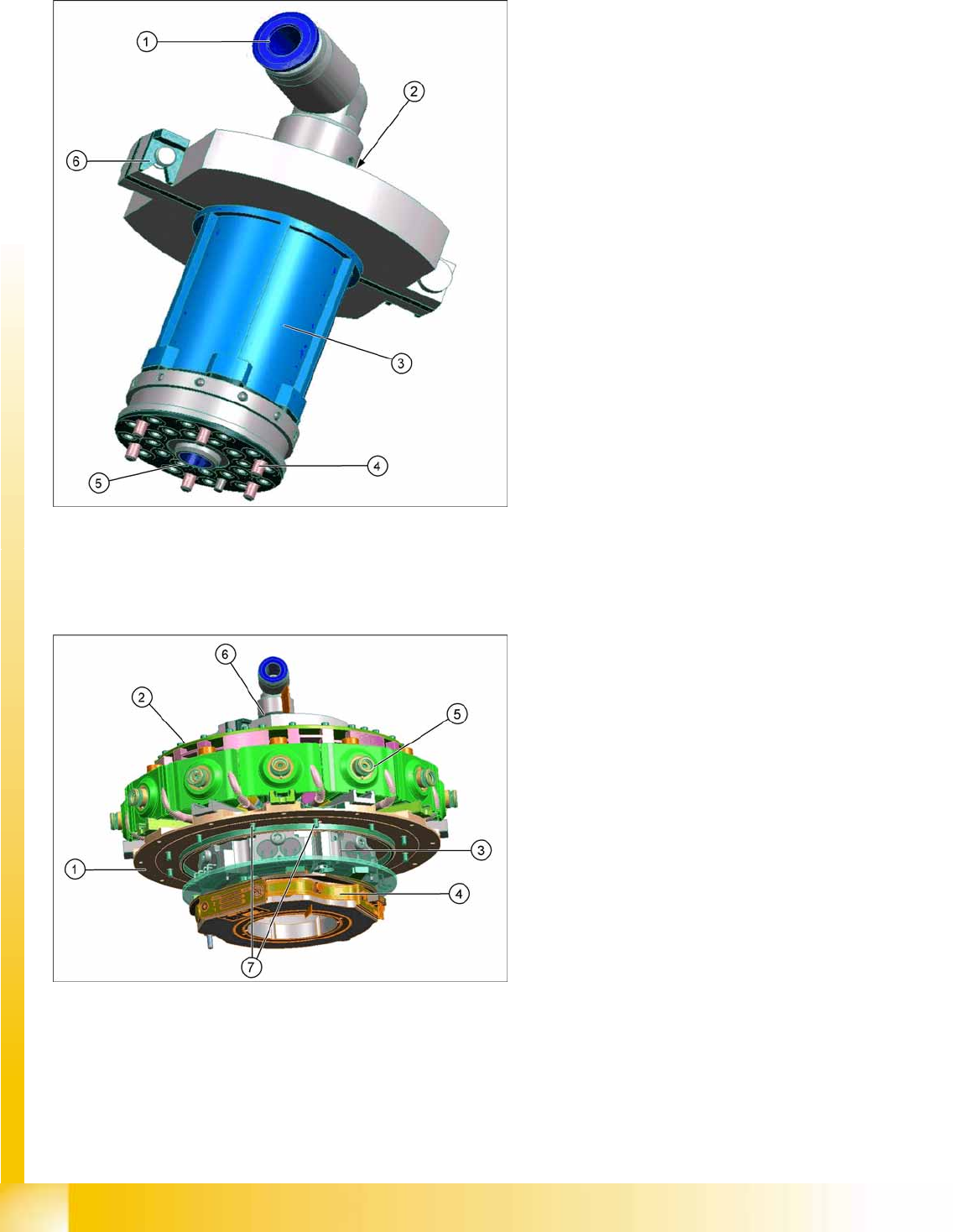
The star consists of the star carrier, on which the 12 DP drives are located, the control board (Single
Core Solution), the valve terminal and the E/D transformer.
The holding circuit is in the center of the star.
The complete unit is fixed to the rotor of the star motor.
Legend
1. Compressed air inlet 4.5 bar
2. Two part silencer for exhaust air from the
venturi nozzles and fixture for the silencer (6)
3. Casing with venturi nozzles
4. Fixture of holding circuit to star carrier
5. Inner drillings: Venturi nozzle inlet
(compressed air)
Outer drillings: Vacuum to the segments.
The holding circuit (4) is fixed with six screws to
the star carrier. It consists of a venturi block with
12 small venturi nozzles (5), a silencer (2) and a
compressed air connection (1).
The compressed air inlet feeds the compressed air
(min. 4.5 bar) via the valves to the venturi nozzles.
Each venturi nozzle supplies one segment with
vacuum in the hold circuit.
If a segment is in the pickup/placement circuit, the
holding circuit vacuum is increased by the
pressure control valve (for pickup) or eliminated
via air blast (for placement).
Legend
1. Star carrier
2. Single Core Solution
3. Valve terminal
4. E/D transformer
5. DP drives
6. Holding circuit in the middle of the star
7. Fixture on rotor of star motor
Collect, Pick and Place Head (CPP)
Overview of Parts Overview
Student Guide (FSE) SIPLACE X Series and X4I
Edition 01/2009 EN Collect, Pick and Place Head (CPP)
309
8.2.7.8 Star carrier
8.2.7.9 Single Core Solution (SCS)
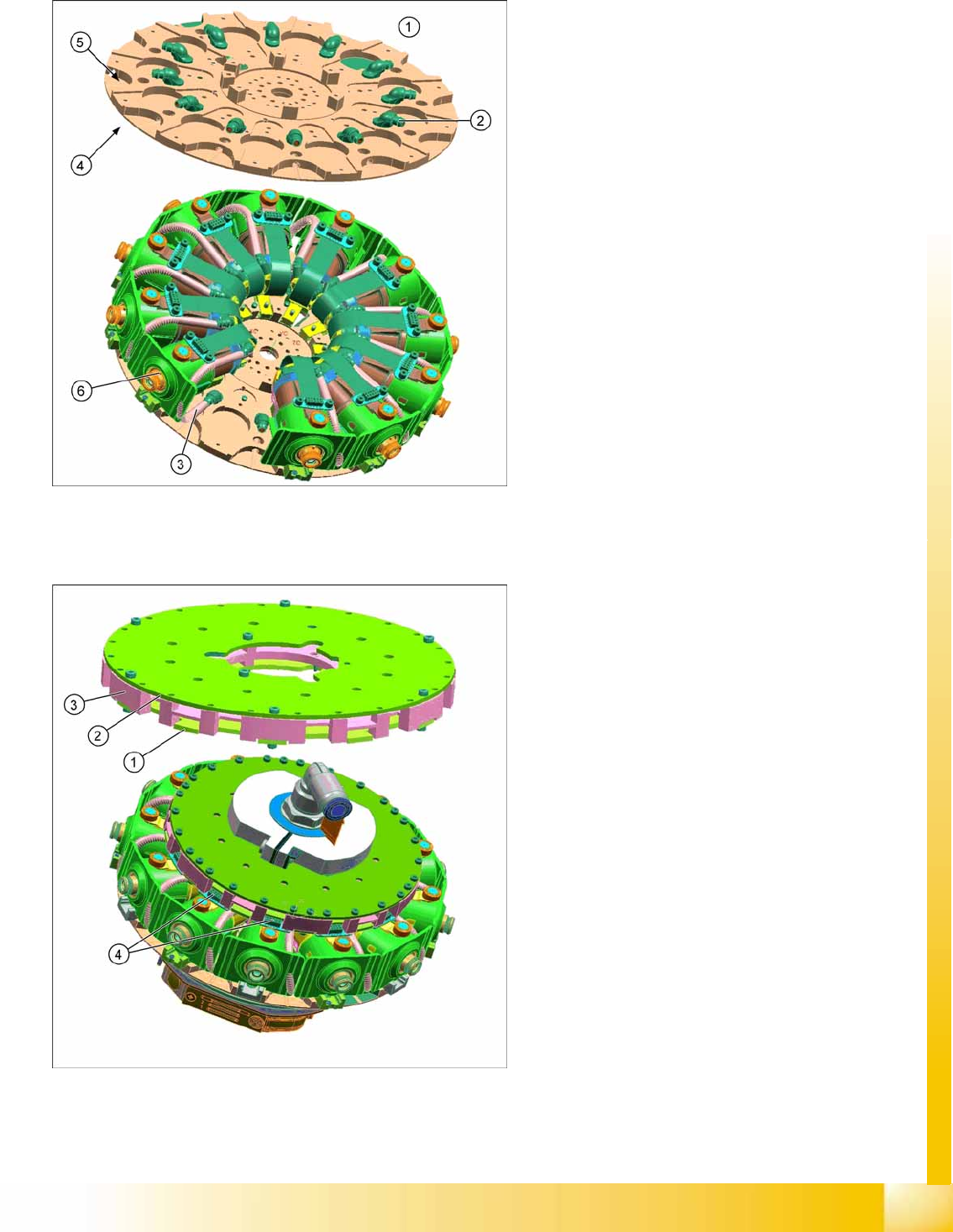
Legend
1. Star carrier
2. Star carrier plate
3. Hose to DP drive
4. Back of the star carrier
5. Front of the star carrier
6. DP drive
The star carrier plate is fixed directly to the rotor of
the star motor.
The valve terminal and the E/D transformer are
fixed to the back of the star carrier.
The twelve DP drives are fixed to the front and the
holding circuit with control unit (SCS) is fixed to the
center.
The vacuum or air blast is fed via the holding
circuit through the star carrier plate to the
individual DP drives (through a hose).
Legend
1. Board control module
2. Board power module
3. Carrier plate
4. Connector for data and power supply to the DP
drives
The SCS has two main tasks:
1. Controlling the DP drives
2. Evaluating the Z down light barrier.
The assembly consists of a carrier plate and two
boards (control module and power module).
The power and data supply is via the head CAN
bus from the intermediate distributor, E/D
transformer to the SCS.
The SCS features 12 connectors, which establish
the connection for the power and data supply to
the DP drives.
The SCS can be replaced during service work.