00196044-05 - sg x und x4i fse_en.pdf - 第328页
Collect, Pick and Place Head (CPP) Pickup and Placement Cycle for CPP Turning Nozz les 1 to 12 to the Pickup Angle (0° or 90°) S tudent Guide (FSE) SI PL ACE X Series and X4I Collect, Pick and Place Head (CPP) Edition 01…
Collect, Pick and Place Head (CPP)
Board Recognition - Centering the Board Fiducials Pickup and Placement Cycle for CPP
Student Guide (FSE) SIPLACE X Series and X4I
Edition 01/2009 EN Collect, Pick and Place Head (CPP)
327
8.4.4 Board Recognition - Centering the Board Fiducials
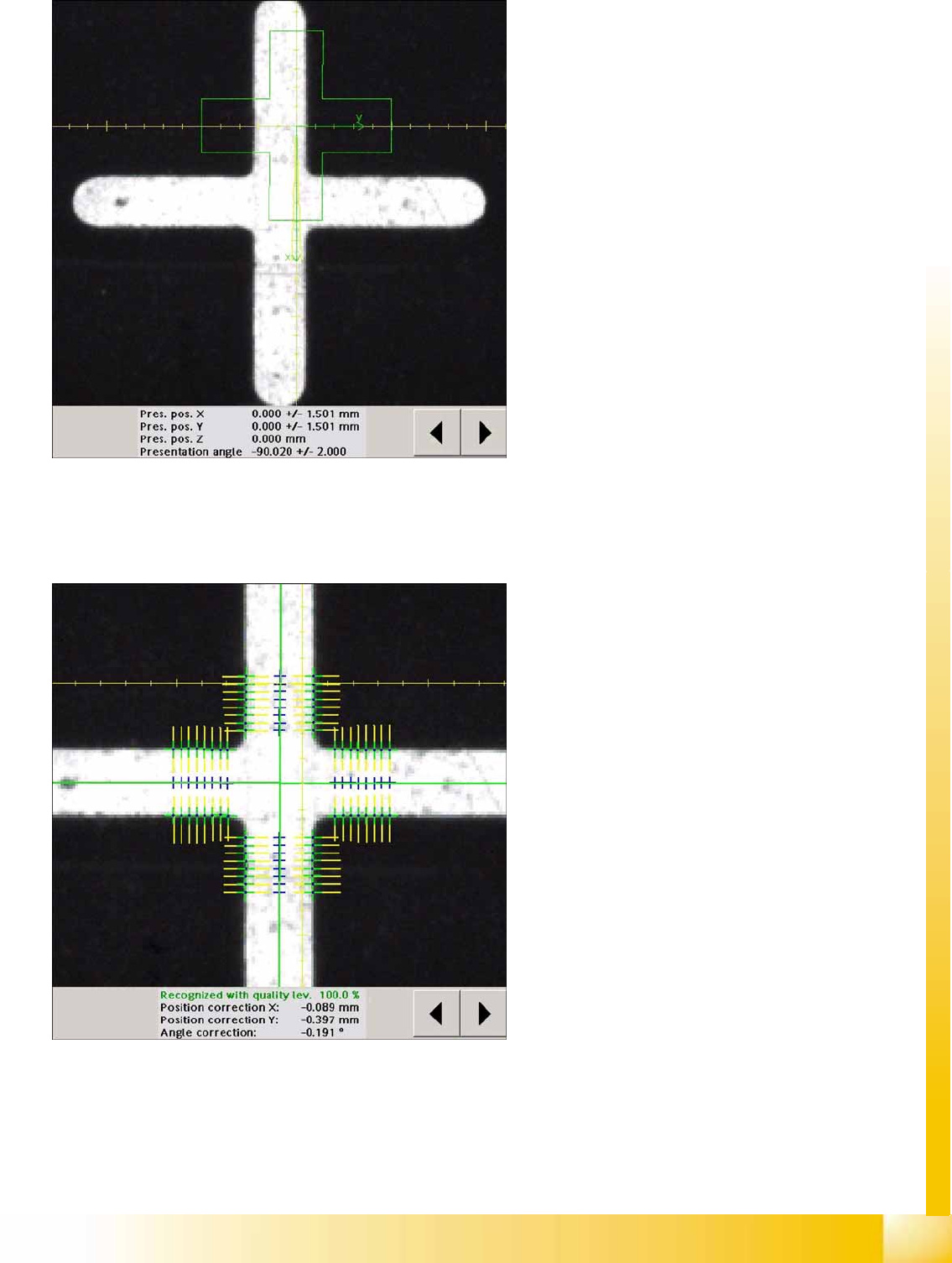
8-9: Board recognition run to target position of board
The fiducial is expected at this target position. The
PCB camera is moved from waiting position to this
fiducial position.
Board position recognition is performed before
the first component is picked up.
The gantry axes move the PCB camera to the
theoretical fiducial position. The camera takes
the picture of the first fiducial and the Vision
system calculates the center position.
8-10: Board recognition - centering the board fiducials
The centered fiducial now defines the actual
position of the board.
The camera records an image of the 2nd
fiducial and the Vision system calculates the
center position of this image.
The 2nd calculation is the deviation between
the target and the calculated fiducial position.
All board fiducials are optically centered with
this procedure.
This data is sent to the machine controller.
Corrected values are now calculated for the
X,Y and angular position of the board.
The gantry axes now move the placement
head to the first pickup position.

Collect, Pick and Place Head (CPP)
Pickup and Placement Cycle for CPP Turning Nozzles 1 to 12 to the Pickup Angle (0° or 90°)
Student Guide (FSE) SIPLACE X Series and X4I
Collect, Pick and Place Head (CPP) Edition 01/2009 EN
328
8.4.5 Turning Nozzles 1 to 12 to the Pickup Angle (0° or 90°)
8.4.6 Procedure for Picking Up Components
Prerequisite: The nozzle must be in the correct pickup position (0° or 90°).
1. The gantry moves over the pickup position of the 1st component.
2. Valve 1 of the valve terminal is switched on.
3. Vacuum measurement in pickup/place circuit „open“
4. The Z axis travels down and interrupts the component sensor.
5. The Z position is read out, the nozzle length calculated and compared to the reference length from
the height reference run.
1. The vacuum is switched on (pressure control valve - either "early vacuum" or with light barrier down,
depending on the pickup profile.)
2. The Z axis moves up. A vacuum check is performed to determine whether there is a component on
the nozzle.
3. The component sensor is released and the Z position is read out. Either the component height is
calculated or a presence check is performed.
4. A vacuum check is performed when the Z axis is in the top position.
5. The star is rotated and more components are picked up.
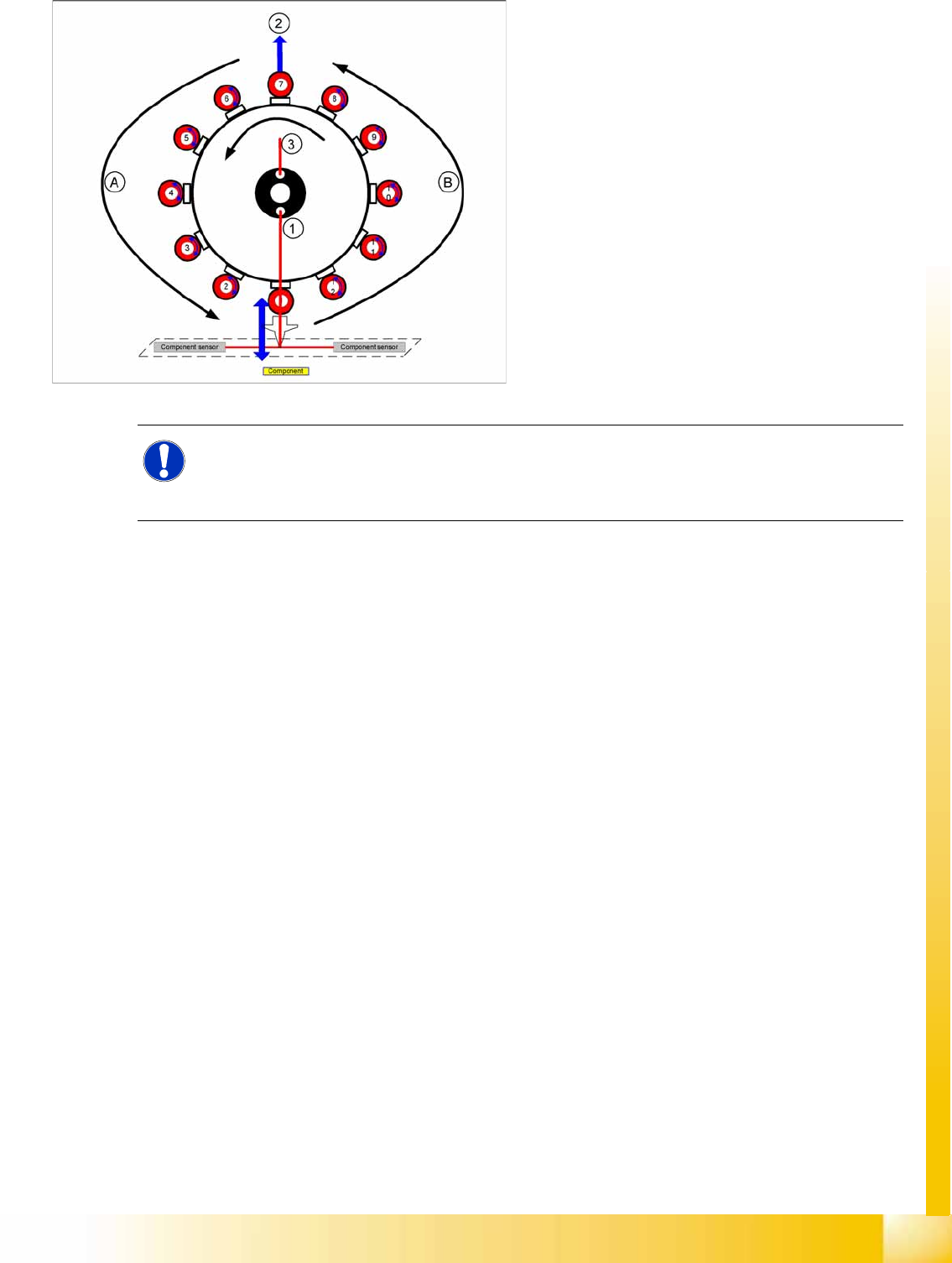
6. The component on segment 1 is rotated into the placement position by the DP drive (area A).
7. A component is picked up at segment 7.
8. The component at segment 1 is optically centered under the component camera.
9. A placement angle correction run is performed after optical centering (area B).
10. Once all 12 components have been picked up, the pickup process has finished.
8-11: Turning segments 1 to 12 to the pickup angle (0° or 90°)
The segments in the CPP head are turned in
succession, from segment 1 to 12, to the
required pickup angle of 0° or 90°.
NOTE:
Each segment has its own DP drive
NOTE:
This calculated nozzle length is used when moving up in the placement cycle, to
check whether the component is placed. If a length difference of -0.15 mm or +0.1
mm is found, a warning will be issued: Replace nozzles.
Collect, Pick and Place Head (CPP)
Procedure for Picking Up Components Pickup and Placement Cycle for CPP
Student Guide (FSE) SIPLACE X Series and X4I
Edition 01/2009 EN Collect, Pick and Place Head (CPP)
329
Legend
1. Vacuum measurement pickup/place circuit
2. Optical centering SIPLACE Vision
3. Vacuum measurement hold circuit
A : Rotate component into placement angle
B : Placement angle correction after optical
centering
NOTE:
All vacuum measurements during the placement process are performed in the background and
do not produce any error messages. The error messages concerning missing components etc.
are produced only by the component sensor.