00196044-05 - sg x und x4i fse_en.pdf - 第46页
Operational Safety Safety Features Safety and Signaling Circuit S tudent Guide (FSE) SI PL ACE X Series and X4I Operational Safety Edition 01/2009 EN 46 2.4.3.2 Safety Loop s 2-20: Safety Loops

Operational Safety
Safety and Signaling Circuit Safety Features
Student Guide (FSE) SIPLACE X Series and X4I
Edition 01/2009 EN Operational Safety
45
2.4.3 Safety and Signaling Circuit
2.4.3.1 Safety Circuit Function
The following conditions must be fulfilled in order to start and operate the placement machine:
All four component trolleys must be docked in and connected.
All protective covers must be closed.
The two cover flaps over the PCB conveyor must be closed.
Both emergency stop buttons must be released.
The cover flaps (option) over the feeder modules must be closed.
The minimum operating pressure must have been reached.
The "software enable" signal must be active. This ensures that the safety circuit is closed.
The power supply must be sending 24 V to the Start buttons and the protective contactor
combination.
If one of the Start buttons is now pressed, the protective contactor combination SSK K6 will switch
and activate the following components:
– 250 VDC intermediate circuit voltage for the servo amplifiers for the gantry axes
– 145 VDC intermediate circuit voltage for the star axes
– The axis unit receives a "servo enable" signal for the servo amplifier
– 48 V for X tables (34 V for S tables, not for X4I) – operating voltage is switched through to
component trolleys
– 24 VDC operating voltage is switched to the used tape cutters.
– The PCB conveyor control receives the enable signal for the PCB clamping, the PCB stopper
and the lifting table control.
The machine is then ready for use.
Operational Safety
Safety Features Safety and Signaling Circuit
Student Guide (FSE) SIPLACE X Series and X4I
Operational Safety Edition 01/2009 EN
46
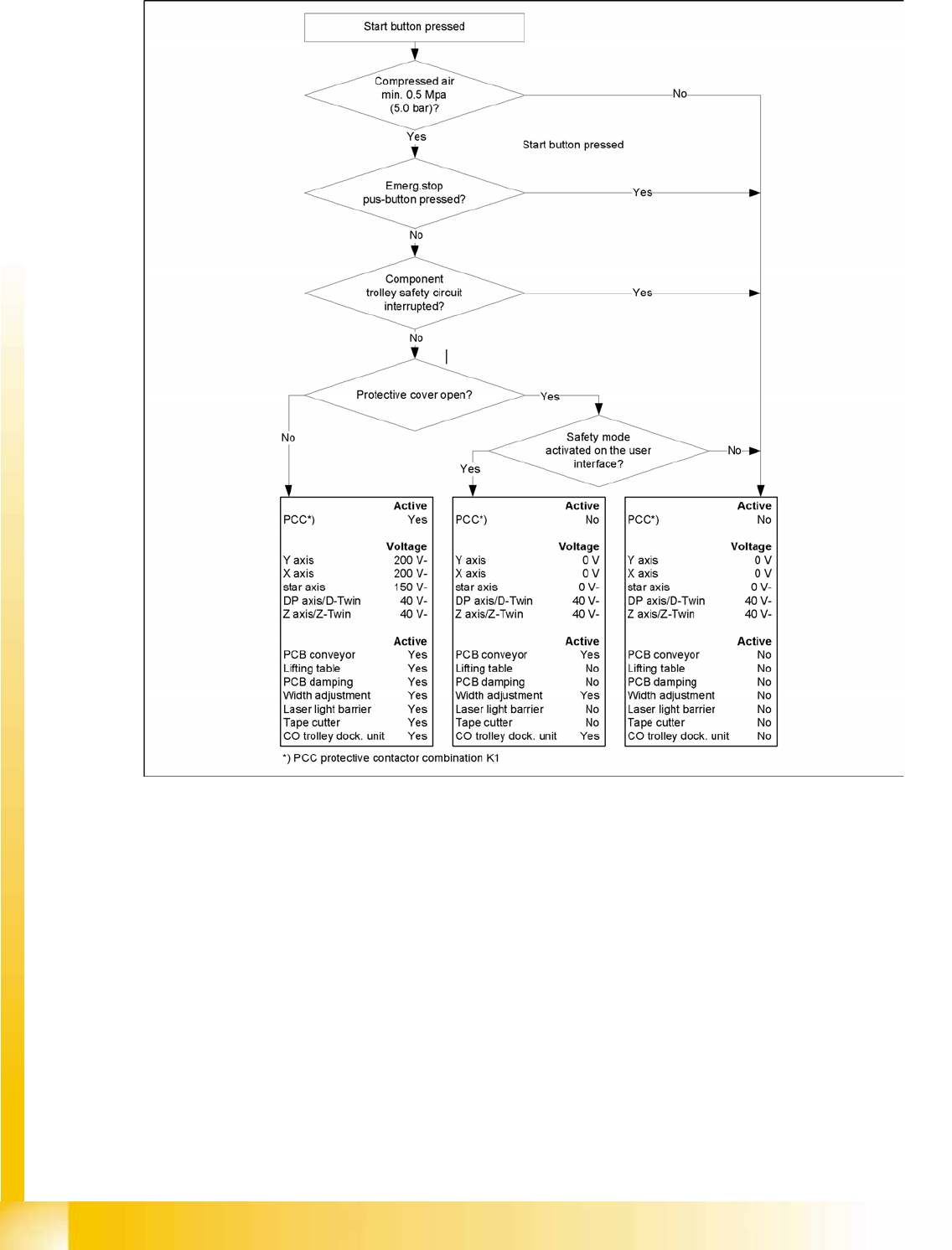
2.4.3.2 Safety Loops
2-20: Safety Loops

Operational Safety
Handling ESD Modules ESD Guidelines
Student Guide (FSE) SIPLACE X Series and X4I
Edition 01/2009 EN Operational Safety
47
2.5 ESD Guidelines
2.5.1 Handling ESD Modules
Do not touch electronic modules unless it is absolutely essential to do so in order to carry out other work.
If it is necessary, make sure that you do not touch the pins or printed conductors when you pick up flat
modules.
Do not touch components unless
you are constantly earthed by an ESD wrist strap or
you are wearing ESD shoes or ESD shoe earthing strips on an ESD floor.
Always discharge yourself before you touch an electronic module. To do this, simply touch a conductive
and earthed object immediately before you touch the module (such as unpainted parts of a switch
cabinet, a water pipe, etc.).
Do not allow modules with chargeable and highly insulating materials to touch one another, e.g. plastic
films, insulating table surfaces or items of clothing made from synthetic fibers.
Always place the modules on a conductive surface (table with an ESD coating, conductive ESD foam,
ESD bag or container).
Do not bring modules near visual display units, monitors or televisions. Keep them at least 10 cm away
from the screen.
2.5.2 Measurements and Modifications to ESD Modules
Measurements of the assemblies may only be taken if
The measuring device has been grounded (e.g. via protective conductor) or
The measuring head of the potential-free measuring device has been briefly discharged before
measurement (e.g. touching blank metal control unit housing).
X Always use an earthed soldering iron if you carry out any soldering work.
2.5.3 Dispatching ESD Modules
X Always store modules and components in conductive packaging (e.g. metallized plastic bags or
metal sleeves) and dispatch them in conductive packaging.
X If the packaging is not conductive, place the modules in a conductive envelope before packaging.
Use conductive expanded rubber, ESD bags, domestic aluminum foil or paper, for example. NEVER
use plastic bags or film.
X If the module has integral batteries, ensure that the conductive packaging does not touch or short-
circuit the battery terminals and, if necessary, first cover the terminals with insulating tape or
material.