00197190-03_VD_SIPLACE_Pro_10_1_SP1_DE_EN - 第17页
SIPLAC E Pro V10. 1 SP1 / Softwar e Version Desc ripti on Ausgabe 02/2013 Edit ion 17 5.4 New TrayStak Feeder A X Feeder Type The ne w TrayStak F eeder AX feeder t ype is suppor ted on the X4 i S p lacem ent m achine on …

SIPLACE Pro V10.1 SP1 / Software Version Description Ausgabe 02/2013 Edition
16
5 Features of SIPLACE Pro 10.1
If not differently described, the features of the previous SIPLACE Pro versions are contained in
SIPLACE Pro 10.1. The main features of SIPLACE Pro 10.1 are listed below.
NOTICE
Detailed information about the single functions can be found in the Online Help for
SIPLACE Pro.
5.1 SIPLACE X-Series S – X3 S, X4 S, X4i S Placement Machines
SIPLACE Pro supports the X3 S (three gantries), X4 S and X4i S (four gantries) placement
machines of the new SIPLACE X-Series S.
The MTC2 (on X3 S and X4 S only), 40X and DX component table types are supported.
Smart Pin Support is supported. When Smart Pin Support is used, each gantry has to be equipped
with a pin picker. Additionally, the maximum board length and the setup area are restricted.
The new conveyor system for the SIPLACE X-Series S is supported.
5.2 New Conveyor System for SIPLACE X-Series S
A new conveyor system has been introduced for the SIPLACE X-Series S placement machines.
The new conveyor system consists of five sections: input section, processing section 1,
intermediate section, processing section 2, output section and supports single and dual conveyor
lane mode. Additionally, input and output belt extensions can be configured.
The maximum board length is 450mm (without the Long Board option). The maximum board width
results from the fixed rail position and the conveyor mode (dual or dual as single).
5.3 Station Software Version 706.x
SIPLACE Pro supports the 706.x station software version on the X-, SX- and DX-series placement
machines.
SIPLACE Pro V10.1 SP1 / Software Version Description Ausgabe 02/2013 Edition
17
5.4 New TrayStak Feeder AX Feeder Type
The new TrayStak Feeder AX feeder type is supported on the X4i S placement machine on the
locations 2 and 3 for CPP (Collect&Place + Pick&Place) placement heads.
The TrayStak Feeder AX has one level with a waffle-pack tray for which the size is defined in the
setup, and a stacked inventory of further waffle-pack trays that obeys the FIFO rule. The current
waffle-pack tray cannot be exchanged by another tray of the inventory until all components have
been picked up.
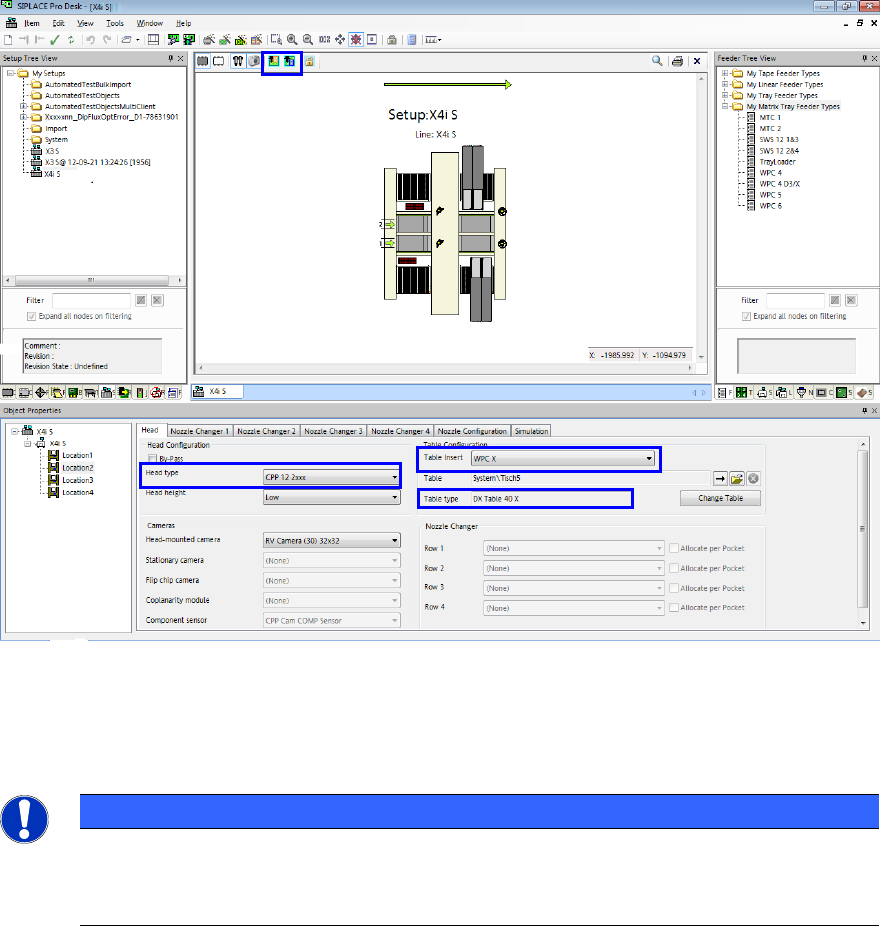
To set up the TrayStak Feeder AX, a table of type DX Table 40 X has to be configured in SIPLACE
Pro Desk on the locations 2 and 3. Additionally, the WPC X table insert has to be selected on these
locations in order to release the traveling range of the placement head for the feeder.
Figure 4-1: Configuring TrayStak Feeder AX
Head type, Table Insert and Table type have to be respectively set for Location 2 and Location 3.
Thereafter, the TrayStak Feeder has to be drawn from the Feeder Tree View to Location 2 and
Location 3 in the setup.
NOTICE
Positioning the Feeders
The tray has to be completely positioned in the travel range (visible via the marked
Show / Hide Traveling ranges buttons).
If 2 TrayStak Feeder AX are installed together with an LDU-X (Linear Dipping Unit), the table has to
be manually selected in the station software.
SIPLACE Pro V10.1 SP1 / Software Version Description Ausgabe 02/2013 Edition
18
5.4.1 Behavior at Pick-up Errors
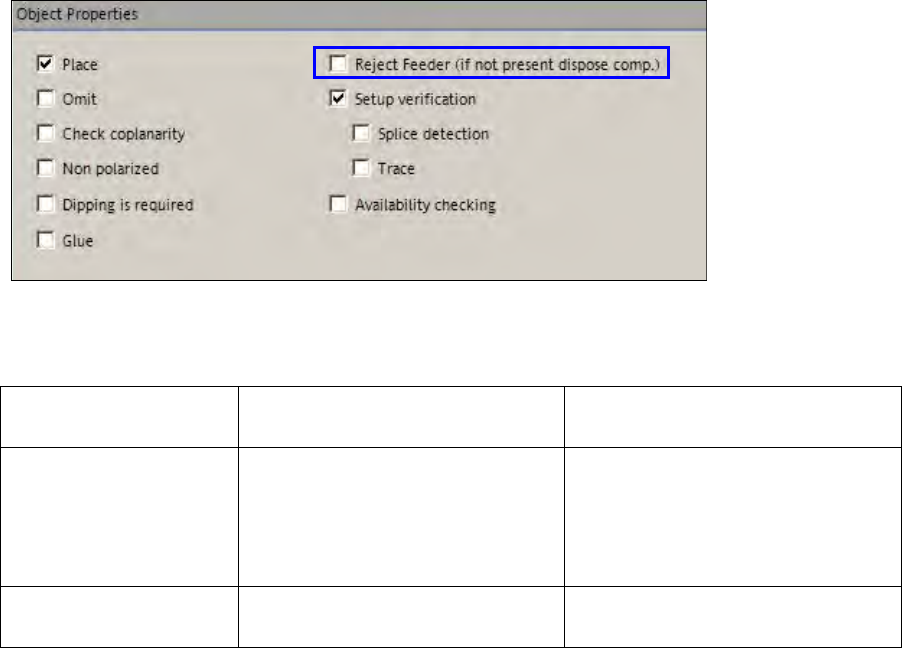
If a component is rejected by SIPLACE Vision it will be put back in the tray as default. If the
component shall be rejected in error cases, the Reject Feeder (if not present dispose comp.)
option has to be enabled for the component. If no reject conveyor is present, the component will be
disposed of in the reject bin.
Figure 4-2: Rejecting component
The behavior at pick-up errors is explained in the following table.
Reject Conveyor
Option
Tape / Linear Feeders Tray Feeders
enabled If the reject conveyor is present,
the component will be put on it.
If no reject conveyor is present,
the component will be disposed of
in the reject bin.
If the reject conveyor is present,
the component will be put on it.
If no reject conveyor is present, the
component will be disposed of in
the reject bin.
disabled The component will always be
disposed of in the reject bin.
The component will be put back
into an empty division of the tray.
Table 4-1: Behavior at pick-up errors
Please also refer to the restrictions in chapter 5.