KE2040Instruction Manual Ver2.01,REV04.2003.6.25.pdf - 第416页
5 − 72 5.2.4.5 Limi tations of a general -purpose vision component 1. Quanti ty - Up to 20 element groups can be def ined per com ponent. - Only one extended array group can be def ined per component. - The m aximum numb…
5 − 71
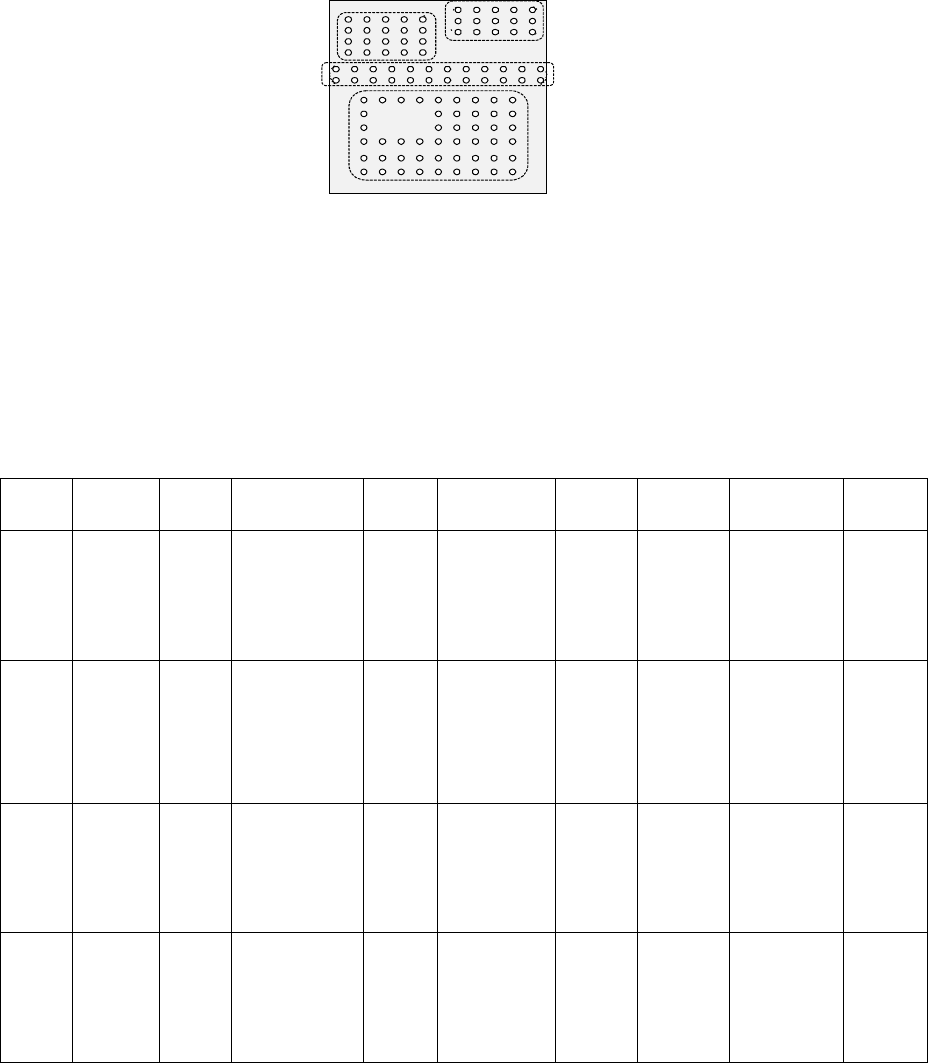
All of the entered data is shown below.
Figure 5.2.4.4.17
Element
Group
Name
First
element
position
Layout
inspectio
n
(Dimension)
Missing
Elements
Element
Element
Offset
Element size (Shape) Inspection
ELG0001 X: -6.0
Y: -5.0
Z: 0
θ: 0
Tolerance:
All set to “0”.
0%
√ 2D
Count of Column: 9
Pitch: 1.5
Count of Row: 6
Pitch: 1.27
Tolerance: 0
Column
Start: 22
Count: 3
Row
Start: 4
Count: 2
Type: Ball
Reference pos.:
Center of element
Polarity: Bright
Offset: all
set to “0”.
Tolerance:
all set to “0”.
Element size
Width: 0.5
Length: 0.5
Tolerance:
all set to “0”.
(Since an element
is a ball, the
selection screen
does not appear
which allows you
to select a circular
or rectangular
shape.)
Diameter:
50
Area: 50
Ball exist?:
30
Average
diameter: 0
ELG0002 X: -8.25
Y: 1.5
Z: 0
θ: 0
Tolerance:
All set to “0”.
0%
√ 2D
Count of Column:
12
Pitch: 1.5
Count of Row: 2
Pitch: 1.0
Tolerance: 0
Type: Ball
Ref
erence pos.:
Center of element
Pol
arity: Bright
Offset: all
set to “0”.
Tolerance:
all set to “0”.
Element size
Width: 0.5
Length: 0.5
Tolerance:
all set to “0”.
(Since an element
is a ball, the
selection screen
does not appear
which allows you
to select a circular
or rectangular
shape.)
Diameter:
50
Area: 50
Ball exist?:
30
Average
diameter: 0
ELG0003 X: -7.5
Y: 4.0
Z: 0
θ: 0
Tolerance:
All set to “0”.
0%
√ 2D
Count of Column: 5
Pitch: 1.5
Count of Row: 4
Pitch: 1.0
Tolerance: 0
Type: Ball
Ref
erence pos.:
Center of element
Pol
arity: Bright
Offset: all
set to “0”.
Tolerance:
all set to “0”.
Element size
Width: 0.5
Length: 0.5
Tolerance:
all set to “0”.
(Since an element
is a ball, the
selection screen
does not appear
which allows you
to select a circular
or rectangular
shape.)
Diameter:
50
Area: 50
Ball exist?:
30
Average
diameter: 0
ELG0004 X: 1.5
Y: 5.5
Z: 0
θ: 0
Tolerance:
All set to “0”.
0%
√ 2D
Count of Column: 5
Pitch: 1.5
Count of Row: 3
Pitch: 0.8
Tolerance: 0
Type: Ball
Ref
erence pos.:
Center of element
Pol
arity: Bright
Offset: all
set to “0”.
Tolerance:
all set to “0”.
Element size
Width: 0.5
Length: 0.5
Tolerance:
all set to “0”.
(Since an element
is a ball, the
selection screen
does not appear
which allows you
to select a circular
or rectangular
shape.)
Diameter:
50
Area: 50
Ball exist?:
30
Average
diameter: 0
Bottom View
Third element group
(X, Y): (-7.5, 4.0) mm
Pitch of Column: 1.5 mm, Count: 5
Pitch of Row: 1.0 mm, Count: 4
Missing Elements: none
Ball diameter: 0.5 mm
Inspection: Area 50 %
Diameter 50 %
Ball exist? 30 %
Forth element
(X, Y): (1.5, 5.5) mm
Pitch of Column: 1.5 mm, Count: 5
Pitch of Row: 0.8 mm, Count: 3
Missing Elements: none
Ball diameter: 0.5 mm
Inspection: Area 50 %
Diameter 50 %
Ball exist? 30 %
Second element
(X, Y): (-8.25, 1.5) mm
Pitch of Column: 1.5 mm, Count: 12
Pitch of Row: 1.0 mm, Count: 2
Missing Elements: none
Ball diameter: 0.5 mm
Inspection: Area 50 %
Diameter 50 %
Ball exist? 30 %
First element
(X, Y): (-6.0, -5.0) mm
Pitch of Column: 1.5 mm, Count: 9
Pitch of Row: 1.27 mm, Count: 6
Missing Elements:
Start 2 Count 3
Start 4 Count 2
Ball diameter: 0.5 mm
Inspection: Area 50 %
Diameter 50 %
Ball exist? 30 %
5 − 72
5.2.4.5 Limitations of a general-purpose vision component
1. Quantity
- Up to 20 element groups can be defined per component.
- Only one extended array group can be defined per component.
- The maximum number of lead elements that can be defined per element group
is 384, and that of ball elements is 6936. These numbers include missing
leads/balls.
- One corner/side/mark element should be defined per element group
respectively.
- The maximum number of ball elements that can be defined per extended array
group is 256.
- Up to four blocks of missing elements can be defined per element group. If
you want to define five or more blocks of missing elements, divide the element
group into two or more groups.
- Up to 6936 balls can be defined per component.
- Up to four corners/sides and up to three marks can be defined per component.
- The total number of element groups that can be handled with one production
program is up to 1,024.
- The total number of extended array groups that can be handled with one
production program is up to 256.
2. Combination
- Both a lead element and a ball (or land) element cannot be defined for one
component at the same time.
- Combination of elements that are seen under the same light only can be
defined for one component.
- Both an element group and an extended array group cannot be defined for one
component at the same time.
3. Lead components
- At least one element group including two or more leads has to exist on a
component.
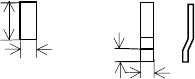
- As the lead size, the ratio of the length to width should be 1 or more. For a
gull-wing lead, the ratio of the length to the length specified in the “Lead size”
should be 1 or more.
Length Length
Width
Width
Normal lead Gull-wing lead
The length of a lead
should be longer than
the width.
5 − 73
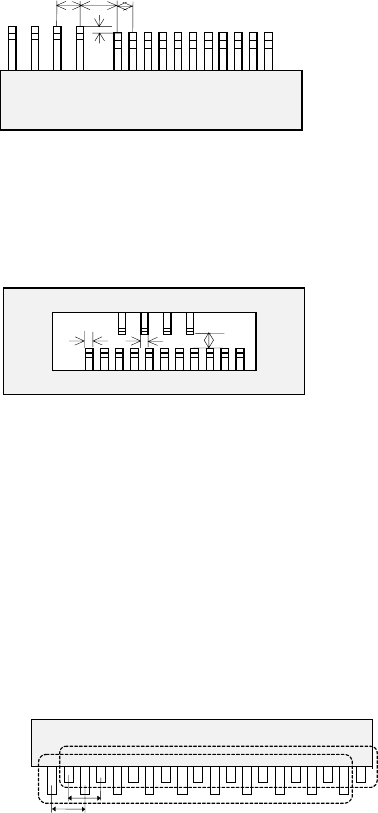
- When a lead end (lead end position) of one lead element group is laterally
located near another lead element group, whose lead end height is almost the
same with that of the former lead element group (that is, the height difference
should be 0.5 times of the pitch or less), the centers of the adjacent two leads
should be located far from one another by two times of the pitch. For an
element group that has only one lead, the center of one group should be far
from that of another one by two times of the lead width. If a lead-like shaped
substance is located near a lead, they should be far from one another in the
same manner.
- If another lead group is located in the longitudinal direction of a lead of one
lead group, it should be far from the lead by the distance equal to the lead
width and at least by 1 mm.
- In any case: if you define all lead groups or if you define only certain groups
to recognize them, you have to follow the two requirements described just
above.
- For a connector on which two types of leads are arranged alternatively: long
one and short one, you can define two groups: a group of long leads and that
of short leads. You can define these lead groups even though they overlap
one another if leads themselves do not overlap each other. The requirements
on the lead distance described above are not applied to these lead groups
unless bent leads of the different groups do not overlap.
- If you specify only the limited leads of one lead group, we cannot guarantee
their recognition precision (due to the Version 1.10 limitations).
- You cannot define one lead for two different groups. You cannot define leads
that overlap each other. Note that you happen to define leads in these ways
if you set the wrong lead pitch, number of leads and/or lead width.
- You cannot specify an inner lead as the lead element type. If you specify in
this way, we cannot guarantee the recognition precision (due to the Version
1.10 limitations).
P1
P2
L
H
<TOP VIEW>
P1: Pitch of Element group 1
P2: Pitch of Element group 2
L: Distance between two element groups
H: Difference between lead ends of two element
groups
H
≧
0.5 P1 and H
≧
0.5 P2
L
≧
2P1 and L
≧
2P2
W1
W2
L
<TOP VIEW>
W1: Pitch of Element group 1
PW2: Pitch of Element group 2
L: Distance between two element groups in
the longitudinal direction
L
≧
W1,
≧
W2 and L
≧
1 mm
<TOP VIEW>
First element group
Second element group
Pitch 1
Pitch 2