KE2040Instruction Manual Ver2.01,REV04.2003.6.25.pdf - 第435页
5 − 91 Optional 18.00- mm VCS - Bottom (re flectiv e) light Dimensions of applicable components Division mode Longer side Short er side Standard 15.50 – 3.00 m m 15. 50 – 3.00 m m 1 × 2 31.00 – 15.51 m m 15. 50 – 3.00 m …
5 − 90
5.2.5.1 Applicable component dimensions during division recognition
Standard VCS (54.00 mm x 54.00 mm)
- Bottom (reflective) light
Dimensions of applicable components
Division mode Longer side Shorter side
Standard 50.00 – 3.00 mm 50.00 – 3.00 mm
1 × 2
100.00 – 50.01 mm 3.00 – 50.00 mm
1 × 3
150.00 – 100.01 mm 3.00 – 50.00 mm
2 × 2
75.00 – 50.01 mm 75.00 mm – 50.01 mm
- Back (penetrative) light
Dimensions of applicable components
Division mode Longer side Shorter side
Standard 50.00 – 9.00 mm 35.00 – 9.00 mm
1 × 2
100.00 – 50.01 mm 35.00 – 17.00 mm
1 × 3
120.00 – 100.01 mm 35.00 – 17.00 mm
Optional 37.00 mm-VCS
- Bottom (reflective) light
Dimensions of applicable components
Division mode Longer side Shorter side
Standard 34.00 – 3.00 mm 34.00 – 3.00 mm
1 × 2
68.00 – 34.01 mm 34.00 – 3.00 mm
1 × 3
102.00 – 68.01 mm 34.00 – 3.00 mm
2 × 2
68.00 – 34.01 mm 68.00 mm – 34.01 mm
- Back (penetrative) light
Dimensions of applicable components
Division mode Longer side Shorter side
Standard 34.00 – 9.00 mm 34.00 – 9.00 mm
Optional 27.00-mm VCS
- Bottom (reflective) light
Dimensions of applicable components
Division mode Longer side Shorter side
Standard 24.00 – 3.00 mm 24.00 – 3.00 mm
1 × 2
48.00 – 24.01 mm 24.00 – 3.00 mm
1 × 3
72.00 – 48.01 mm 24.00 – 3.00 mm
2 × 2
48.00 – 24.01 mm 48.00 mm – 24.01 mm
- Back (penetrative) light
Dimensions of applicable components
Division mode Longer side Shorter side
Standard 24.00 – 9.00 mm 24.00 – 9.00 mm

5 − 91
Optional 18.00-mm VCS
- Bottom (reflective) light
Dimensions of applicable components
Division mode Longer side Shorter side
Standard 15.50 – 3.00 mm 15.50 – 3.00 mm
1 × 2
31.00 – 15.51 mm 15.50 – 3.00 mm
1 × 3
46.50 – 31.51 mm 15.50 – 3.00 mm
2 × 2
31.00 – 15.51 mm 31.00 mm – 15.51 mm
- Back (penetrative) light
Dimensions of applicable components
Division mode Longer side Shorter side
Standard 15.50 – 9.00 mm 15.50 – 9.00 mm
5 − 46
5.2.4 General-purpose vision components
5.2.4.1 Overview of a general-purpose vision component
The following types of components are handled as a general-purpose vision
component (“GNRL. vision” displayed as the component type):
- Components having multi-pitch leads, components having various sized leads,
and components having leads at not-regulated positions (these components are
called “multi-lead” components; see Figure -1.)
- Area array components having two or more arrays (called “complex array
components”; see Figure -2.)
- Components having balls/lands on not-regulated positions (called “random
component”)
- Components having a side or corner (outline-recognized components)
• The components above are classified into the following sub-component types:
Multi-lead component: Lead component group
Complex array component and random component: Ball component
group
Outline-recognized component: Outline-recognized component group
• The data format definition of each type of components is as follows:
Multi-lead component, complex array component and outline-recognized
component → Element group/Element format
Random component → Extended array data format
* The “Element group/Element format” specifies an element to be recognized such
as a lead and ball, defines the group of the same elements (element group): the
pitch and/or quantity is the same, and specifies the direction and position of the
group.
The “Extended array data format” defines the element (ball and land) arrangement
with X and Y coordinates.
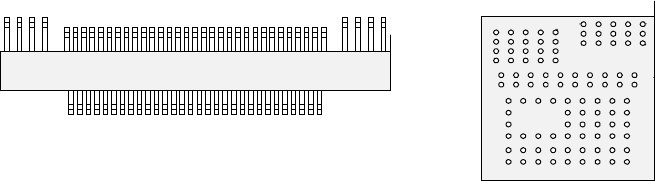
Figure -1 Figure -2
Ball component group
(Complex array component)
Lead component group (Multi-lead component)