00191987-02.pdf - 第25页
External Power Supply Unit for the HS-50 / HS-60 / D 4 Component Table User Manual 03/2006 Edition 2.6 CAN Bus 25 8. Insert the black plastic insert incl. fuseholder an d fuses back into the unit in th e correct positio …
User Manual External Power Supply Unit for the HS-50 / HS-60 / D4 Component Table
2.5 Checking the Main Voltage and Perhaps Converting for It 03/2006 Edition
24
2.5 Checking the Main Voltage and Perhaps Convert-
ing for It
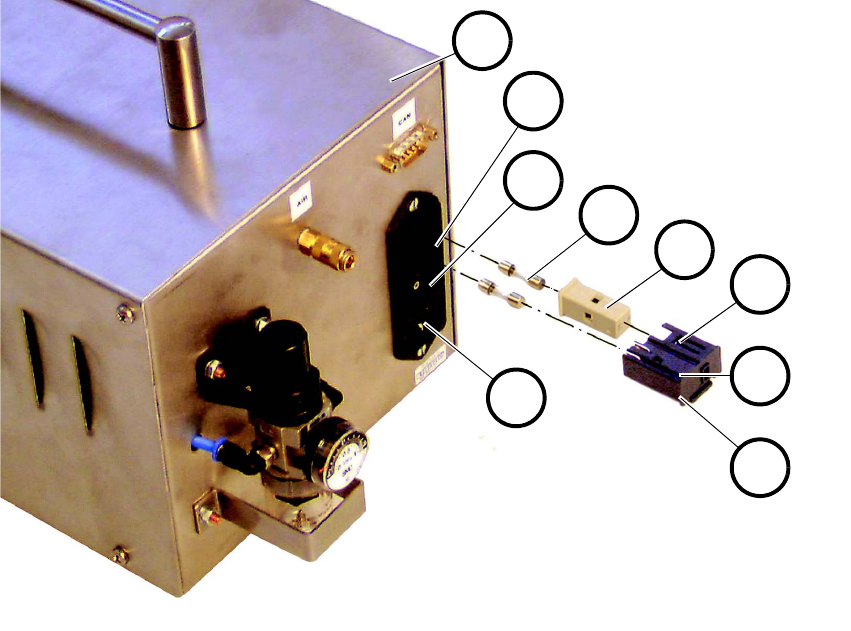
Fig. 2.5 - 1 Main Switch with Fuses and Input Voltage Adjuster
2
1. Turn the main switch (3 in Fig. 2.5 - 1) for the unit to OFF and make certain that the mains con-
nector is not plugged into the unit.
2. Unlock the snap lock (9) by pushing it up and pull out the black plastic insert (7) with the fuses.
3. Remove the two fuses (5).
4. Check to make certain that the two fuses are the correct ones:
2 ea. 1.25 A medium time-lag fuses are designed for 210-240 V AC.
2 ea. 2.5 A medium time-lag fuses designed for 100-120V AC (for USA or Asia; accompany
the unit as delivered).
5. Check whether the existing main voltage is indicated in the window (8). If so, proceed to step 7.
6. Pull the gray fuseholder (6) out of the black plastic insert, turn it 180° and re-insert it.
7. Put in the correct fuse.
1
2
3
4
5
6
7
8
9
External Power Supply Unit for the HS-50 / HS-60 / D4 Component Table User Manual
03/2006 Edition 2.6 CAN Bus
25
8. Insert the black plastic insert incl. fuseholder and fuses back into the unit in the correct position
until the snap lock engages.
9. Important: Make certain that the correct voltage is now being indicated in the window (8 in Fig.
2.5 - 1) of the plastic insert. If it isn’t, start with step 6ff.
2.6 CAN Bus
The CAN bus plug-ion connection is located on the back of the unit (2 in Fig. 2.3 - 2). This can be
employed to transfer data from a computer. 2
The unit can also be operated as just a power supply unit (if the CAN bus is not connected). 2
User Manual External Power Supply Unit for the HS-50 / HS-60 / D4 Component Table
2.7 Pneumatic System Unit 03/2006 Edition
26
2.7 Pneumatic System Unit
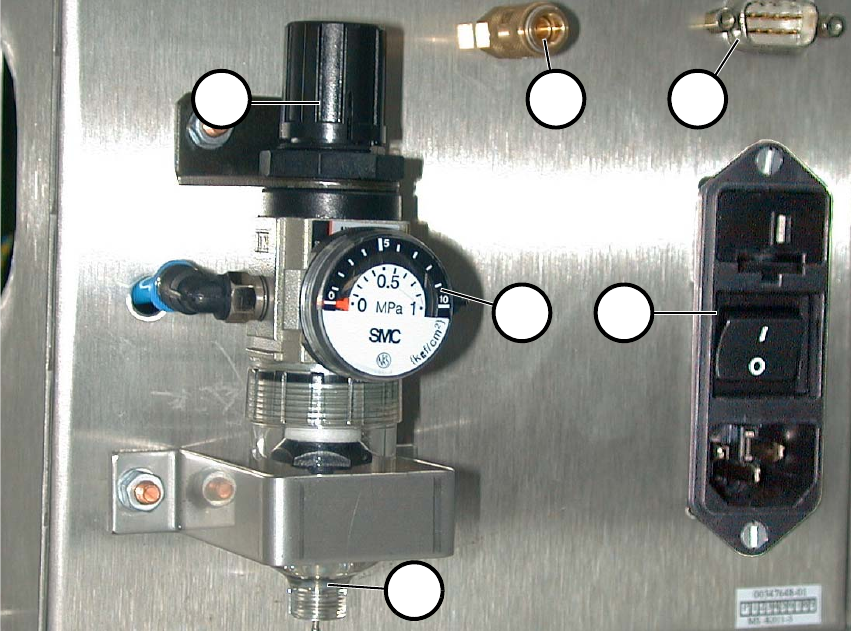
It consists of a pressure reducer, pressure gauge and filter with container for condensed water.
The starting pressure is indicated on the pressure gauge (2 in Fig. 2.7 - 1). You can set it this pres-
sure by pulling it up and turning the cap (1). 2
Fig. 2.7 - 1 Back View with Pneumatic System Unit, etc.
(1) Cap of pressure reducer
(2) Pressure gauge
(3) Hand drain
(4) Compressed air connection
(5) CAN bus connection
(6) Main switch
2
2
1 4 5
62
3