KE2010.Instruction Manual.Ver.2.01,Rev.08.pdf - 第115页
4 − 8 Specifying a f ile t ype Change the f ile type to be displayed on the File nam e window . A production prog ram is saved with the file t ype specified when you created it. See the "List of f ile types" be…
4 − 7
4.2.1 Create New
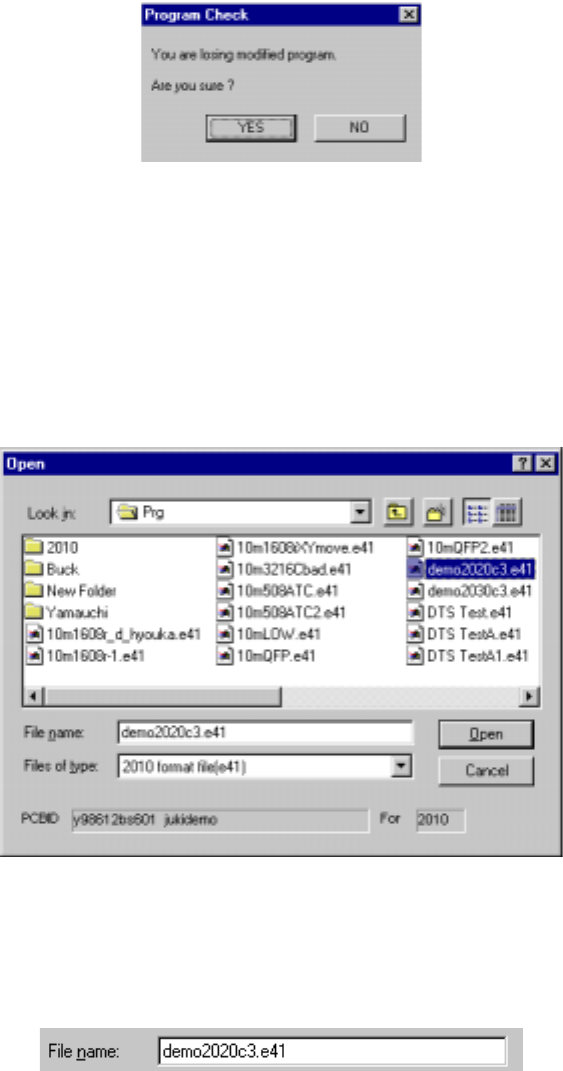
This command initializes the current data, then assigns the program name
“UNTITLED” to the data. Before initializing the current data, the machine checks to
see if the program has been changed. If changed, the machine displays the dialog
box which indicates that data being created will be lost.
4.2.2 Open
This command reads a program stored on a disk into the machine. Before reading
it, the machine checks to see if the current program has been changed. If changed,
the machine displays the dialog box which indicates that data being created will be
lost.
When you select the [Open] command, the dialog box shown below appears on the
screen. Select a file to be read.
Selecting a file
• Directly selecting a file name from the dialog box shown above
Enter a file name with a keyboard, then press the “• key.
• Specifying a file name in the list box
Double-click the desired file name or move the cursor over it, then click the
<OK> button.
The scroll bar appears when all of file names cannot be shown on the screen.
4 − 8
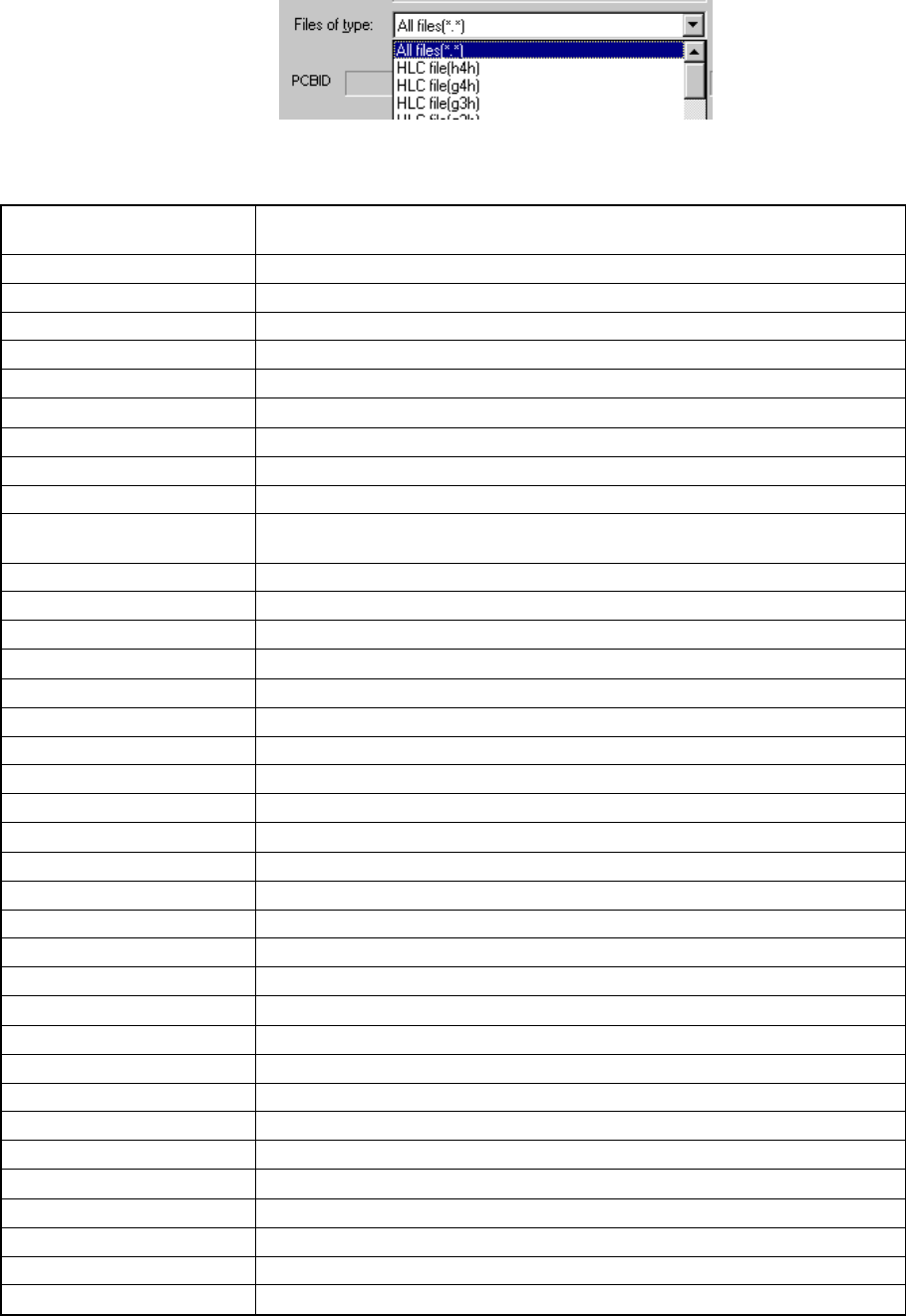
Specifying a file type
Change the file type to be displayed on the File name window.
A production program is saved with the file type specified when you created it.
See the "List of file types" below to select a file type.
List of file types
File types displayed in the
pull-down list box
Description of a program file
all the files (*.*) All the files stored in the folder
2010 format file (e41) Files created with a KE-2010 machine main unit
2020 format file (e42) Files created with a KE-2020 machine main unit
2030 format file (e43) Files created with a KE-2030 machine main unit
2040 format file (e44) Files created with a KE-2040 machine main unit
HLC file (g4h) Files created with HLC Version 4.5 and a KE-2000 series machine
HLC file (h4h) Files created with HLC Version 5.0 or later and a KE-2000 series machine
HLC file (g3h) Files created with HLC Version 4.0 to 4.4x.
HLC file (g2h) Files created with HLC Version 3 or earlier
730, 750 format file (g3c)
Files created with a KE-730/730plus/750 machine or EPU for a
KE-730/730plus/750 machine
740, 760 format file (g3g) Files created with a KE-740/760 machine or EPU for a KE-740/760 machine
775 format file (g3d) Files created with a KD-775 machine
710 format file (g2c) Files created with a KE-710 machine or EPU for a KE-710 machine.
720 format file (g2g) Files created with a KE-720 machine or EPU for a KE-720 machine.
770 format file (g2d) Files created with a KD-770 machine.
Opt. divided file #1 (h41) File divided for the No. 1 machine of the KE-2000 series MSL line
Opt. divided file #2 (h42) File divided for the No. 2 machine of the KE-2000 series MSL line
Opt. divided file #3 (h43) File divided for the No. 3 machine of the KE-2000 series MSL line
Opt. divided file #4 (h44) File divided for the No. 4 machine of the KE-2000 series MSL line
Opt. divided file #5 (h45) File divided for the No. 5 machine of the KE-2000 series MSL line
Opt. divided file #6 (h46) File divided for the No. 6 machine of the KE-2000 series MSL line
Opt. divided file #7 (h47) File divided for the No. 7 machine of the KE-2000 series MSL line
Opt. divided file #1 (g41) File divided for the No.1 machine of the HLC version 4.5 MSL line.
Opt. divided file #2 (g42) File divided for the No.2 machine of the HLC version 4.5 MSL line.
Opt. divided file #3 (g43) File divided for the No.1 machine of the HLC version 4.5 MSL line.
Opt. divided file #4 (g44) File divided for the No.1 machine of the HLC version 4.5 MSL line.
Opt. divided file #5 (g45) File divided for the No.1 machine of the HLC version 4.5 MSL line.
Opt. divided file #6 (g46) File divided for the No.1 machine of the HLC version 4.5 MSL line.
Opt. divided file #7 (g47) File divided for the No.1 machine of the HLC version 4.5 MSL line.
Opt. divided file #1 (g31) File divided for the No. 1 machine of the KE-700 or earlier series MSL line
Opt. divided file #2 (g32) File divided for the No. 2 machine of the KE-700 or earlier series MSL line
Opt. divided file #3 (g33) File divided for the No. 3 machine of the KE-700 or earlier series MSL line
Opt. divided file #4 (g34) File divided for the No. 4 machine of the KE-700 or earlier series MSL line
Opt. divided file #5 (g35) File divided for the No. 5 machine of the KE-700 or earlier series MSL line
Opt. divided file #6 (g36) File divided for the No. 6 machine of the KE-700 or earlier series MSL line
Opt. divided file #7 (g37) File divided for the No. 7 machine of the KE-700 or earlier series MSL line
4 − 9
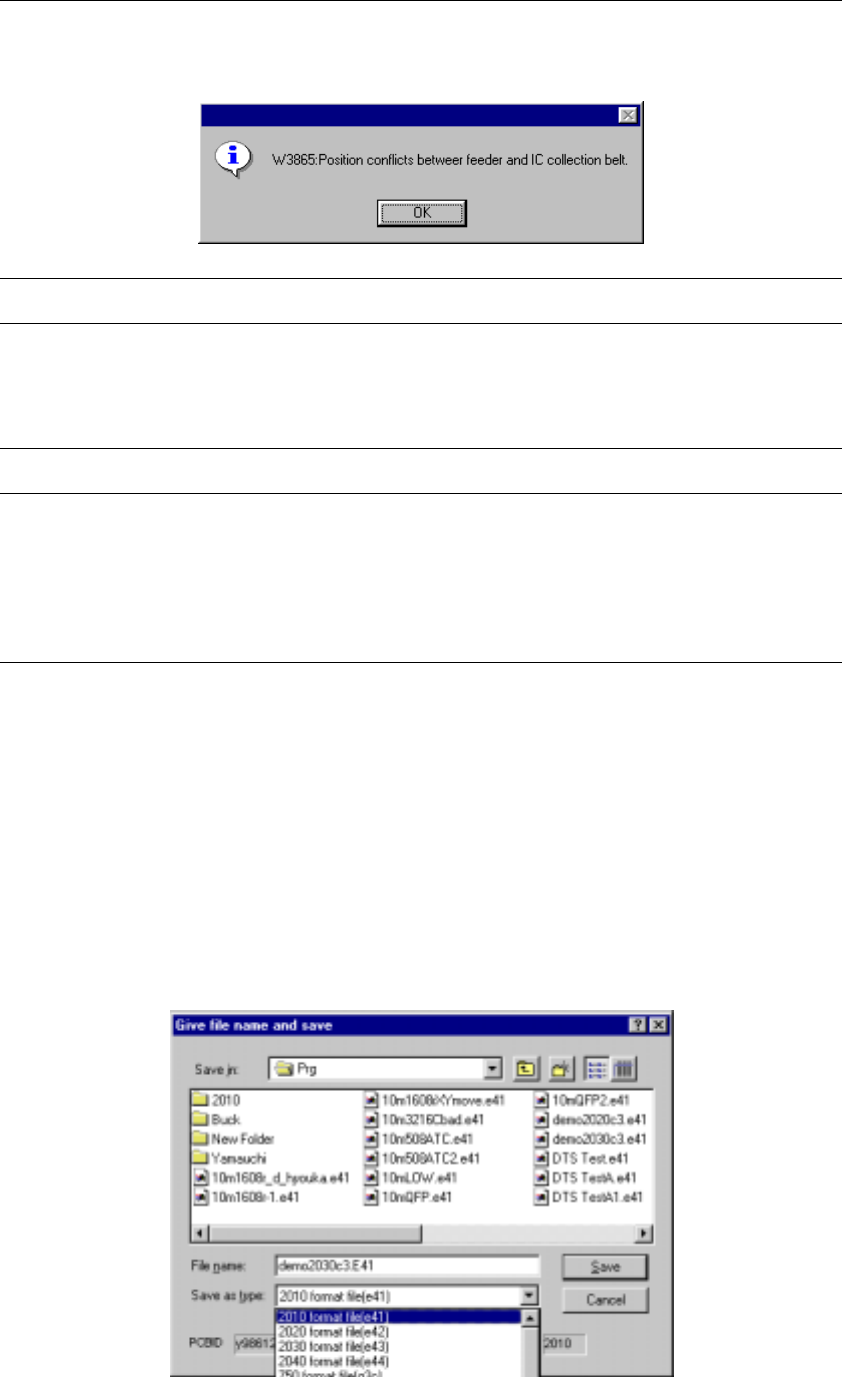
Note: When reading a file, the machine checks to see if a position specified in Pick
data is overlapped with the IC collection belt position. If the machine
detects any overlap, it displays the warning message as shown below.
Note : When reading a file, the machine cannot read data associated with Vision
data or Adhesive data.
If data to be read includes such data, the machine cannot read any data.
Vision and adhesive data stored in Component data is changed.
Note : If any production program file created with another type of machine is loaded
to the system, the system may recalculate the component pick-up
coordinates saved in the Pick data since the reference coordinates are
unique to each type of machine. Therefore, be sure to check the
component pick-up coordinates when you load a production program created
with another type of machine.
4.2.3 Overwrite & Save
This command stores the current program on a disk as a file. If the program name is
“UNTITLED”, the Save As dialog box appears as shown below. When a file name
other than “UNTITLED” is assigned to a program name, the program is immediately
stored.
4.2.4 Save As
This command stores the current program on a disk with another name.